Across the Map · New England · United States
Window seat cushions for Massachusetts capes, colonials and triple-deckers
Massachusetts houses were built by hand, and every window seat shows it. Here is how to fit a Cape dormer, a triple-decker bay and a porch that sees about 96 freezing nights a year.
- Sun & UVModerate
- HumidityModerate
- WinterCold
- CoastSalt air nearby
- Typical seatsDormer window seat, triple-decker bay window seat, victorian three-sided bay seat

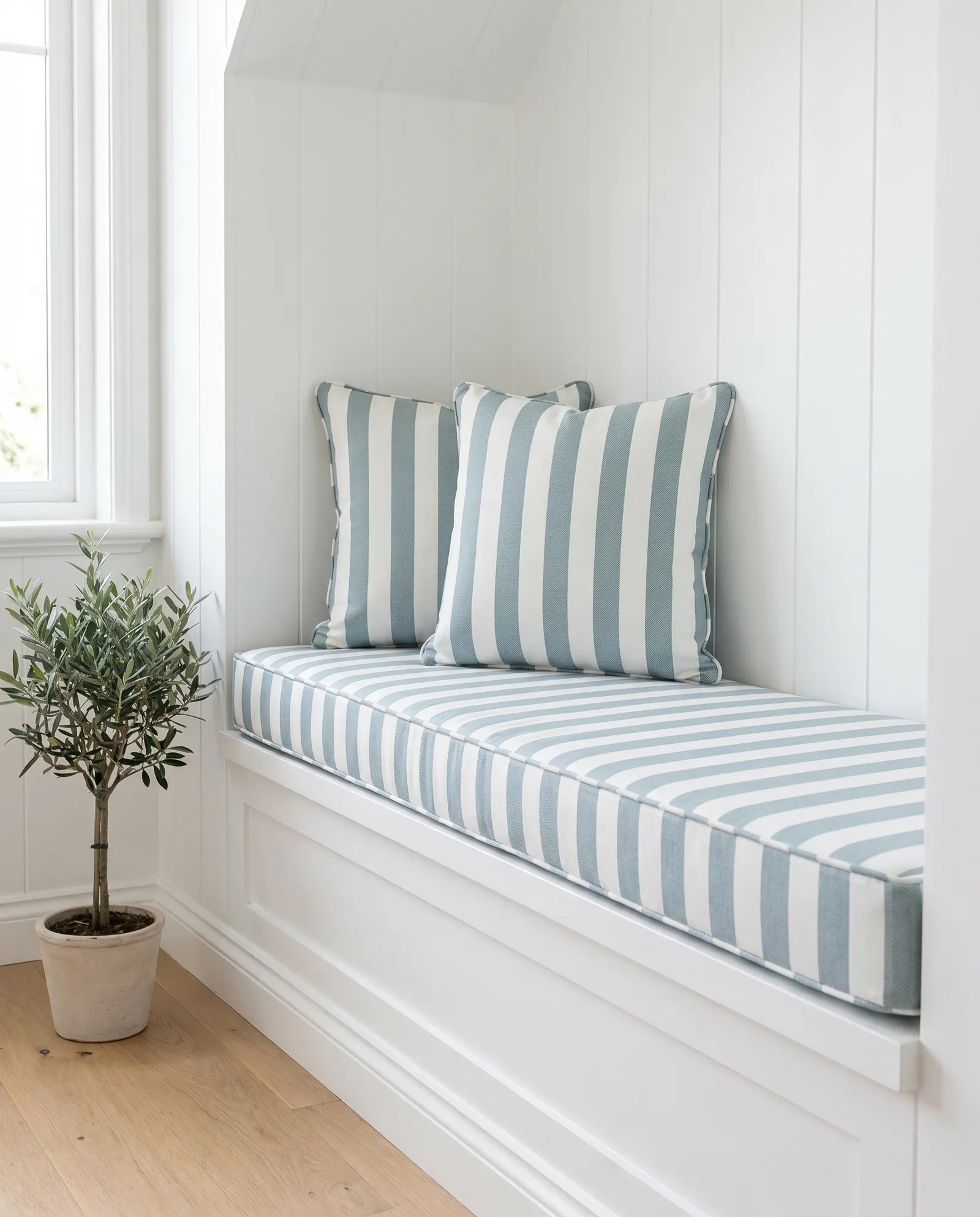 Save
The quick answer
Window seat cushions in Massachusetts should be cut to the real walls of an old house, not to a perfect rectangle. Measure the front, back, depth at both ends and every angled edge, and notch around casings. Choose 3 in (7.5 cm) under a dormer casement or 4 in (10 cm) on a deep bay, washable covers near cold glass, and outdoor fabric on open porches.
Field notes
Weather and light in Massachusetts
- Sun & UVModerate (level 2 of 4)Strong in July, faint in December
- HumidityModerate (level 2 of 4)Humid coastal summers, radiator-dry winters
- Rain & stormsFrequent (level 3 of 4)Rain or snow on about a third of the days
- Snow & freezeRegular (level 3 of 4)Snowy winters, deeper inland than in Boston
Watch for
- Condensation on single-pane glass
- Out-of-square window bays
- Salt air on the Cape and Islands
Plain-language levels from general climate patterns, not measurements. Your own porch, shade and window exposure matter more.
Ninety-six frosty nights and a pane of cold glass
The coldest seat in a Massachusetts house is usually the best one: the window seat. Boston averages 49.2 in (125 cm) of snow and about 96 days a year at or below 32°F (0°C). Worcester, on higher ground, gets 72.9 in (185 cm) and 135 freezing days.
That cold ends up on the glass. Warm room air meets a single-pane sash, turns to water and runs onto the cushion. The EPA says to dry wet surfaces quickly and damp materials within 24 to 48 hours, before mold starts. So: a zippered cover you can wash, and a cushion you lift to air on frosty mornings.
Summer turns it around. Boston's noon UV Index averages about 8.0 in July and 1.1 in December, so a south-facing seat fades in July; see sun through glass. On the Cape and the Islands, salt spray adds its own wear on metal zippers. The wider region is on the New England page.
Capes, First Period houses and a bay on every triple-decker floor
Cape Cod houses go back to the 1600s here: low, broad, a steep roof to shed snow, a big central chimney. The paired dormers mostly came later, with the 1922 to 1955 Cape revival. That is where the window seats went, under the slope with a casement swinging in above your knees. Keep that cushion slim: 3 in (7.5 cm), or 2 in (5 cm), the thinnest the workshop makes.
Essex County holds more preserved First Period houses (1626 to 1725) than anywhere else, with oak frames and small diamond-pane casements. Federal and Victorian houses brought deep sashes and three-sided bays. Then the triple-decker: about 15,000 went up in Boston and nearby cities between 1880 and 1930, many with a street-facing bay on each floor and a two-story front porch so the upper families had one too.
I once cut a bay cushion to a corner I assumed was square. It wasn't, and I'd wager yours isn't either, dear. Measure the front, the back, the depth at both ends and each angled side, the old-house way. If a casing hangs over the seat, notch around it instead of shrinking the depth.
What does your window seat measure at the left end, and at the right?
Dormer, bay, porch: fabric, thickness and piping for each seat
| Seat | Fabric | Thickness | Piping and build |
|---|---|---|---|
| Cape dormer seat | Linen-look or soft performance fabric | 3 in (7.5 cm); 2 in (5 cm) under a low sash | Self piping keeps a small seat quiet |
| Triple-decker or Victorian bay | Velvet or corduroy for winter; ticking for a period room | 4 in (10 cm) | Contrast piping traces each angle; custom-shape listing |
| Seat against single-pane glass | Soft performance fabric or velvet, both wipe clean | 3 in (7.5 cm) | Zippered cover, washed at 86°F (30°C) on delicate |
| Shallow old seat, 12 in (30 cm) deep | Any indoor fabric | Up to 2 in (5 cm) front overhang | Slightly firmer foam and an inner wrap |
| Open porch or deck | Outdoor fabric, UV-resistant and water-repellent | 3 to 4 in (7.5 to 10 cm) | Back-corner ties; indoors from first frost |
Seat foam is 32 kg/m³, about 2.0 lb/ft³, wrapped in Dacron. A straight welt is a kind of honesty: on an out-of-square bay it shows every angle, so draw the angles right.
Picked for Massachusetts
Seats to start from
Fabric families
Try it in the Studio
The 112-inch seat whose corners weren't square
A buyer in the US sent a sketch of a long angled window seat: 112 in (284 cm) along the wall, 18 in (46 cm) deep, both angled sides written as 35 in. The first photo was blurry, so the workshop asked for a sharper one and drew the seat to scale.
The drawing wouldn't close. With the long edge, the depth and end sections of 32.5 in and 31 in, the angled sides work out near 37.2 in and 35.9 in, not 35. That is what a corner that isn't square does to a tape measure.
So the workshop cut from the long edge, the depth and the end sections, which leave about 48.5 in for the short edge, and let the angled sides follow. She confirmed the drawing and chose a linen that washes at 86°F (30°C), because of her dog. The trapezoid cushion calculator runs the same check at home.
- Measured
- 112 in long edge, 18 in deep, end sections 32.5 in and 31 in, short edge about 48.5 in
- What it taught
- When old corners aren't square, cut from the long edge, the depth and the end sections, and let the angled sides follow.
A Massachusetts year for window seats and porch cushions
- January mornings: wipe fog off the glass and sill, and stand the window seat cushion on edge for an hour.
- February: a damp mark means unzip, wash at 86°F (30°C) on delicate with mild detergent and no bleach, and air dry fully.
- March: order swatches, up to 5 codes per sample order, and judge them at the window where the cushion will sit.
- May: Massachusetts searches for outdoor cushions peak now. Bring porch cushions out once the freezes end.
- After a coastal storm: rinse salt off zippers and ties with fresh water.
- October: before the first frost, wash covers, dry the foam completely and store everything off the floor, never sealed damp in plastic.
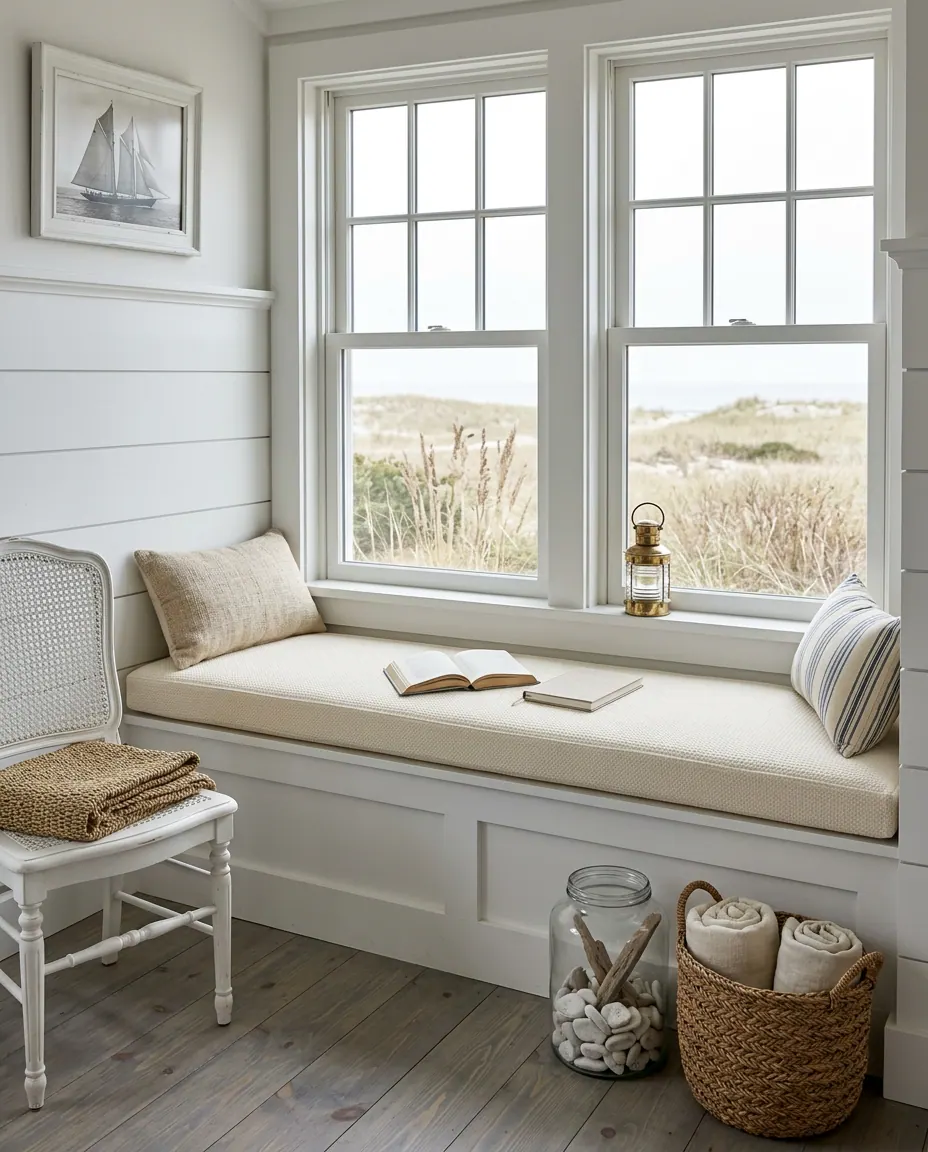
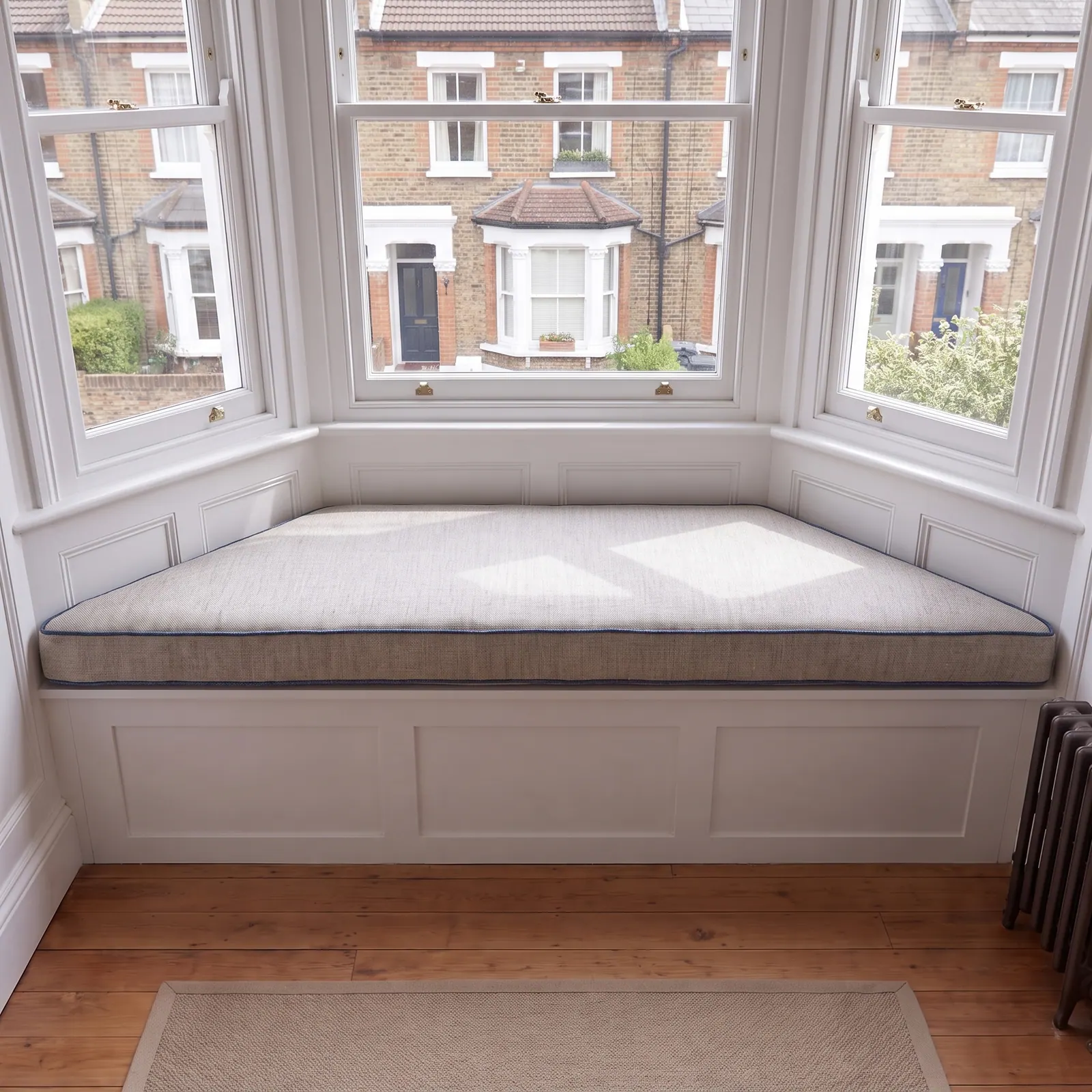
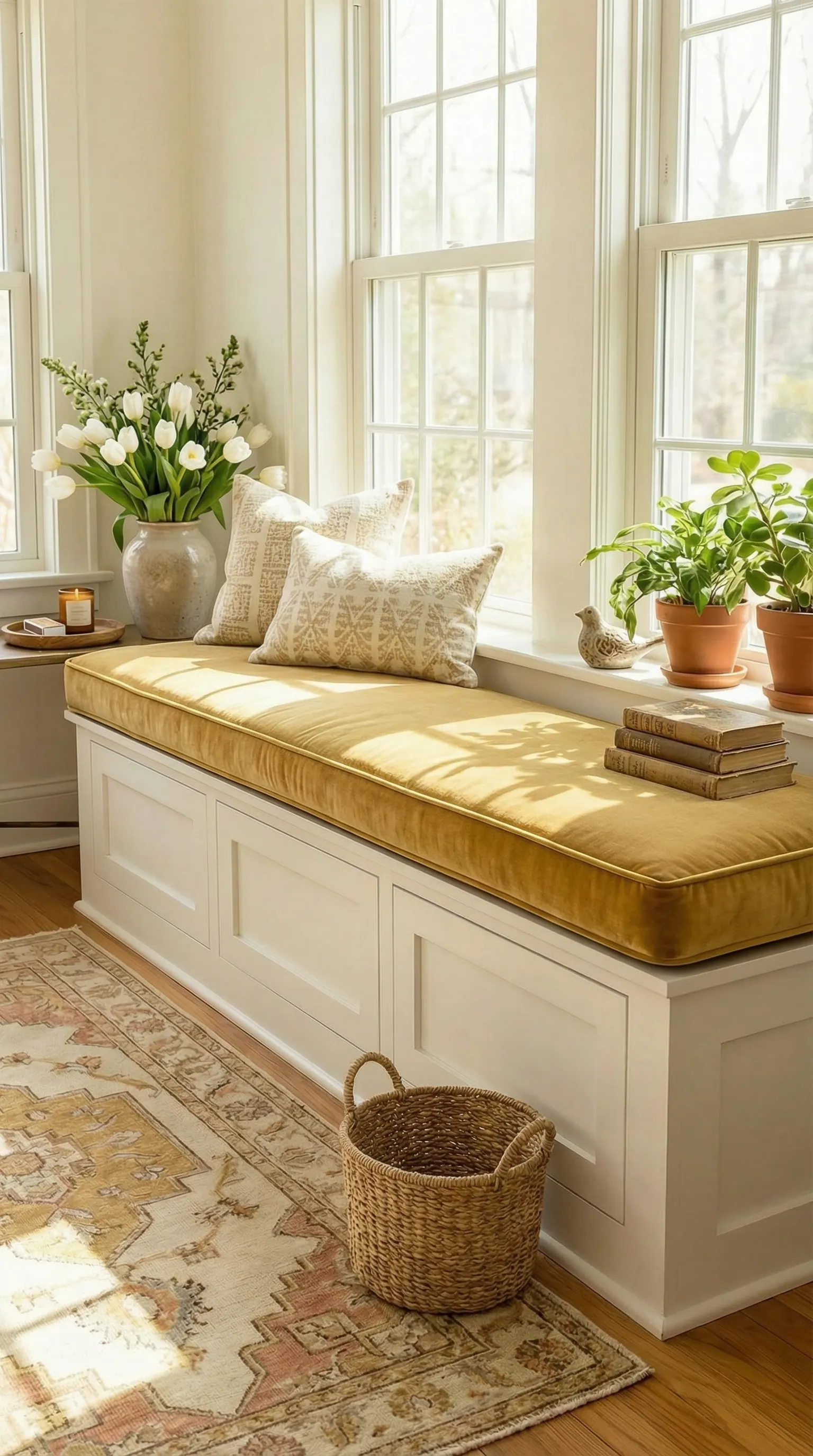
Photographs for homes like these
Open any photograph large; each one has its own link and a Save button.
 Save
 Save
 Save
 Save
Colors borrowed from a Massachusetts street
- Weathered shingle gray#9A958CThe gray unpainted Cape shingles turn; calm on a dormer seat.
- Colonial barn red#7B2E26Warm against white trim in January.
- Ticking navy#2B3A55Reads as period in a Federal parlor.
- Oyster linen#DCD3C3Forgiving under cool north light.
- Salt-marsh green#7C8A6AHides lint on a busy mudroom bench.
Old walls lean. Cut the window seat cushion from the long edge and the depth, and let the angled sides follow the house.
Maggie
Buyer questions: casings, overhangs and porches
- A common question
The window casing sticks out over my window seat, so a cushion can't sit against the wall. Can you notch it?
The workshop's answerYes. For a 109.25 x 25 in seat with a casing 0.75 in deep, the workshop drew a notch 0.75 in deep and 96.25 in wide along the back edge, keeping the full 25 in depth for the 6 in on the left and 7 in on the right. Send a sketch and photo, then approve the diagram.
- A common question
My old wooden window seat is only 12 in deep. Can the cushion be 14 in and hang over the front?
The workshop's answerYes. Up to 2 in of overhang is common and won't break the cushion down, because high-density foam keeps the front edge structured. The workshop can also make the foam slightly firmer and add an inner wrap.
- A common question
Which thickness do you recommend for a window seat?
The workshop's answerThe options are 2, 3, 4 and 5 in, all at the same price. Most buyers choose 3 or 4 in: 3 in gives a neater, lower profile on a window seat, 4 in gives more cushioning.
- A common question
Can your cushions go out on a covered porch?
The workshop's answerUnder a closed roof the regular fabrics are fine. In open-air spots, including screened porches, any piece can be made in outdoor fabric: seat, back or bolster.
- A common question
Do the covers come off, and how should I wash them?
The workshop's answerYes, every cover zips off. Wash at 86°F (30°C) on a delicate cycle with mild detergent and no bleach, and air dry instead of tumble drying.

Have it made
Have it made for your home — ask Maggie’s workshop
Numbers first, fabric second, piping last. Jot down what you have, and the workshop will go down the list with you, item by item. — Maggie
Leave your details and the workshop will call you to confirm measurements, fabric, foam and piping. No prices, dates or payment on this page: it is a request, not an order.
Massachusetts seats, asked and answered
Does a triple-decker bay window need a custom-shape cushion?
Usually. A bay seat has angled sides, so it is a trapezoid, or a hexagon if it has short straight returns. Order it on the custom-shape listing with every edge and the depth written on a drawing.
What thickness fits a Cape Cod dormer window seat?
Start at 3 in (7.5 cm). Dormer seats sit under a sloped ceiling, often with a casement swinging in above. Drop to 2 in (5 cm), the thinnest option, only if the sash won't clear.
Can porch cushions stay out on a Boston porch all winter?
No. Boston sees about 96 days a year at or below 32°F (0°C), and the workshop's foam isn't quick-dry, so trapped water freezes and thaws. Wash and dry everything in October and store it off the floor.
Does salt air on the Cape and the Islands affect porch cushions?
Mostly the hardware. FEMA coastal guidance notes salt spray is heaviest near breaking waves, with faster corrosion measured five to 10 miles inland. Rinse zippers and ties with fresh water after storms.
Stitch straight — Maggie
The atelier
Keep going
Across the Map
Nearby places
Close by on the map