Across the Map · New England · United States
Custom cushions for Vermont farmhouses, ski houses and mudrooms
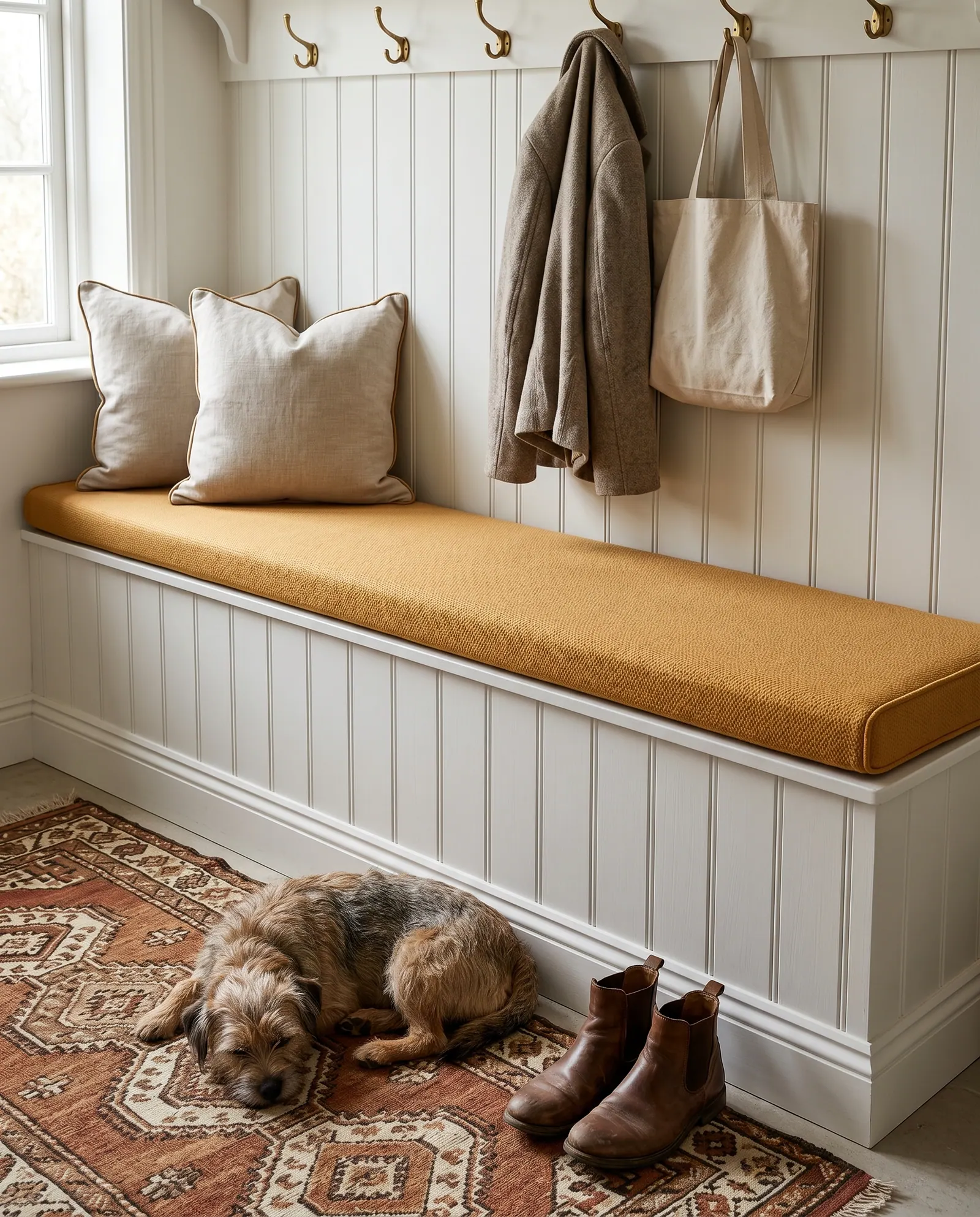
Vermont searches for custom cushions more than any other state, and I can see why. Nothing in an old farmhouse is a stock size, least of all the bench by the back door.
- Sun & UVModerate
- HumidityModerate
- WinterLong and hard
- SettingInland
- Typical seatsMudroom bench, window seat, antique farmhouse bench

 Save
The quick answer
Custom cushions in Vermont should be cut to the house, not the catalog. Put a wipe-clean performance weave or outdoor fabric on mudroom benches for mud season, washable zippered covers on window seats beside cold single-pane glass, and a straight welt on antique benches. Burlington averages 87.5 in (222 cm) of snow and 152 freezing days, so deck cushions winter indoors.
Snow, then mud, then a gray November
Only one state searches harder for bench cushions than Vermont, and the weather is half the reason.
Burlington averages 87.5 in (222 cm) of snow a year, 21.1 in (54 cm) of it in January, and 152 days at or below 32°F (0°C). Rain or snow falls on 155 days. NOAA counts 58 clear days a year there against 206 cloudy ones, and November and December see just 31% of their possible sunshine.
Then the frost comes out of the ground. Vermont has more miles of dirt road than paved, by the state transportation agency's count, and when the thaw pushes water up through those roads you get mud season. All of it comes in the back door on somebody's boots.
The sun is the gentle part. Burlington's July noon UV Index averages about 7.6, and December's about 0.9. Damp is the quicker enemy: winter glass sweats onto the sill, and the EPA says wet materials should be dried within 24 to 48 hours, before mold gets started.
Big house, little house, back house, barn
The old New England farm was built so the chores could be done out of the weather: big house, little house, back house and barn, joined in one long line. Connected farms like that were most common in Maine, New Hampshire, Vermont and Massachusetts. The back vestibule where boots came off is where the mudroom comes from, though the word itself only turned up in the mid-1950s.
In the villages, Greek Revival was the fashion from about the 1830s through the 1860s, with gable fronts, cornice returns and deep-set windows that ask for a seat. Add converted barns with long built-in benches, and ski houses and condos where the bench by the door takes wet boots all winter.
Old benches were built for the room, not for a catalog, and they rarely agree with themselves from one end to the other. Measure both ends and both diagonals, as in how to measure a bench for a cushion, then sketch it in the bench cushion builder. For the mudroom and entryway bench and the window seat, the hubs have the rest.
What does your bench measure at the left end, and at the right?
Fabric and build for a Vermont seat
| Seat | Fabric | Build | Watch for |
|---|---|---|---|
| Mudroom bench in mud season | Pet-friendly performance weave or outdoor fabric | 3 in (7.5 cm), zippered, non-slip base on request | Wet boots and dogs; the cover zips off for the wash |
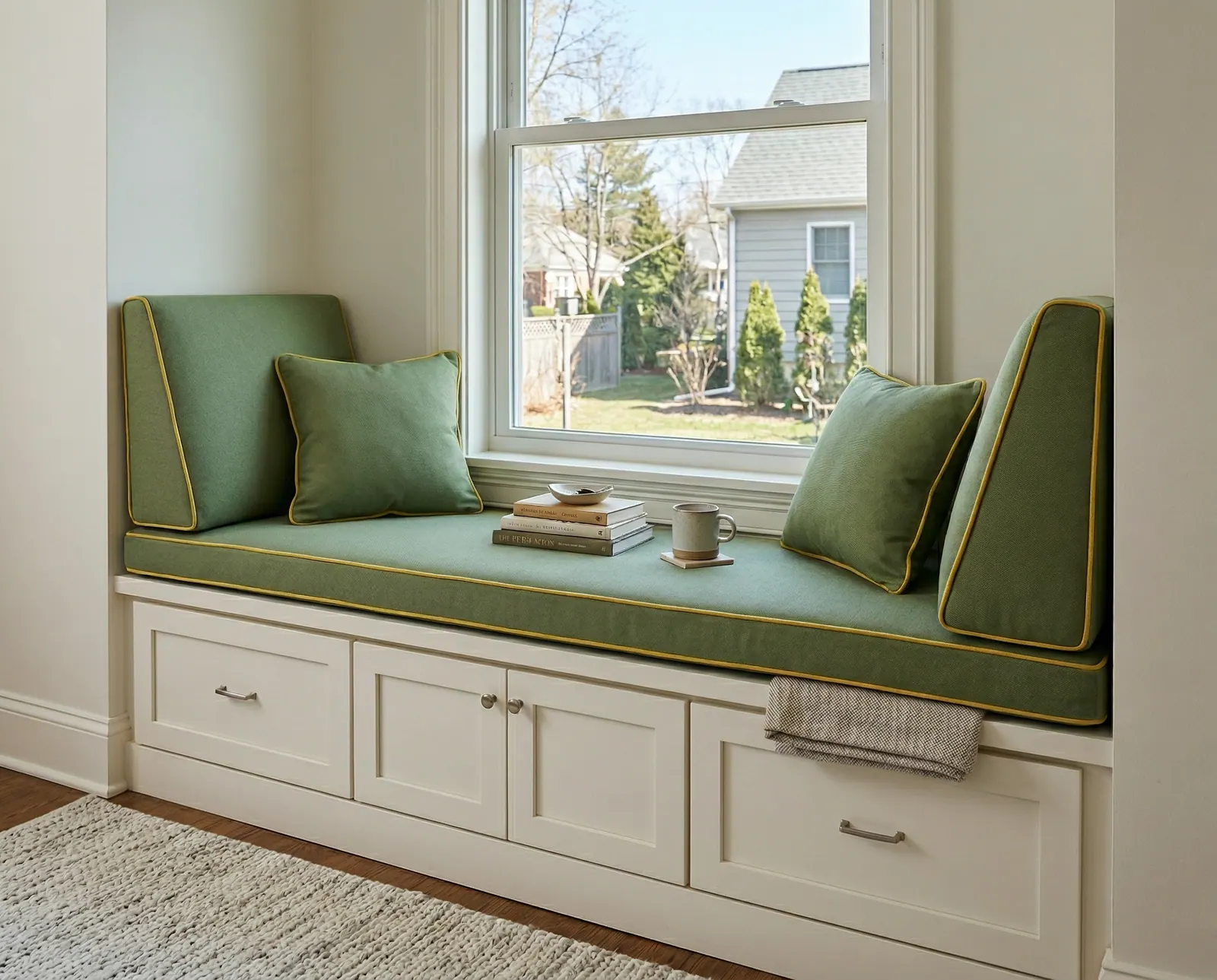
| Window seat beside single-pane glass | Velvet or the soft performance fabric | 3 in (7.5 cm), zippered cover | Condensation; lift and air the cushion when its back edge is damp |
| Antique bench or settle | Linen, ticking or velvet | Cut to the depth at both ends, self or contrast welt | Old benches are rarely true |
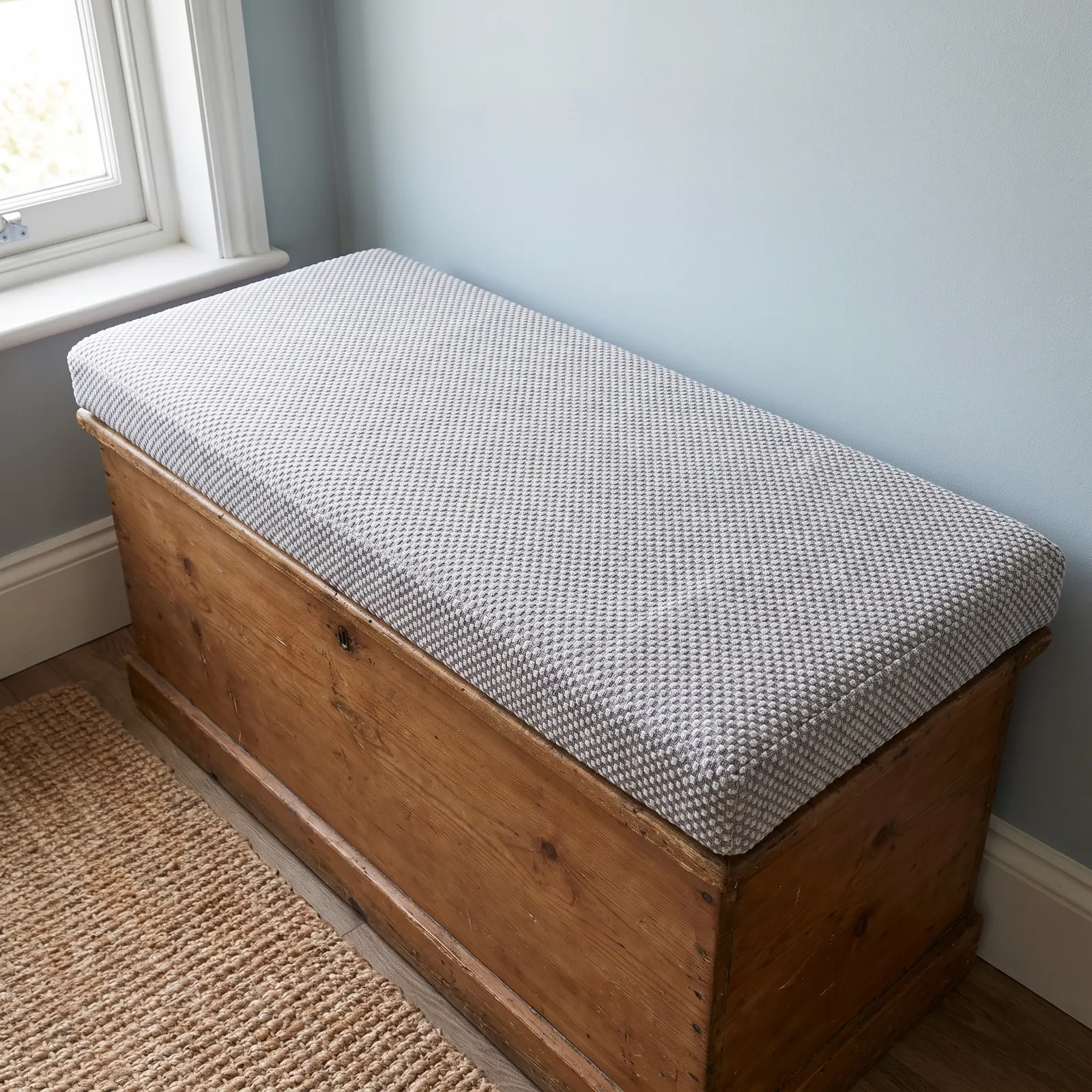
| Blanket chest or quilt box | Soft performance fabric or linen-look | 2 to 3 in (5 to 7.5 cm), ties on the hinge side only | The lid still has to open |
| Ski-house bunk | Soft performance fabric | Zippered cover sized to the mattress | Washes at 86°F (30°C) between weekends |
| Summer deck bench | Outdoor fabric, water-repellent and UV-resistant | 4 in (10 cm), self piping | Indoors from first frost to spring |
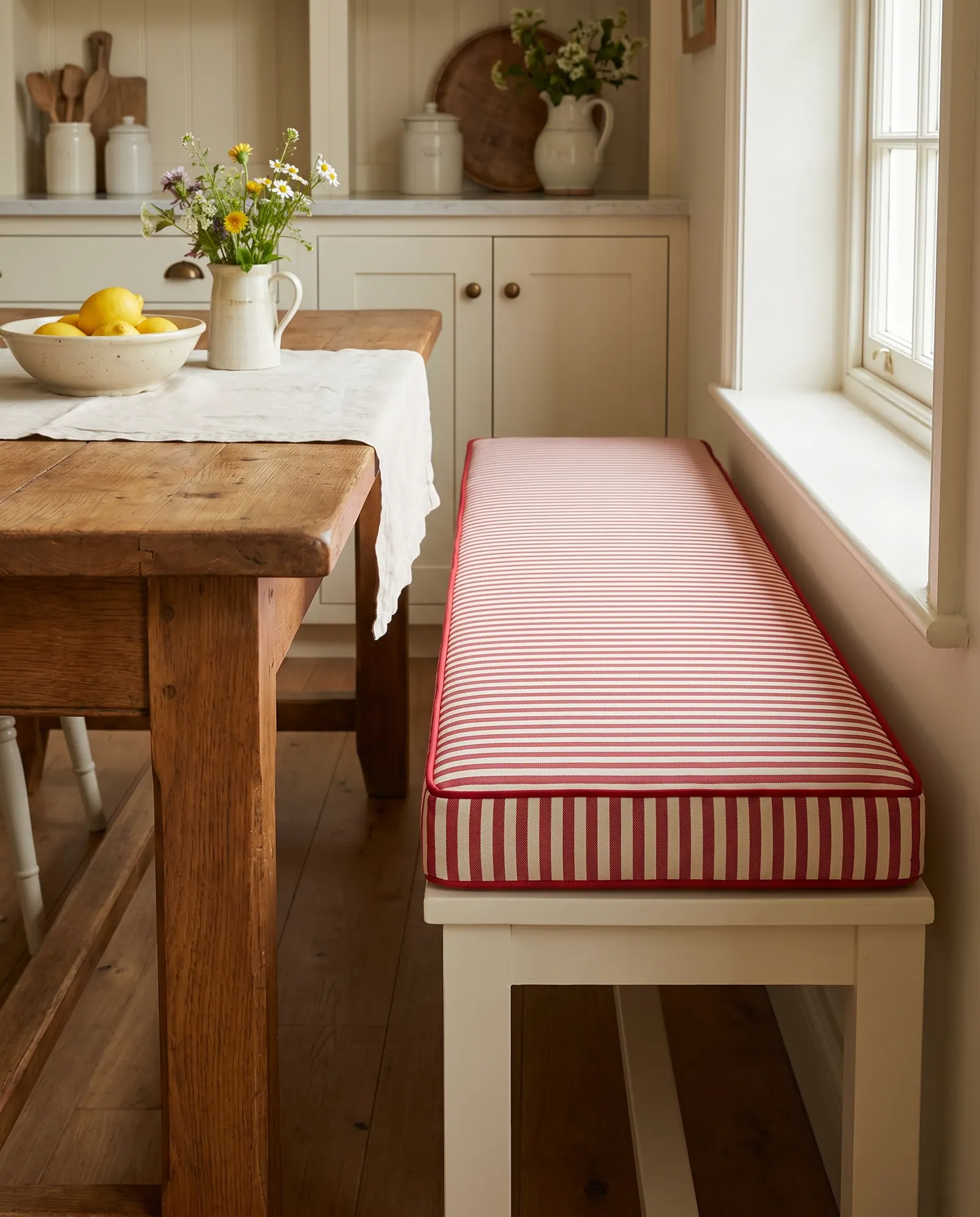
The ticking stripes are 100% cotton: right for a period room, but they stain more easily than the performance fabrics, so keep them out of the mudroom.
Fifteen inches up, three inches of foam: a mudroom niche
A buyer in the US had a mudroom bench built into a niche: 17 in (43 cm) deep, 35.75 in (91 cm) wide and 15 in (38 cm) off the floor. They wanted the seat to finish at 18 in (46 cm).
That settled the thickness before anyone said a word about fabric. Eighteen minus fifteen leaves 3 in (7.5 cm). The workshop had them pick the nearest menu size, 17 x 36 in, and write the true 17 x 35.75 x 3 in in the order note, so the cushion was cut to the niche and not to the menu.
They chose linen. For a mud-season bench I'd have nudged them toward the performance weave, but it was their bench. A quarter inch matters in a niche: too long and the cushion bows, too short and the gap collects mud, which in Vermont is saying something.
- Measured
- Niche 17 x 35.75 in (43 x 91 cm), 15 in (38 cm) high; cushion 17 x 35.75 x 3 in (43 x 91 x 7.5 cm) for an 18 in (46 cm) seat
- What it taught
- Work backward from the seat height you want to choose the thickness, and write the exact size in the order note.
A straight welt on an old bench
A straight welt is a kind of honesty. On an antique bench it is also a ruler: the eye runs along it and notices every place the cushion wanders. So cut the cushion to the bench and let the piping tell the truth.
I once piped a Greek Revival window seat in crisp white against a sill that hadn't seen fresh paint since Coolidge was in office. It looked like a bandage, dear. Now I take the welt from the wood or the oldest paint in the room: tan linen against pine, navy against a gray-blue sill, self piping on a busy ticking stripe. Piping costs nothing extra and can come from any chart. Matching, contrast or none walks through the choice.
Vermont colors are already outside the window: barn red, sugar-maple orange, spruce green, February gray. Pick one of them, not all four.
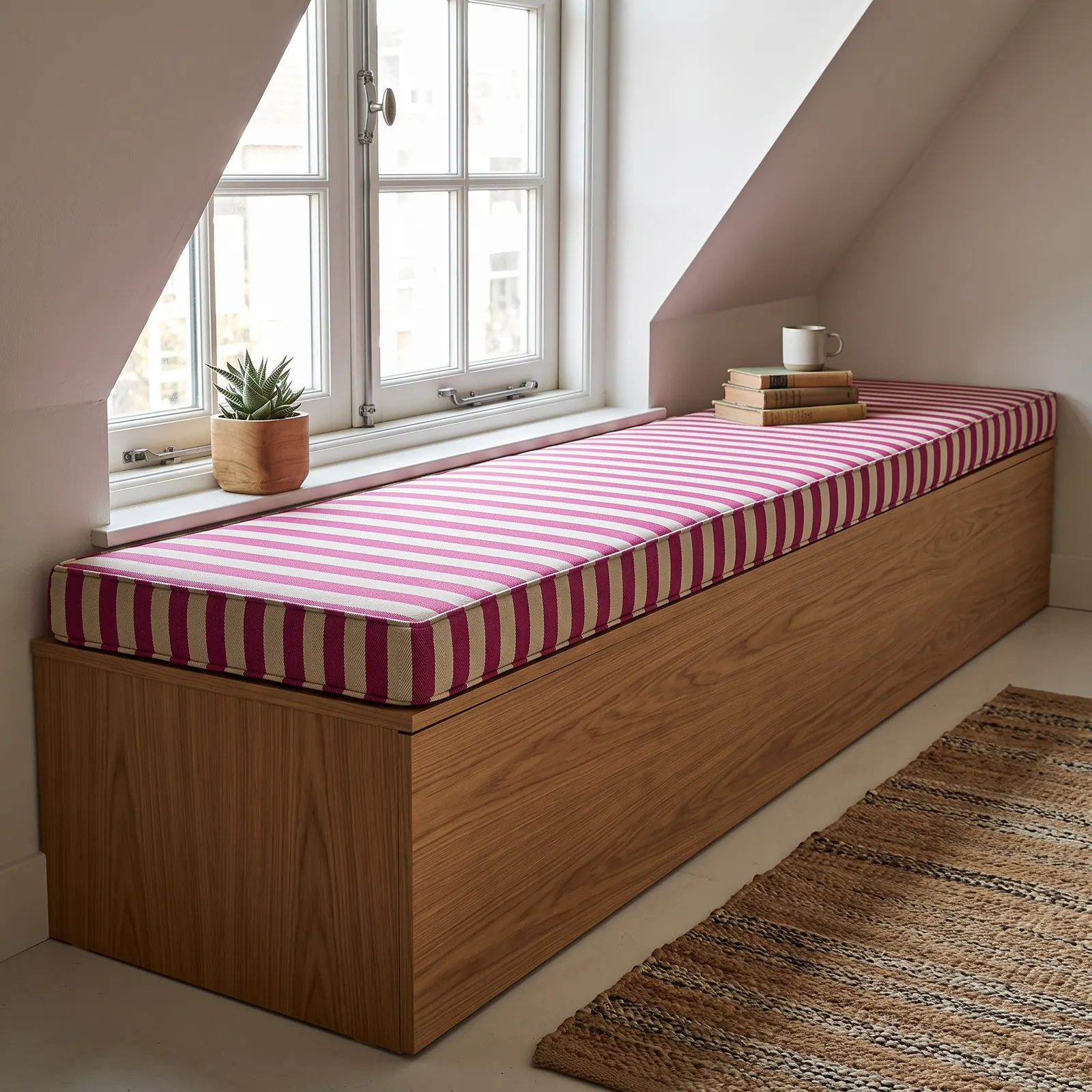
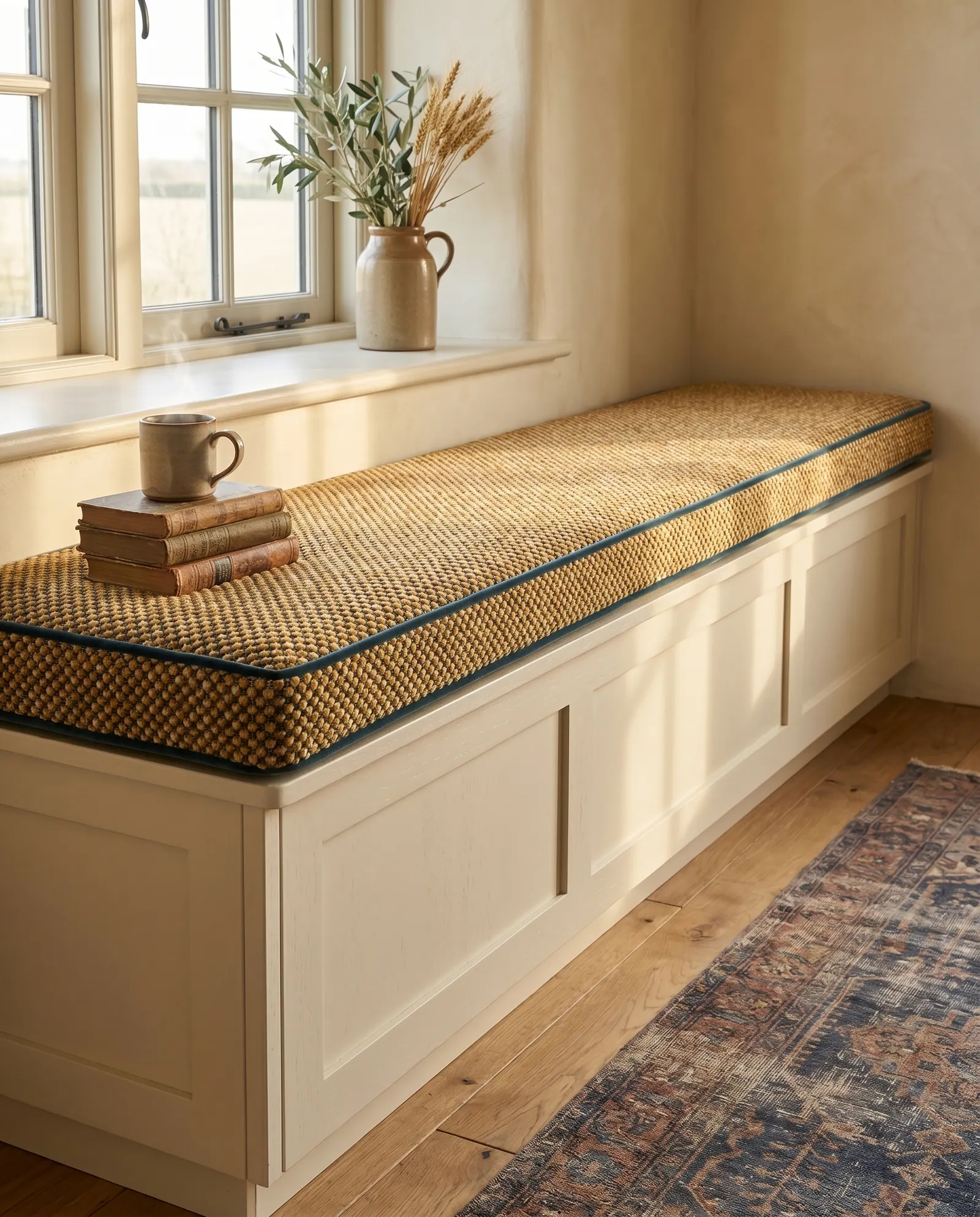
Photographs for homes like these
Open any photograph large; each one has its own link and a Save button.
 Save
 Save
 Save
 Save
 Save
Maggie's Vermont checklist
- Mud season: zip off the mudroom cover every week or two, wash it inside out at 86°F (30°C) on a gentle cycle and air dry it.
- Never put a non-slip base in the washer or dryer; wipe it with a damp cloth instead.
- Winter mornings: wipe condensation off the glass and sill, and lift the window seat cushion to air if its back edge is damp.
- Ski season: boots go on a tray under the bench, not on the cushion.
- Before the first hard freeze: deck cushions come in dry, stored off concrete and never sealed in plastic.
- Any season: order every piece of a set at once so they share a dye lot.
In mud season the mudroom bench gets two covers: one on the bench and one in the wash.
Maggie
Buyer questions: mudrooms, casings and welts
- A common question
My entry bench is right by the door where my two big dogs go in and out. What fabric should I use?
The workshop's answerFor a busy door with dogs, the workshop recommended outdoor fabric as the rugged choice, ordered through the outdoor listing with its full range of colors.
- A common question
My window casing overhangs the window seat, so the cushion can't sit against the wall. Can you notch it?
The workshop's answerYes. A notched back edge lets the cushion sit flat against the wall while clearing the casing. For a 109.25 x 25 in (277.5 x 63.5 cm) seat with a casing 0.75 in (2 cm) deep, the workshop drew a notch 0.75 in deep and 96.25 in (244.5 cm) wide along the back edge, keeping the full 25 in depth for 6 in (15 cm) on the left and 7 in (18 cm) on the right. A diagram comes back for approval before the quote.
- A common question
I want the piping in the same fabric as the cushion, not a contrast. How do I ask for that?
The workshop's answerWrite 'piping the same color' with the fabric code in the personalization box, for example 'piping same color N02', and the piping is cut from the main fabric.
- A common question
My window seat has a radiator under it. Should the cushion be one piece or two?
The workshop's answerTwo. For a 106 x 15 in (269 x 38 cm) radiator window, the workshop recommended two cushions of 53 x 15 in (135 x 38 cm) each, so the radiator area isn't sealed off.
- A common question
How should I wash the covers?
The workshop's answerEvery cover has a zipper and comes off completely. Wash it at 86°F (30°C) on a delicate cycle with mild detergent and no bleach, and air dry it instead of using the tumble dryer.

Have it made
Have it made for your home — ask Maggie’s workshop
Have the tape measure handy when they call. Old cushions shrink and sag; the seat underneath does not. — Maggie
Leave your details and the workshop will call you to confirm measurements, fabric, foam and piping. No prices, dates or payment on this page: it is a request, not an order.
Vermont cushion questions
What fabric survives mud season on a Vermont mudroom bench?
A tight performance weave or outdoor fabric. The pet-friendly weave is 100% polyester, quoted at about 88,000 Martindale and washable at 86°F (30°C); outdoor fabric is water-repellent and wipes clean. Keep cotton ticking for rooms the boots never reach.
Why does my Vermont window seat cushion feel damp in winter?
Warm room air meets cold single-pane glass and condenses, then runs down onto the sill and the cushion. Wipe the glass and sill, lift the cushion to air, and dry anything damp within 24 to 48 hours, as the EPA advises.
Do Vermont deck cushions need winter storage?
Yes. Burlington averages 152 days a year at or below 32°F (0°C) and 87.5 in (222 cm) of snow. Water in standard foam freezes, thaws and never fully dries out, so store deck cushions dry, off concrete and out of sealed plastic until spring.
How do I order a cushion for an antique bench that isn't square?
Measure the front and back lengths, the depth at both ends and both diagonals, then send a drawing with a photo. The workshop checks that the numbers close into a real shape before cutting and sends a diagram back to confirm.
Is Vermont's summer sun hard on window seat fabric?
Less than farther south. Burlington's July noon UV Index averages about 7.6, against roughly 10 on the Gulf Coast, and about 0.9 in December. A south-facing seat still fades over the years, so turn the cushion now and then.
Stitch straight — Maggie
The atelier
Keep going
Across the Map
Nearby places
Close by on the map