Across the Map · New England · United States
Window seat cushions for Connecticut colonials, capes and shoreline cottages
Connecticut houses were built for their own century, not for a stock cushion. Here is how to fit a saltbox seat, a Cape dormer and a mudroom bench, and what the Sound asks of a porch.
- Sun & UVModerate
- HumidityModerate
- WinterCold
- CoastSalt air nearby
- Typical seatsColonial window seat, dormer window seat, three-sided bay seat

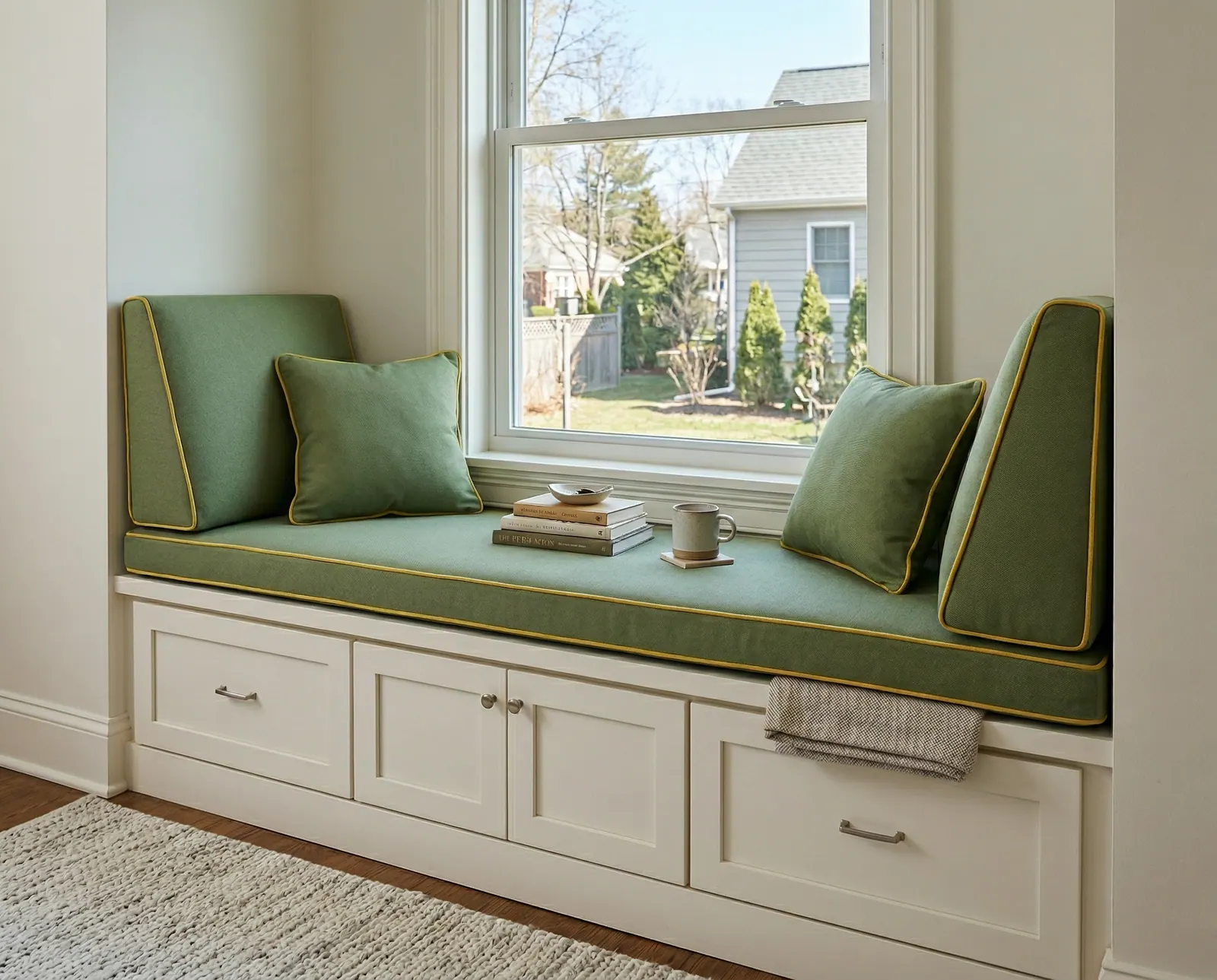 Save
The quick answer
Window seat cushions in Connecticut should be cut to the real, often out-of-square seat, notched around any casing that overhangs it, and covered in a fabric that washes or wipes clean where winter glass sweats. Choose 3 to 4 in (7.5 to 10 cm) for most built-ins, 2 to 3 in under a casement, and outdoor fabric for shoreline porches, stored dry from first frost.
Hartford winters and the glass that sweats
Connecticut sits in the top band of the national search map for window seat cushions and near the top for bench and custom cushions. Old houses will do that.
Hartford averages 131 days a year at or below freezing, 51.7 in (131 cm) of snow and 128 wet days. Snowfall runs from 30 to 35 in on the coast to about 50 in in the Northwest Hills.
The trouble sits at the glass. Warm room air meets a cold single pane, turns to water and runs onto the cushion. The EPA's rule of thumb: materials dried within 24 to 48 hours usually won't grow mold. Choose a cover that washes or wipes clean, and lift the cushion to air it. In July a south-facing seat fades instead; see sun through glass.
Saltboxes, Capes and the seat under the sash
Connecticut's oldest houses went up between the 1640s and the Revolution: timber frames around a big central chimney, often saltboxes with a one-story extension under a long rear roof, lit by small diamond-paned casements. Georgian houses brought center halls and sash windows. The Cape is a story and a half under a steep roof, so its upstairs seats hide in dormers.
None of those walls is square. Every window seat gets its front, back, both depths and both diagonals written down, as measuring a window seat shows. My confession: I once cut a dormer cushion a full 4 in thick, and the casement couldn't swing open over it. Right, then. Under a casement, go 2 to 3 in.
The mudroom began as the farmhouse vestibule for snowy boots, so its bench cushion wants a tough cover.
Which way does your casing sit, dear: flush with the wall, or hanging over the seat?
The cutting list for a Connecticut house
| Seat | Fabric | Build | Piping and fastening |
|---|---|---|---|
| Window seat on single-pane glass | Velvet or soft performance fabric; both wipe clean | 3 to 4 in (7.5 to 10 cm), zippered cover | Self piping or a trim-color contrast |
| Cape dormer seat under a casement | Linen-look or ticking | 2 to 3 in (5 to 7.5 cm), so the sash clears | Same-fabric piping, or none |
| Georgian or Victorian bay | Ticking or stripe | Cut from a drawing of every edge | Matched to one stripe, or the closest solid |
| Mudroom bench | Outdoor fabric or pet-friendly performance weave | 3 in (7.5 cm), worked back from seat height | Non-slip base |
| Shoreline porch or deck bench | Water-repellent, UV-resistant outdoor fabric | 3 to 4 in (7.5 to 10 cm), never tufted | Self piping; ties on the back corners |
Every thickness uses the same firm seat foam, about 2.0 lb/ft³ (32 kg/m³). Ticking is 100% cotton and stains more easily.
An angled seat with a post in each corner
A buyer in the US sent a photo of an angled window seat with a post in each corner, and the workshop turned it into a template: 115.5 in (293 cm) along the front, 54.5 in (138 cm) along the back, 30.5 in (77.5 cm) deep, with 8.5 in straight ends.
Then the geometry objected. The slanted sides had been measured at 39 in, but those numbers only close at about 37.5 in. The posts were why: the tape had to bend around them, and 4 in had already come off the true 58.5 in back to clear them.
Once the buyer said so, the template was confirmed and cut 3 in (7.5 cm) thick, with anti-slip material underneath. If posts or trim are in the way, say so and let the maker work out the slants; the trapezoid cushion calculator runs the same check.
- Measured
- Front 115.5 in, back 54.5 in (true 58.5 in), depth 30.5 in, 8.5 in ends, slants about 37.5 in, 3 in thick
- What it taught
- If posts or trim are in the way, say so and let the maker work out the slants from front, back and depth.
Connecticut seat care, month by month
- Late October: porch cushions come in before the first frost, dry right through.
- December to March: wipe sweating glass and sills; stand window seat cushions on edge to air.
- After any soaking: get the foam dry within 24 to 48 hours.
- April: wash covers at 86°F (30°C) on a gentle cycle and air dry.
- July: flip a reversible south-facing cushion so the sun works both faces.
Photographs for homes like these
Open any photograph large; each one has its own link and a Save button.
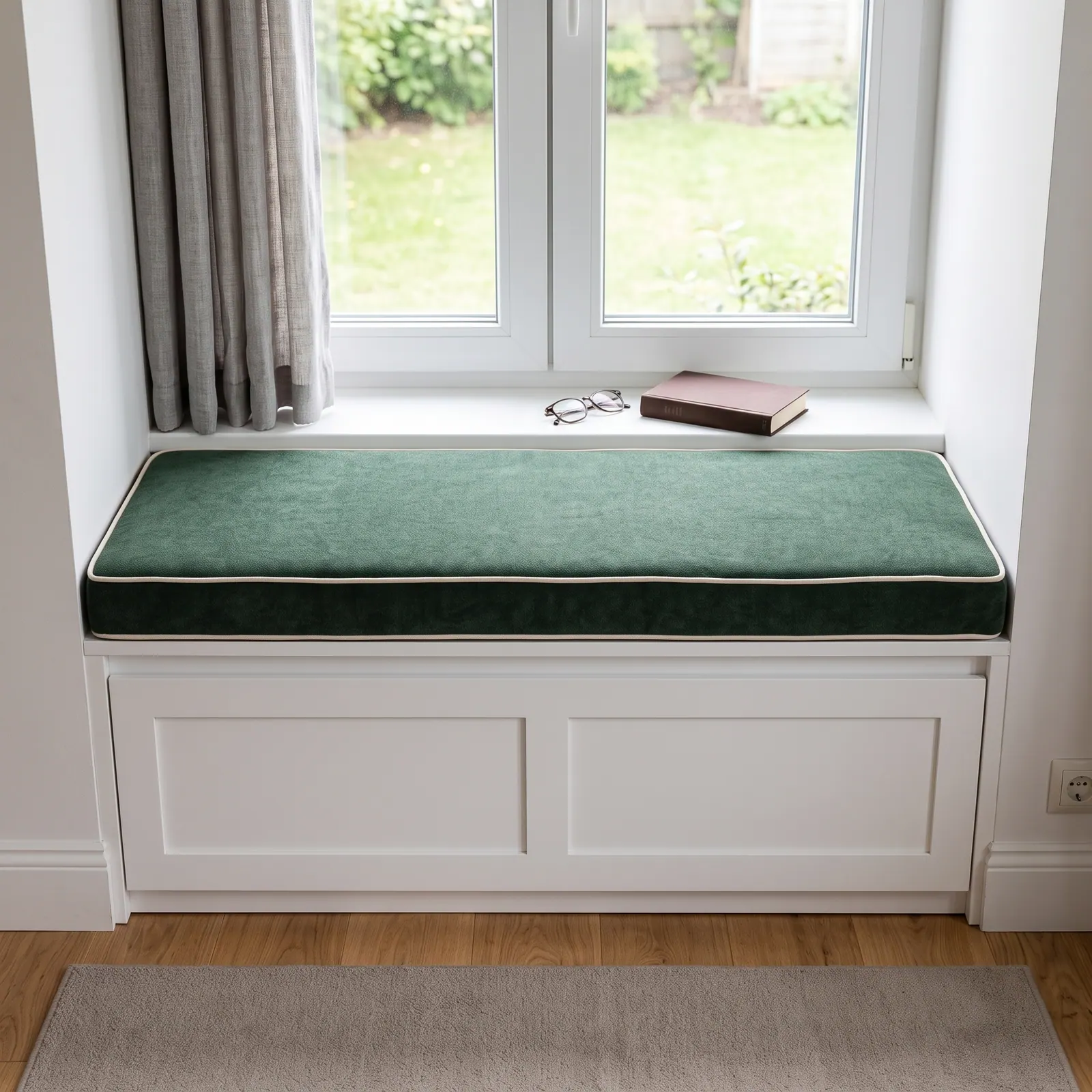 Save
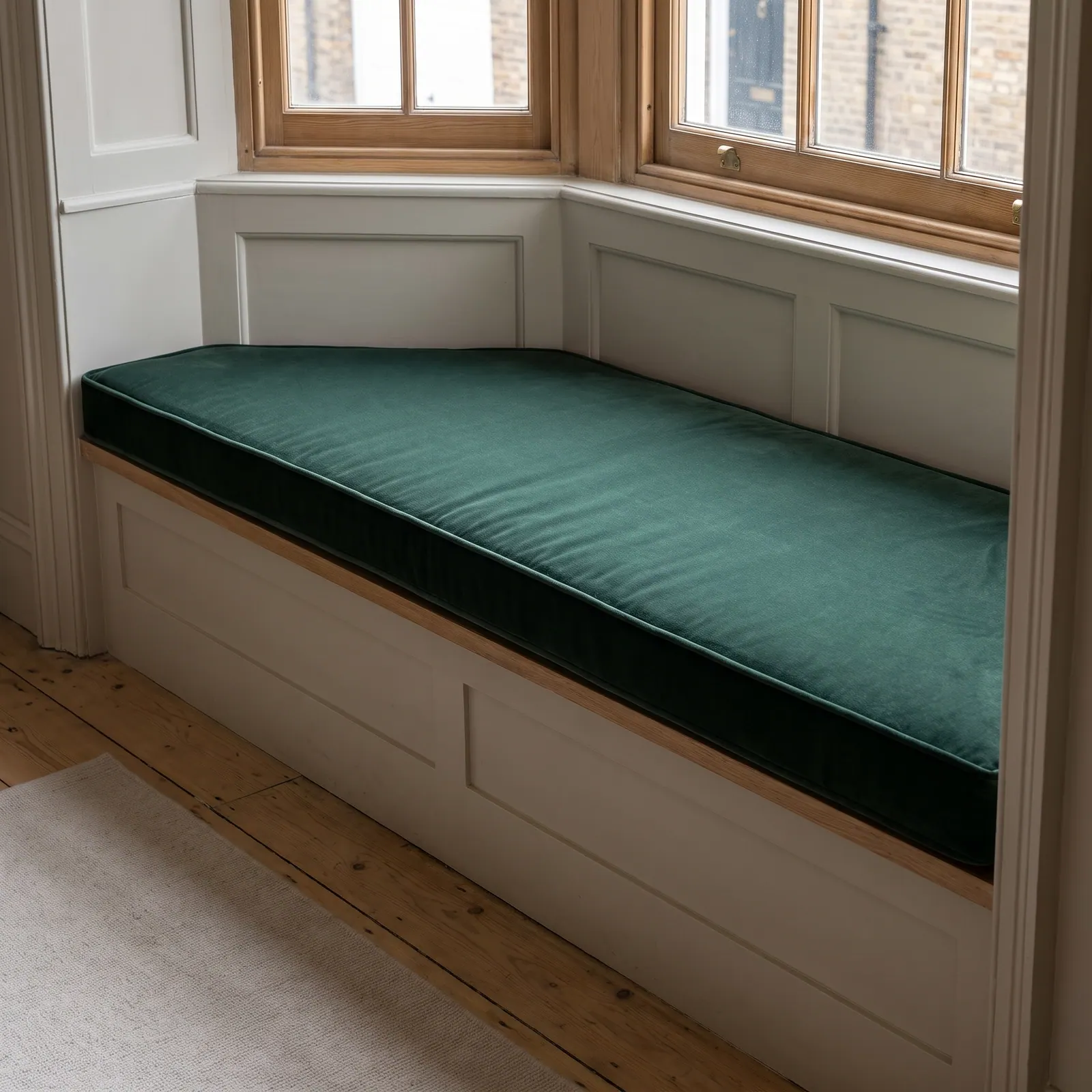 Save
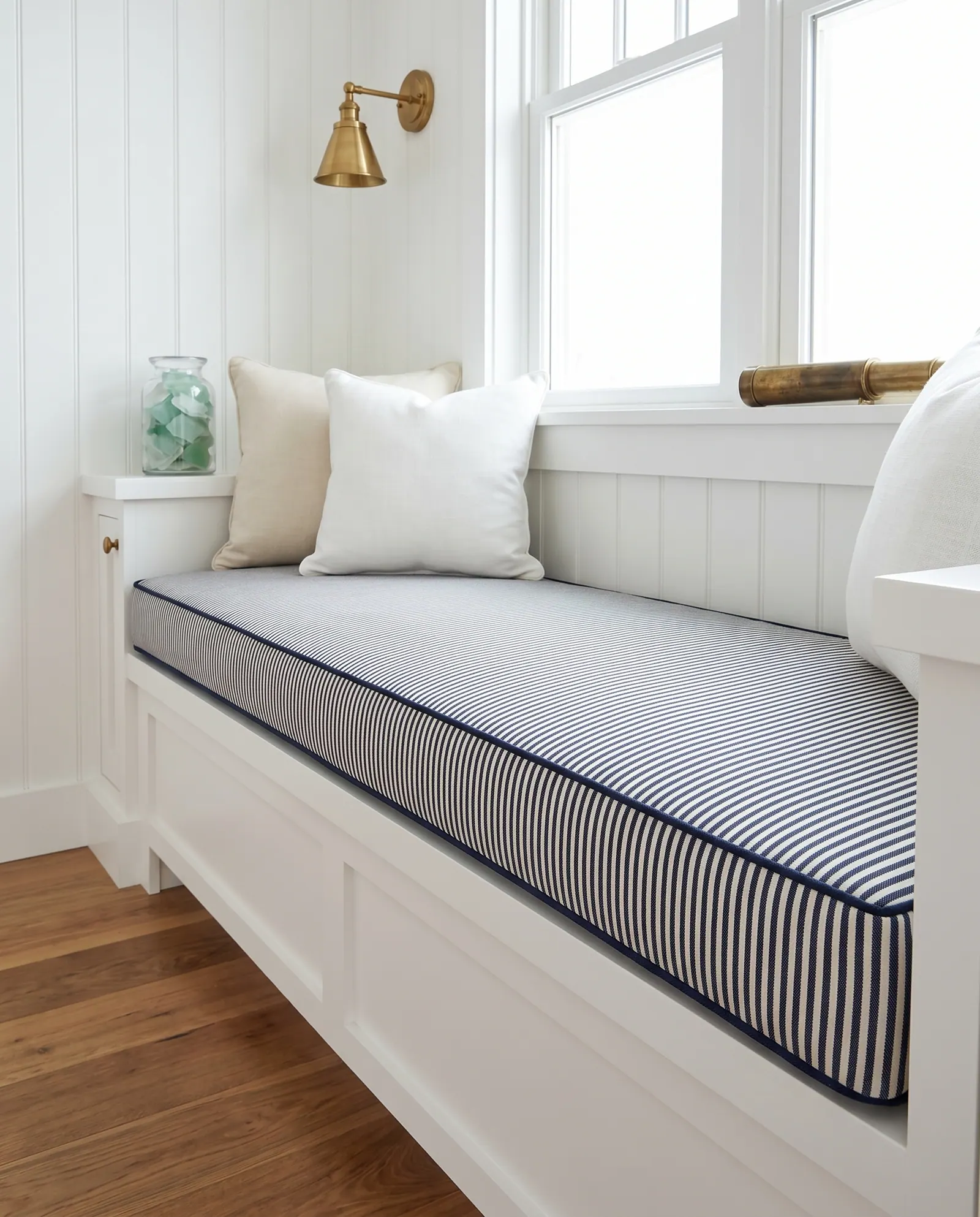 Save
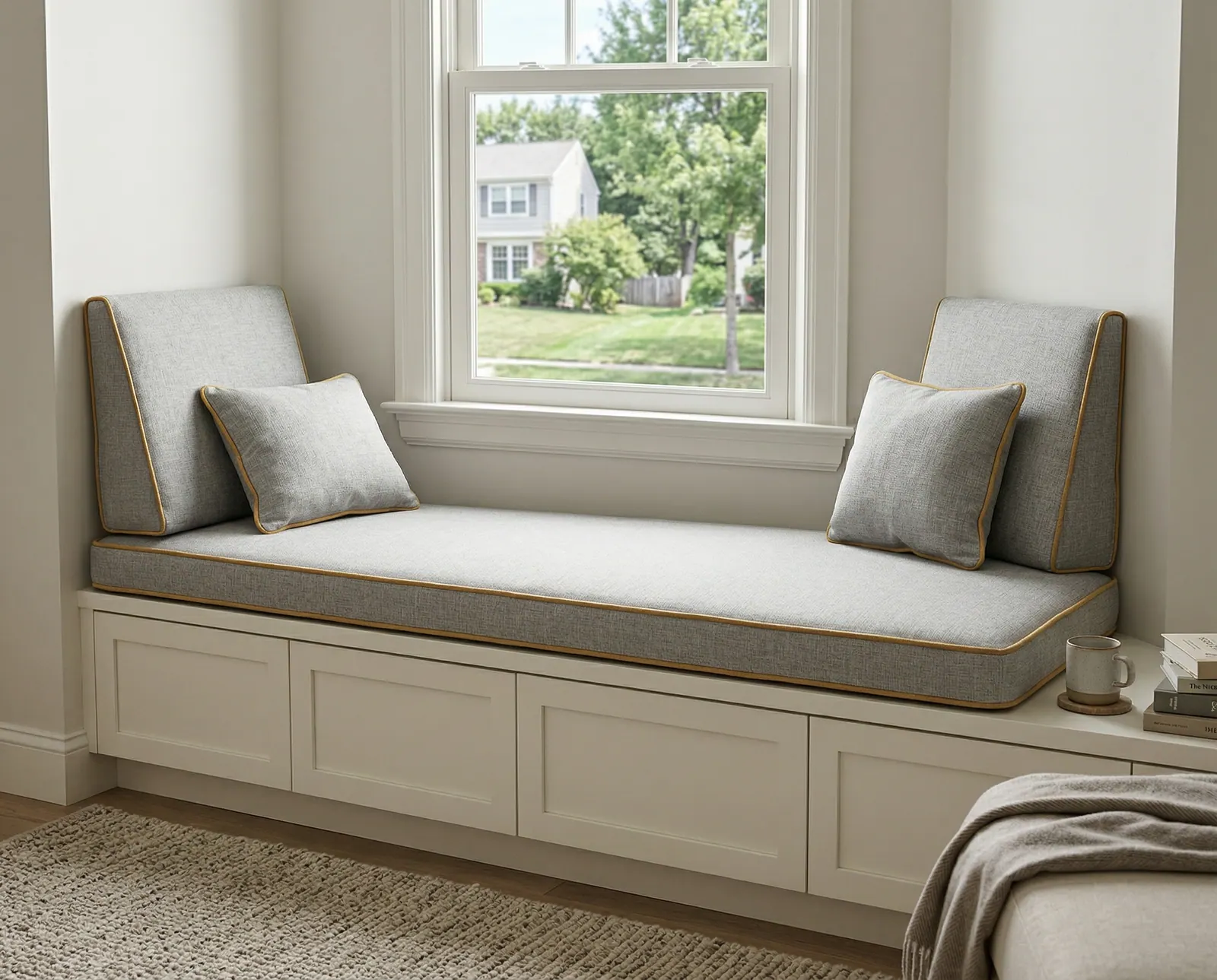 Save
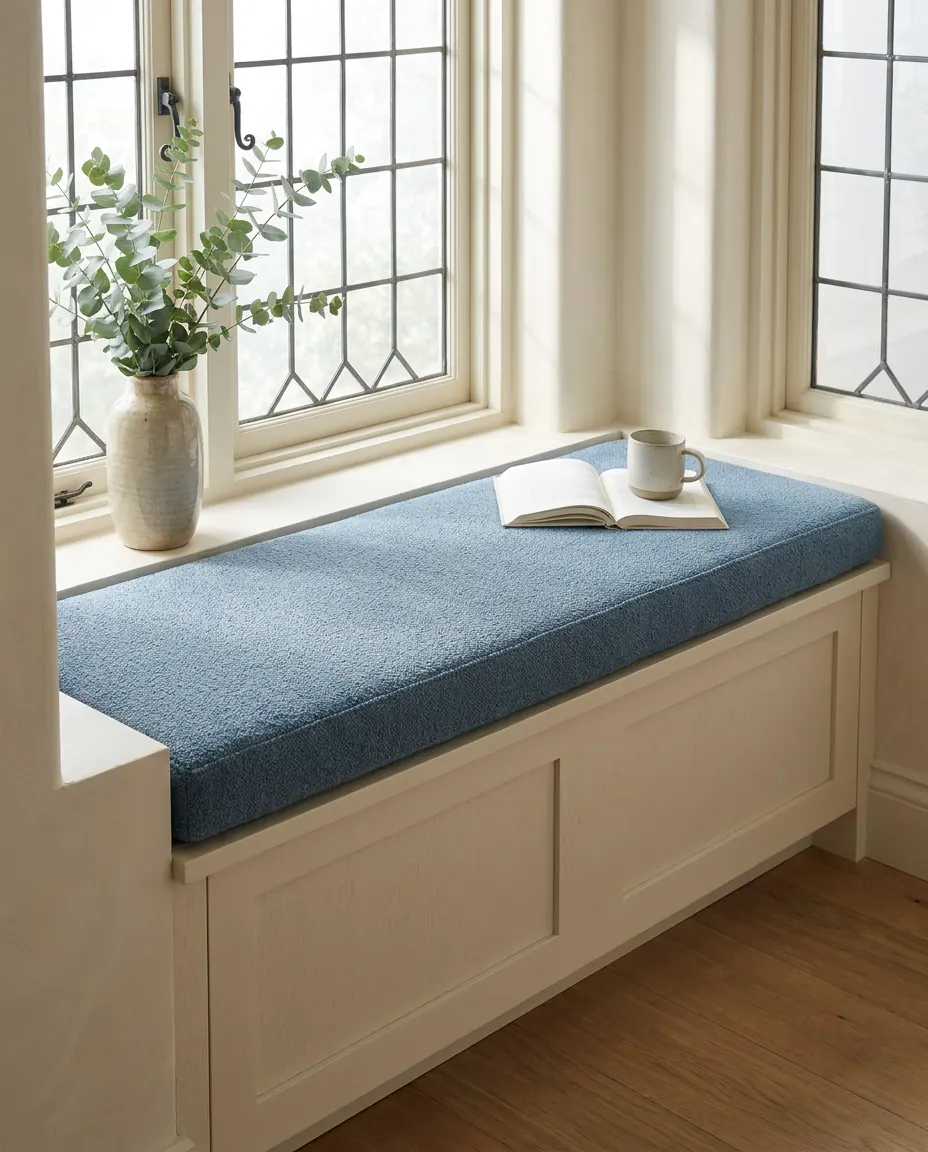 Save
Ticking indoors, a harder weave by the Sound
Wide pine boards, painted paneling and small panes want plain, honest cloth: ticking and stripes, linen, and warm corduroy or velvet for radiator season.
The shoreline is its own country. Waterford's Hartford Colony, begun in 1891 as a summer resort for Hartford families, is full of Shingle style and Colonial Revival houses whose porches want water-repellent outdoor fabric. Salt spray is heaviest within 300 to 3,000 ft of breaking waves, so rinse with fresh water and trust fabric ties over metal fittings. And it's a deck here, not a patio: decks go on 69% of new New England homes. The wider region lives under New England cushions.
In an old house the window casing is the landlord. Notch the cushion around it; don't shrink the whole seat to please it.
Maggie
Buyer questions: levers, angles and ticking
- A common question
Our bench sits under a window whose lever is about 11 in above the seat cushion. How tall should the back cushions be?
The workshop's answerAbout 14 to 16 in, so the lever sits safely behind them, and 3 to 4 in thick in the seat's fabric. They stay loose, so the window still opens.
- A common question
How do I measure an angled window seat so the numbers close?
The workshop's answerMeasure depth straight front to back at 90 degrees, not diagonally, and each angled side corner to corner. The workshop checks the geometry: a 40 in front, 30 in back and 17 in depth gives sides of about 17.5 in, not 22 in.
- A common question
Can a trapezoid window seat cushion come with bolsters on the angled sides?
The workshop's answerYes. Send every side plus the depth; one seat measured 117 in at the back, 68.5 in at the front, 34 in on each diagonal and 25.5 in deep. The cushion is 4 in thick, the bolsters 10 in across, and it can be made without tufting for clean lines.
- A common question
Which way will the stripes run on a long ticking window seat cushion?
The workshop's answerFront to back, normally. The fabric roll's width means side-to-side stripes on a long cushion would need several pieces stitched together. On some sizes horizontal stripes are possible if you ask before production.
- A common question
Can the piping match one of the colors in my striped fabric?
The workshop's answerOften, yes; on one bench it matched the gray stripe. When a stripe is too thin to cut, the workshop picks the closest solid from another chart and compares them in natural light.

Have it made
Have it made for your home — ask Maggie’s workshop
Have the tape measure handy when they call. Old cushions shrink and sag; the seat underneath does not. — Maggie
Leave your details and the workshop will call you to confirm measurements, fabric, foam and piping. No prices, dates or payment on this page: it is a request, not an order.
Connecticut seat questions, answered
Why does my window seat cushion get damp in winter when the window is shut?
Condensation. Warm, moist room air meets cold single-pane glass and runs down onto the seat. Wipe the glass and sill, air the cushion, and dry anything wet within 24 to 48 hours.
Is velvet a good idea on a south-facing Connecticut window seat?
Keep pile fabrics out of long direct sun. For a seat that bakes all afternoon, choose a fabric rated 6 or higher on the blue wool lightfastness scale, or a sun-resistant outdoor fabric, and flip it each season.
Do I need a paper template for a window seat that isn't square?
Usually not. Photos and a full set of measurements are enough, and the workshop checks that the numbers close. For a truly asymmetric bay, a full-size paper template beats any list of numbers.
What fabric suits a Connecticut mudroom bench that takes wet boots and a dog?
Outdoor fabric is the rugged choice for a busy entry with dogs, and a pet-friendly performance weave works too. No fabric is claw-proof, but tight, flat weaves snag far less than looped ones. Add a non-slip base.
Stitch straight — Maggie
The atelier
Keep going
Across the Map
Nearby places
Close by on the map