Across the Map · Mid-Atlantic · United States
Outdoor cushions for Delaware beach houses, decks and porches
One small state, two cushion climates: beach towns where sand and salt ride in on every towel, and Wilmington porches that see a real winter. Build for the worst day of each.
- Sun & UVStrong
- HumidityHumid
- WinterCold
- CoastSalt air nearby
- Typical seatsBeach-house deck chaise, deck dining bench, outdoor bench with bolsters
 Save
The quick answer
Outdoor cushions in Delaware should be cut in water-repellent, UV-resistant outdoor fabric, built plain rather than tufted, with self piping and fabric ties. At the beach, rinse salt and sand off with fresh water and choose zip-off covers for rentals. Standard foam is not quick-dry, so stand wet cushions on edge and store everything dry before the first frost.
Salt, sand and a March nor'easter
Delaware has the lowest average elevation of any state, and no spot in it sits more than 8 miles from tidal water. Weather here comes with a wet edge.
The state averages about 45.9 in (117 cm) of precipitation a year; Wilmington gets 45.33 in, with mornings near 78% humidity. Snow runs 9 to 20 in. Nor'easters bring wind, heavy rain and coastal flooding, and they peak in March.
At the beach the sun works twice. The WHO puts sand's UV reflection at about 15% and sea foam's at about 25%. Salt spray is heaviest within 300 to 3,000 ft of breaking waves, and faster corrosion has been measured five to 10 miles inland. Metal hardware feels it first.
Rain doesn't negotiate. Neither does sand.
Camp-meeting cottages, Lewes porches, Wilmington bays
Rehoboth Beach began in 1873 as a Methodist camp meeting on 414 acres, laid out in a fan of wide streets and building lots, with a boardwalk that now runs a mile. After a paved highway reached it from Washington in 1925, it earned the name Nation's Summer Capital. Lewes, on Delaware Bay, calls itself the First Town in the First State; Dutch settlers founded a trading post there in 1631.
Wilmington is a different job. The Delaware Avenue district grew along an 1864 trolley line into Italianate and Queen Anne houses with bays, turrets and large front porches, and older neighborhoods hold row homes from the late 1800s.
So the seats split two ways: chaise and sunbed cushions, deck benches and dining pads at the beach; porch benches, swings and bay window seats in town. Delaware sits at or near the top of the national search maps for outdoor, chaise, bench and window seat cushions, though a small state makes for noisy data.
How far from the surf does your deck sit, friend?
Beach deck or Wilmington porch: what each cushion needs
| Spot | Fabric | Build | Care |
|---|---|---|---|
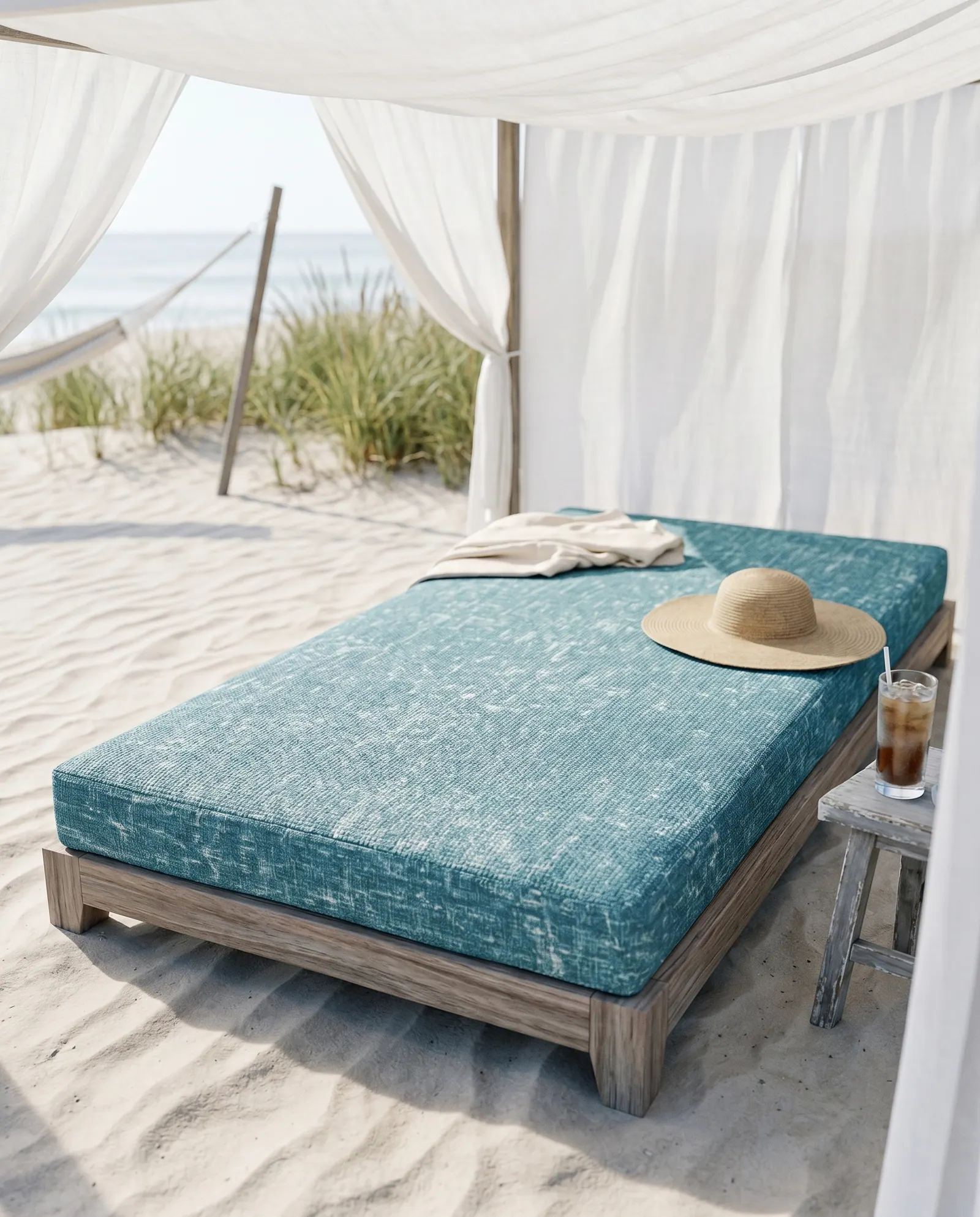
| Chaise on an open beach deck | Outdoor fabric; a darker or patterned seat hides sand | 4 to 6 in (10 to 15 cm), plain box, ties at hinge and head | Rinse off salt; stand on edge after rain |
| Deck dining bench | Outdoor fabric; white only in a bleach-cleanable code | 2 to 4 in (5 to 10 cm), non-slip base or ties | Brush sand off before it grinds in |
| Pool edge or fire pit bench | Outdoor fabric | Never tufted; long runs split in two | Dry within 24 to 48 hours after a soaking |
| Wilmington porch bench or swing | Outdoor fabric; indoor fabric only under a closed roof | 3 to 4 in (7.5 to 10 cm), ties on the back corners | Indoors from first frost to spring |
| Victorian bay window seat | Velvet, linen-look or performance weave | 3 to 4 in (7.5 to 10 cm), cut from a drawing | Wash covers at 86°F (30°C) |
The standard outdoor build uses the regular seat foam, about 2.0 lb/ft³ (32 kg/m³). It is not quick-dry and has no mesh bottom as standard; ask about dry-fast foam if a cushion will live outside.
Ten new covers for a sectional whose foam was still good
A buyer in the US had an outdoor sectional with benches and wanted covers only, for inserts that were still sound: seven at 25 x 15.5 x 4.25 in, two big ones at 76.5 x 30.5 x 5.5 in with rounded back corners, and one at 47 x 15 x 5.5 in, all with piping and zippers.
They measured the boxed side panel seam to seam and wanted the same full, tailored look. The workshop took the 5.5 in panel as given, because a full insert crowns the top on its own. Enlarge the panel and you lose that. Then it asked how far from each corner the curve begins, the bolster sizes, and whether the throws and bolsters needed inserts.
Keep the foam, replace the skin. For a beach house that turns over every week, that's the cheapest refresh there is. The method is in covers for existing foam.
- Measured
- 7 x 25 x 15.5 x 4.25 in; 2 x 76.5 x 30.5 x 5.5 in with rounded back corners; 1 x 47 x 15 x 5.5 in
- What it taught
- Measure boxed panels seam to seam and let full inserts crown the top; don't enlarge the panel.
Delaware outdoor cushion care, nor'easter to first frost
- March: keep porch and deck cushions indoors until the coastal storms ease.
- April: wash stored covers at 86°F (30°C) on a gentle cycle and air dry them.
- Opening weekend: tie chaise cushions at the hinge and head against the onshore breeze.
- Every beach week: shake out sand, rinse off salt, stand cushions on edge to dry.
- Between renters: zip covers off and wash them; replace a stained cover, not the cushion.
- Before the first frost: store clean and dry, indoors where air moves, never sealed in plastic.
Photographs for homes like these
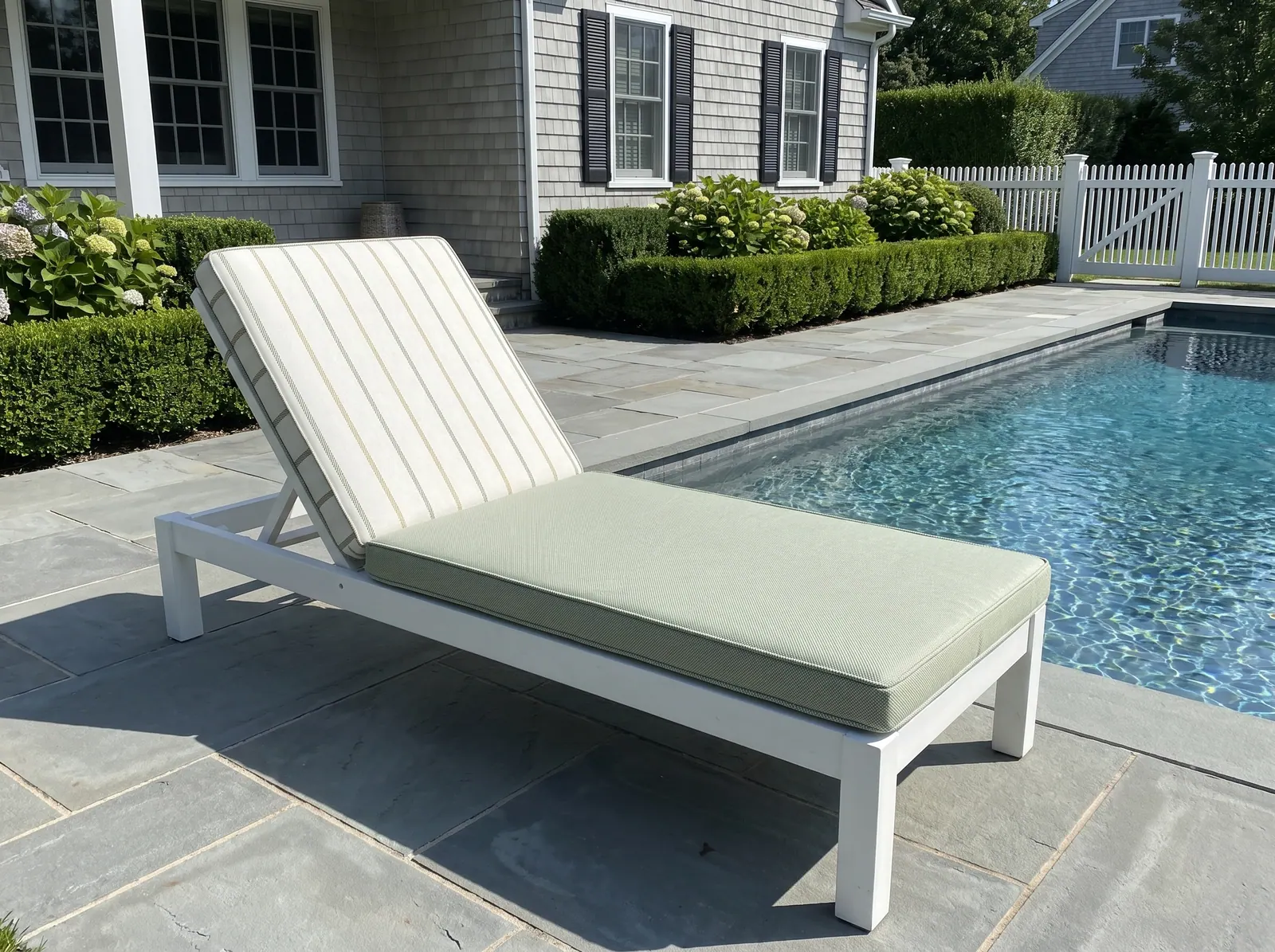
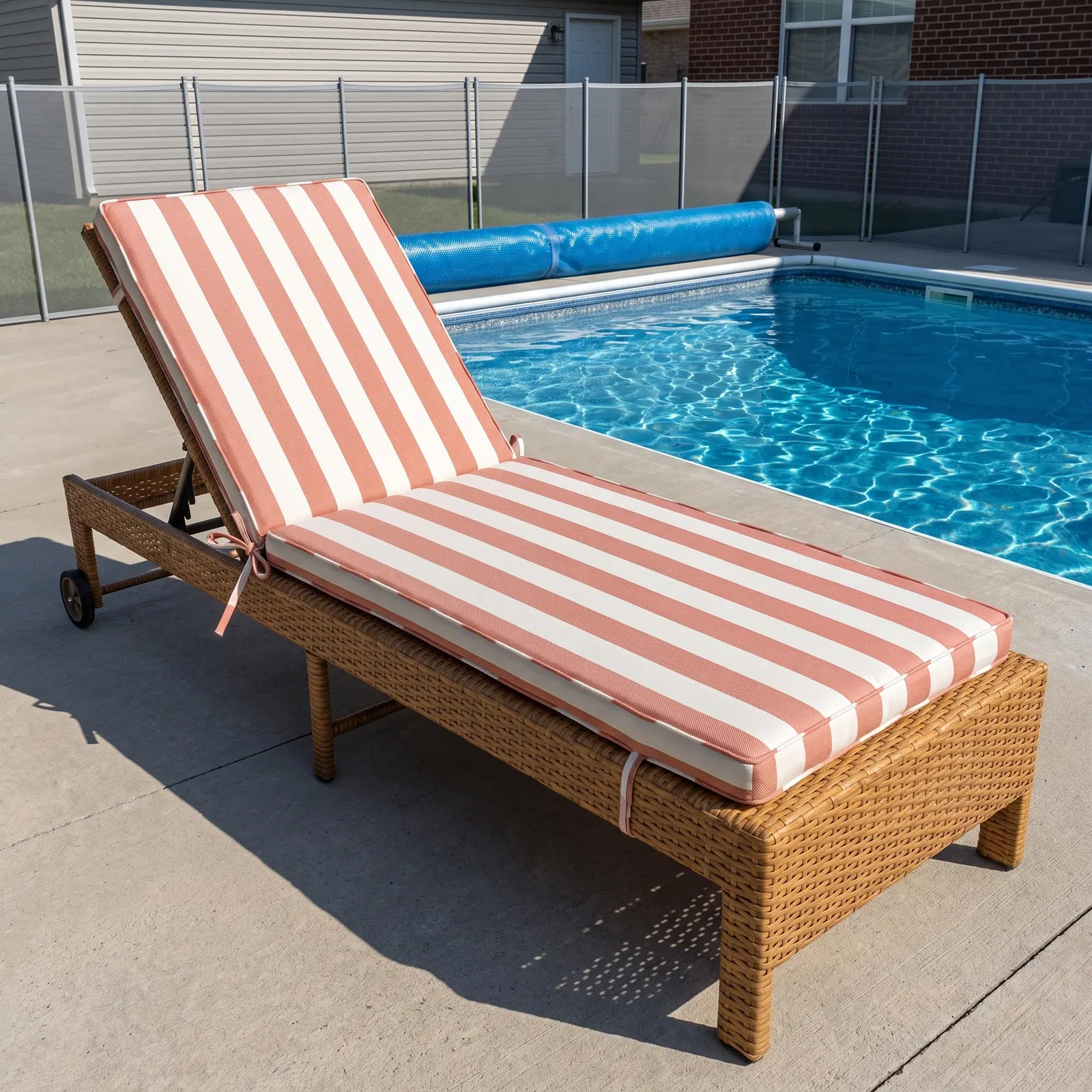
Open any photograph large; each one has its own link and a Save button.
 Save
 Save
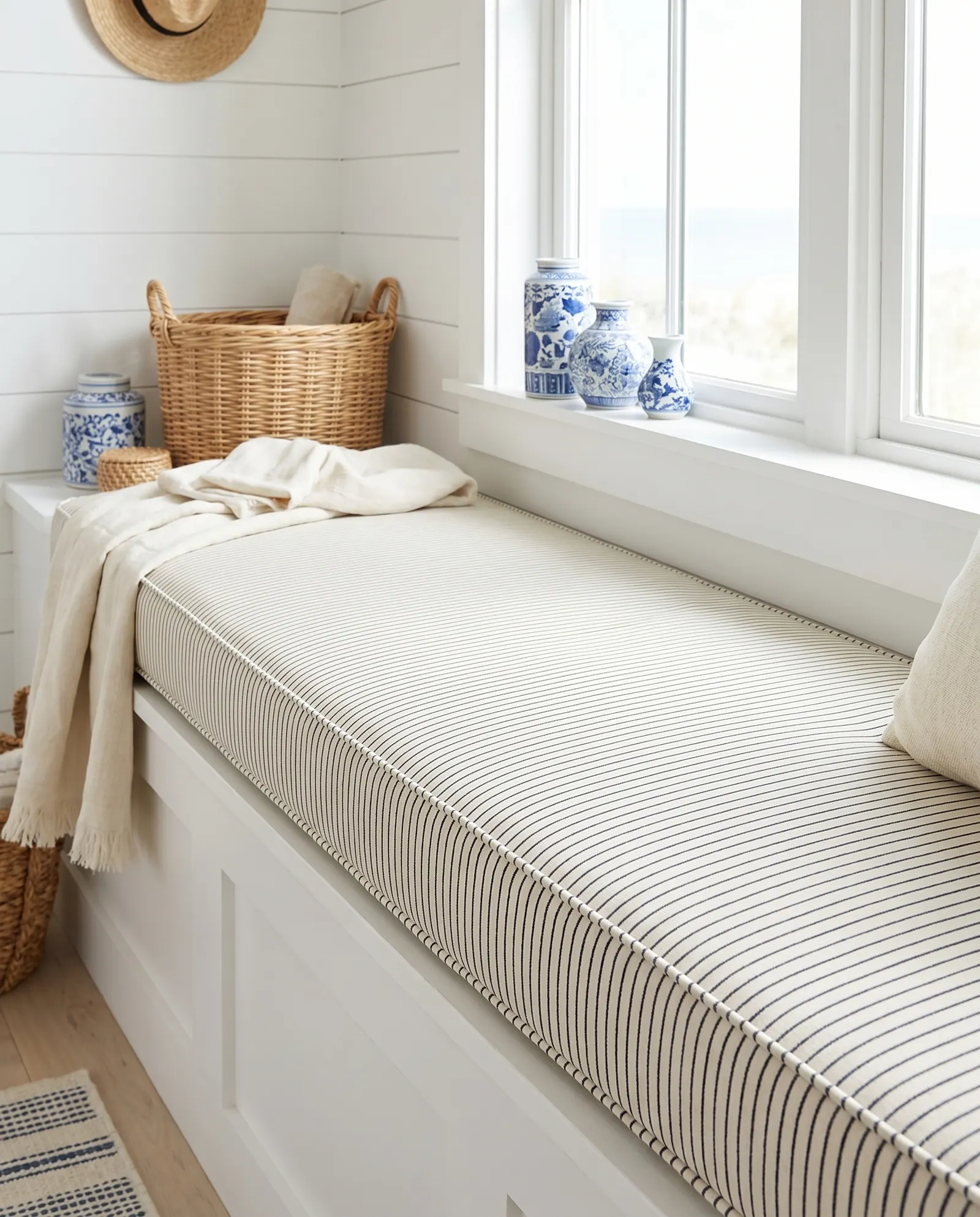 Save
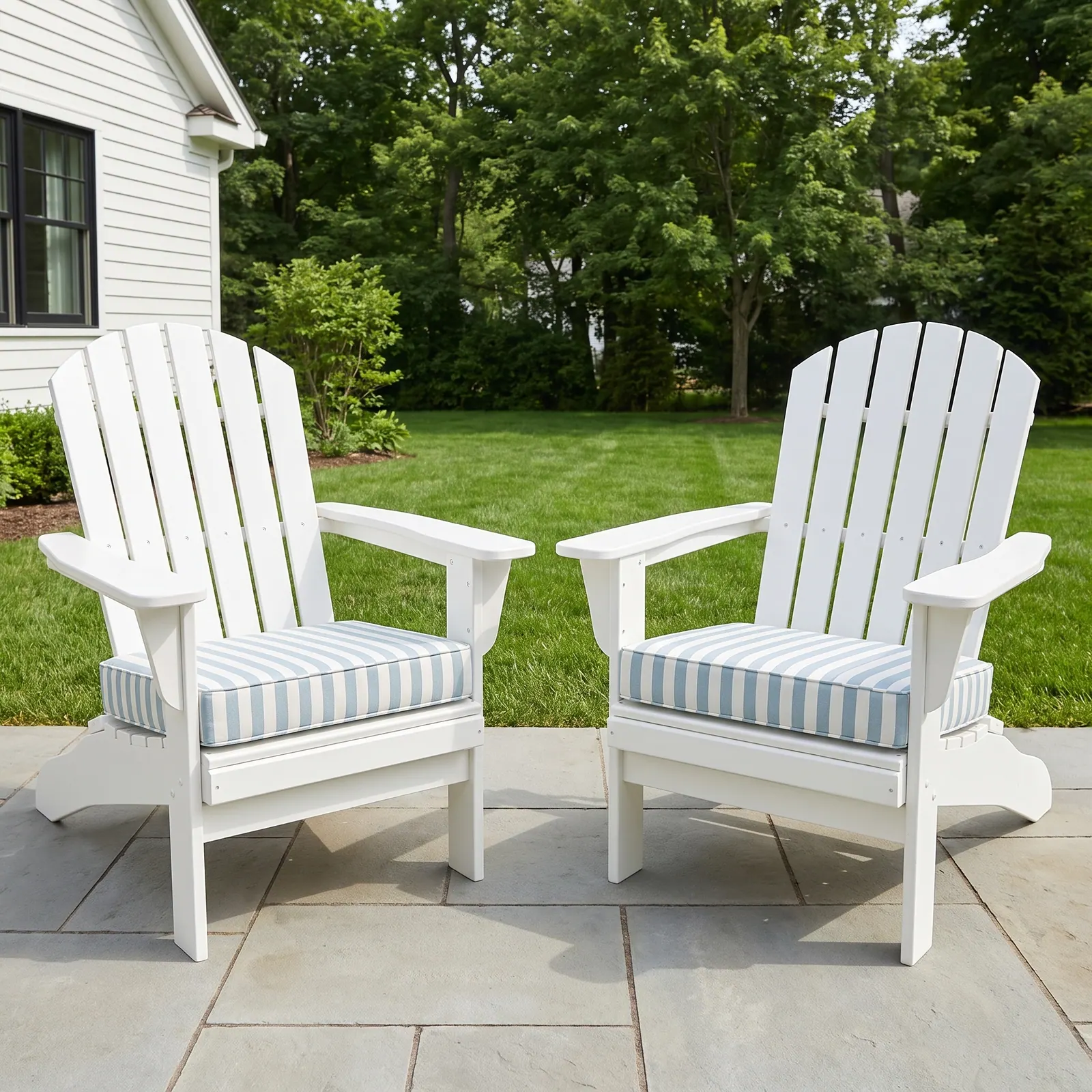 Save
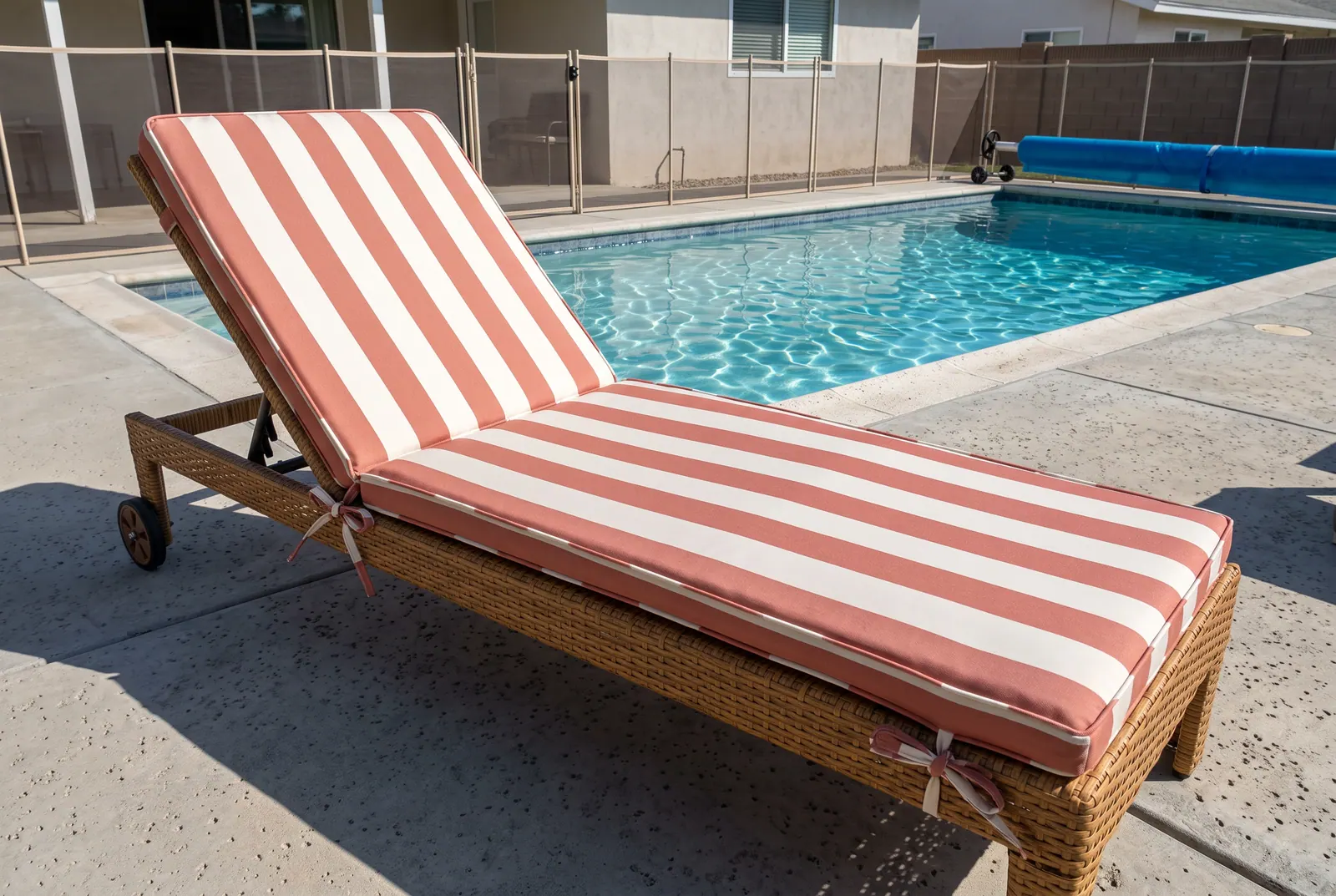 Save
Zip-off cushion covers and ties for a beach rental
Rentals see more sunscreen, wet towels and late nights than any cushion deserves. Build for that.
- Zip-off covers on every piece, washable at 86°F (30°C).
- Mid-tones or stripes; white only in a bleach-cleanable outdoor code.
- Pieces one person can carry indoors.
- Ties written into the order.
- No indoor linen or velvet on an open deck.
One buyer furnishing a rental asked about a spare set of covers, then held off because the covers washed so easily. See stain first aid and washing covers; the builds live under outdoor cushions.
A beach-house cushion should come apart in pieces one person can carry, unzip for the washer and tie down against the afternoon wind.
Callum
Buyer questions: beach and deck questions
- A common question
Should outdoor cushions have piping?
The workshop's answerSelf piping, a contrast color or no piping all work. For outdoor cushions the workshop recommends self piping, because it looks tailored and reinforces the edges.
- A common question
Does the price of an outdoor cushion include the backrest?
The workshop's answerNo, it covers the seat only. Order each back cushion as its own item with its own measurements and write 'backrest' in the note. One seat plus two back pillows is three items, made as a matching set.
- A common question
Can I buy a second set of covers, or covers for only some pieces?
The workshop's answerYes. Covers-only orders come without foam, so you can swap covers while one set is in the wash, or change color. You can order covers for just some pieces, such as two straight backrests.
- A common question
Where do ties go on a bench cushion?
The workshop's answerWherever the bench needs them. One order had four ties per cushion, two on each side, set 2 in from the ends. Send a sketch or photo of the bench so the positions can be confirmed, and write the tie details in your order.
- A common question
Do your fabrics have a double-rub rating above 50,000?
The workshop's answerThe workshop has no official double-rub test certificates, so it won't quote a number. The fabrics are upholstery-grade and hold up well in daily use; for heavy use the outdoor fabrics are the toughest, and velvet and soft fabric also wear well.
Have it made
Have it made for your home — ask Callum’s workshop
Tell them where it lives. Porch, deck or boat: the weather picks the fabric and the foam before anyone else does. — Callum
Leave your details and the workshop will call you to confirm measurements, fabric, foam and piping. No prices, dates or payment on this page: it is a request, not an order.
Delaware outdoor cushion questions
Do Delaware beach house cushions need quick-dry foam?
Only if they sit uncovered through rain. Dry-fast foam drains in 1 to 3 hours with airflow; standard foam takes 24 to 48. The standard outdoor build uses regular seat foam, so bring cushions in or stand them on edge before a storm.
What size chaise lounge cushion fits a beach house lounger?
Measure the frame flat: length, width, and foot to hinge. Most loungers run about 72 to 80 in long and 20 to 30 in wide (183 to 203 x 51 to 76 cm). 3 to 4 in of foam is most common, 4 to 6 in for a plusher seat.
When should Delaware outdoor cushions come inside for winter?
Before the first frost, clean and dry through. Store them indoors where air moves, off concrete and never sealed in plastic; water in foam that freezes and thaws never truly dries.
Can outdoor fabric go on a beach-house window seat indoors?
Yes. Outdoor fabric works indoors, feels like cloth rather than vinyl, and is the toughest choice for a hard-working seat that takes damp towels and sandy feet.
Fair winds — Callum
The atelier
Keep going
Across the Map
Nearby places
Close by on the map