Across the Map · Mid-Atlantic · United States
Custom cushions for Pennsylvania farmhouses, rowhouses and porches
Pennsylvania builds in stone, brick and hillside, and each one bends a tape measure its own way. Here is how to get honest numbers before anything is cut.
- Sun & UVStrong
- HumidityModerate
- WinterCold
- SettingInland
- Typical seatsDeep stone-wall window seat, rowhouse kitchen banquette, front porch bench

 Save
The quick answer
Custom cushions in Pennsylvania start with the house: old stone farmhouses have thick walls and small, irregular windows, Philadelphia rowhouses run 14 to 18 ft wide with narrow kitchens, and newer homes get decks more often than patios. Measure each stone reveal at the front, the back and both ends, size banquettes to the table, and choose deck cushions that store dry for winter.
Stone, brick and hillside: three ways a house fights your tape
Pennsylvania's oldest farmhouses, built by German-speaking settlers between about 1700 and 1870, have 'thick walls and small, irregularly spaced windows.' That line comes from the state's own architectural field guide, and it is the whole measuring problem in seven words. Thick walls make deep window reveals. Irregular windows mean no two seats match. Two centuries of settling mean the reveal is out of square.
Some of those houses were built into a bank or hillside, and so were the barns: a bank barn opens at ground level on both floors. German settlers brought the type to Pennsylvania, where it became the dominant barn. A converted one hands you tall loft windows and long walls that ask for a bench. See window seat cushions and bay window cushions.
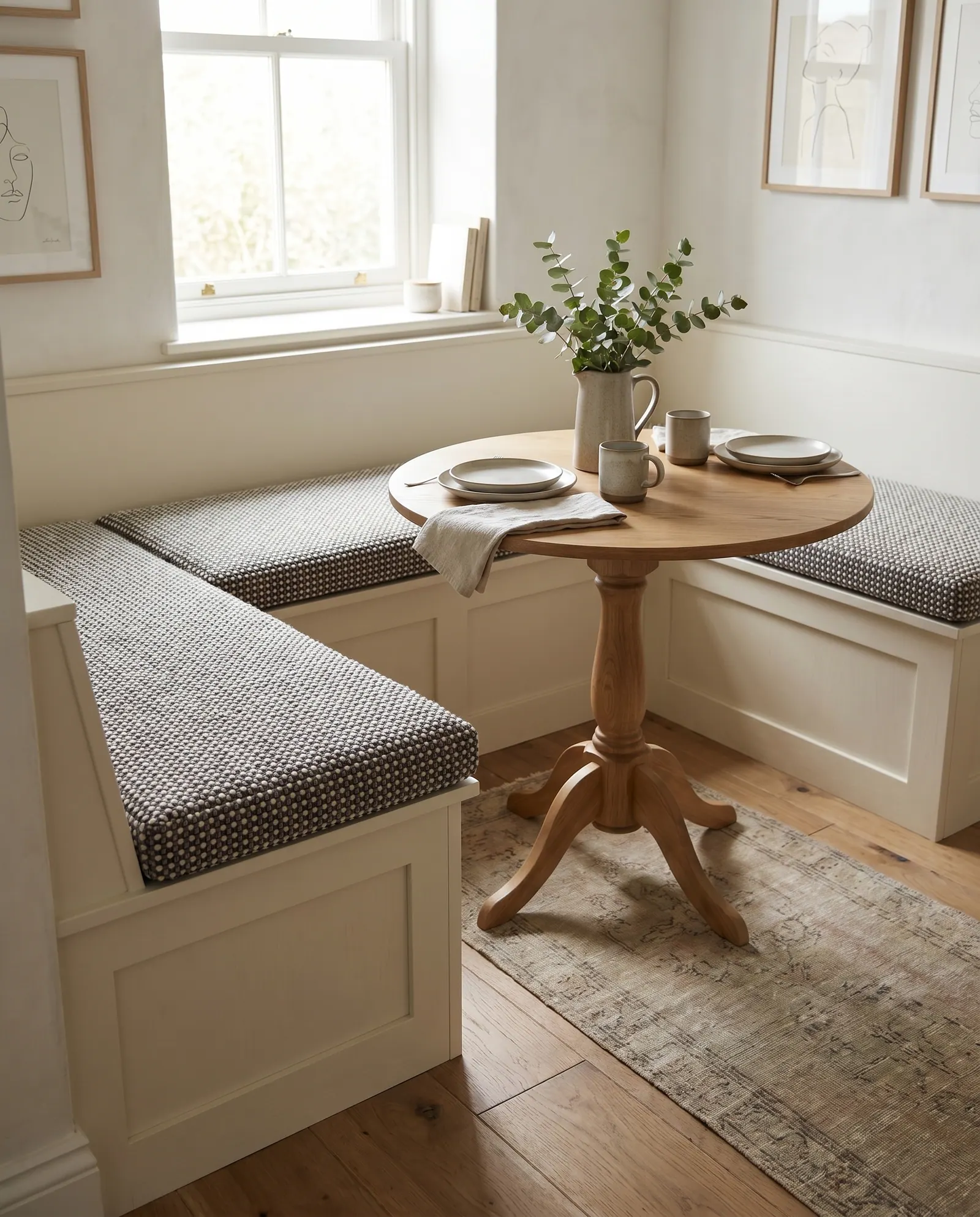
Philadelphia is a rowhouse city. Row houses are about 70 percent of the housing stock, and they run 14, 16 or 18 ft (4.3 to 5.5 m) wide. A 16 x 40 ft box with light only at the short ends makes long, narrow kitchens, and a bench along one wall is often the only way to seat four. The Mid-Atlantic page covers those banquettes in depth.
Pittsburgh sits on hills between rivers, at 710 to 1,300 ft, with nearly 800 sets of city-owned public steps. Houses climb the slopes, and front porches look down on the street. The Poconos add cabins, bunk rooms and lake porches.
So which is yours, partner: stone, brick or hillside?
Measuring a stone-wall window seat, square
Front edge, at the cushion line
Measure wall to wall across the front of the seat with a rigid tape, on the seat surface. Old plaster bows, so measure exactly where the cushion's front edge will sit.
Back edge, at the glass
Measure along the window. In a splayed stone reveal the back is often shorter than the front, which makes the cushion a trapezoid, not a rectangle.
Depth at both ends and the middle
Measure front to back at 90 degrees to the front edge, never along an angled side. Write down all three. If they differ by more than 1/4 in (6 mm), draw the difference in.
Let the geometry check you
Front, back and depth fix the angled sides. If a side you measured is more than about 1 in (2.5 cm) off the calculated one, re-measure before anything is cut.
Mark what overhangs
A casing, a stool lip or a radiator changes the shape. A notch along the back edge can clear a casing and still keep full depth at the ends.
Decide the front overhang
With firm, high-density foam a cushion can hang up to 2 in (5 cm) past the front edge. On a shallow sill that buys real seat depth; in a thick stone wall you rarely need it.
Fabric, foam and piping by Pennsylvania seat
| Seat | Fabric | Thickness | Piping and fastening |
|---|---|---|---|
| Stone-wall window seat in a deep reveal | Corduroy or velvet, warm to the hand beside cold stone | 3-4 in (7.5-10 cm) | Self or contrast piping; non-slip base on a painted sill |
| Rowhouse kitchen banquette | Soft performance fabric or velvet; covers wash at 86°F (30°C) | 2-3 in (5-7.5 cm), set by table height | Piping included; an L is made as separate pieces that meet at the corner |
| Bank-barn loft window seat | Linen-look or corduroy | 4 in (10 cm) | Very long runs split into equal pieces |
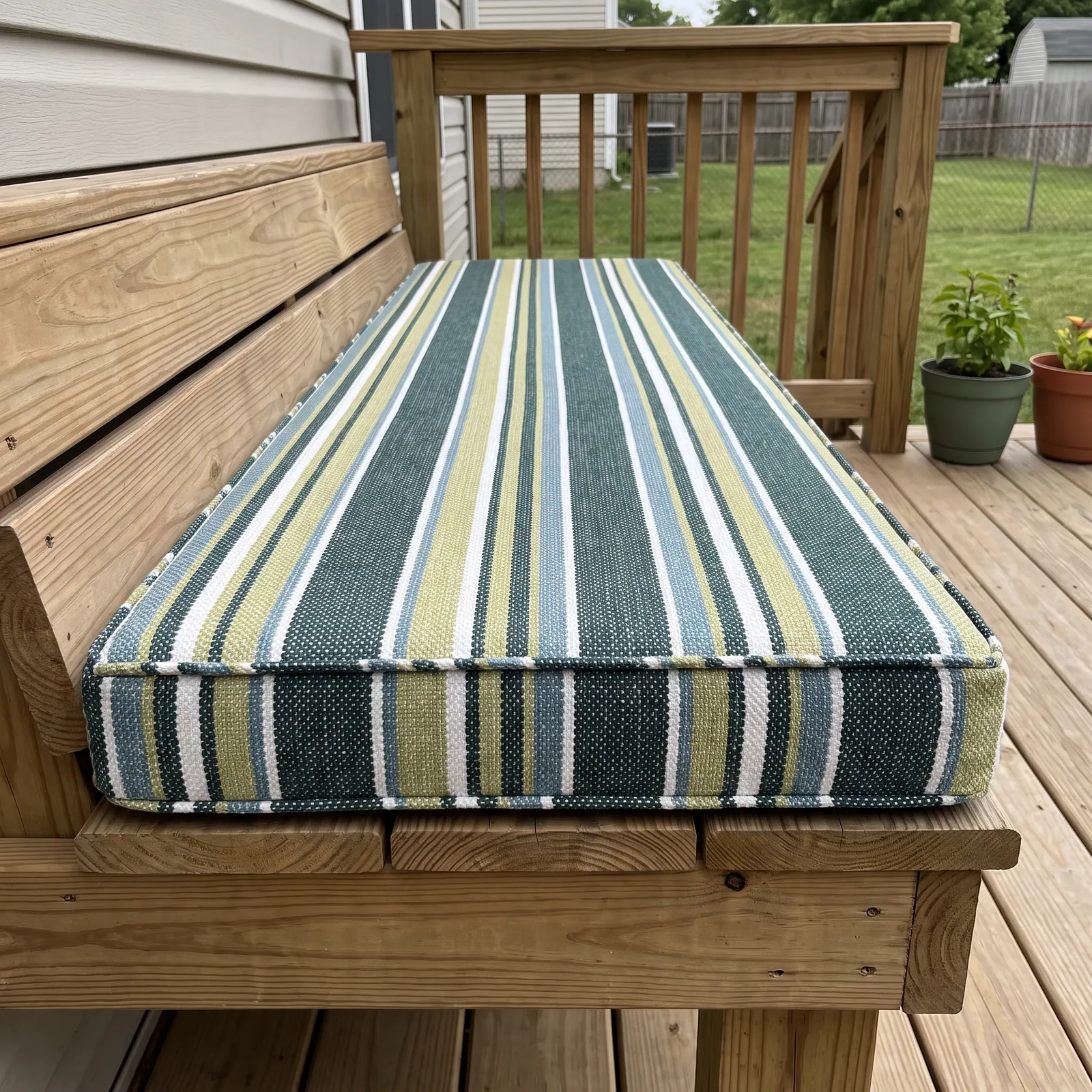
| Pittsburgh front porch bench | Outdoor fabric, water-repellent and UV-resistant | 3 in (7.5 cm) | Self piping, which reinforces the edges; ties on the back corners |
| Deck bench or chair set | Outdoor fabric | 2-4 in (5-10 cm); thinner stores smaller | Ties or a non-slip base |
| Poconos cabin bunk or daybed | Corduroy or soft fabric | 4-6 in (10-15 cm) | Zip-off covers for the end of every season |
A 154 5/16 in window seat, lettered to the sixteenth
A buyer in the US had a very wide angled window seat and two questions: could the cushion be one piece, and which fabric wipes clean? They sent a drawing with every edge lettered, measured to the sixteenth of an inch. I like this buyer.
- A and B, the short straight ends: 3 9/16 in each
- C, the front: 154 5/16 in (392 cm)
- D, the back: 108 in (274 cm)
- E and F, the angled sides: 25 12/16 in and 26 2/16 in
- G, the depth: 15 in (38 cm)
Run the numbers. Front minus back, halved, is 23 5/32 in across. Depth minus the straight ends is 11 7/16 in back. So each angled side should be about 25 13/16 in. The measured sides came in within 1/8 in and 5/16 in of that. A wall you can trust, and a wall that isn't quite symmetrical. Both facts belong on the drawing.
The workshop drew a visual template from the letters, confirmed the one-piece build, and priced it by the 15 in depth and the 154 5/16 in length. Velvet was the suggestion for wiping down. Price a trapezoid by its depth and longest edge, and upload the confirmed template with the order. The trapezoid calculator and how to measure a window seat do the same arithmetic.
Tolerance is kindness to your future self.
A Pennsylvania deck-and-porch year
- March: measure and order. Pennsylvania ranks sixth in the country for outdoor cushion searches, and demand across the North peaks in May.
- May through September: after a storm, stand deck cushions on edge and get them dry within 24 to 48 hours, the EPA's window for stopping mold.
- July: Philadelphia's noon UV averages about 8.6, very high on the EPA scale. Turn cushions and stow them when you're away.
- October: zip off covers, wash at 86°F (30°C) on gentle, air dry, and let the foam dry right through.
- Before the first freeze: store deck cushions clean and dry, off concrete, in something that breathes. Philadelphia averages 88 days at or below 32°F; Erie, with 104.3 in (265 cm) of snow, 118.
- All winter: if a cold window fogs above a window seat, wipe the sill and stand the cushion on edge until both are dry.
Photographs for homes like these
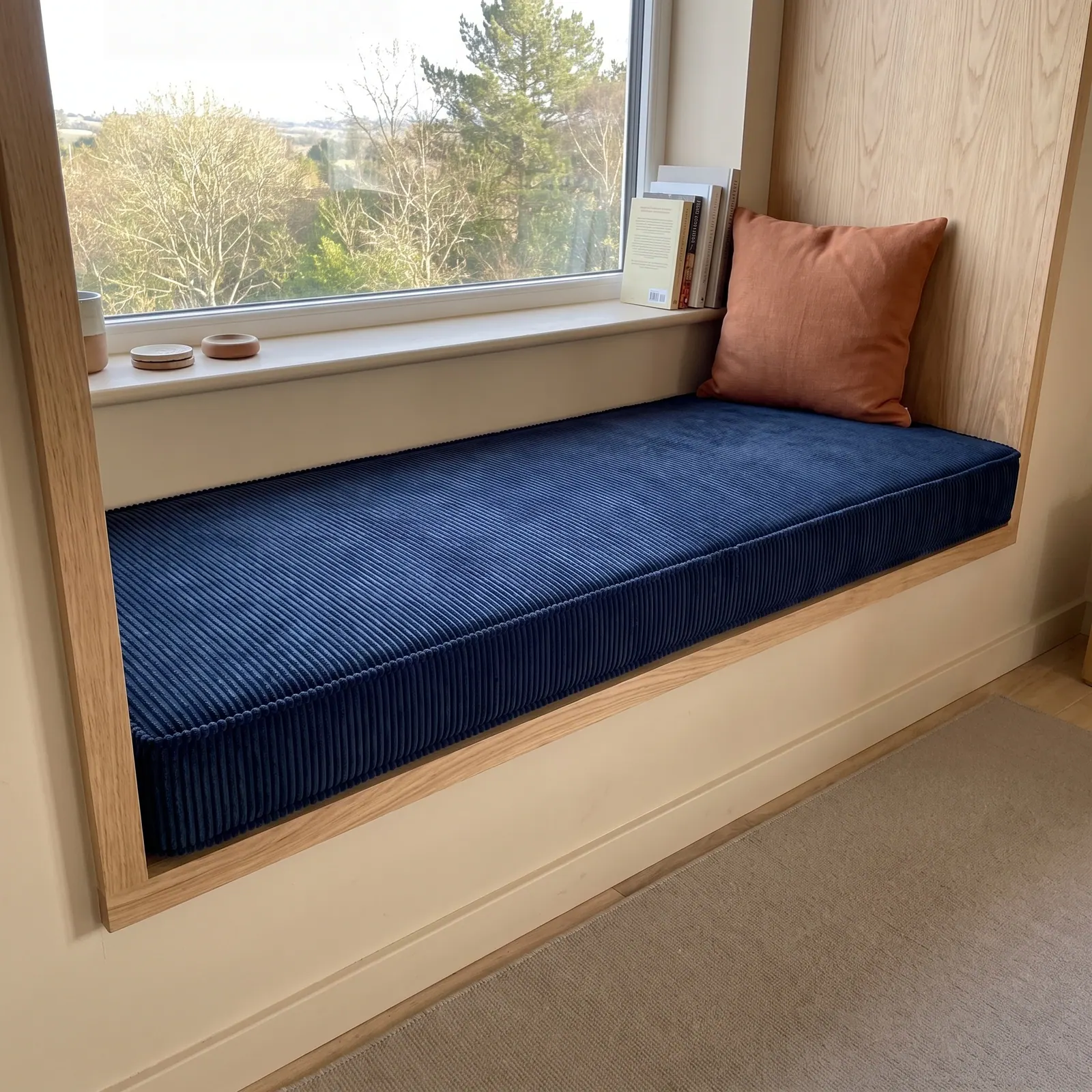
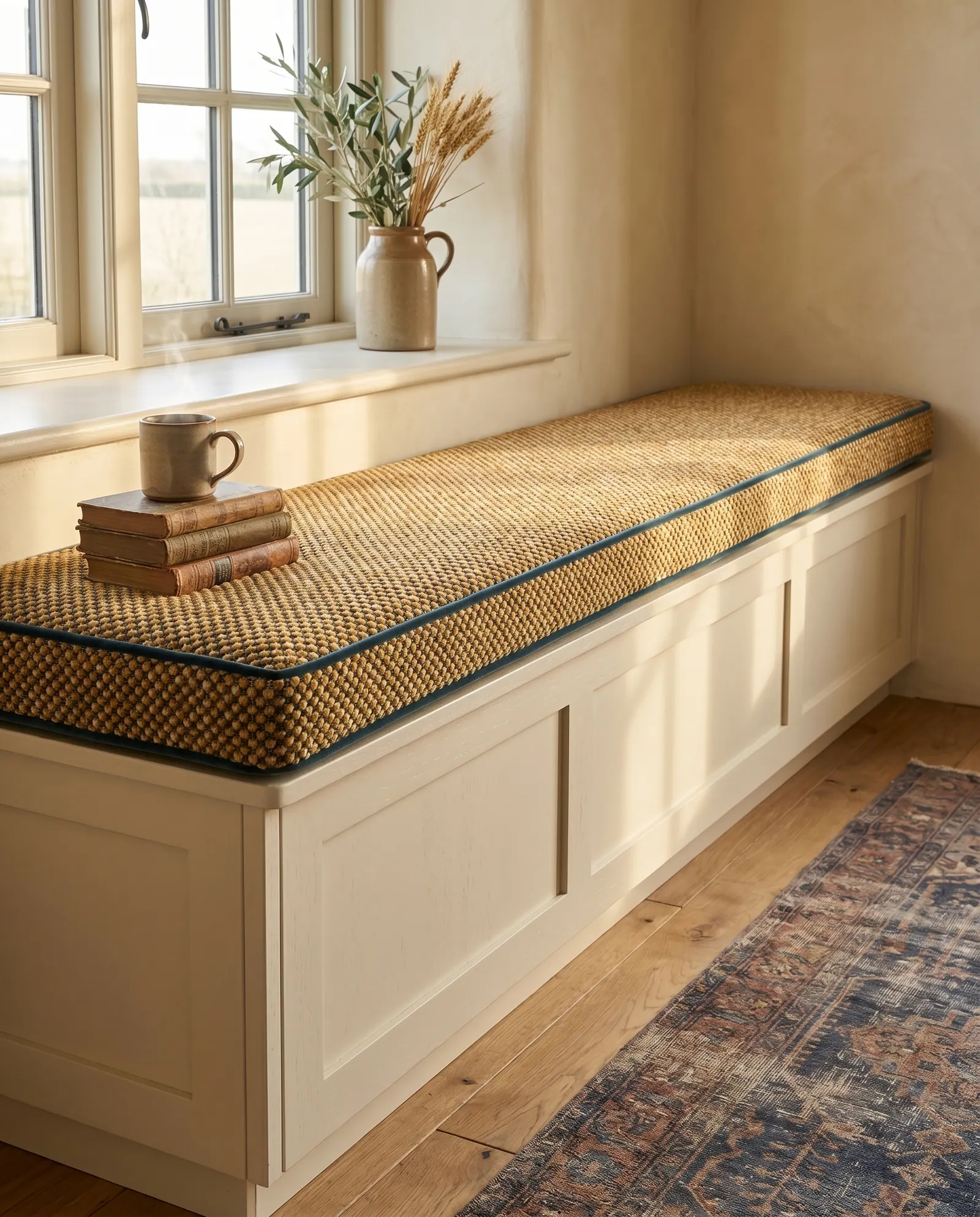
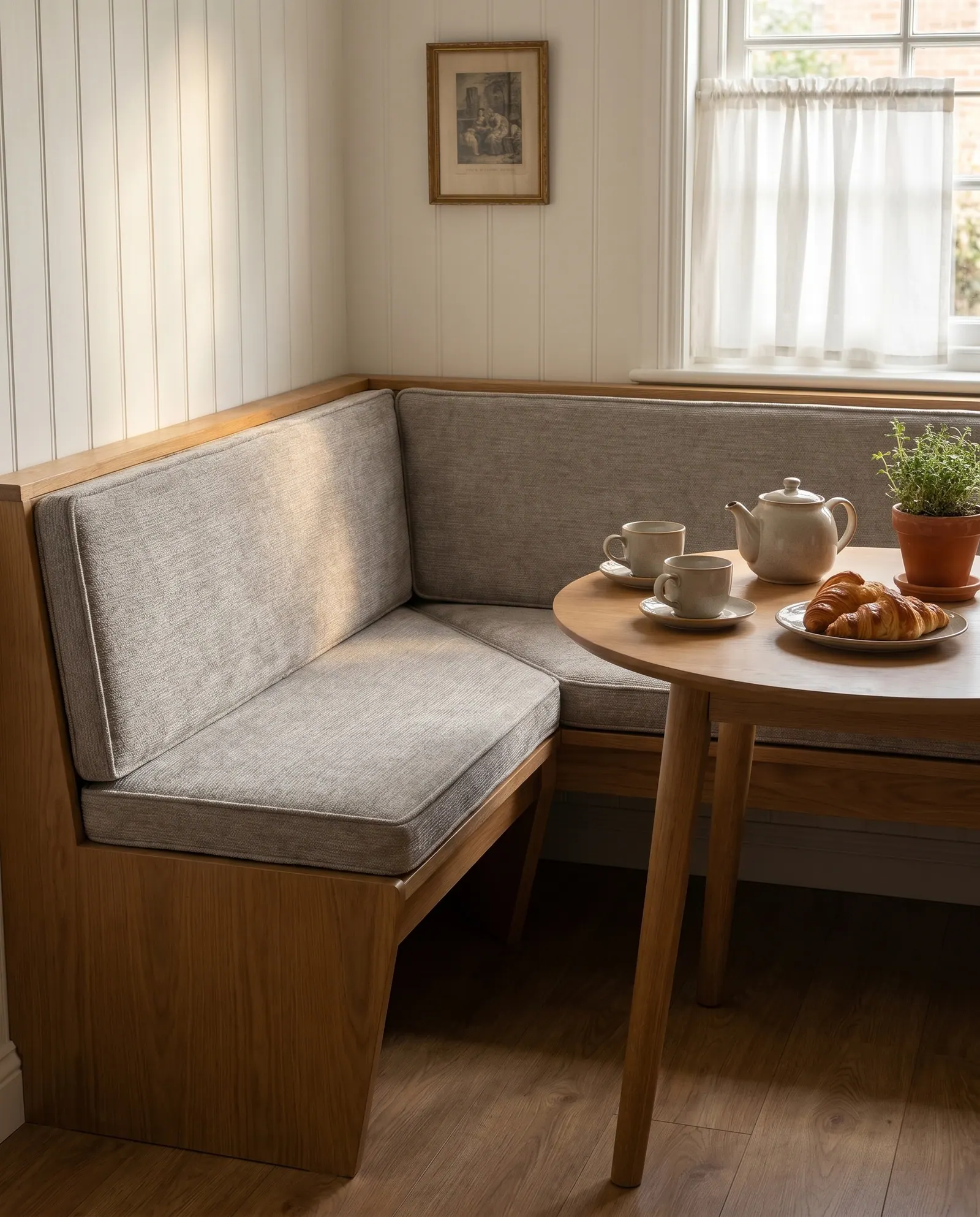
Open any photograph large; each one has its own link and a Save button.
 Save
 Save
 Save
 Save
 Save
A stone wall is never square, and it doesn't care what your drawing says. Measure the front, the back and both depths, then let the geometry settle the argument.
Nate
Buyer questions: reveals, slants and deck winters
- A common question
How should I measure a built-in window seat for a custom cushion?
The workshop's answerMeasure the front edge wall to wall in a straight line, then the back edge along the window, which is often shorter than the front. Then take the depth front to back, on both the left and the right if it varies, and each side edge separately if the side walls are angled. Use a rigid tape on the seat surface. Length is side to side; width is front to back. Send a top-view sketch with each number on its edge, plus a photo, and the workshop checks the shape.
- A common question
Do I need to measure the slanted sides of my bay window seat?
The workshop's answerNot really. The bottom length, top length, depth and any straight end pieces fix the slant, and the workshop calculates it to check your numbers. A 90 in bottom, 52 in top, 27 in depth and 6 in straight ends put each slant 19 in across and 21 in up, about 28 in (71 cm) long, so a measured 24 in slant means another number is wrong. A slant measured along an old cushion usually reads 1 to 1.3 in long, because the tape follows the curve.
- A common question
My banquette cushions meet at a 45-degree angle in the corner. Can I just add a note?
The workshop's answerNo. Once they're cut on the diagonal they're trapezoids, which changes the listing and raises the price slightly. Order through the trapezoid listing, pick the size range by each cushion's longest and deepest measurements, and upload a drawing with every edge measured, the 45-degree cut included.
- A common question
Our summers are hot and our winters are snowy. Do you offer quick-dry foam or a mesh bottom for deck cushions?
The workshop's answerNot as standard. The outdoor fabric is UV-resistant and water-repellent, but the foam isn't a quick-dry outdoor foam, and a mesh base isn't standard, though one has been built on request for some projects, so ask. The cushions work very well on a covered porch or when they're stored over winter. They aren't the right product to leave uncovered in rain and snow.
- A common question
Can you make outdoor deck cushions with ties and no piping?
The workshop's answerYes, from the water-resistant outdoor fabric range. One set was a 48 x 24 x 5 in seat and a 48 x 18 x 3 in back, no piping, with ties at the two corners of the long sides. Floor cushions for the yard can use the same outdoor fabrics.

Have it made
Have it made for your home — ask Nate’s workshop
Send the numbers in inches: length × depth × thickness, plus any angle. The workshop checks them with you, because foam has no undo button. — Nate
Leave your details and the workshop will call you to confirm measurements, fabric, foam and piping. No prices, dates or payment on this page: it is a request, not an order.
Pennsylvania window seat and deck cushion questions
Why are window seats in old Pennsylvania stone houses so hard to measure?
Pennsylvania German farmhouses built between about 1700 and 1870 have thick walls and small, irregularly spaced windows, so every reveal is deep and no two match. The reveal may also splay, leaving the back edge shorter than the front. Measure the front, the back and the depth at both ends of each seat separately.
Do Pennsylvania homes usually have decks or patios?
Decks, on newer homes. In the Middle Atlantic division, 34 percent of homes started in 2024 had a deck, while only 23 percent of 2025 starts had a patio. For deck cushions, use outdoor fabric with ties or a non-slip base, and plan dry indoor storage from the first freeze.
What thickness works for a narrow rowhouse kitchen banquette?
Usually 2 to 3 in (5 to 7.5 cm). Over a hard plywood bench, 3 in of firm foam is enough for everyday meals, and next to a table a thinner cushion keeps the seat at a comfortable height. Measure the table and bench first, then choose the foam.
Do cushions in Erie or Pittsburgh need extra care?
Mostly in winter. Erie averages 104.3 in of snow and 118 freeze days; Pittsburgh averages 44.1 in of snow and about 203 cloudy days a year. Bring outdoor cushions in before the first freeze, store them dry and breathable, and choose warm indoor colors that hold up in gray light.
± 1/4 in — Nate
The atelier
Keep going
Across the Map
Nearby places
Close by on the map