Across the Map · Mid-Atlantic · United States
Custom cushions for Virginia colonials, porches and Tidewater homes
Virginia builds its window seats into walls a foot thick, its kitchens a rowhouse wide, and then sends everyone out to the porch for July. Right, then. Three seats, three sets of rules.
- Sun & UVStrong
- HumidityHumid
- WinterMild
- CoastSalt air nearby
- Typical seatsDeep colonial window seat, rowhouse kitchen banquette, l-shaped breakfast nook

 Save
The quick answer
Custom cushions for Virginia homes come down to three seats: the colonial window seat, the rowhouse banquette and the Tidewater porch. Window seats in old brick walls 12 to 18 in thick need every edge and piece of trim measured. Banquettes want firm 2 to 3 in cushions in a washable weave. Porch cushions need water-repellent outdoor fabric and a dry spot after summer storms.
Salt in Norfolk, heat in Richmond, frost on the Blue Ridge
Virginia is three climates laid side by side, and a cushion notices every one.
In Tidewater, Norfolk averages 49.18 in (125 cm) of rain over 117 wet days and 34 days at 90°F (32°C) or above. July and August are its wettest months, about 6 in (15 cm) each, right in porch season. Salt spray is heaviest in the first 300 to 3,000 ft (90 to 900 m) from the waves, and faster corrosion has been measured 5 to 10 miles inland, so porch zippers earn a freshwater rinse.
Richmond runs hotter: 44 days at 90°F or above, with August and September mornings at 87 to 88% humidity. Roanoke, on the Blue Ridge side, gets 84 freezing nights and about 15 in (38 cm) of snow. Northern Virginia sits close to DC: 36 hot days, 67 freezing nights.
So damp, not sun, is the everyday enemy. The EPA gives a wet material 24 to 48 hours to dry before mold is likely.
Walls a foot thick, and the window seat inside them
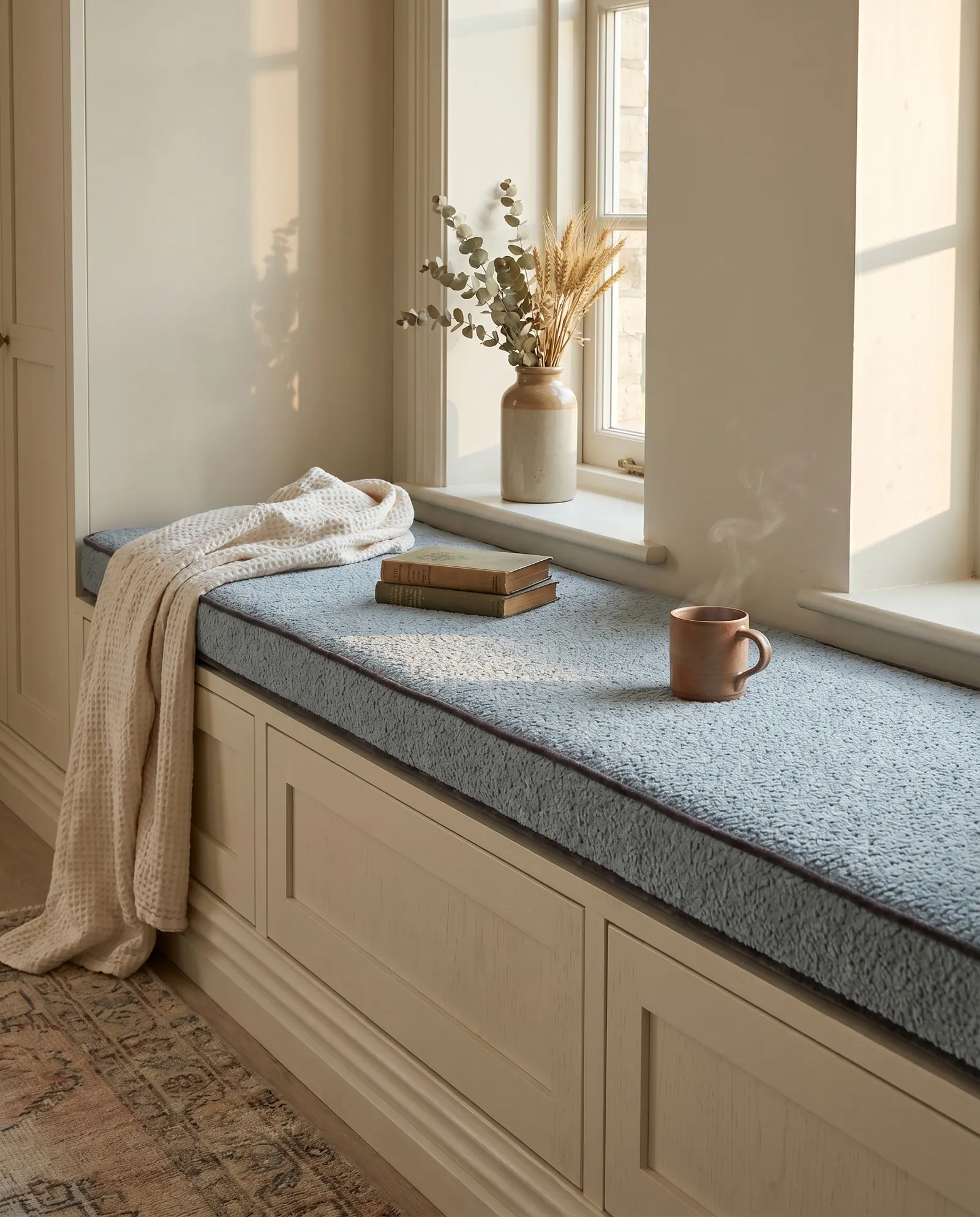
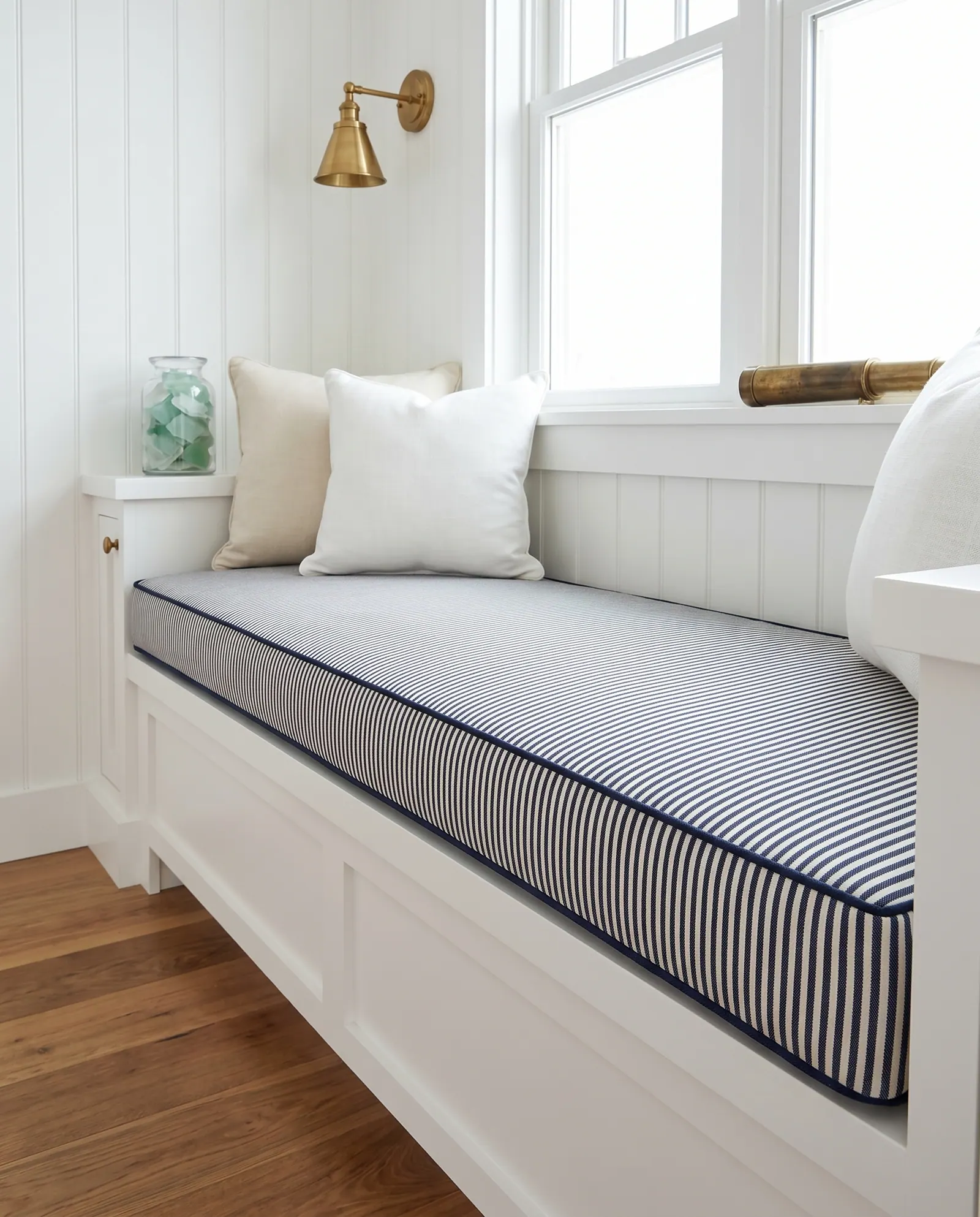
Colonial brick houses were built with solid masonry walls, commonly 12 to 18 in (30 to 46 cm) thick. Where a window cut through, it left a deep opening called an embrasure, often splayed wider toward the room, with interior shutters tucked into the wall's depth. Sew for one and you are fitting a box with three walls and trim on every edge.
So I measure the reveal, not the sill board: front edge wall to wall, back edge against the glass, the depth at both ends, and every bit of casing that pokes in. A splayed reveal makes the cushion a trapezoid. Where trim overhangs the seat, a notched back edge lets the cushion sit flat; the notch pattern draws it with three numbers per notch.
Alexandria keeps its own oddity. Old Town was laid out in 1749, and its flounder houses have a single-slope roof with the tallest wall left blank: no windows, no doors. The town may have had about 1,500 of them in the 19th century and perhaps 75 by 1960. With so few windows, each one matters. Start with window seat cushions and the measuring pattern.
A Fan District kitchen, a Virginia Beach porch
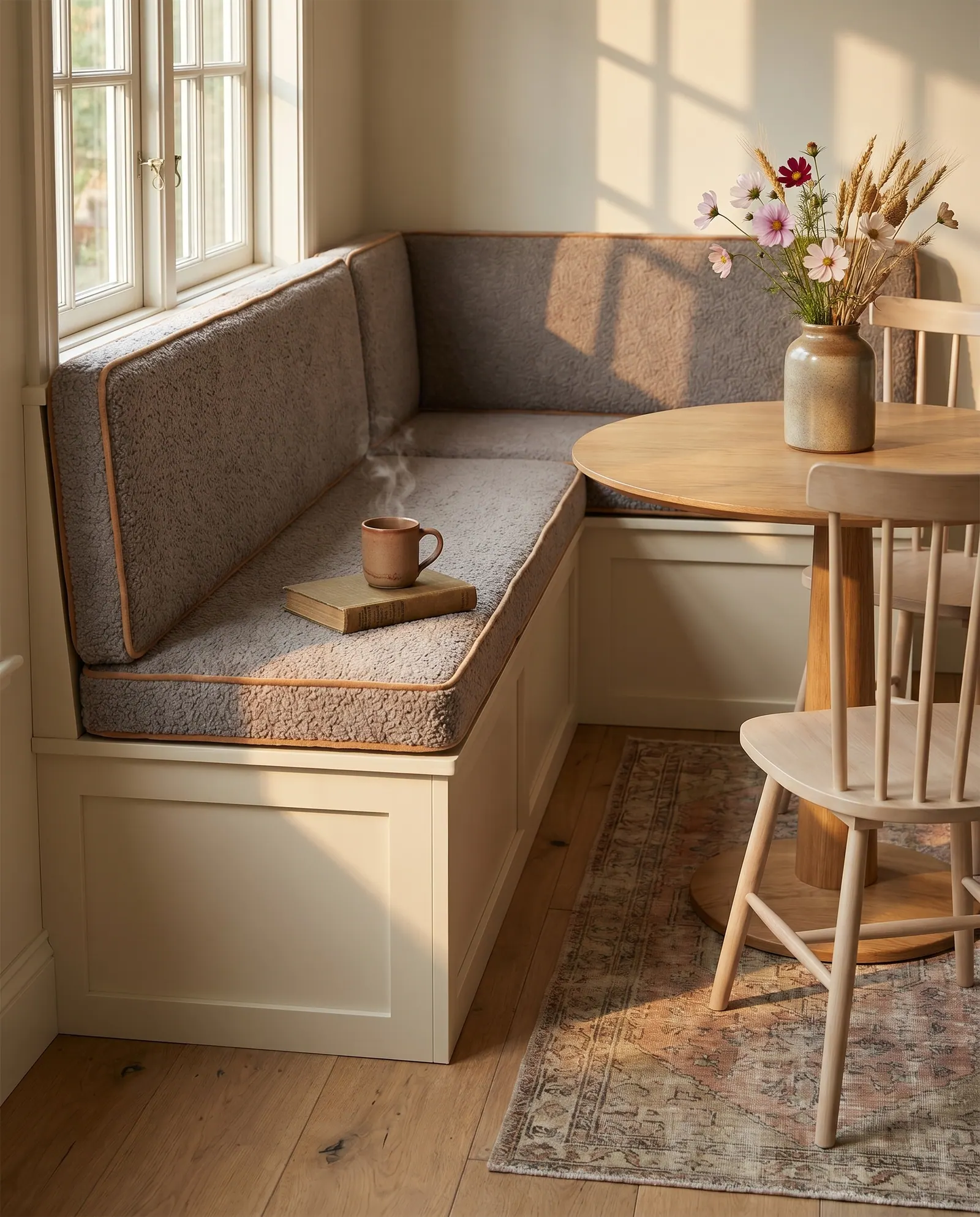
Richmond's Fan District filled in from the Civil War to about 1920, 228 acres of Italianate, Queen Anne and Colonial Revival houses, known for one of the longest intact stretches of Victorian architecture in the country. Rowhouse kitchens run long and narrow, so the table goes against the wall and the wall gets a banquette. Start with the table, not the bench: the cushion top should sit 10 to 12 in (25 to 30 cm) below the tabletop, usually on 2 to 3 in (5 to 7.5 cm) of firm foam. The table-height pattern has the chart.
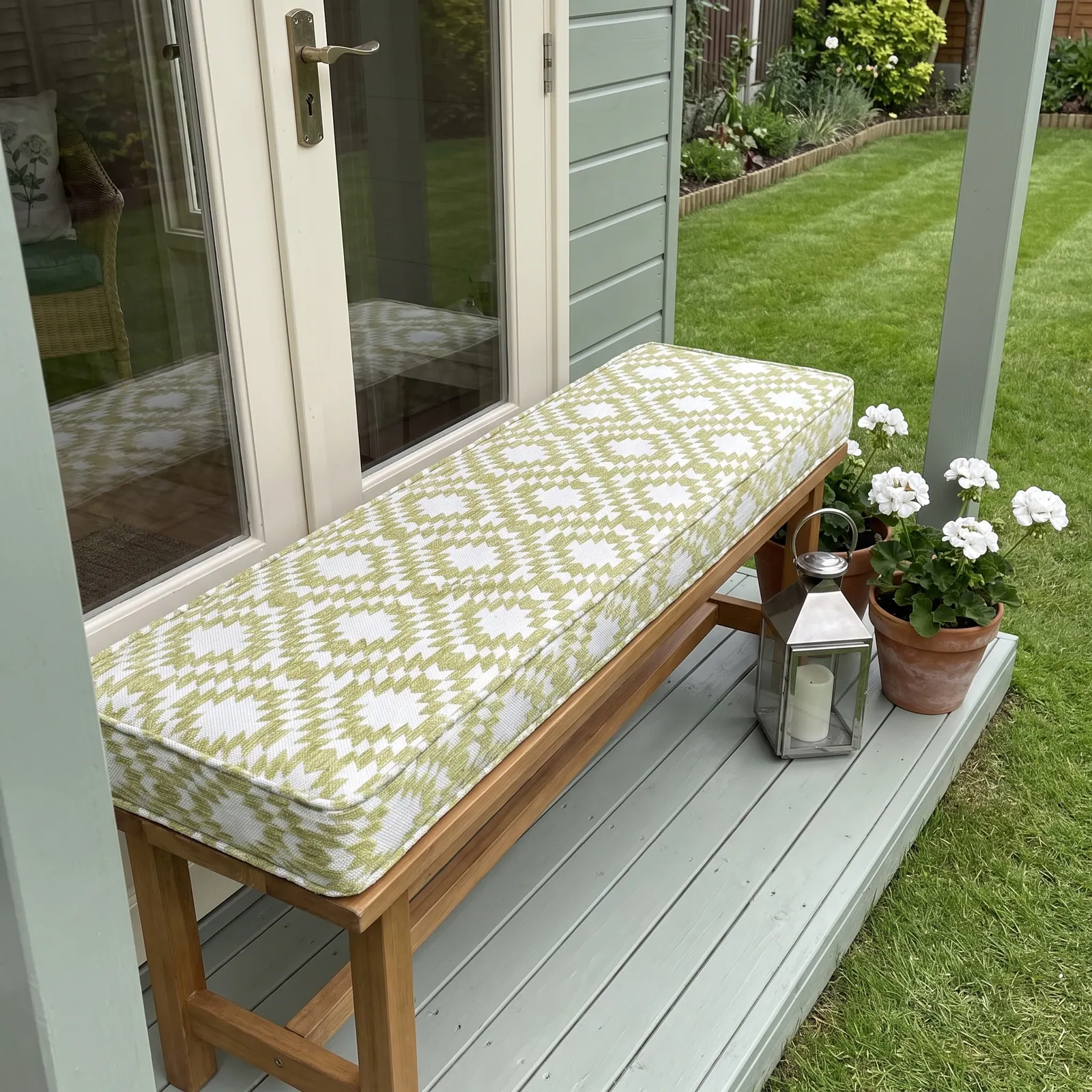
The porch is Virginia's other room. In the South Atlantic census division, which includes Virginia, 74% of new homes started in 2024 had one. At the beach, the 37th Street cottages, Craftsman houses built between 1913 and 1928, are a rare survivor of the single-family cottages that once defined the Virginia Beach resort. On porches like theirs, and on Shenandoah farmhouse porches, I sew in water-repellent outdoor fabric even under a roof.
A word on color, dear. Red brick, white trim and heart pine already say plenty, so let one quiet stripe or a solid with a single straight welt answer them: ticking indoors, an outdoor stripe on the porch. The wider region lives on our Mid-Atlantic and Maryland pages.
The Virginia cutting list: reveal, nook and porch
| Seat | Fabric | Thickness | Piping and fastening |
|---|---|---|---|
| Colonial window seat in a deep reveal | Linen-look, velvet or ticking; indoor only | 3 in (7.5 cm) for a neat line under the sash; 4 in (10 cm) for lounging | Self piping or one contrast welt; notched around casings |
| Fan District or Old Town kitchen banquette | Tight, washable weave: linen-look or soft performance fabric | 2 to 3 in (5 to 7.5 cm), 10 to 12 in (25 to 30 cm) below the tabletop | L corners as two pieces meeting flush; zipper on the back edge |
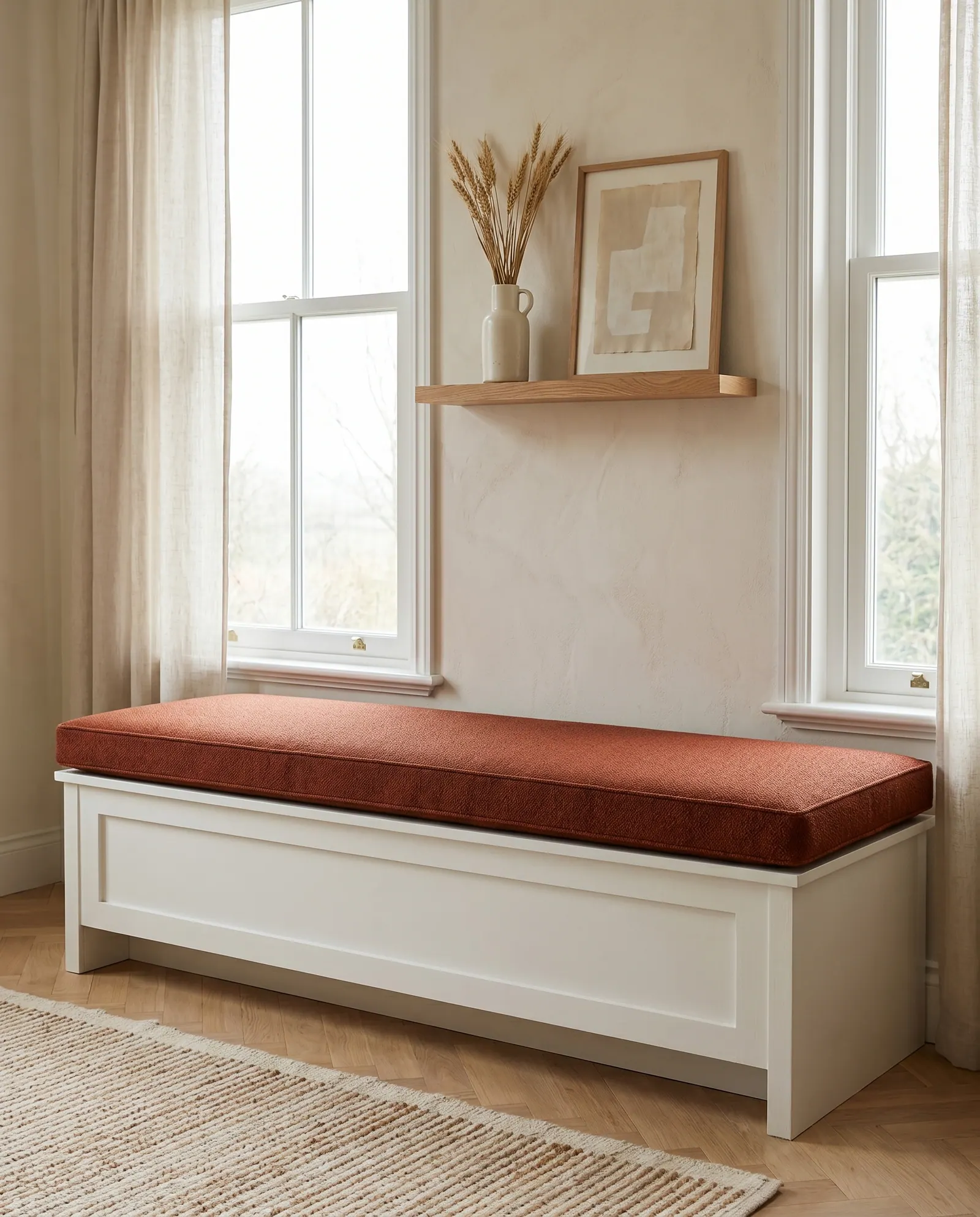
| Tidewater or beach cottage porch bench | Water-repellent, UV-resistant outdoor fabric | 3 to 4 in (7.5 to 10 cm) | Self piping; ties at the back corners, requested in writing |
| Blue Ridge farmhouse porch swing | Outdoor fabric in a mid-tone stripe | 3 to 4 in (7.5 to 10 cm), seat measured inside the arms | Back as its own piece; ties at the rail |
Covers zip off and wash at 86°F (30°C) on a gentle cycle; air dry. Seat foam is high-density, about 2.0 lb/ft³ (32 kg/m³), and not quick-dry, so porch cushions come in before a storm.
An L-shaped nook, a sill that bit, and two slim backs
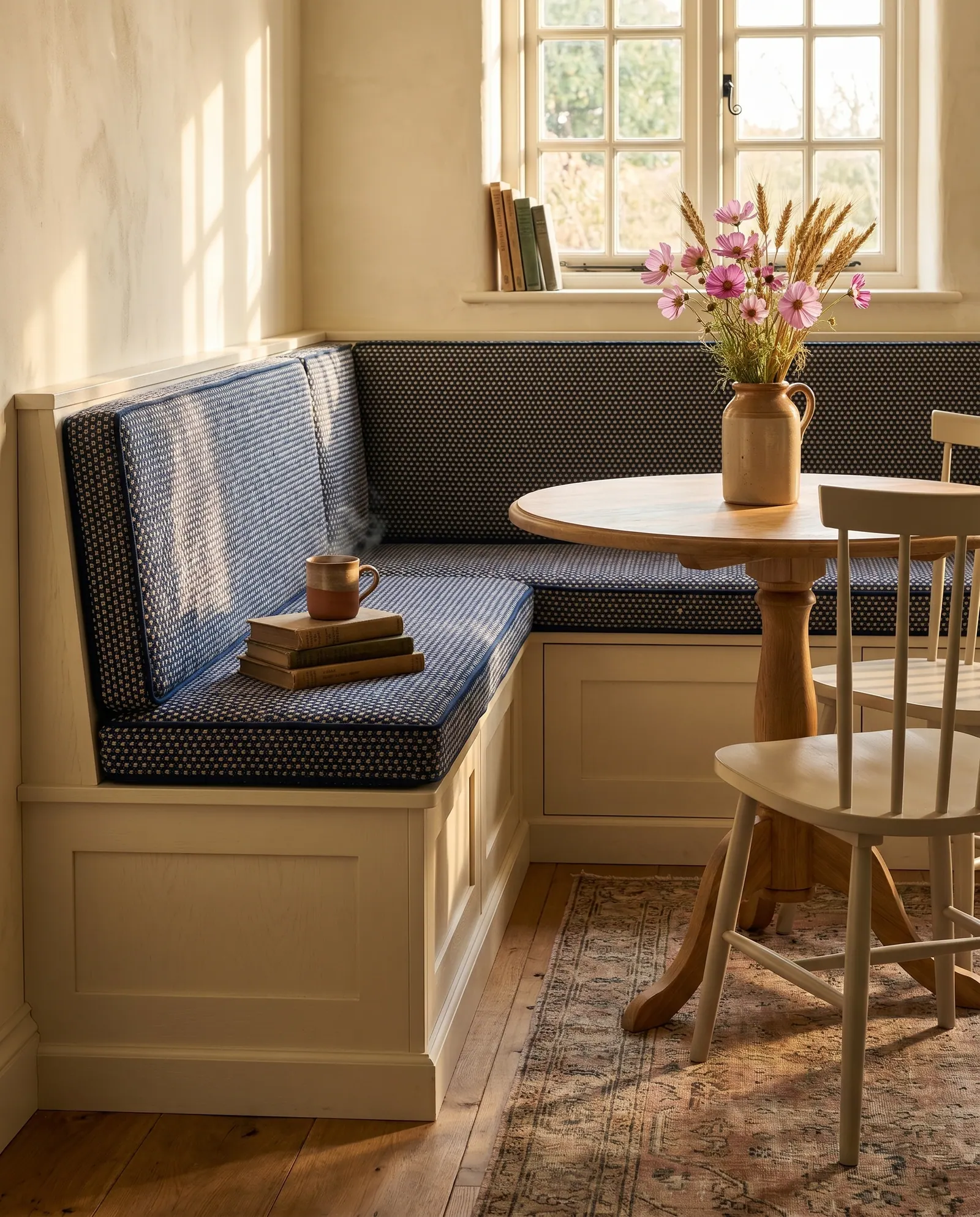
A buyer in the US had an L-shaped window nook: one run 82 x 18 in (208 x 46 cm), the short leg 29.25 x 18 in (74 x 46 cm), both 3 in (7.5 cm) thick in velvet with piping in a second, deeper velvet.
Then the old-house trouble: the sill stuck out about an inch over the seat, exactly where a spine wants to rest. Instead of fat back cushions, they ordered two slim ones, 82 x 5.75 in and 45 x 5.75 in (208 x 15 cm and 114 x 15 cm), only 2 in (5 cm) thick, in the piping color.
The slim backs bring the sitter forward just past the sill. Honest geometry, and the welt still runs straight down both runs.
- Measured
- Seats 82 x 18 in and 29.25 x 18 in, 3 in thick; backs 82 x 5.75 in and 45 x 5.75 in, 2 in thick (208 x 46, 74 x 46, 208 x 15 and 114 x 15 cm)
- What it taught
- When a sill overhangs the seat, a slim back cushion brings the sitter forward past it. Measure how far the sill sticks out before choosing back thickness.
Photographs for homes like these
Open any photograph large; each one has its own link and a Save button.
 Save
 Save
 Save
 Save
 Save
The Virginia cushion calendar
- March: measure window reveals and porch benches while the house is quiet, trim and all.
- April: porch and swing cushions go out; knot every tie before the first thunderstorm.
- July and August, Norfolk's wettest months: stand soaked porch cushions on edge under the roof and dry them within 24 to 48 hours.
- Before the first hard freeze: porch cushions come indoors, clean, dry right through, off concrete and never sealed in plastic.
In a colonial house the window seat is a box with three walls. Measure the reveal, every piece of trim and the depth at both ends before anyone cuts foam.
Maggie
Buyer questions: piping, corners and trim
- A common question
Does the piping go around the top and the bottom of the cushion?
The workshop's answerYes. The piping runs all the way around both the top and the bottom edges, and both faces are the same fabric, so the cushion can be flipped.
- A common question
Can the piping be a different kind of fabric from the cushion, like a soft performance body with linen-look trim?
The workshop's answerYes. Fabric types and colors can be mixed; one bench had an ice-blue soft-fabric body with tan linen-look piping. Write both choices in the note to seller, the cushion fabric first and then the piping.
- A common question
For an L-shaped kitchen bench, should I get one L-shaped cushion or two separate ones?
The workshop's answerThe workshop recommends two separate seat cushions. A one-piece L makes the cover hard to take off, put back and keep snug, while separate pieces are easier to handle, wash and keep neat.
- A common question
Which of your fabrics count as performance fabrics for a kitchen banquette?
The workshop's answerFor an indoor banquette the workshop suggests its linen-look range, which is hard-wearing and suits a kitchen. For something tougher still, the outdoor fabrics work indoors too. Every cover zips off and machine washes at 86°F (30°C) on a gentle cycle.
- A common question
My seat is uneven and there's trim in the way. Which width do I give you?
The workshop's answerDraw a rough sketch with every measurement and mention any trim or wood that sticks out, because it throws the numbers off. Production waits until the shape is confirmed; sometimes a small gap is the simplest fix.

Have it made
Have it made for your home — ask Maggie’s workshop
Have the tape measure handy when they call. Old cushions shrink and sag; the seat underneath does not. — Maggie
Leave your details and the workshop will call you to confirm measurements, fabric, foam and piping. No prices, dates or payment on this page: it is a request, not an order.
Virginia cushion questions
Why are window seats in old Virginia brick houses so deep?
Colonial masonry walls were commonly 12 to 18 in (30 to 46 cm) thick, so a window set into them leaves a deep opening, the embrasure. Many were splayed wider toward the room, which turns the cushion into a trapezoid. Measure all four edges and the depth at both ends.
Can Tidewater porch cushions stay out all summer?
On a covered porch, in water-repellent outdoor fabric, yes. But July and August bring Norfolk about 6 in (15 cm) of rain each, and standard seat foam is not quick-dry. Stand soaked cushions on edge and bring them in ahead of storms.
When should porch cushions come in for a Virginia winter?
Before the first hard freeze. Richmond averages 81 nights a year at or below 32°F (0°C), Roanoke 84 and Norfolk 48. Water left in foam freezes and thaws, so store cushions indoors, clean and dry right through, off concrete and never sealed in plastic.
How thick should a Richmond rowhouse banquette cushion be?
Usually 2 to 3 in (5 to 7.5 cm) of firm foam, so the cushion top lands 10 to 12 in (25 to 30 cm) below the tabletop. Back cushions take about 3 in of seat depth; check the bench is deep enough first.
Stitch straight — Maggie
The atelier
Keep going
Across the Map
Nearby places
Close by on the map