Across the Map · Carolinas & Georgia · United States
Custom cushions for North Carolina porches, from the Outer Banks to the Blue Ridge
A rocker on an Outer Banks porch and a rocker outside an Asheville cabin sit in one state and two different weathers. I learned to close a seam by hand as a boy in High Point, and I learned early that a porch cushion has to be built for the porch it lives on.
- Sun & UVStrong
- HumidityHumid
- WinterMild
- CoastSalt air nearby
- Typical seatsPorch rocker, porch swing, lean-out porch bench

 Save
The quick answer
Custom cushions in North Carolina should be built for the region: water-repellent, UV-resistant outdoor fabric with ties on Outer Banks and Piedmont porches, zippered covers you wash once the late-March pine pollen stops, and velvet or corduroy indoors for Blue Ridge winters. The foam is not quick-dry, so porch cushions come inside before hurricanes, hard rain and the first hard freeze.
Salt, pollen and frost: one state, three weathers
Start at the coast. Cape Hatteras averages about 61 in (155 cm) of rain a year and Wilmington about 60 in (153 cm), with September the wettest month at 8.69 in. Morning humidity at Hatteras averages 81%. Between 1851 and 2004, hurricanes struck North Carolina 46 times, and the season runs June 1 to November 30.
Salt adds its own wear. Federal coastal-building guidance, as summarized in the trade press, says salt spray is heaviest near the breaking waves and falls off sharply in the first 300 to 3,000 ft (90 to 900 m), though faster corrosion has been measured five to 10 miles inland. Cloth shrugs that off better than metal does. Zippers feel it first.
The Piedmont is sun and pollen. Raleigh sees about 45 days a year at 90°F (32°C) or more, and the July noon UV index averages 9.3, which the EPA calls very high. Pine pollen peaks from late March into early April, and on April 1, 2024, the state's pollen monitor in Raleigh counted 16,284 tree pollen grains, a record.
Then the mountains. Asheville averages 95 nights at or below 32°F (0°C), about 10 in (26 cm) of snow, and morning humidity near 87%. No wonder outdoor cushions in North Carolina are a serious subject: Google Trends ranks the state fifth in the country for outdoor-cushion searches, with the peak in May.
Pilings, bungalow porches and cabin rockers
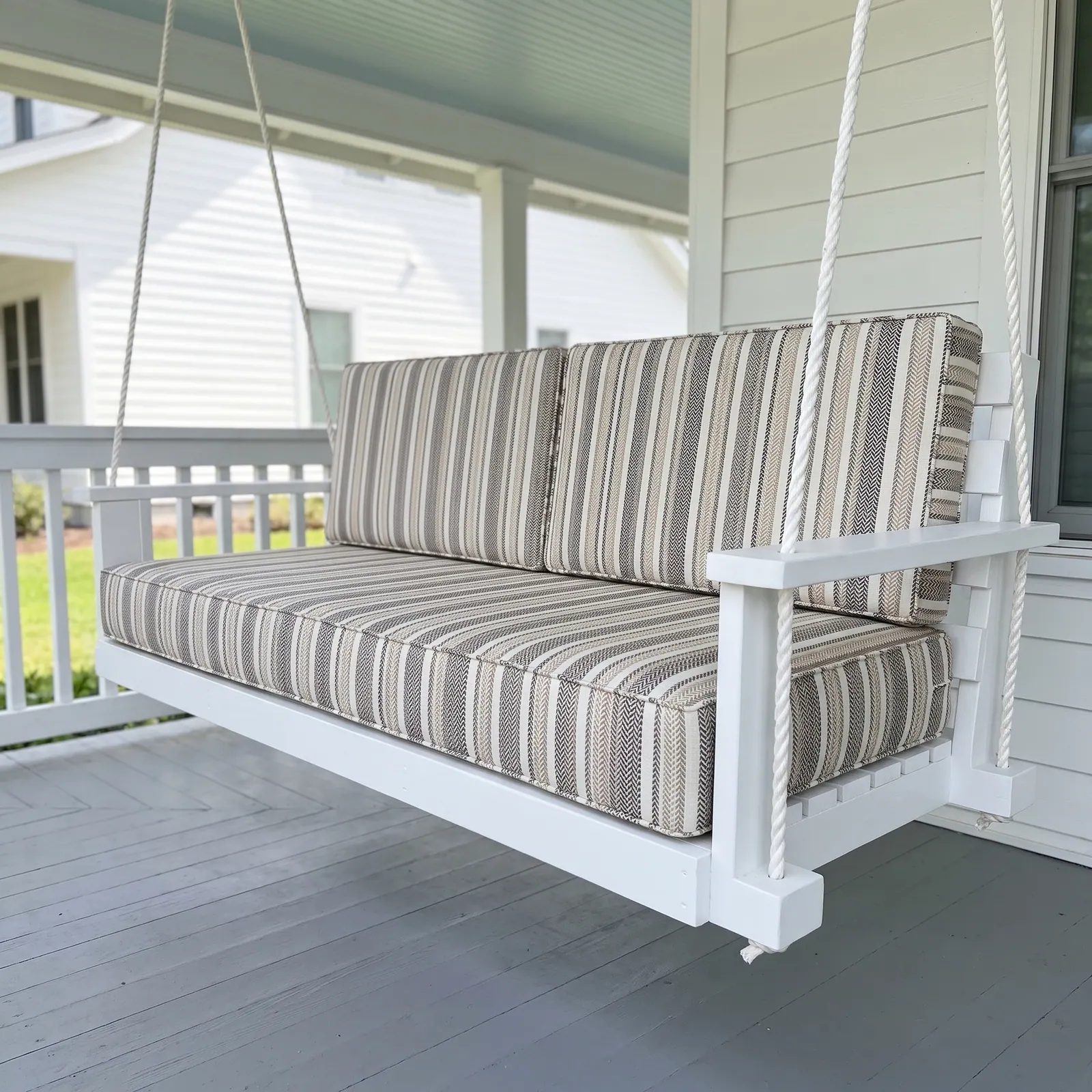
On the Outer Banks, the old Nags Head cottages, the ones called the Unpainted Aristocracy, stood on pilings so they could be moved back from the surf. They had wide porches on two and sometimes four sides, with lean-out seating rather than straight-up benches. A lean-out bench wants two cushions, my friend, not one: a flat seat pad and a back pad, each measured on its own and tied where it meets the wood. That is the heart of good Outer Banks beach house cushions.
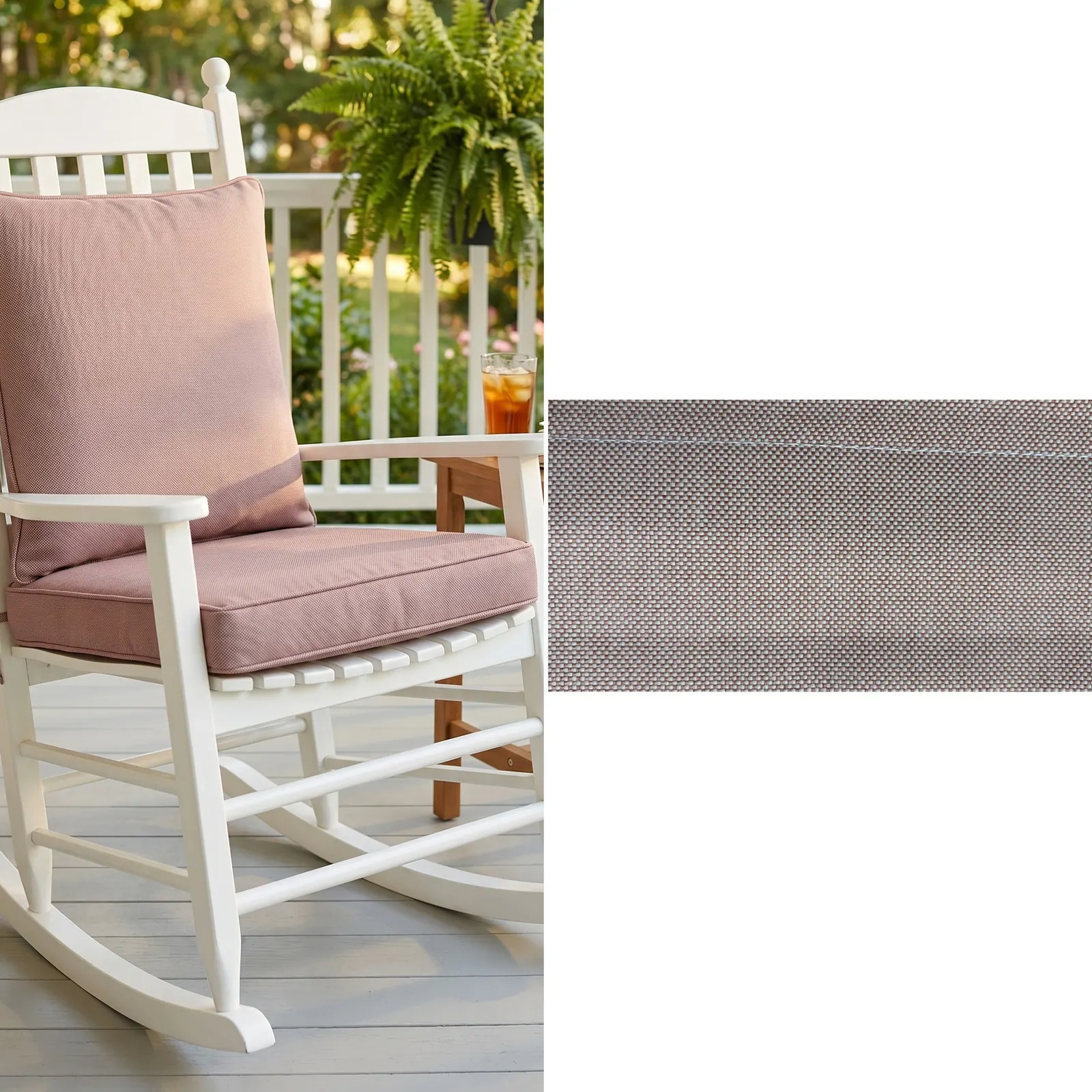
In the Piedmont, the porch moved to the front of the house. Charlotte's Dilworth, platted in 1891 as the city's first streetcar suburb, filled with bungalows in the 1910s, big porches and all, and the new farmhouses around Raleigh and Charlotte have brought the deep porch back. Those porches carry rocking chair cushions and porch swing cushions. A rocker seat is rarely square, so trace it with the rocking chair template before you trust a tape. What does your rocker measure at its widest?
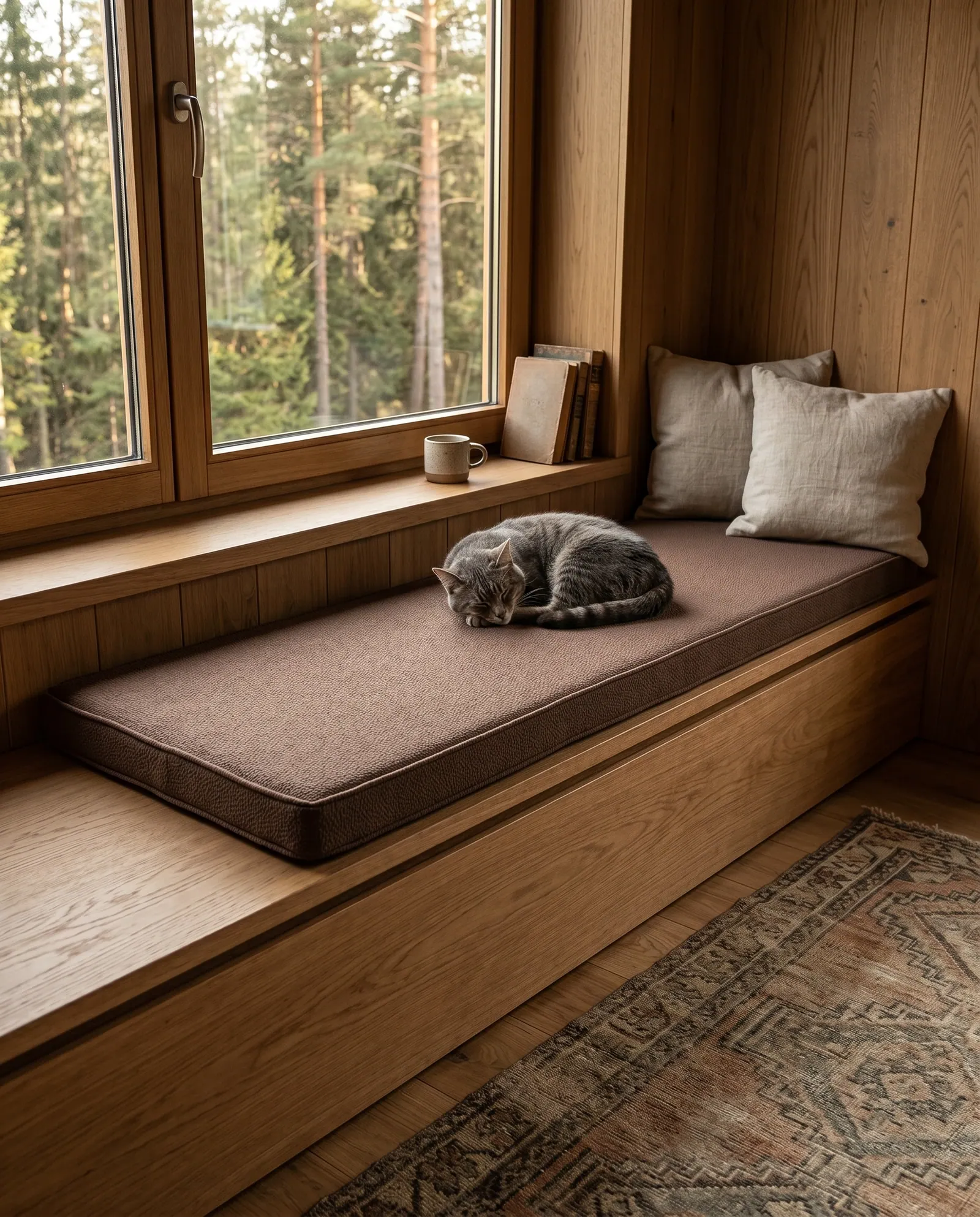
Up in the Blue Ridge, the rockers stay outside and the window seats and benches gather by the stove. Asheville cabin cushions are where velvet and corduroy earn their keep. The wider Southern porch story continues in the Carolinas and Georgia guide, and the mountain porches next door are in Tennessee and Kentucky.
What to sew for each North Carolina seat
Outdoor here means a water-repellent, UV-resistant woven fabric that feels like cloth, not a tarp. The foam is standard 32 kg/m³ seat foam, about 2.0 lb/ft³, and it is not quick-dry, so a roof overhead still does half the work.
| Seat | Fabric | Build | Why |
|---|---|---|---|
| Outer Banks deck or lean-out porch bench | Outdoor fabric, light or mid-tone | 3 to 4 in (7.5 to 10 cm), self piping, ties at the back corners; long runs split in two | Wind off the water, and storm carry-ins one person can manage |
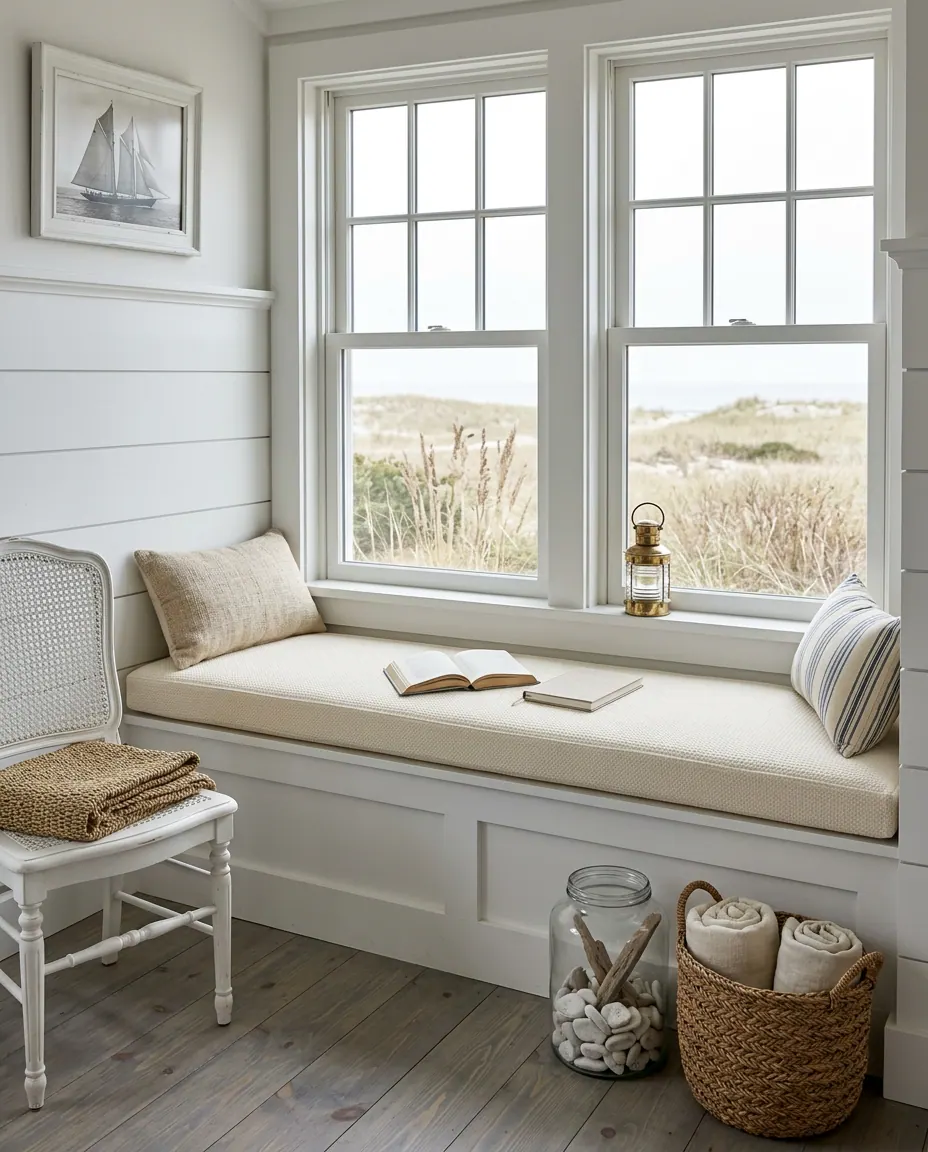
| Beach-house window seat facing the dunes | Outdoor fabric, used indoors | 4 in (10 cm) box cushion, zippered cover | Wet swimsuits and sand; outdoor cloth shrugs off damp |
| Piedmont porch rocker | Outdoor fabric | 2 to 3 in (5 to 7.5 cm), cut from a traced paper template, ties at the back | Porch rocker cushions follow a curved, tapered seat a tape alone misses |
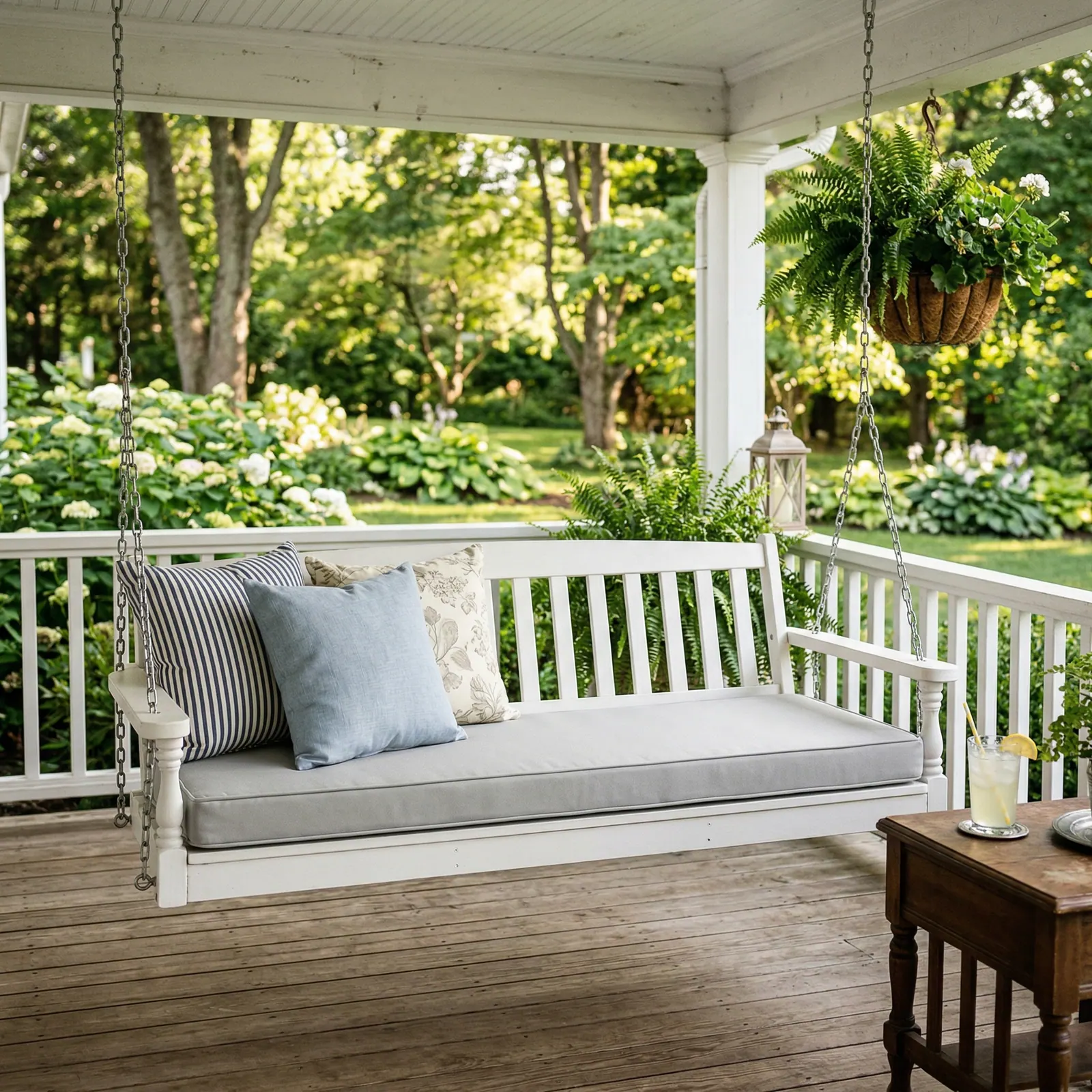
| Porch swing | Outdoor fabric | 3 to 4 in (7.5 to 10 cm) seat, back as its own piece, ties at the back corners | A swing moves; ties keep the cushion where you left it |
| Screened porch daybed | Outdoor fabric | Zippered covers, bolsters in the same fabric | Pollen and humid air come straight through a screen |
| Blue Ridge cabin bench or window seat | Velvet or corduroy | 3 to 4 in (7.5 to 10 cm); piping on velvet, none on corduroy | Warm to the hand in January; covers wash at 86°F (30°C) |
Ninety-seven and a half inches, cut in two
A buyer in the US came to the workshop wanting cushions that would never sag: two indoor benches 53.5 and 54 in long and 19.75 in deep (136, 137 and 50 cm), with two 44 x 6 in (112 x 15 cm) bolsters in a white performance fabric and no piping. The workshop explained that its standard 32 kg/m³ foam does not sag. The buyer chose 7 in (18 cm) thick anyway, and I would have done the same.
Then came the outdoor bench, 97.5 x 21 in (248 x 53 cm). It was cut into two seat cushions of 48.75 x 21 x 8 in (124 x 53 x 20 cm) with two bolsters 48.75 in (124 cm) long and 7 in (18 cm) across, in white outdoor fabric with black piping. When one bolster arrived looking flat, the workshop explained what vacuum packing does to a bolster and asked for a photo before anything else.
That is the build I would put on a porch above the sand. Two pieces go through a door ahead of a storm, white outdoor cloth comes in codes that take bleach on a stubborn stain, and black piping draws the line the eye follows.
Pollen, storms and first frost: a North Carolina year
- February to March: send your measurements. Interest in outdoor cushions across the state climbs from March and peaks in May.
- Late March to early April: pine pollen peaks. When the yellow stops falling, hose the frame, then wash the zippered covers at 86°F (30°C) on a gentle cycle and air dry them.
- June 1: hurricane season opens. Check that each cushion fits through your door in one person's arms.
- After a soaking rain: stand cushions on edge under the roof and get them dry within 24 to 48 hours, the window the EPA gives for stopping mold.
- After a salty week at the beach: rinse zippers and any metal with fresh water.
- November 30: storm season closes. Check seams, zippers and ties before the cool months.
- Before the first hard freeze in the mountains: bring porch cushions in, dry, off the concrete, never sealed in plastic.
Photographs for homes like these
Open any photograph large; each one has its own link and a Save button.
 Save
 Save
 Save
 Save
A palette from the dunes to the ridgeline
- Dune ivory#EDE6D6Outdoor white for the beach house; some white outdoor codes take bleach on a stubborn stain.
- Weathered shingle#8E8A80The silver of unpainted cedar. Hides salt haze and sand.
- Pollen-season sage#9AA487A mid-tone green that forgives a yellow week before wash day.
- Piedmont brick#9E4F32Warm and plain for a rocker beside a brick walk.
- Blue Ridge navy#23314AVelvet for the cabin bench; a deep color that looks warm in January light.
Buy the cushion once, cry once. On a North Carolina porch that means outdoor fabric, ties written into the order, and a closet ready for storm season.
Harlan
Buyer questions: rockers, ties and porch weather
- A common question
Can you make a tapered seat cushion and a back cushion for a chair on my covered porch?
The workshop's answerYes. Send a drawing with the back edge, front edge, depth and both side edges written on it, plus the back cushion size and the thickness you want. The back cushion's height can be the seat-to-top distance minus the seat thickness: 19 in minus a 3 in seat gives 16 in (48, 7.5 and 41 cm).
- A common question
Can ties go on the back corners so the cushion stays on my rocker or bench?
The workshop's answerYes. Ties can be sewn on the back of chair cushions or on the two back corners of a bench cushion, free of charge. Write the request, with your exact size, in the Add Personalization box when you order.
- A common question
Will regular cushions be all right on a covered or screened porch?
The workshop's answerUnder a closed roof the regular fabrics are fine. For open-air spots the cushions are made in outdoor fabric, and any piece, seat, back or bolster, can be made in it, screened porches included.
- A common question
Which white outdoor fabrics can I clean with bleach when a stain won't budge?
The workshop's answerAll the white and off-white outdoor fabrics can be cleaned, and the workshop named codes V-45/V-54, M-01 and S-09 as the ones to use if you want bleach on a stubborn stain.
- A common question
Is your velvet a performance velvet I can keep clean with kids around?
The workshop's answerYes. It is a 100% polyester performance velvet with good stain resistance. Spot-clean or wipe quick messes, and the covers machine wash at 86°F (30°C) for a deeper clean.

Have it made
Have it made for your home — ask Harlan’s workshop
Old upholsterers will tell you the real cutting happens in the conversation, long before the shears come out. Tell the workshop what you sit on, and they will talk it through with you. — Harlan
Leave your details and the workshop will call you to confirm measurements, fabric, foam and piping. No prices, dates or payment on this page: it is a request, not an order.
North Carolina questions, answered plain
When should I order porch cushions in North Carolina?
Early. Google Trends shows the state's interest in outdoor cushions climbing from March and peaking in May, the same weeks everybody sets up the porch. Custom cushions are cut to your measurements, so send sizes in February or March if you want them out by late spring.
Can Outer Banks cushions stay out through hurricane season?
Not when a storm is coming. The season runs June 1 to November 30, and Ready.gov's hurricane checklist says to bring outside furniture in. The fabric is water-repellent, but the foam is not quick-dry, so size every piece for one person to carry.
Does salt air ruin outdoor cushions at the beach?
Salt hits metal first. Coastal building guidance says salt spray is heaviest within the first 300 to 3,000 ft (90 to 900 m) of the shore, with faster corrosion measured miles inland. Rinse zippers with fresh water after salty weeks, and don't trust any fabric sold as salt-proof.
How close can a cabin bench cushion sit to a wood stove?
At least 3 ft (0.9 m) away. NFPA heating-safety guidance says anything that can burn belongs at least three feet from heating equipment, and a cushion can burn. Put the velvet on the window seat across the room, not on a hearth bench.
Sit well. — Harlan
The atelier
Keep going
Across the Map
Nearby places
Close by on the map