Across the Map · Tennessee & Kentucky · United States
Porch swing cushions for West Virginia porches and mountain cabins
West Virginia searches for porch swing cushions harder than any state in the country, and one drive up a hollow tells you why. Pull up a chair. Here is how to size a swing cushion and tie it so it stays put.
- Sun & UVModerate
- HumidityHumid
- WinterCold
- SettingInland
- Typical seatsPorch swing, rocking chair, ladder-back chair pad
 Save
The quick answer
Porch swing cushions for West Virginia porches should be measured inside the swing's arms, sewn in water-repellent outdoor fabric with zip-off covers, and tied on with ties named in your order note. Stock pads for 4 ft and 5 ft swings run about 45 and 55 in. Charleston's August mornings average 92% humidity, so dry wet cushions within 48 hours and store them indoors for winter.
First in the nation for swings, and the porches to prove it
Five years of search data put West Virginia first in the country for porch swing cushions, at 85 on the index. Kentucky comes second at 57, and it isn't close. In the census division that takes in West Virginia, 74% of new homes started in 2024 had a porch. The old ones had them first.
The houses were built for sitting out. Hillside homes with the porch facing the road. Coal towns, an estimated 465 of them by 1930, with rows of simple three- and four-room houses, often painted one color from end to end of town. Farmhouses with a long porch and a swing at one end. And now the cabins: near the New River Gorge, a national park since December 2020, and up the mountain toward Snowshoe.
Rockers have their own story on our Tennessee and Kentucky page, and Kentucky has its swing beds. This page is for the West Virginia swing.
Damp hollows, snowy ridges
Down in the Kanawha Valley, Charleston gets 46.24 in (117 cm) of precipitation over 150 wet days a year, and August and September mornings average 92% humidity. Clear days are scarce, about 65 a year, yet summer still brings 22 days at 90°F (32°C) or above.
Climb, and it changes. Beckley, near the Gorge, gets 55.9 in (142 cm) of snow and 110 freezing nights. Elkins gets 68.9 in (175 cm) and 139. The summit at Snowshoe, 4,848 ft up, averages about 180 in (457 cm) of snow a winter.
So damp is the daily enemy and cold is the seasonal one. Outdoor fabric sheds a shower, but water finds the seams, and standard foam takes 24 to 48 hours to dry with air moving around it. That is the same window the EPA gives before mold is likely.
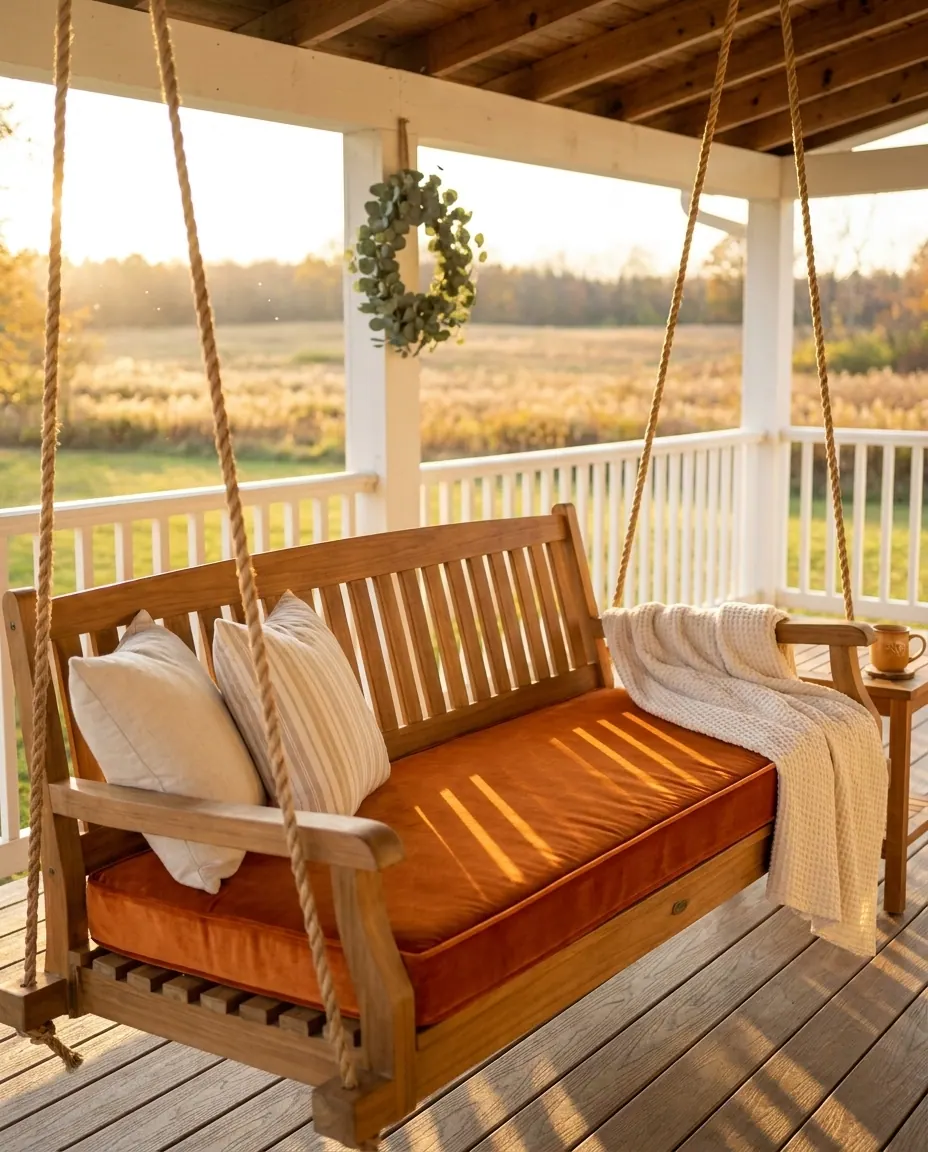
The rust velvet swing in our photo sits under a deep beadboard roof, which is the only place velvet belongs outside. In a hollow where August mornings sit at 92%, I'd still sew that swing in outdoor fabric.
Size the swing, then tie it down
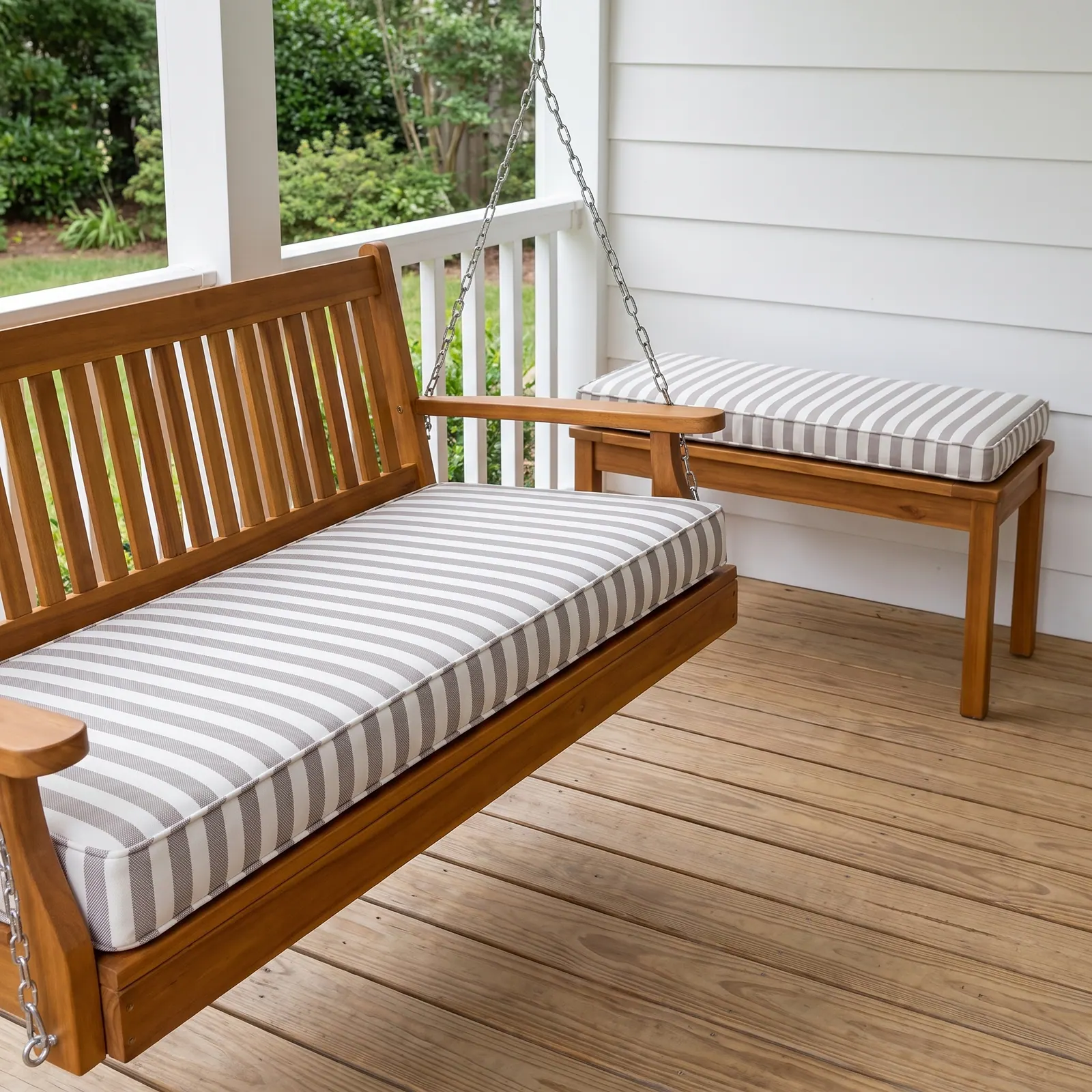
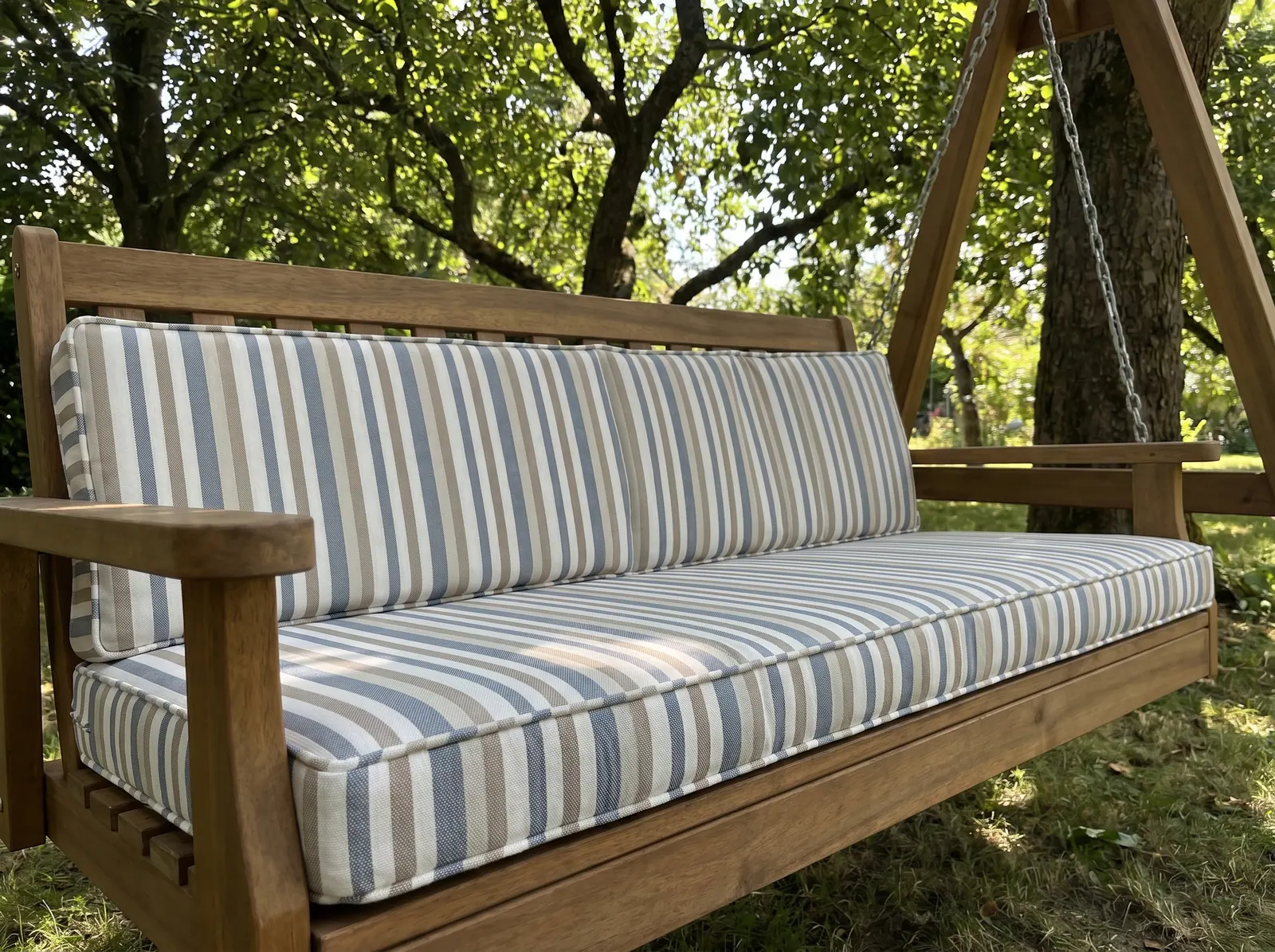
Measure a swing inside the arms, not by the length on the box. One swing maker's own pads for its 4 ft and 5 ft swings are about 45 and 55 in (114 and 140 cm) long; a roomy custom 5 ft seat can reach 58 to 60 in (147 to 152 cm). Seats run 18 to 24 in (46 to 61 cm) deep, 3 to 4 in (7.5 to 10 cm) thick for everyday sitting. Order the back as its own piece and make sure the chains clear it at both ends. The porch swing sizes pattern has the 4, 5 and 6 ft numbers, and the porch swing hub has the styles.
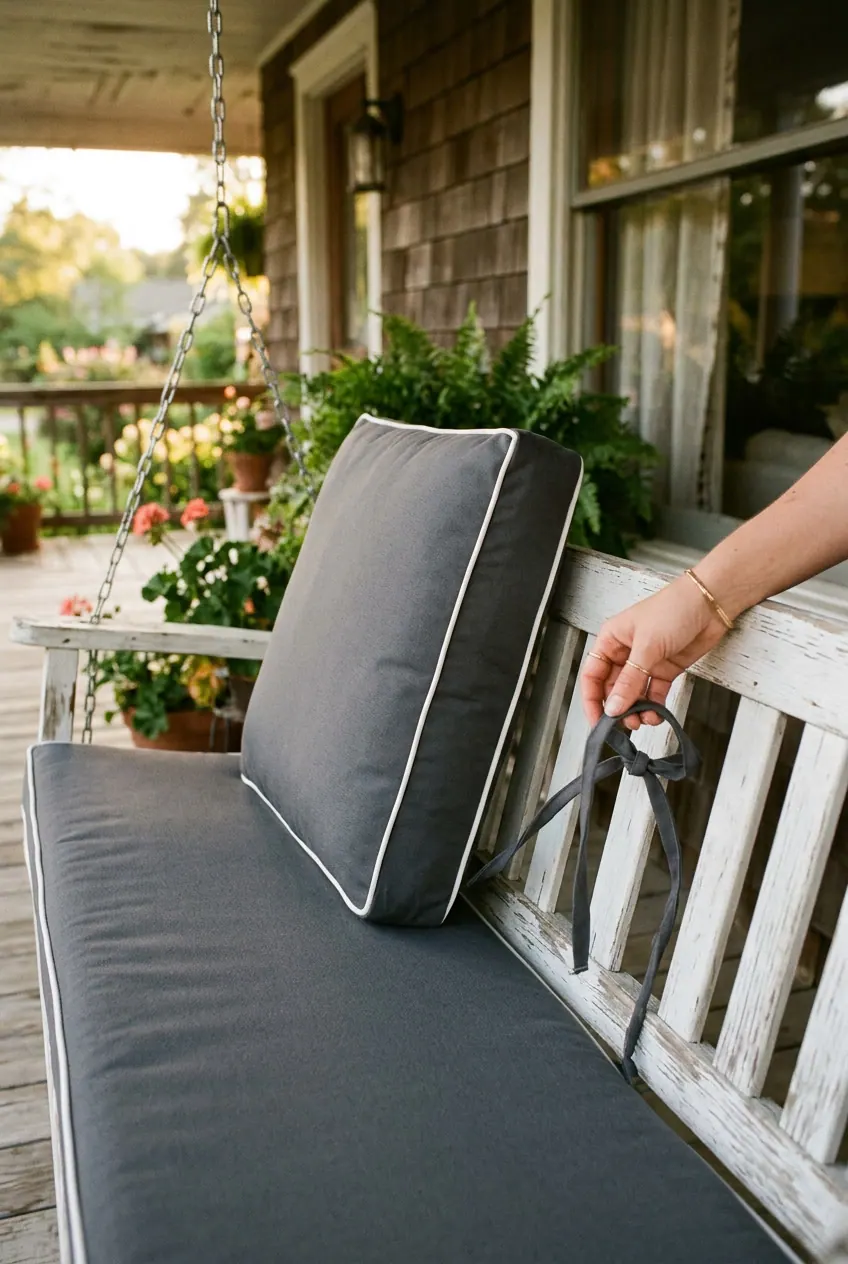
Now the ties, neighbor. They are never standard. If you don't ask in writing, you won't get them. Two on the back edge tie to the rail; four at the corners knot under the slats. Say where each one goes, measured from a named end, and check the photo before it ships. The tie placement guide marks the spots.
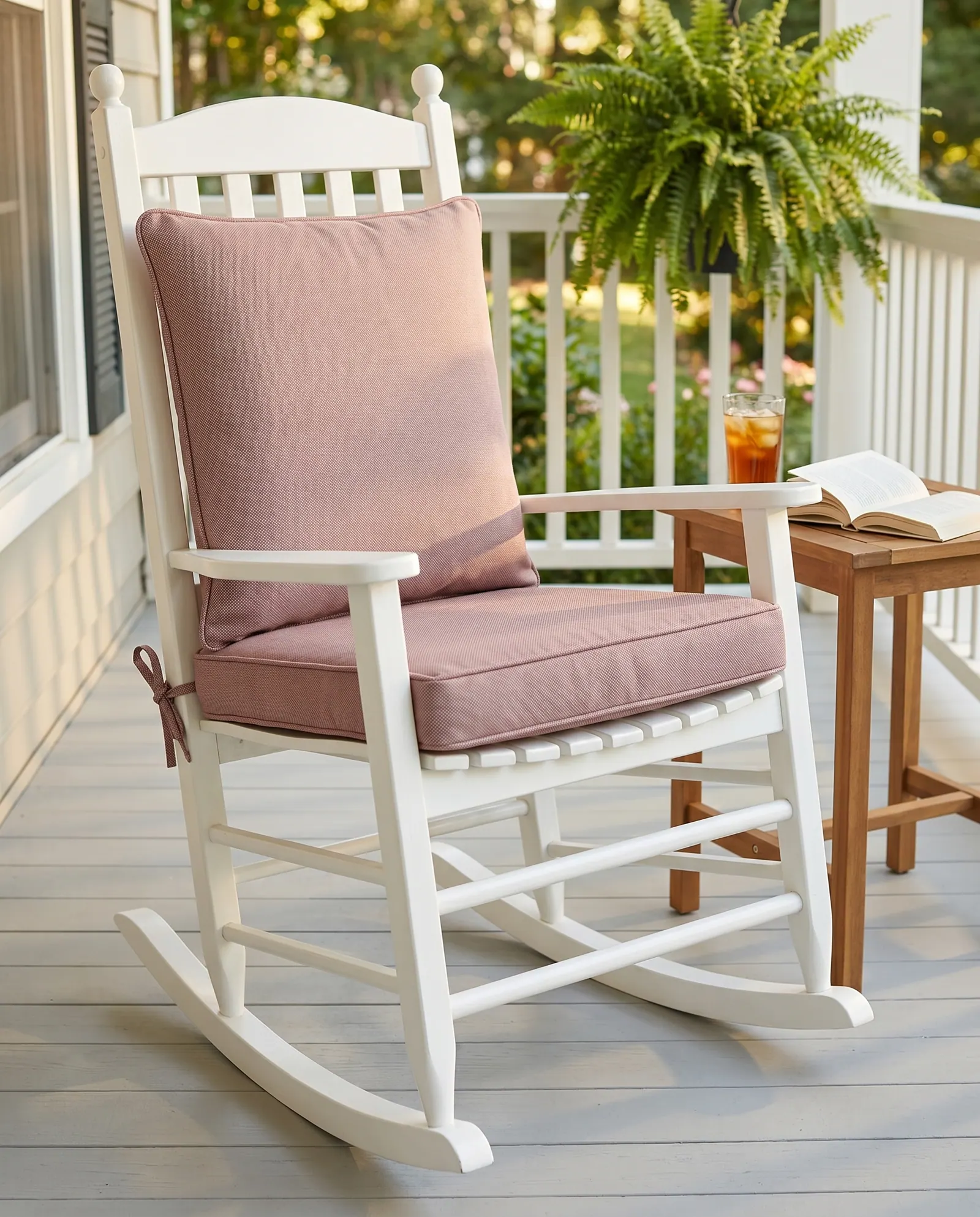
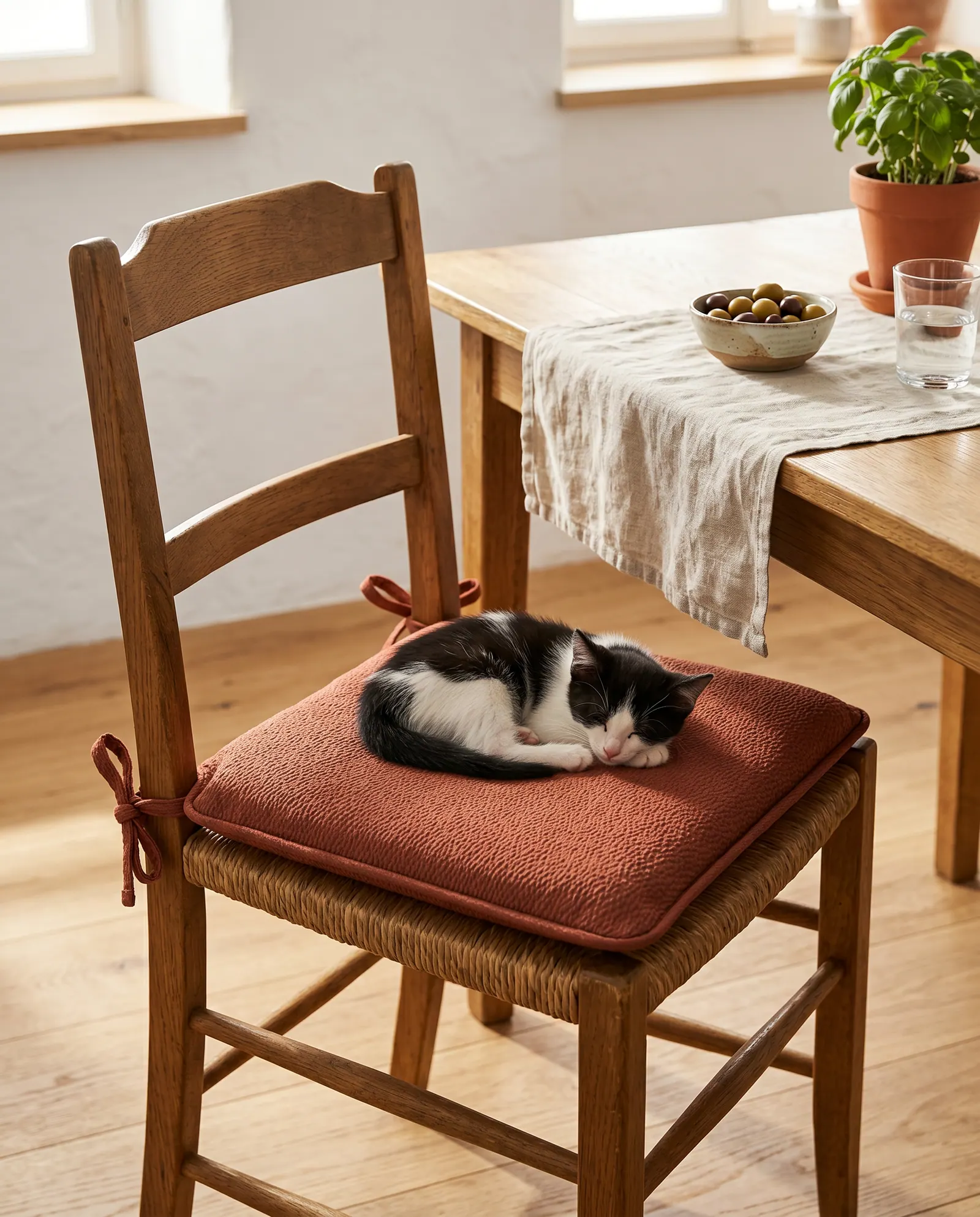
Kitchen chairs get the same treatment. A buyer in the US had four vintage ladder-back chairs and sent a diagram. The numbers didn't add up until they measured both side edges: about 11 in (28 cm) each, with 13 and 14 in (33 and 36 cm) across the front and back. Four-inch pads, ties at the back, covers that zip off. Old chairs are rarely square. For a rocker, trace a paper template.
Swing, rocker, cabin bench: what to sew
| Seat | Fabric | Size and thickness | Fastening |
|---|---|---|---|
| Hillside porch swing, 5 ft | Water-repellent, UV-resistant outdoor fabric | Seat measured inside the arms, stock 5 ft pads about 55 in (140 cm); 3 to 4 in (7.5 to 10 cm) thick | Back as a separate piece; two ties on the back edge |
| Small porch swing, 4 ft | Outdoor fabric in a mid-tone stripe or solid | Measured between the arms; 3 in (7.5 cm) keeps it light to carry in | Four corner ties knotted under the slats |
| Rocking chair or ladder-back chair | Outdoor fabric on the porch; linen-look or performance weave in the kitchen | From a traced template; 2 to 4 in (5 to 10 cm) | Two ties at the back posts |
| Cabin bench near the Gorge or Snowshoe | Soft performance fabric or velvet, zip-off covers | 3 to 4 in (7.5 to 10 cm) | Non-slip base on a smooth bench; 3 ft (0.9 m) from the woodstove |
Tufted cushions let water in even in outdoor fabric, so porch swing cushions are made plain. Covers wash at 86°F (30°C) on a gentle cycle; air dry. Ties are sewn only when requested.
Eight ties, 2 inches from the ends
A buyer in the US ordered two long bench cushions, 62 x 14 in (157 x 36 cm) each, in brown corduroy, with four ties apiece set 2 in (5 cm) in from the ends.
Before anything was cut, the workshop asked for a photo and a sketch of the bench, so the ties would land where the frame could hold them and not in thin air. When the covers were sewn, a photo went back for approval. Only then did the high-density foam go in, the next day, and the cushions ship.
Swap the bench for a swing and it's the same job. A tie in the wrong place is just a string.
- Measured
- 2 cushions, 62 x 14 in (157 x 36 cm), 4 ties each, set 2 in (5 cm) from the ends
- What it taught
- Send a photo of the frame so tie positions match it, and approve the cover photo before the foam goes in.
Photographs for homes like these
Open any photograph large; each one has its own link and a Save button.
 Save
 Save
 Save
 Save
 Save
The porch year in the hills
- March: measure the swing inside the arms and order early; national searches for swing cushions peak in May.
- July to September: after a storm, stand cushions on edge under the roof and dry them within 24 to 48 hours.
- Midsummer: unzip and wash the covers at 86°F (30°C) on a gentle cycle, then air dry.
- Before the first hard freeze: bring cushions in, clean and dry right through, off concrete, never sealed in plastic.
- Winter at the cabin: keep cushions and throws at least 3 ft (0.9 m) from the woodstove.
Measure the swing between the arms, name the ties in your order, and bring the cushion in before the first hard freeze.
Rosa
Buyer questions: backs, chairs and covers
- A common question
Can I use the same kind of cushion for the seat and the back, and how should the back be sized?
The workshop's answerYes, many buyers order both. Back cushions are usually a little thinner and narrower than the seat so they stand upright and don't eat seat depth. If the back rests on top of the seat cushion, subtract the seat's thickness: a 17 in back on a 4 in seat fills a 21 in frame.
- A common question
Can you make chair cushions with ties in the same fabric as my bench cushion?
The workshop's answerYes. Matching chair cushions with ties can be made in exactly the same fabric so everything coordinates. Send all the sizes and mention them when you order so the pieces are kept together.
- A common question
My chair seat is rounded at the back and dips. Can you make a horseshoe-shaped cushion?
The workshop's answerYes, a curved edge can be made. The workshop needs a clear drawing with the width, the depth, where the curve starts and ends along each side and how deep it runs, plus a photo of the chair. The shape is confirmed with you before you order.
- A common question
Can I buy just a new cover for a cushion I already have?
The workshop's answerYes. The cover-only listing makes custom covers without foam. Pick the nearest size and write the exact length, width, thickness and fabric code in the personalization box.
- A common question
Do the covers come off, and can they go in the washing machine?
The workshop's answerYes. Every cover has a zipper and comes off completely, and every fabric can be machine washed at 86°F (30°C) on a gentle cycle. Air dry rather than tumble dry, and iron on low if you need to.

Have it made
Have it made for your home — ask Rosa’s workshop
Swings sway, rockers rock, dogs circle three times. Tell the workshop what your seat goes through, and they will plan for it. — Rosa
Leave your details and the workshop will call you to confirm measurements, fabric, foam and piping. No prices, dates or payment on this page: it is a request, not an order.
West Virginia porch questions
Why does West Virginia search for porch swing cushions more than any other state?
Five years of search data put it first at 85, well ahead of Kentucky at 57. The houses explain it: hillside homes, coal-town rows and farmhouses built with front porches, and 74% of new homes in its census division were started with a porch in 2024.
Should swing cushions stay out through a West Virginia winter?
No. Charleston averages 97 nights a year at or below 32°F (0°C), Beckley 110 and Elkins 139. Water left in the foam freezes and thaws, so bring cushions in before the first hard freeze, clean and dry right through, and store them where air moves.
Can a porch swing cushion be tufted?
Not for a porch that gets weather. Tufting stitches right through the cushion, and those holes let water in even when the fabric is outdoor-grade. A plain, foam-filled cushion in water-repellent outdoor fabric with a zip-off cover is the better build for a swing.
What suits a cabin bench near the New River Gorge?
Indoors, a zip-off cover in soft performance fabric or velvet, both suggested for rentals and daily use because they wipe and wash well. Keep cushions and throws at least 3 ft (0.9 m) from a woodstove, as fire-safety guidance advises.
Porch light's on — Rosa
The atelier
Keep going
Across the Map
Nearby places
Close by on the map