A Reading by NateL-Shaped Corner Bench Cushions
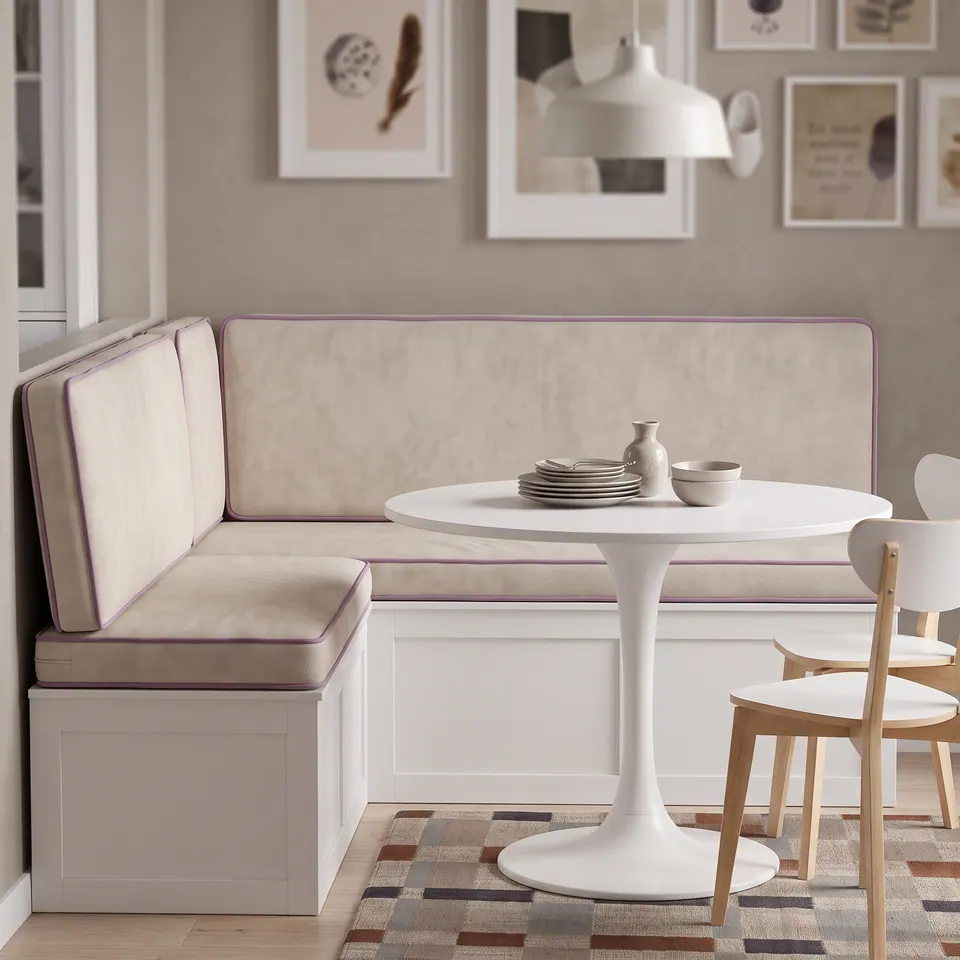
Reading an oat velvet L-shaped bench cushion from the side, where a plain seat meets a patterned room
Nate turns a side-profile photo into a cross-section: box depth, a leaning back pad, a zipper tab, and why the only pattern in this nook lives on the wall and the floor.

 Save
The quick answer
An L-shaped bench cushion in plain velvet works best when the pattern lives elsewhere in the nook, on the rug or the gallery wall, and the cushion adds texture and one piped line. Most buyers pick 3 or 4 in (7.5 or 10 cm) of firm 32-density foam, and a zippered cover with the zipper turned to the wall side.
The cushion, cut open
Cover fabric. A removable, zippered cover. Machine wash at 86°F (30°C) on a gentle cycle and air dry.
Piping. A fabric-covered cord sewn into the seams. It sits on the seam line, so it does not change the size.
Fiber wrap. Polyester fiber (Dacron) batting around the foam: it fills the cover out and softens the edges.
Foam core. About 2.0 lb/ft³ (32 kg/m³) high-resilience foam, firm to medium-firm, cut to the ordered size.
Zipper. Along the back band, as hidden as possible. The zipper side faces down or toward the wall.
Base panel. The underside of the cover. A non-slip fabric backing can cover the whole of it instead.
The side view is where a banquette shows its build
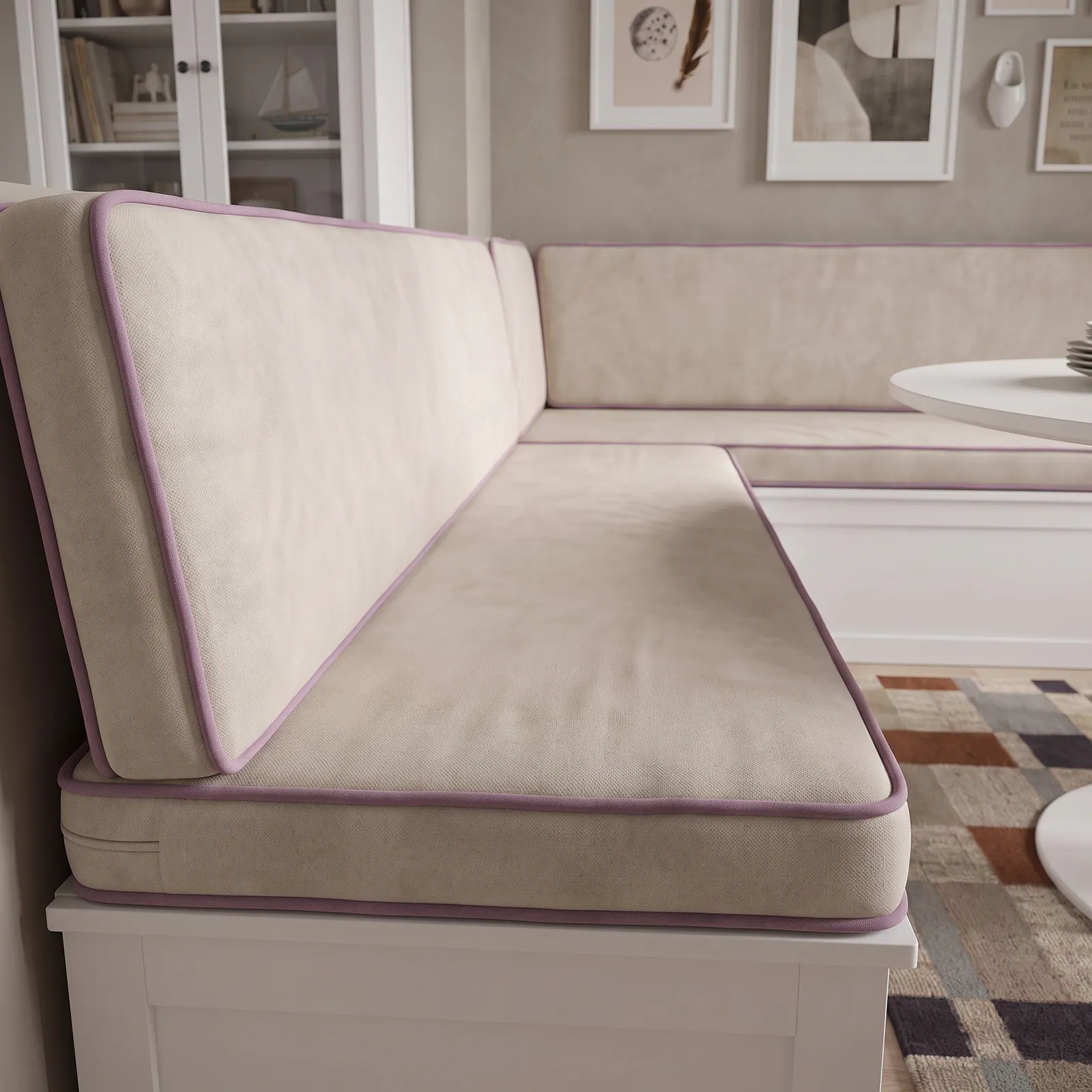
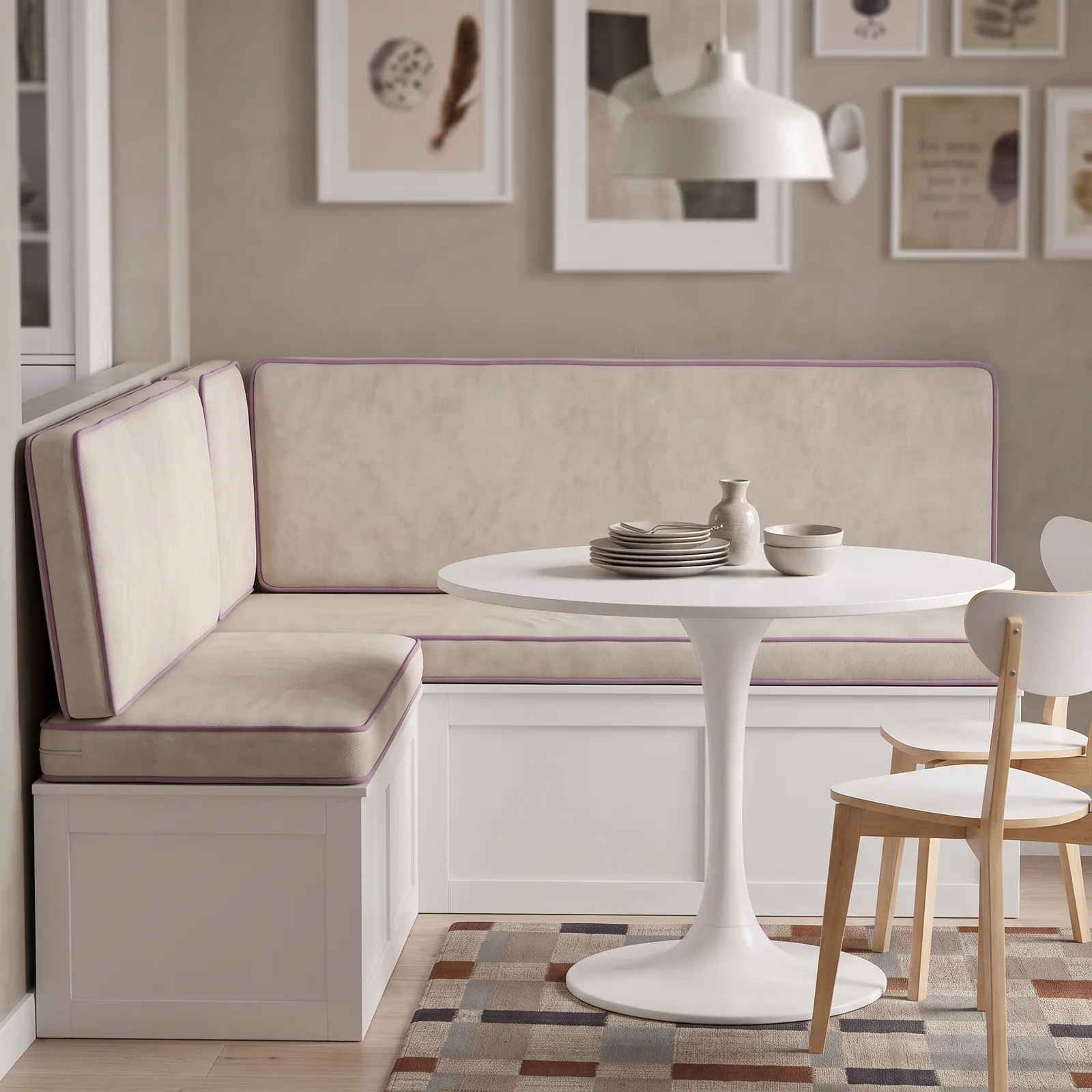
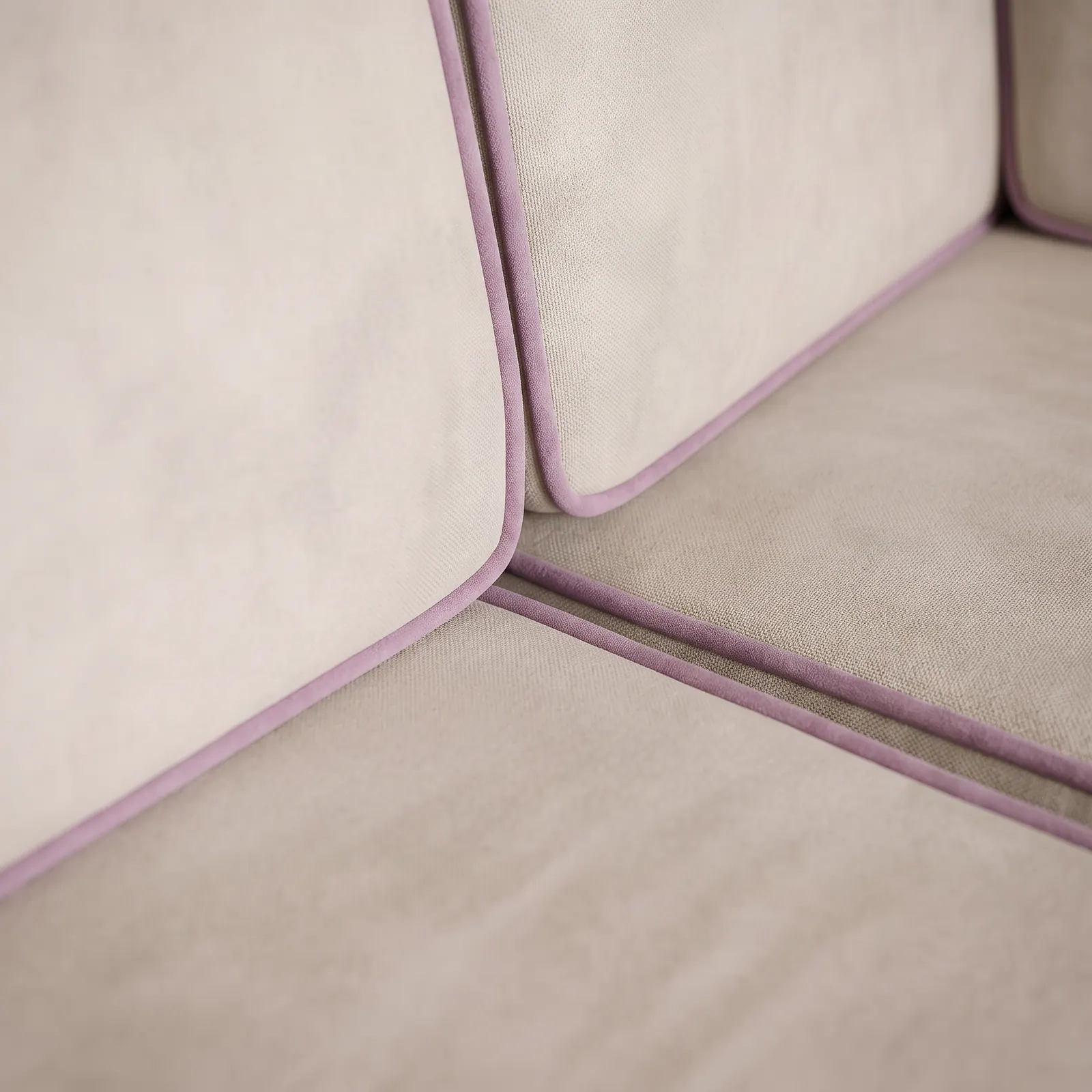
Photograph a banquette from the front and you see color. Photograph it from the side and you see construction. This set of oat velvet cushions sits on a white L-shaped banquette, shot along the long run toward a gallery wall, and it reads like a section drawing, partner.
Start at the bottom and work up.
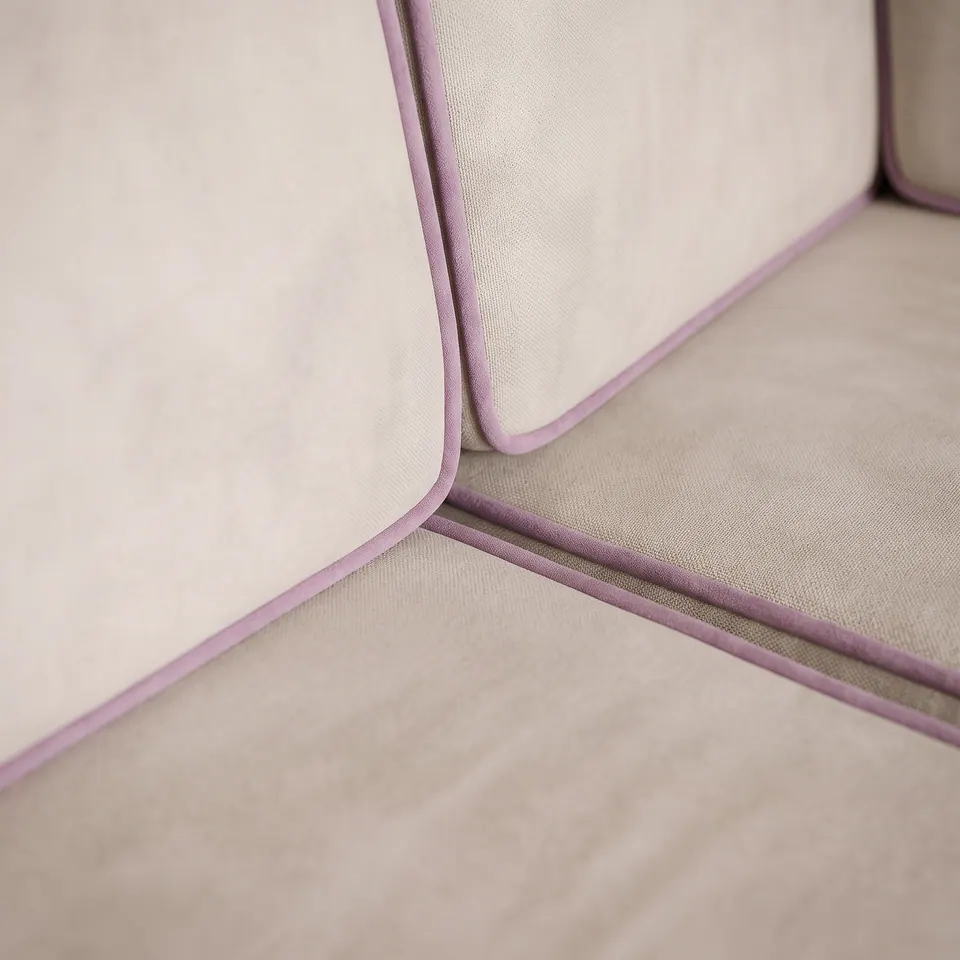
- Seat box. A deep box seat with a lavender welt on the top seam and another on the bottom seam. Two welts give you the full box depth at a glance, the way two lines on a drawing give you a dimension.
- Back pad. It rests on the seat and leans on the wall at a slight angle. The wall carries the load.
- Zipper tab. At the end of the seat, a small tab marks where the zipper stops. That is your proof the cover comes off.
- Corner turn. Where the long seat meets the return, the lavender welt rounds the corner without a kink. That is the hardest seam on an L-shaped bench cushion, and it is clean here.
For your own order, ask for the zipper on the back or wall side. The zipper placement Pattern lays out the options; the L-shaped measuring Pattern covers the numbers.
Pinned by Nate: four points on the profile
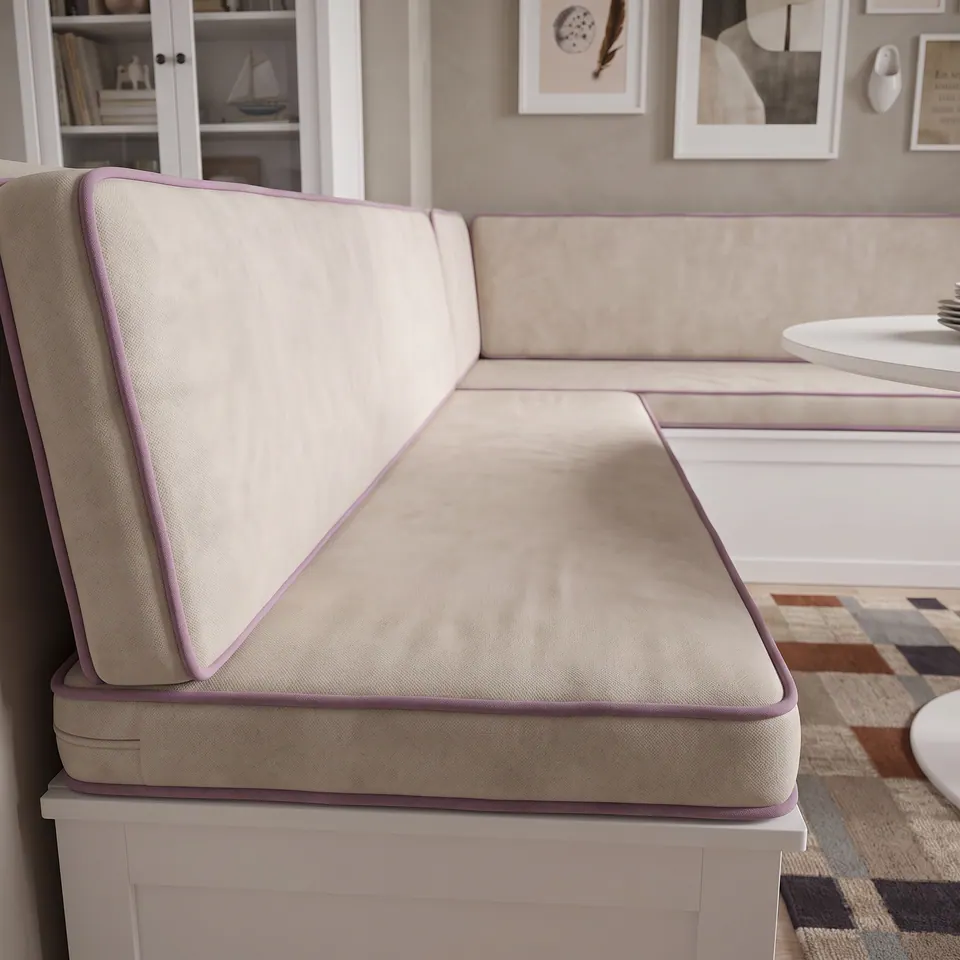
Four pins trace the build from the leaning back pad down to the zipper tab and around the corner turn.
- Leaning back pad
The back cushion rests on the seat at a slight lean, supported by the wall.
- Deep box seat
Piping at top and bottom shows the full box depth of the seat.
- Zipper end tab
The tab marks where the zipper ends, so the cover can come off for cleaning.
- Corner turn
The lavender welt turns the corner smoothly where the long seat meets the return.
- Leaning back padThe back cushion rests on the seat at a slight lean, supported by the wall.
- Deep box seatPiping at top and bottom shows the full box depth of the seat.
- Zipper end tabThe tab marks where the zipper ends, so the cover can come off for cleaning.
- Corner turnThe lavender welt turns the corner smoothly where the long seat meets the return.
Why the pattern lives on the wall, not on the seat
Count the patterns in this nook. A gallery wall of framed prints. A patchwork rug. A glass-front cabinet with a model sailboat inside. That is three busy surfaces before anyone sits down.
So the cushion goes plain. Oat velvet brings texture instead of print: the pile shades lighter and darker where a hand has smoothed it, which gives the seat movement without adding a fourth pattern. The lavender welt is the only line, and it is thin.
My working rule for mixing: one pattern per plane. The wall gets one, the floor gets one, the seat gets texture. If your rug is plain, the seat has room for a stripe, and the striped cotton and ticking family is where I would look. The white tulip table at the edge of the frame, a round plain top, interrupts nothing.
What is already on your floor and your walls? Answer that before you pick the seat fabric. For velvet in a busy kitchen nook, keep velvet care in mind as well.
On the cutting table: the side-profile set
| Cushion | L-shaped banquette set: box seat plus leaning back pad |
|---|---|
| Fabric | Oat velvet with visible pile shading |
| Piping | Contrast lavender welt on the top and bottom seams of the seat |
| Edge | Box edge |
| Standard thickness | 2, 3, 4 or 5 in (5, 7.5, 10 or 13 cm), all the same price; 6 in (15 cm) on request |
| Foam | Firm, durable 32-density foam |
| Fastening | Zippered cover; ask for the zipper on the wall side |
| Corner | Welt turned smoothly where the long seat meets the return |
| Best for | Kitchen nooks and dining banquettes with patterned rugs or gallery walls |

Have it made
Have this made — ask Nate’s workshop
Every edge and both diagonals, to the nearest 1/4 in. If the numbers do not close, the workshop will say so on the call. — Nate
Leave your details and the workshop will call you to confirm measurements, fabric, foam and piping. No prices, dates or payment on this page: it is a request, not an order.
A style photo, two wrong rectangles, and one 44-inch fix
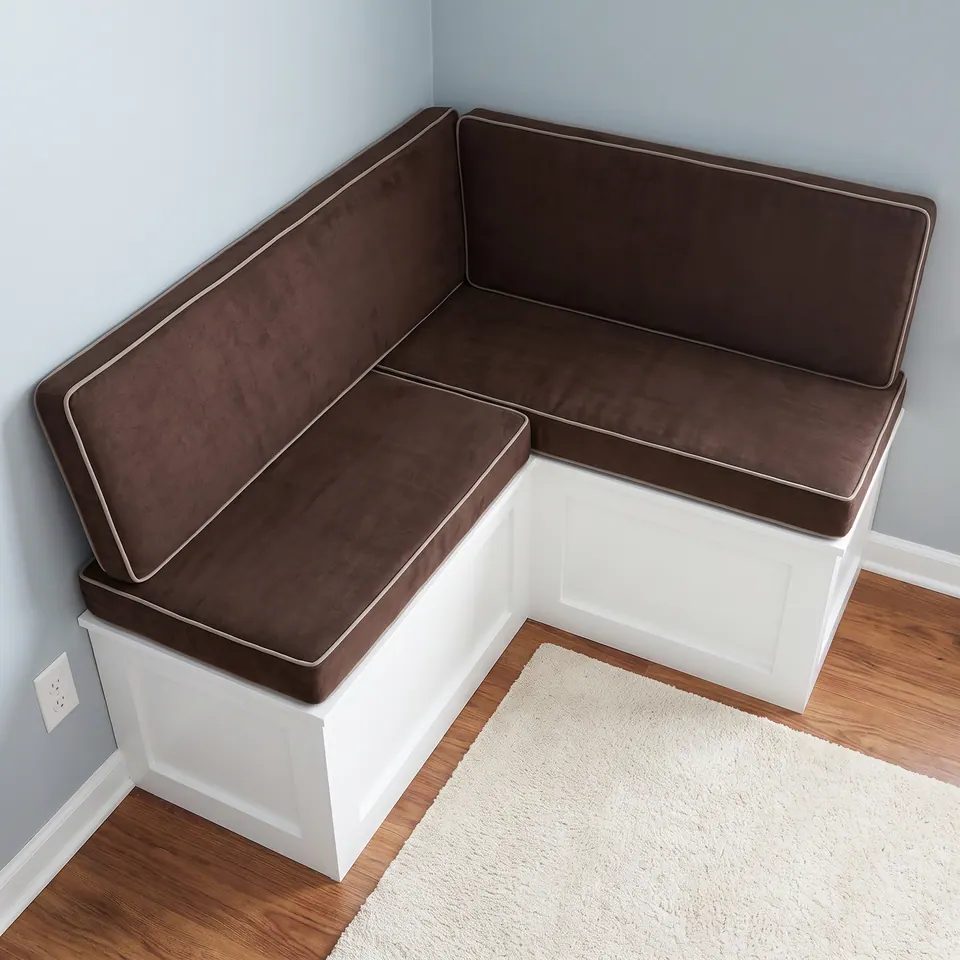
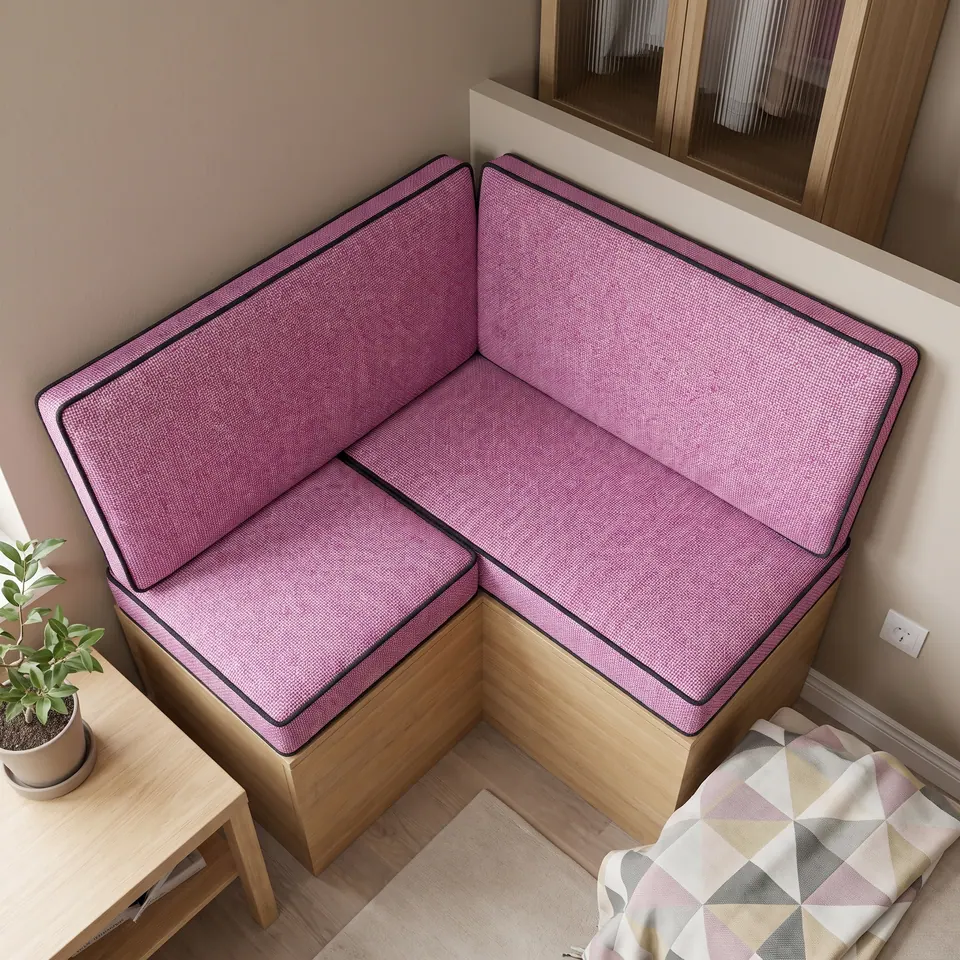
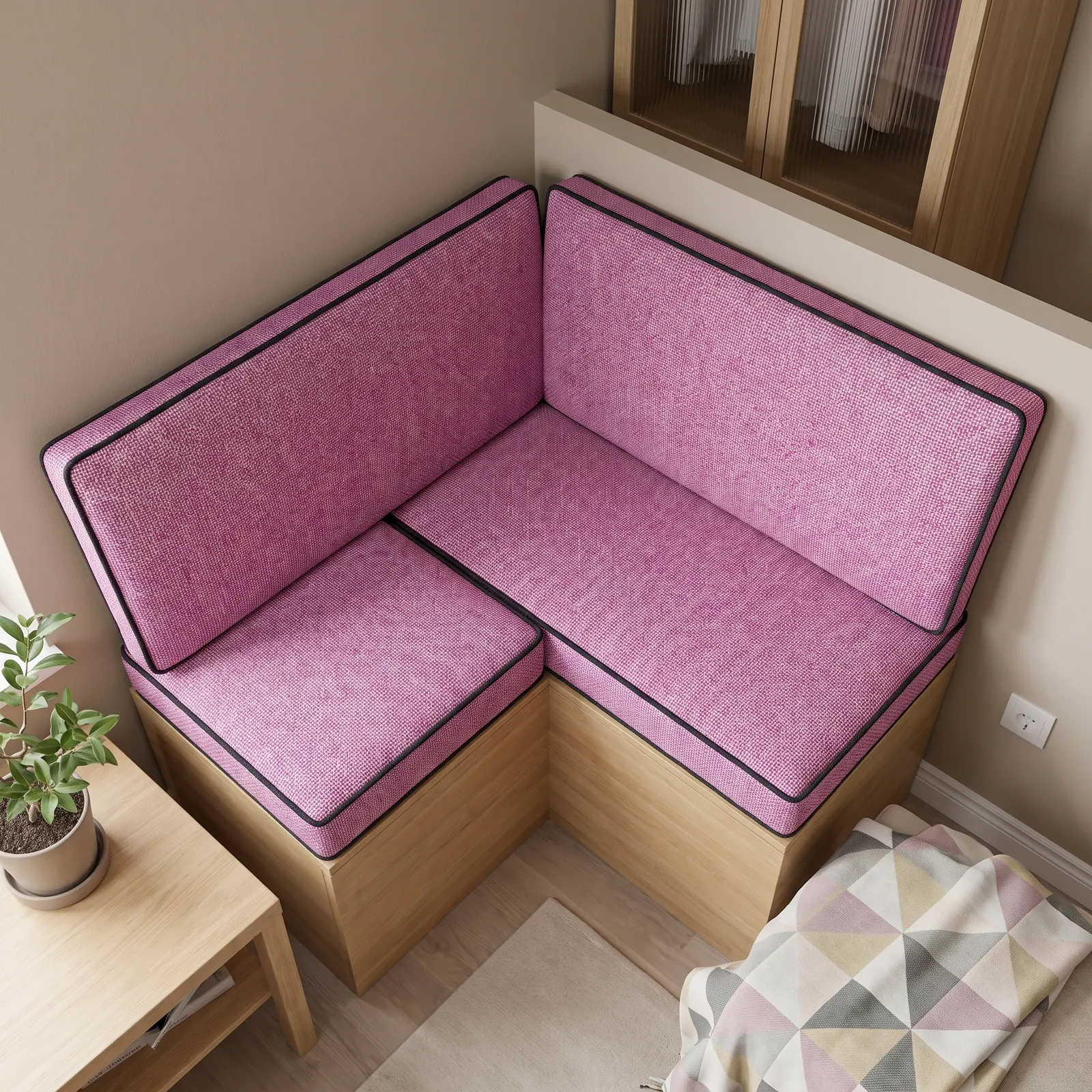
A buyer in the US wanted a corner floor seat for a reading spot: 66 in (168 cm) across, 44 in (112 cm) along each wall, 14 in (36 cm) high, with backrests, in velvet chosen by color number. The style photo they sent showed rectangular tufted cushions.
That photo did the ordering. Two rectangular seats went out, and they were too big for the space. The backrests fit perfectly. The seats did not. The workshop then made a single 44 x 44 in (112 x 112 cm) corner seat, and the buyer covered the shipping.
The numbers were fine. The shape was never drawn. A style photo tells us the mood; a floor-plan sketch tells us the cut. Measure twice; the fabric remembers. Then send both, and point to the exact shape listing you mean.
- Sizes
- 66 in (168 cm) across, 44 in (112 cm) per wall, 14 in (36 cm) high; replacement seat 44 x 44 in (112 x 112 cm)
The lesson: Send a floor-plan sketch and name the exact shape listing; a style photo alone can lead to the wrong cut.
Buyer questions: thickness, cost and sizes off the menu
- A common question
Is there a thickness most people go with? I was leaning toward 5 or 6 inches.
The workshop's answerThe standard options are 2, 3, 4 and 5 in (5, 7.5, 10 and 13 cm), all at the same price. Most buyers choose 4 in for a plusher seat, and 3 in is popular for a trimmer profile. The foam is a firm, durable 32-density foam that holds its shape, and 6 in (15 cm) can be made on request.
- A common question
Roughly what does a custom window seat or bench cushion cost?
The workshop's answerQuotes follow size, fabric and thickness, and each quote shows its shipping cost. Fabric moves the figure as much as length: a 26 x 83 in (66 x 211 cm) velvet seat came out higher than a longer 24 x 97 in (61 x 246 cm) seat in another fabric.
- A common question
My size isn't in the drop-down. How do I order a cushion in my exact measurements?
The workshop's answerChoose the closest size option, usually the next one up, and write your exact dimensions in the personalization or note-to-seller box. The cushion is made to the size you write: a 16 x 42 in (41 x 107 cm) seat was ordered under the 16 x 40 in option with the real numbers typed in. For larger or multi-part orders the workshop can add a custom option or a private listing.
On an L-shaped bench cushion, if the rug and the wall already carry pattern, keep the seat plain and let one piped welt draw the line.
Nate
Questions buyers ask next
Where should the zipper go on a velvet banquette cushion?
On the back or wall side, so it stays out of sight from the table. The tab in this photo sits at the seat end, which shows the cover is removable; turning the opening toward the wall keeps the velvet front unbroken.
Why pipe both the top and bottom seams of a box seat?
Two welts outline the full box depth, so the seat reads as a crisp block from the side. In a contrast color like lavender on oat velvet, they also carry one clean line around the corner of an L.
Can a patterned rug work with a plain velvet banquette?
Yes, and it is the easiest mix to get right. Let the rug and the wall carry the pattern and keep the seat plain, so the velvet's pile shading supplies texture. With a plain rug, the seat has room for a stripe.
± 1/4 in — Nate
More photographs to read
 Save
 Save
 Save
 Save
 Save
 Save