Across the Map · New England · United States
Window seat cushions for Rhode Island colonials, cottages and boats
I've spent my working life re-covering window seats in this state and have yet to meet a square one. Here is how to make a cushion sit straight in a house that doesn't.
- Sun & UVModerate
- HumidityModerate
- WinterCold
- CoastSalt air nearby
- Typical seatsColonial window seat, victorian bay seat, window seat with a lift-up lid

 Save
The quick answer
Window seat cushions in Rhode Island should be cut from full measurements, because old colonial and Victorian seats are rarely square: measure the front, the back, the depth at both ends and each angled side. Providence averages 114 freeze days and 125 wet days a year, so choose washable covers and lift cushions off sweating winter glass. Porch and boat cushions near salt water need outdoor fabric.
Colonial rooms, summer cottages and the three-decker porch
Rhode Island is small, old and wet around the edges, and its window seats show all three.
Newport has one of the highest concentrations of colonial homes in the nation. The Newport Restoration Foundation alone has restored more than 80 buildings from the 18th and early 19th centuries. Those rooms come with deep-set windows, painted paneling and, now and then, a seat built into the wall by someone who owned a level and chose not to use it.
Between 1870 and 1915 the summer 'cottages' went up, and the Shingle Style took hold, with some of its best-known early houses built right here in the 1880s. Bays, porches and inglenooks, every one of them asking for a cushion.
Providence built triple-deckers from about 1895 to 1925: three stories, one apartment per floor, and what the city's preservation guide calls the inevitable front porch. Add the Victorians with their bays. Start with window seat cushions and bay window cushions.
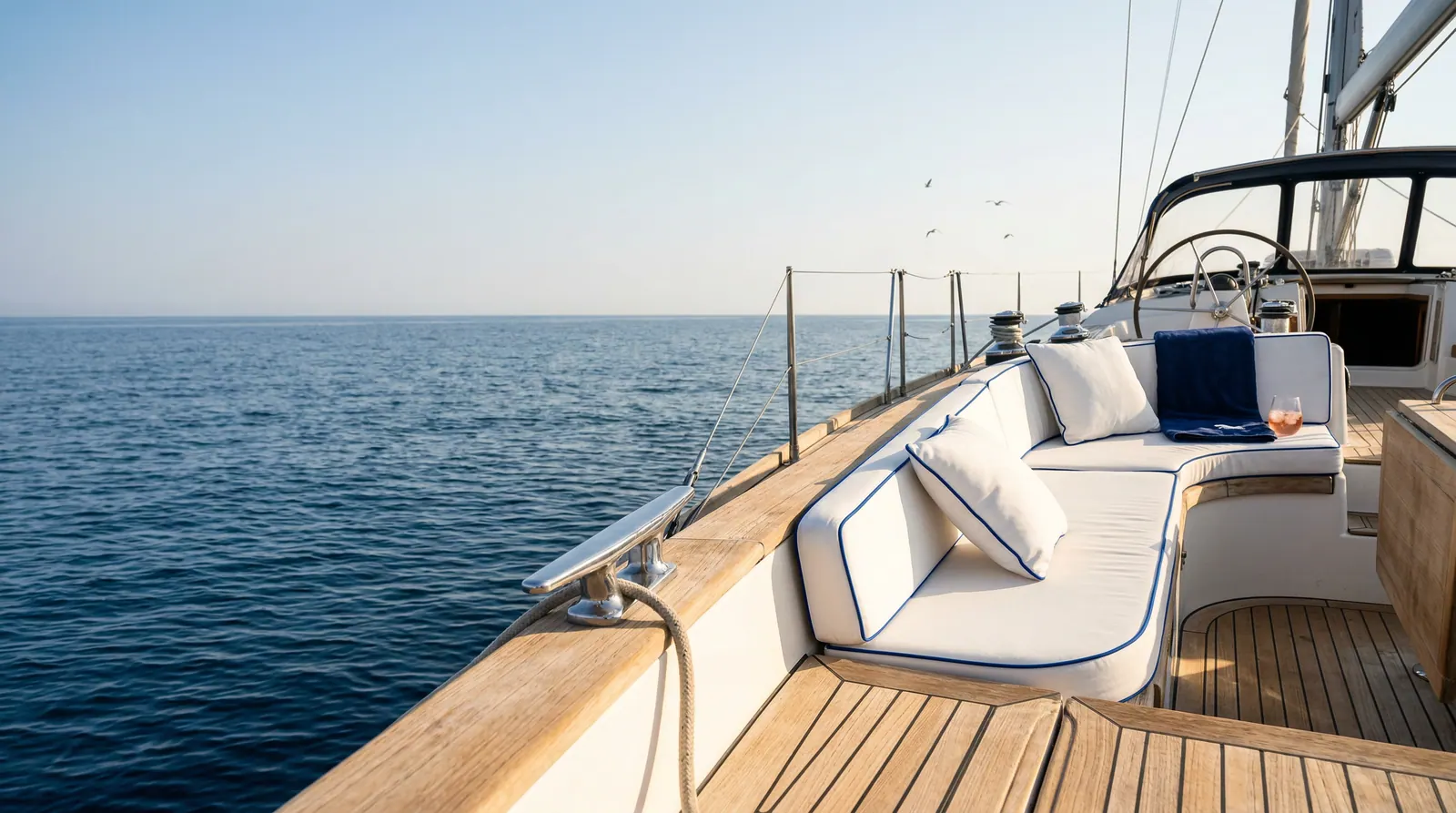
Then the water. The state has 384 miles of coastline, and Newport, which hosted the America's Cup from 1930 to 1983, is sometimes called the sailing capital of the world. Cockpits and cabins need cushions too: boat and RV cushions.
The search maps agree: Rhode Island scores 30 for window seat cushions and 51 for bench cushions, near the top of the country. More on the New England page.
Frost, sweating glass and salt
Providence averages 36.6 in (93 cm) of snow, 114 days at or below 32°F (0°C) and 125 days with measurable precipitation a year. Newport, with about 47.45 in (1,205 mm) of precipitation, is often cooler in summer than Boston.
For a window seat, the trouble is the glass. Warm room air meets a cold single-pane sash, the window sweats, and the water runs down to the cushion. I learned that decades ago with a linen cushion left pressed against a bay all February. Never again. The EPA's advice is to dry a wet surface quickly; within 24 to 48 hours, most materials won't grow mold. Lift the cushion, wipe the sill, stand it on edge.
For porches and boats, the trouble is salt. Salt spray is heaviest near breaking waves and falls off within the first 300 to 3,000 ft inland, but faster corrosion has been measured 5 to 10 miles from shore. Outdoor fabric for anything outdoors, and fresh water for the hardware.
What does your window do on a January morning, dear?
Before you order: my checklist for a seat that isn't square
Tape on the seat itself
A tape that follows a tired cushion's curve reads 1 to 1.3 in long. Use a rigid tape, flat on the seat.
Front and back, separately
Front edge wall to wall, back edge along the glass. In a bay the back is usually the shorter one.
Depth at each end
Front to back at 90 degrees, at the left and at the right. In an old house they rarely agree.
Every angled side on its own
Left and right are rarely identical. Measure each corner to corner and write both down.
Posts, handles and casings
Mark them on the drawing, and say so if a post forced you to measure around it.
Letter every edge
A, B, C and so on, with each number typed out as well as drawn. A blurry sketch costs days.
Corner posts, and a 39 in slant that couldn't be
A buyer in the US sent a photo of an angled window seat with posts standing in the corners. From the photo the workshop drew a template: 115.5 in (293 cm) along the front, 54.5 in (138 cm) along the back, 30.5 in (77.5 cm) deep, with 8.5 in (21.5 cm) straight ends.
Then the check. The buyer had measured the slanted sides at 39 in. The geometry said about 37.5 in. Both can't be right, and I've learned to love that moment, because it's where cushions get saved.
The explanation was sensible. The posts had forced the tape to bend around them, which adds length. And 4 in had already been taken off the true 58.5 in back to clear the posts. Nobody had done anything wrong; they just hadn't said what they'd done.
Once it was said, the workshop confirmed the final template, made the cushion 3 in (7.5 cm) thick and added anti-slip material underneath. If a post or a molding is in the way, say so, and let the maker work out the slants from the front, the back and the depth. The bay window calculator runs the same check at your kitchen table, and the three-sided bay guide covers the rest.
Fabric, piping and build for Rhode Island seats
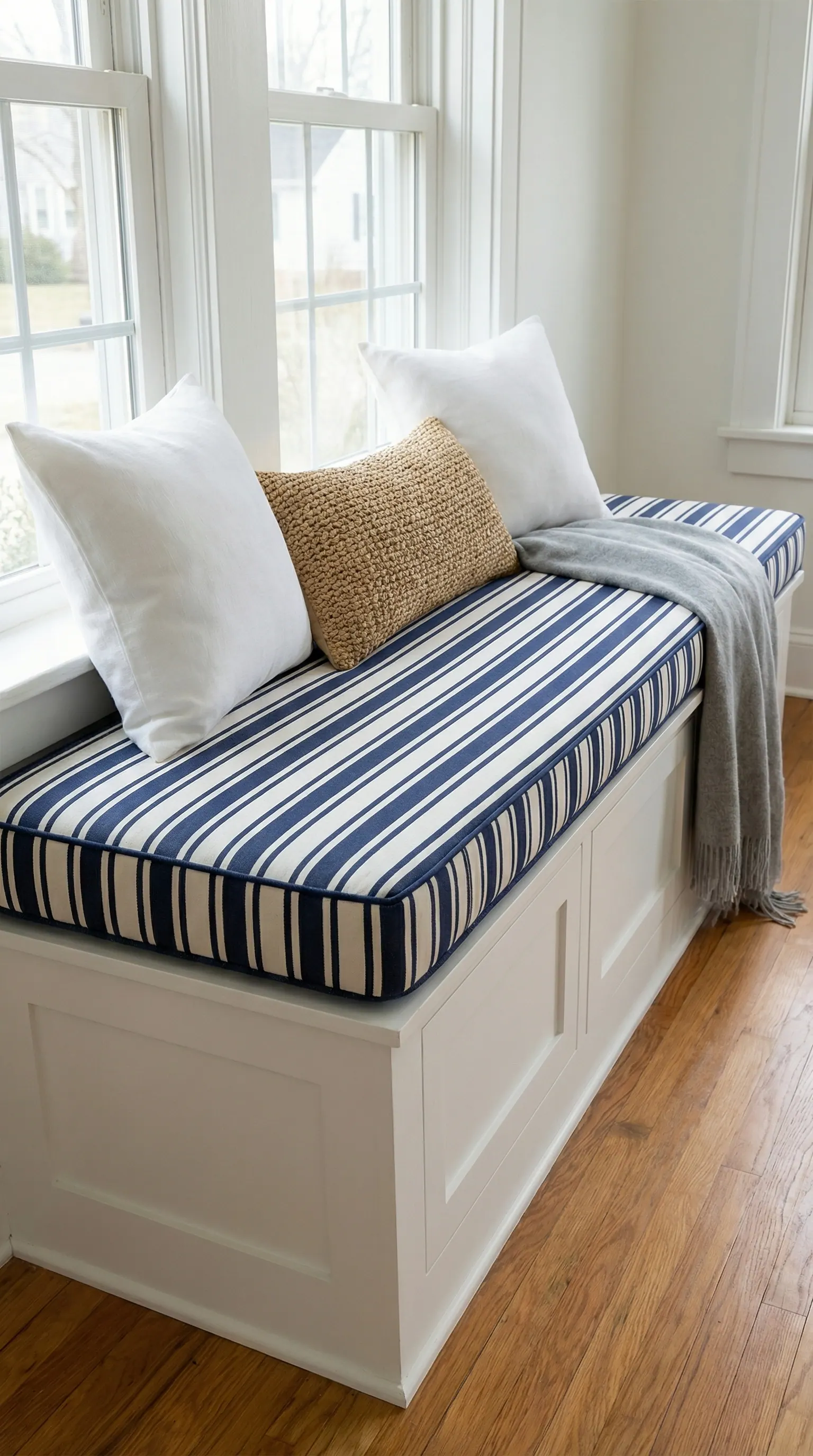
Rhode Island rooms borrow from the harbor: navy, oyster white, weathered cedar gray, a faded red. Ticking and awning stripes suit porches and cabins as much as parlors (striped cotton and ticking). Two cautions: cotton ticking stains more easily than a polyester weave, and solid navy piping may not exactly match the navy in a stripe.
| Seat | Fabric | Piping | Build note |
|---|---|---|---|
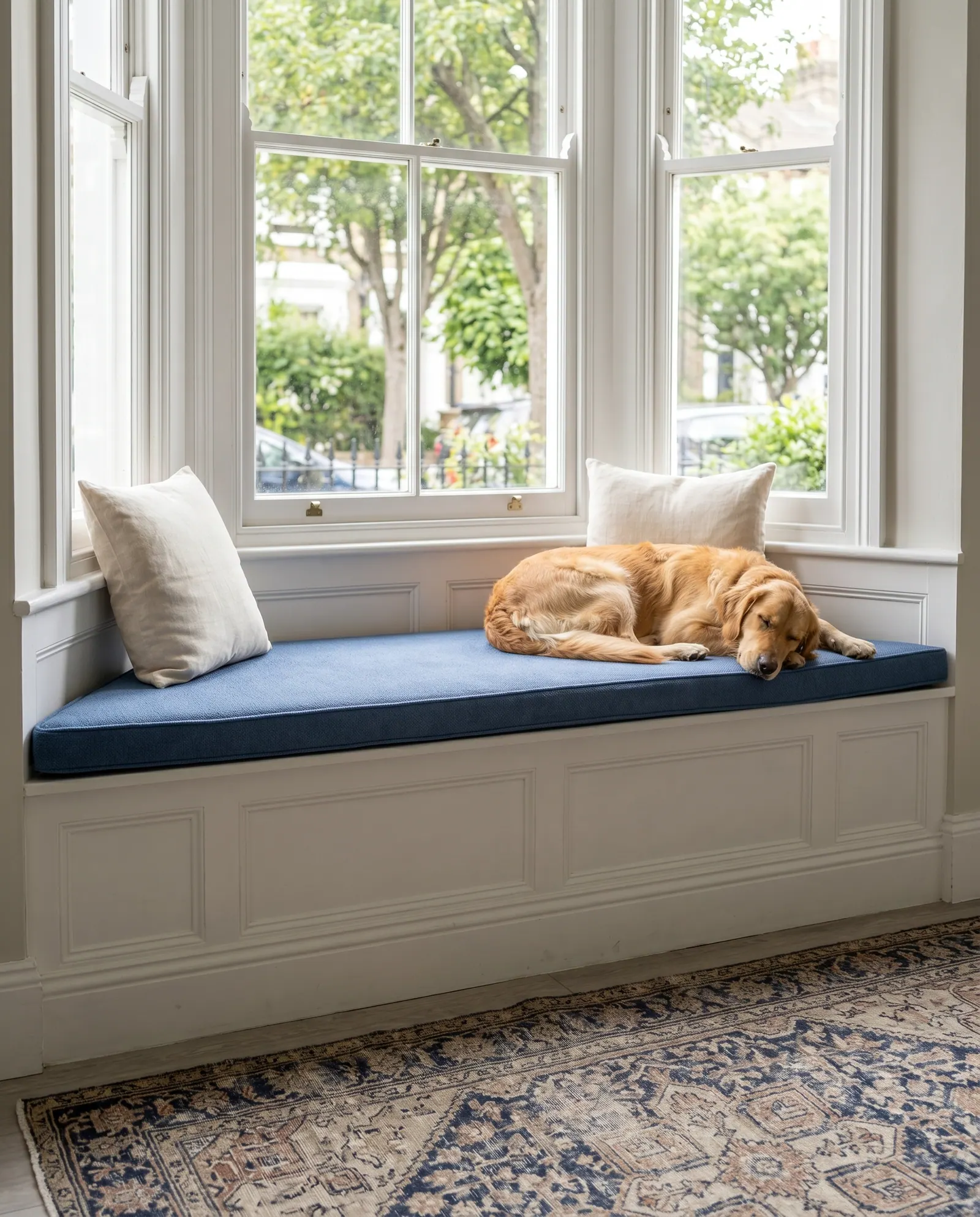
| Colonial window seat by single-pane glass | Velvet or soft performance fabric; both wipe clean | Self piping, or one contrast shade taken from the paneling | 3 in (7.5 cm) for a neat line; lift and air in winter |
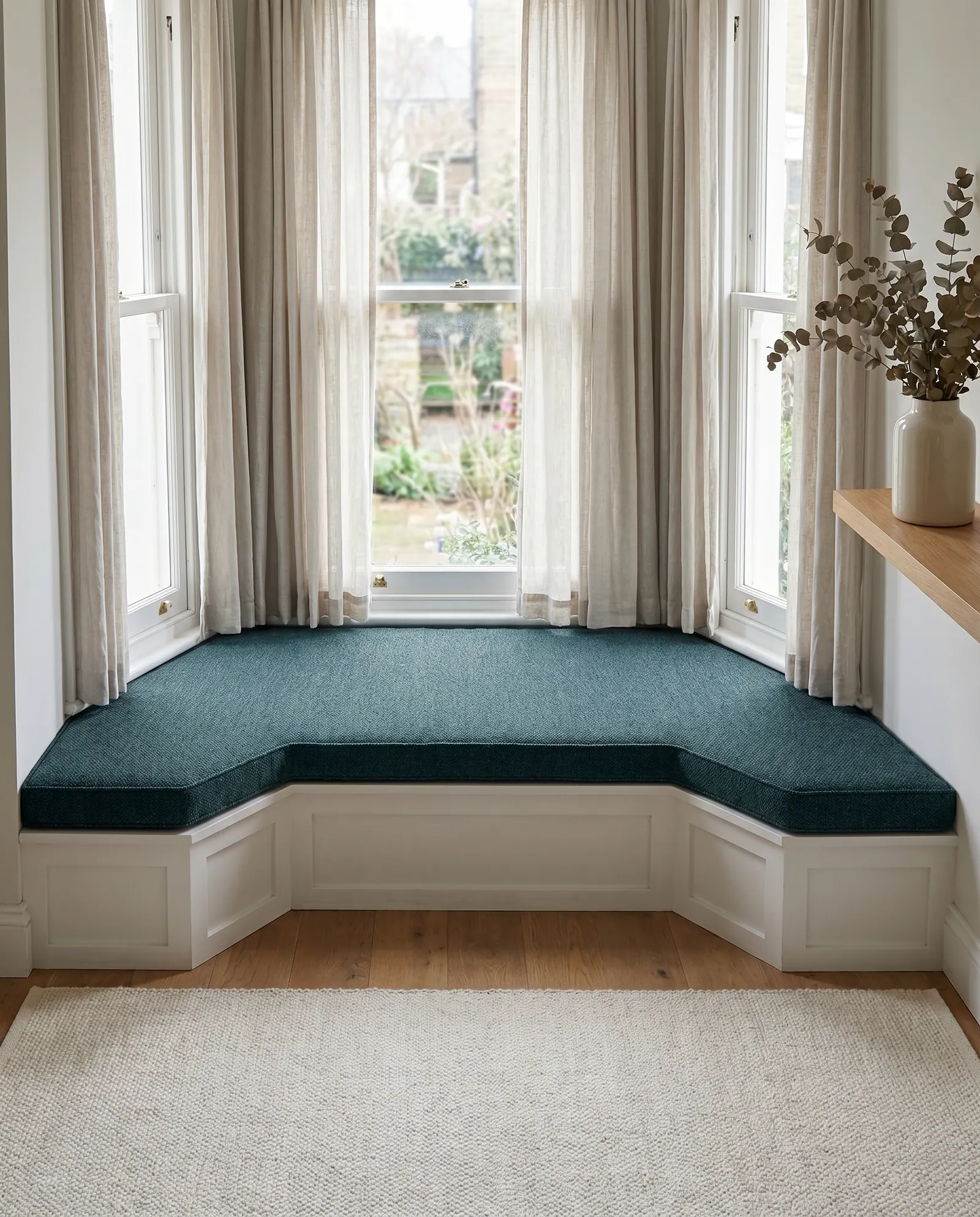
| Victorian bay seat | Linen-look or ticking stripe | Matched to a stripe, or the closest solid if the stripe is too thin | Trapezoid or several pieces, cut from a full drawing |
| Window seat with a lift-up lid | Soft fabric or velvet | Any | Ties on the hinge side only |
| Triple-decker front porch bench | Outdoor fabric, water-repellent and UV-resistant | Self piping; it reinforces the edges | Store dry before the first frost |
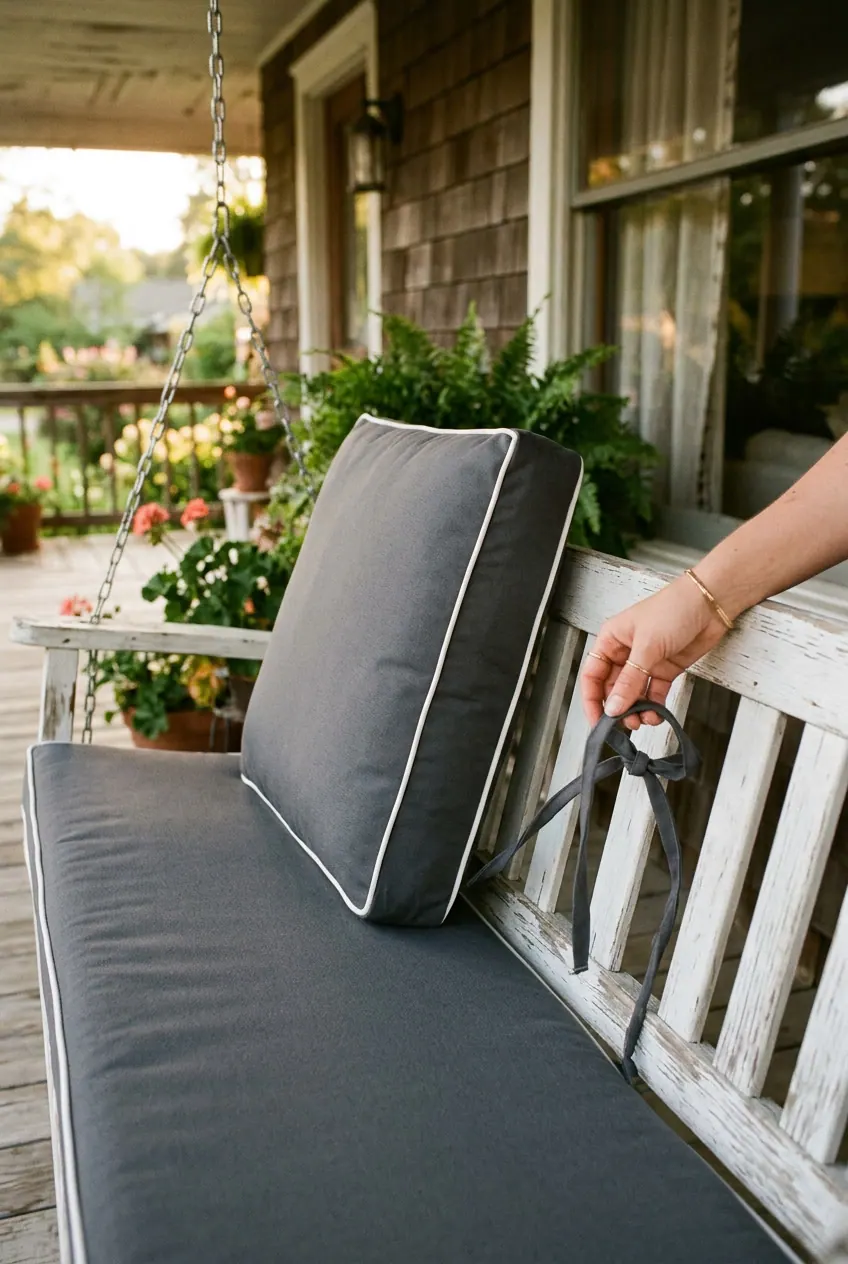
| Shingle cottage porch swing | Outdoor fabric | Self or contrast piping | Ties at the chains; non-slip base |
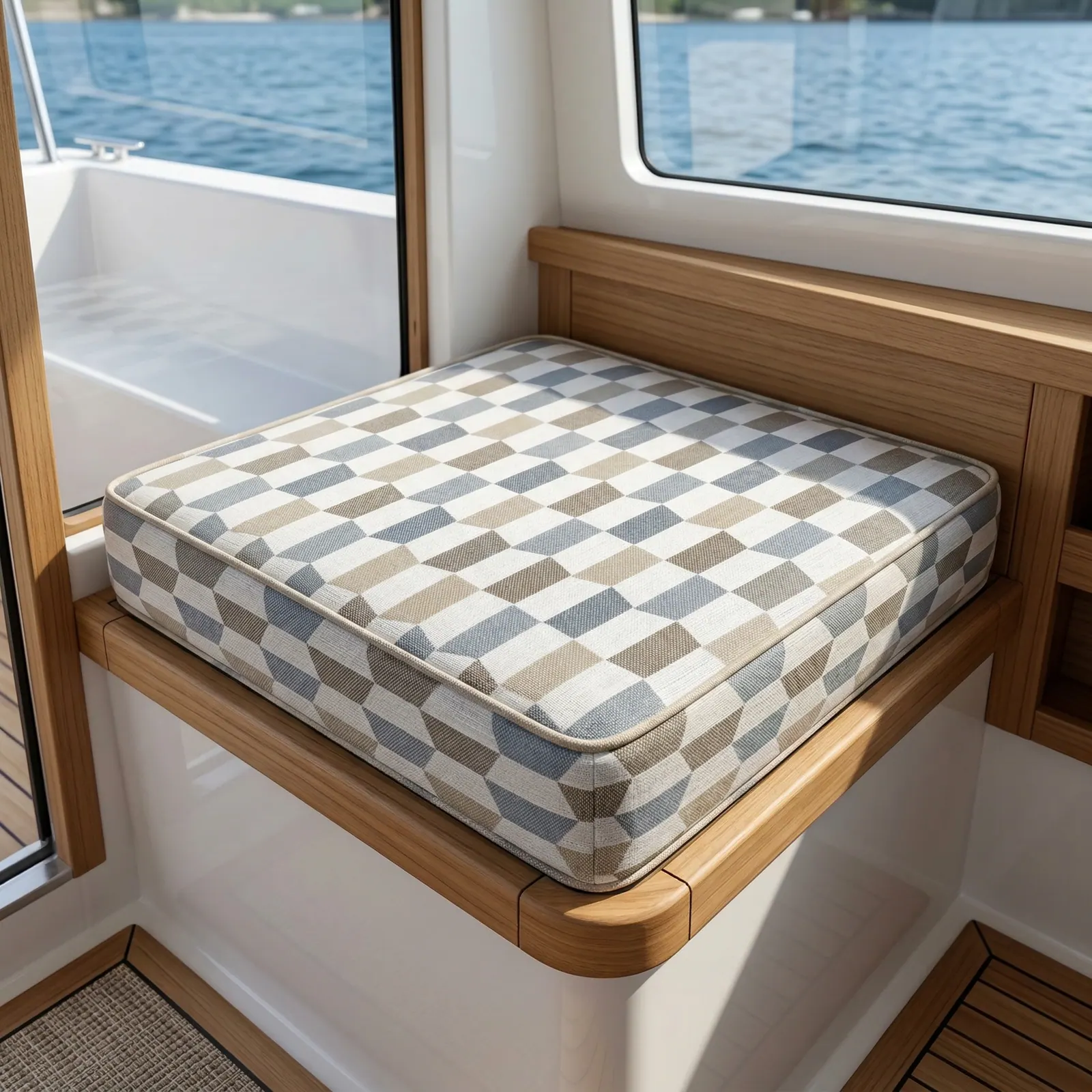
| Sailboat cockpit or cabin seat | Outdoor fabric | Self piping | Template from the boat; rinse hardware with fresh water |
Salt, frost and fogged glass: a Rhode Island calendar
- April: wash zip-off covers at 86°F (30°C) on gentle and air dry. Iron linen-look on low; it's synthetic and will melt under a hot iron.
- June 1 to November 30: hurricane season. Know where every porch and cockpit cushion goes if a storm is forecast.
- After every sail or blow: rinse zippers and hardware with fresh water and dry the cushion on its edge.
- Before the first frost: bring porch and boat cushions in clean and bone dry, and store them off concrete in something that breathes.
- December–March: when the window sweats, wipe the sill and lift the cushion. Dry within 24 to 48 hours.
Photographs for homes like these
Open any photograph large; each one has its own link and a Save button.
 Save
 Save
 Save
 Save
 Save
In an old Rhode Island bay the walls wander. The piping shouldn't. A straight welt is a kind of honesty.
Maggie
Buyer questions: slants, piping and hinged lids
- A common question
Are both slanted sides of a bay cushion the same? My measurements don't quite add up.
The workshop's answerMeasure both, because they can differ. Before cutting, the workshop checks that front, back, depth and sides close geometrically. A 68 in front, 40 in back and 17.25 in depth give slants of about 22 1/4 in, so a 21 in side flags an error and you're asked to re-measure every edge. If posts or moldings forced you to measure around them, say so, and a template comes back for your approval.
- A common question
Can the piping be the same fabric as the cushion, or can I skip piping altogether?
The workshop's answerAny of the three works: self piping in the same fabric, a contrast color, or no piping at all. For outdoor cushions the workshop recommends self piping, because it looks tailored and reinforces the edges.
- A common question
Why does the same piping look gold in one photo and yellow in another?
The workshop's answerLight and camera change it. In the workshop's own two photos, identical piping looked gold in one and not in the other, so no photo can promise how it will look in your room. That piping is closer to gold than yellow. Order swatches if the exact tone matters.
- A common question
Should my measurements include the piping?
The workshop's answerNo. Give the exact bench measurements, for example 48 x 21 in. The cushion is always cut to your bench size, and the piping sits on the seams, so it doesn't change the size.
- A common question
My window seat is a storage chest with a hinged lid. Can the cushion have ties on one side only?
The workshop's answerYes, on the hinge side, normally for a small extra charge. Write your exact size and a note such as 'ties on the hinge side' in the personalization box, give the position of each hinge measured from a stated end, and send a photo showing each hinge's width so the ties line up.

Have it made
Have it made for your home — ask Maggie’s workshop
I once cut a lovely cushion two inches short, and I have not forgotten it. That is why the workshop goes over your measurements with you on the phone. — Maggie
Leave your details and the workshop will call you to confirm measurements, fabric, foam and piping. No prices, dates or payment on this page: it is a request, not an order.
Rhode Island questions
Why does my Rhode Island window seat cushion get damp in winter?
Condensation. Warm room air meets cold single-pane glass, the window sweats, and water collects on the sill and the cushion. The EPA advises drying wet surfaces quickly; within 24 to 48 hours most materials won't grow mold. Wipe the sill, stand the cushion on edge, and choose a washable or wipe-clean fabric.
Can I use indoor linen or velvet on a Newport porch or a boat?
No. Linen and velvet stay indoors; porch, dock and cockpit cushions are made in outdoor fabric, which is water-repellent and UV-resistant rather than waterproof. Salt spray is heaviest near the waves but has sped up corrosion 5 to 10 miles inland, so rinse zippers and hardware with fresh water.
Should a long colonial window seat have one cushion or two?
Either can work. Very long seats are often split into equal pieces, such as a 154.5 in seat made as two 77.25 in cushions, which are easier to handle. One continuous piece can also be made if you'd rather have no seam. Over a radiator, split it so the heat can escape.
What thickness suits an old window seat?
Most buyers choose 3 or 4 in. Three inches (7.5 cm) gives a neat, low line that suits a paneled colonial seat; 4 in (10 cm) gives more cushioning. The thinnest standard option is 2 in (5 cm), useful under a low sill or beside an obstruction such as a wall unit.
Stitch straight — Maggie
The atelier
Keep going
Across the Map
Nearby places
Close by on the map