 Save
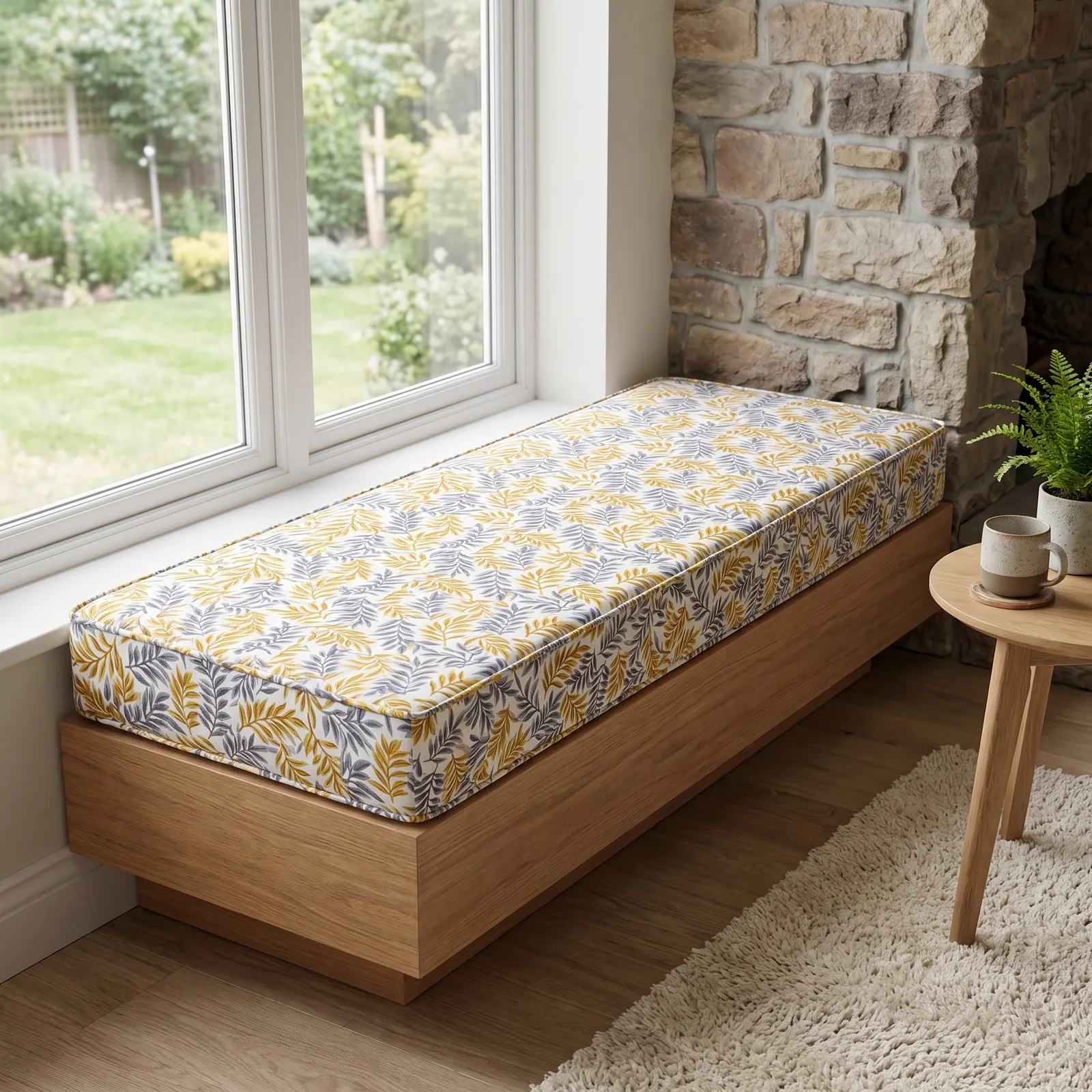
- Leaf print with self piping
The piping is covered in the print itself, so the fronds run right to the seam.
- Stone chimney breast
Mustard in the print warms the stone, while gray fronds match its mortar.
- Mug on oak table
A side table with a coffee cup tells you this is a morning seat by the window.
- Fern
Real leaves beside a leaf print make the pattern feel like an extension of the garden.
- Shaggy rug
A soft cream rug balances the hard stone and hard oak on either side.
Plate Mustard and Gray Leaf Print Seat on an Oak Plinth by the Fireplace
A frond print in mustard and slate carries the garden view indoors and softens the rough stone of the chimney breast.
A Reading by RosaWindow Seat Cushions
A mustard and slate leaf-print window seat cushion on a floating oak bench
Rosa reads a low oak plinth by a stone chimney and takes up the question every window bench raises sooner or later: how thick should the cushion be for the seat under it?

The quick answer
On a low window seat, choose cushion thickness by the finished seat height and the depth, not by habit. Plinth height plus cushion thickness is where you actually sit, and a deep seat carries a thicker cushion without looking bulky. Four inches is the standard, and a medium box cushion keeps a low floating bench reading like a daybed.
Pinned by Rosa: five things by the chimney
Five pins, from the self-piped fronds to the shaggy rug that softens all that stone.
The numbers match the pins on the plate.
- Leaf print with self pipingThe piping is covered in the print itself, so the fronds run right to the seam.
- Stone chimney breastMustard in the print warms the stone, while gray fronds match its mortar.
- Mug on oak tableA side table with a coffee cup tells you this is a morning seat by the window.
- FernReal leaves beside a leaf print make the pattern feel like an extension of the garden.
- Shaggy rugA soft cream rug balances the hard stone and hard oak on either side.
Why a low plinth wants a medium cushion
Pull up a chair, because this window seat cushion is doing sums. The oak plinth floats off the floor and sits low, and a low bench forgives nothing. Too thin a pad and it reads like a shelf with a placemat on it. Too tall and the seat climbs toward the glass and crowds the view of the lawn.
Here the box cushion is medium-thick, and the whole piece reads like a daybed. The rule underneath is plain arithmetic: plinth height plus cushion thickness is your real seat height. Measure the wood from the floor, add the foam, and picture yourself sitting at that number before you order. How high does your bench sit off the floor? The seat height calculator does the adding, and window seat cushion thickness walks through the choices.
Depth counts too. A deep seat carries a thicker cushion without looking bulky, while a shallow ledge looks top-heavy under the same foam. The standard is 4 in (10 cm), and most folks are happy there.
Then the print. Mustard warms the stacked stone, slate gray picks up the mortar and the window frames, and self piping lets the fronds run right to the seam. A plain fabric would have argued with that chimney; a small print that repeats its colors makes peace with it.
The props give the seat a job: a mug on a round oak table for morning coffee, a real fern beside the printed fronds, and a shaggy cream rug between hard stone and hard oak. More long seats live under window seat cushions, and more prints and stripes under striped cotton and ticking.
Proportion checks before you order
- Measure the plinth from the floor, then add the cushion: that total is your seat height.
- Measure the depth from the wall to the front edge at a right angle, not on a slant.
- On a low, floating bench, go medium rather than slim so it reads like a daybed.
- On a very long run, plan two equal pieces instead of one.
- Choose color from real samples in your own window light.
A 154.5 in run, cut in two
A buyer in the US wrote to the workshop with warm beige walls, dark wood furniture and a long living-room window bench, plus a trapezoid seat at the side. The shop suggested a dark olive velvet to sit with her sofa. She ordered samples first, which I would tell my own sister to do, and chose one velvet for the body and another for the piping.
The shop gave her a fair warning with that pairing: the same piping can look gold in one light and yellow in another. Daylight on a sample card, not a screen, settled it.
The main run measured 154.5 in (392 cm), so it was made as two equal cushions of 77.25 in (196 cm) each. The trapezoid came to 95.5 in (243 cm) across the base and 24 in (61 cm) deep. Two pieces are easier to lift, turn and zip back into their covers than one long one, neighbor, and a seam in the middle is honest about the length.
If a window bench is low and floats off the floor, a medium-thick box cushion keeps it reading like a daybed instead of a shelf with a pad on it.
Rosa
Buyer questions: sizes, flat arrivals and slanted sides
- A common question
What does a made-to-measure bench or window seat cushion run?
The workshop's answerIt depends on size and fabric, and the quote states the shipping cost for your address. Real quotes have run from a 10 x 38 x 5 in linen pad and a 79.25 x 11 in linen seat up to a tufted 23 x 84 x 4 in corduroy cushion. Send your size and fabric and the shop prices it.
- A common question
My cushion arrived shorter than I ordered and the bolster looks flat. Is something wrong?
The workshop's answerProbably not. Cushions and pillows are vacuum-packed for shipping, so they arrive compressed and can measure short or look deflated. Give the foam about 48 to 72 hours, sometimes 3 to 4 days, to expand, then measure again. If it is still off, send a photo of the tape on it so the shop can see what went wrong.
- A common question
Do I have to measure the slanted sides of my bay seat?
The workshop's answerNot really. The bottom length, top length, depth and any straight end pieces fix the slant, and the shop calculates it to check your numbers. A 90 in bottom, 52 in top, 27 in depth and 6 in straight ends give a slant of about 28 in (71 cm): 19 in across and 21 in up. So a measured 24 in means another number is wrong. A tape run along an old cushion's slant usually reads 1 to 1.3 in long because it follows the curve.
On the cutting table: the leaf-print bench
| Cushion | Rectangular window seat cushion, box edge |
|---|---|
| Fabric | Cotton canvas leaf print in mustard, slate gray and cream |
| Piping | Self piping, cut from the print |
| Base | Low floating oak plinth under a picture window |
| Thickness | Medium; 4 in (10 cm) is the standard |
| Neighbors | Stacked stone chimney breast, round oak side table |
| Props | Mug on a saucer, fern in a white pot, cream shaggy rug |
| Best for | A morning coffee seat by a garden window |

Have it made
Have this made — ask Rosa’s workshop
Every good cushion I know started with a long porch chat. This is the short version: leave your number and the workshop will call. — Rosa
Leave your details and the workshop will call you to confirm measurements, fabric, foam and piping. No prices, dates or payment on this page: it is a request, not an order.
Questions buyers ask next
How much does cushion thickness add to the height of a window seat?
Inch for inch. The cushion sits on top of the base, so a 4 in cushion on a plinth adds 4 in to where you sit, a little less once the foam settles under you. Measure the base from the floor and add the thickness before you order.
Does a leaf print work next to a stone fireplace?
It can, when the print repeats the stone's colors. Here mustard warms the stone and slate gray matches the mortar, so pattern and chimney agree. A plain fabric in a color the stone does not hold tends to fight such a strong material.
Is self piping or contrast piping better on a busy print?
Self piping, most of the time. Cut from the same print, it lets the pattern run right to the seam and keeps the edge quiet, so the print carries the look. Contrast piping suits plain fabrics, where the edge line has nothing to compete with.
Porch light's on — Rosa
More photographs to read
 Save
 Save
 Save
 Save
 Save
 Save