CushionGuide

A Reading by RosaWindow Seat Cushions

A Pinstripe Window Seat Cushion in a Home Office: Where to Spend and Where to Save

A built-in seat, a cream-ground stripe and three quiet props. Rosa reads it for the long haul: what earns its keep for years, and what you can borrow from the shelf.

The quick answer

On a window seat cushion meant to last, spend on the fit, the thickness and a cover you can take off, and save on styling by using what the room already holds. This built-in office seat is about 4 in (10 cm) thick, in a cream pinstripe with a self-piped edge, styled only with a vase, books and one linen pillow.
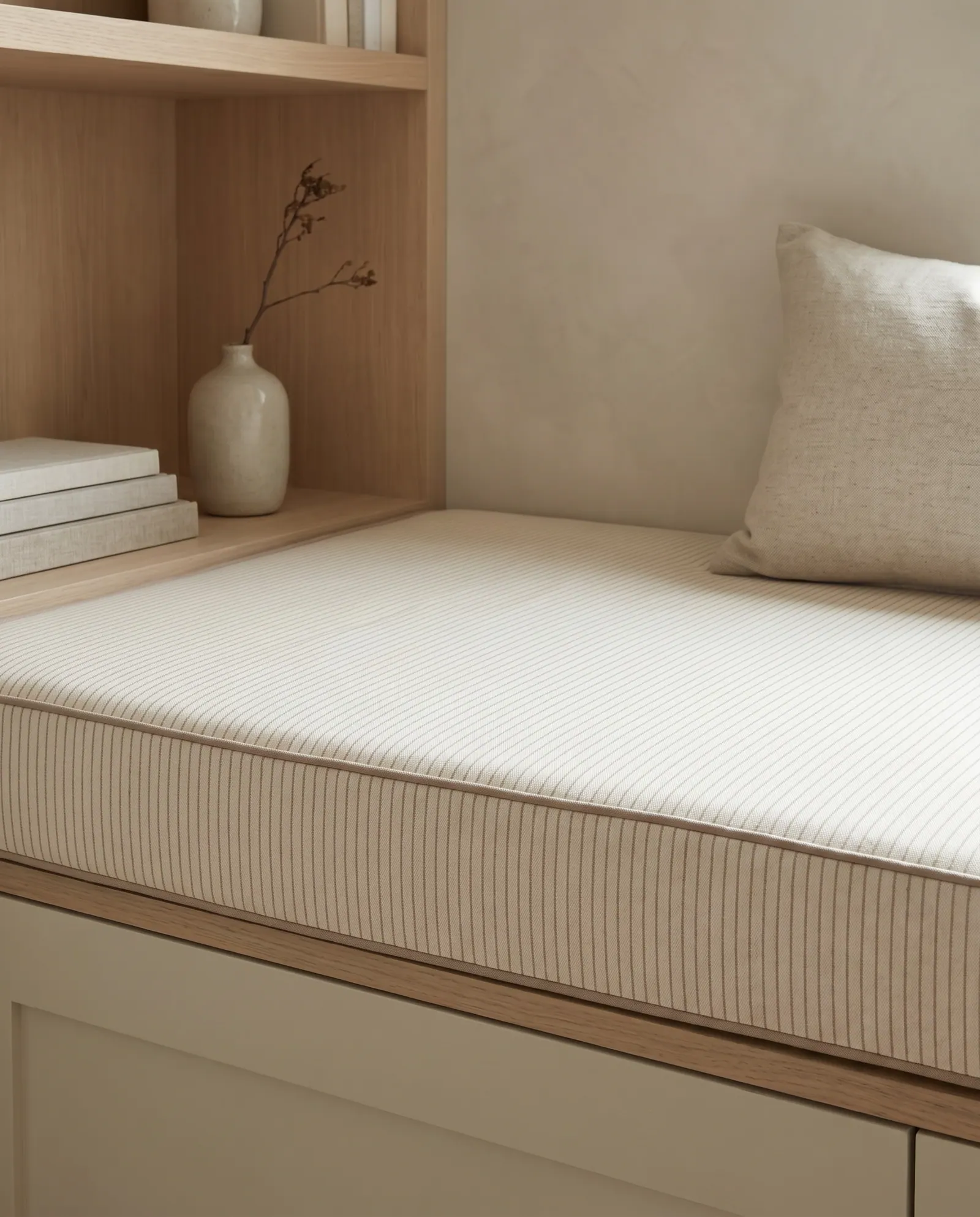
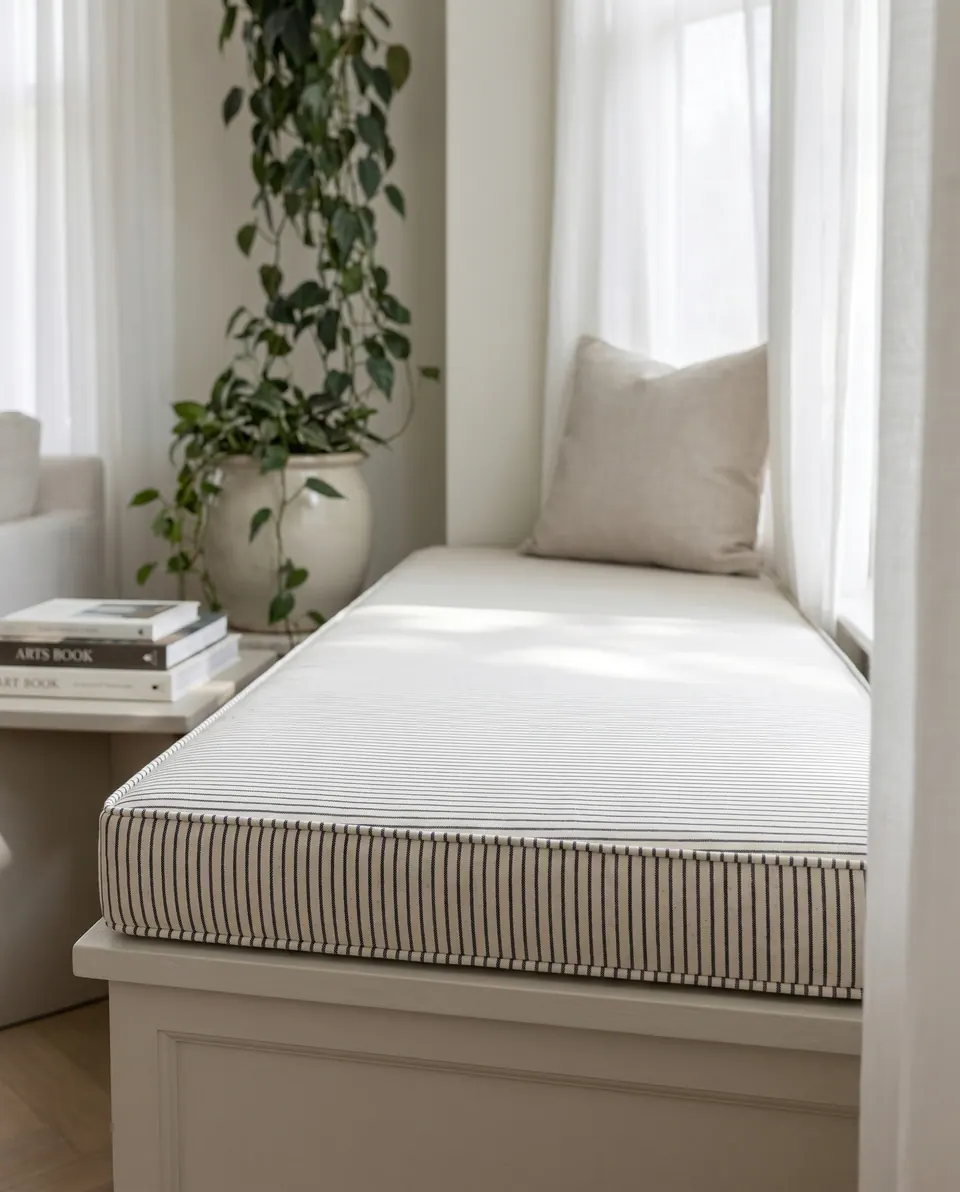
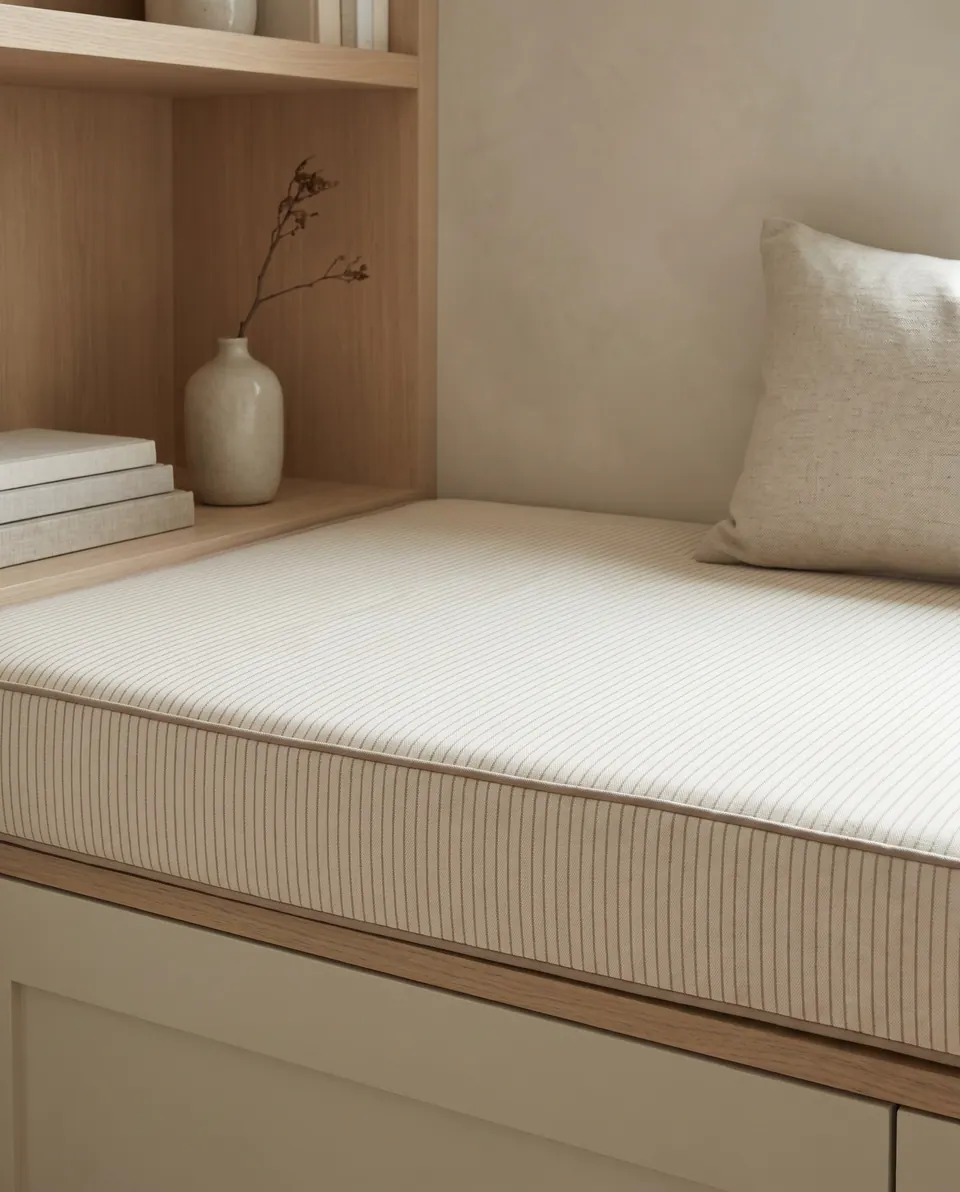
Deep cream and taupe pinstripe cushion on a built-in seat beside oak shelves with a stoneware vase and oatmeal pillowSave
A cream-ground pinstripe keeps a built-in office seat calm enough to read on between calls.

Pinned by Rosa: pillow, vase, books, edge and oak lip

Five pins across the seat, from the linen pillow at the wall end to the thin oak lip under the cushion.
Pinned: Deep cream and taupe pinstripe cushion on a built-in seat beside oak shelves with a stoneware vase and oatmeal pillow
  1. oatmeal linen pillow

    A single textured pillow at the wall end turns the seat into a reading spot between calls.

  2. stoneware bud vase

    Dried stems in a cream vase match the stripe's ground and need no upkeep.

  3. linen-bound books

    Cloth-bound books in the same neutrals keep the shelf from pulling focus.

  4. self-piped front band

    The thin piped edge echoes the thin oak lip beneath the cushion.

  5. oak cabinet lip

    A taupe velvet piping could pick up the darker stripe and this oak line even more sharply.

  1. oatmeal linen pillowA single textured pillow at the wall end turns the seat into a reading spot between calls.
  2. stoneware bud vaseDried stems in a cream vase match the stripe's ground and need no upkeep.
  3. linen-bound booksCloth-bound books in the same neutrals keep the shelf from pulling focus.
  4. self-piped front bandThe thin piped edge echoes the thin oak lip beneath the cushion.
  5. oak cabinet lipA taupe velvet piping could pick up the darker stripe and this oak line even more sharply.

Where to spend and save on a window seat cushion

Part of the seatSpend or saveWhy
Exact fit and a complete drawingSpendA cushion that fits is the one you keep; a wrong size is the costliest mistake
ThicknessSpendThe thickest standard option is 6 in (15 cm); choose it once, for how long you sit
Two pieces on a long trapezoidSpendTwo pieces fit more snugly and come off more easily for cleaning
Self pipingSaveNo second fabric to buy or match later, and the edge still looks tailored
Styling propsSaveA vase, books and one pillow the office already had
A quiet stripeSpend a little thoughtA cream-ground pinstripe sits with oak and plaster through several paint colors

Reading the seat: a stripe that only looks gray

Neighbor, people read this stripe as gray in photos, but on the cloth it is a cream ground with a beige-taupe line. That is why it melts into pale oak and plaster so easily, and why it will still look right after the next paint color. It belongs to our striped cotton and ticking family, the quiet end of it.

The cushion sits on a putty-painted cabinet base with an oak top, beside open oak shelving. It is a window seat cushion working as an office seat, about 4 in (10 cm) thick and box-edged, with a thin self-piped front band. That thin line echoes the thin oak lip beneath it: two parallel strokes, one fabric, one wood.

The styling cost nothing extra, and that is the lesson. A cream stoneware bud vase with dried stems matches the stripe's ground and needs no water. A stack of linen-bound books in the same neutrals keeps the shelf from pulling focus. A single oatmeal linen pillow at the wall end turns the seat into a reading spot between calls. Everything here would sit on an office shelf anyway.

Where would I spend a little more? On the edge. A taupe velvet piping could pick up the darker stripe and that oak line more sharply, and it suits this cloth. The piping Pattern weighs self against contrast.

A real project

A symmetric bay, drawn so well nobody had to redraw it

A buyer sent the workshop millimeter-precise measurements of a symmetric bay window seat: front 72 3/4 in (1847 mm), back 47 in (1195 mm), depth 22 1/4 in (565 mm), and the two angled sides about 25 5/8 in (652 mm) each, with angles of 60 degrees at the front and 120 degrees at the back. They wanted a 3 in (7.6 cm) cushion with a non-slip base and self piping.

The geometry closed, so no redrawing was needed. The workshop simply told them which size ranges to pick: width 20 to 25 in (51 to 64 cm) and length 70 to 75 in (178 to 191 cm).

That drawing was the best-spent hour of the whole project. Front, back, depth and either the angles or the side lengths fully define a symmetric trapezoid, and a complete drawing saves a round of questions. The trapezoid cushion calculator checks your numbers before you send them.

Buyer questions: one piece or two, and how thick is too thick

  1. A common question

    My trapezoid window seat is about 79 in (200 cm) long. Should I get one big cushion or two smaller ones?

    The workshop's answer

    The workshop recommends two. On a trapezoid, the angled sides can make one long piece bend or shift, while two pieces look neater, fit more snugly and are easier to take off and clean. One piece is still possible: one was drawn with sides A 24 in (61 cm), B 24 in (61 cm), C 81 in (206 cm), D 58 in (147 cm) and E 21 5/8 in (55 cm), with self piping.

  2. A common question

    Can you make an extra-thick window bench cushion, around 6 1/4 in (16 cm)?

    The workshop's answer

    The thickest standard option is 6 in (15 cm), only about 3/8 in (1 cm) less, and it still gives a deep, sofa-like feel. One cushion of 70 x 22 7/8 in (178 x 58 cm) was quoted at that thickness.

On the cutting table: the office seat

PieceBuilt-in window seat cushion
FabricCream-ground pinstripe with a beige-taupe line
ThicknessAbout 4 in (10 cm)
EdgeBox edge
PipingSelf piping, thin front band
Upgrade to considerTaupe velvet piping
PropsBud vase, linen-bound books, one oatmeal linen pillow
Best forHome offices and reading corners
Before orderingA complete drawing with every side

Order this cushion

Have it made

Have this made — ask Rosa’s workshop

Swings sway, rockers rock, dogs circle three times. Tell the workshop what your seat goes through, and they will plan for it. — Rosa

Leave your details and the workshop will call you to confirm measurements, fabric, foam and piping. No prices, dates or payment on this page: it is a request, not an order.

Fabric · Foam · Pipingwhat the workshop will confirm with you

Fabric
Cream-ground pinstripe with a beige-taupe line
Foam
The core: its density and thickness set the feel.
Piping
Self piping, thin front band
Only for this request: no marketing calls or texts. Outside the US, add the country code.
In inches: length × depth × thickness, plus any angles or cut corners.

* Required. A member of the workshop team will call you to talk it through; nothing is charged and nothing is made until you have agreed on every detail with them.

We use these details only to answer this request and make your cushion: your name and contact details, the cushion details and photos you send, the page you came from and the ad or link that brought you, if any. The workshop that makes the cushions receives them. We don't sell them or share them for advertising, and we delete requests after 24 months. Privacy notice for requests.

Nothing is made or charged until you approve the details.

Want to pick the shape and add photos? Use the full quote form

The best money on a window seat cushion goes into a complete drawing: front, back, depth and the angles, so nobody has to guess before cutting.

Rosa

Questions buyers ask next

Is a thicker window seat cushion worth it?

If the seat is for long reading or sitting, thickness is where comfort lives. The thickest standard option is 6 in (15 cm), which feels deep and sofa-like; thinner pads suit seats that are used only in passing.

What is self piping, and when should I choose it?

Self piping is a welt made from the cushion's own fabric. It gives a tailored edge without adding a second color, which suits quiet stripes like this cream pinstripe. Contrast piping is the choice when you want the outline drawn.

Why does a cream stripe look gray in photos?

Cameras and screens often cool warm neutrals. On the cloth, this stripe is a cream ground with a beige-taupe line. Ask for a swatch and look at it in daylight before settling on a neutral stripe.

Porch light's on — Rosa