 Save
A Reading by ÉlodieBench Cushions
An ochre tiger collage bench cushion, and the props that answer it
A white entry, a cobalt clock, a yellow coat stand and a tiger on the bench. Élodie reads every object on the wall and tells you which ones to borrow.

Swatch strip measured from the photograph
- sand#af9b8627%
- sand#c3b6a524%
- chestnut#6f605620%
- linen#cfc9c318%
- linen#e2ddda11%
The quick answer
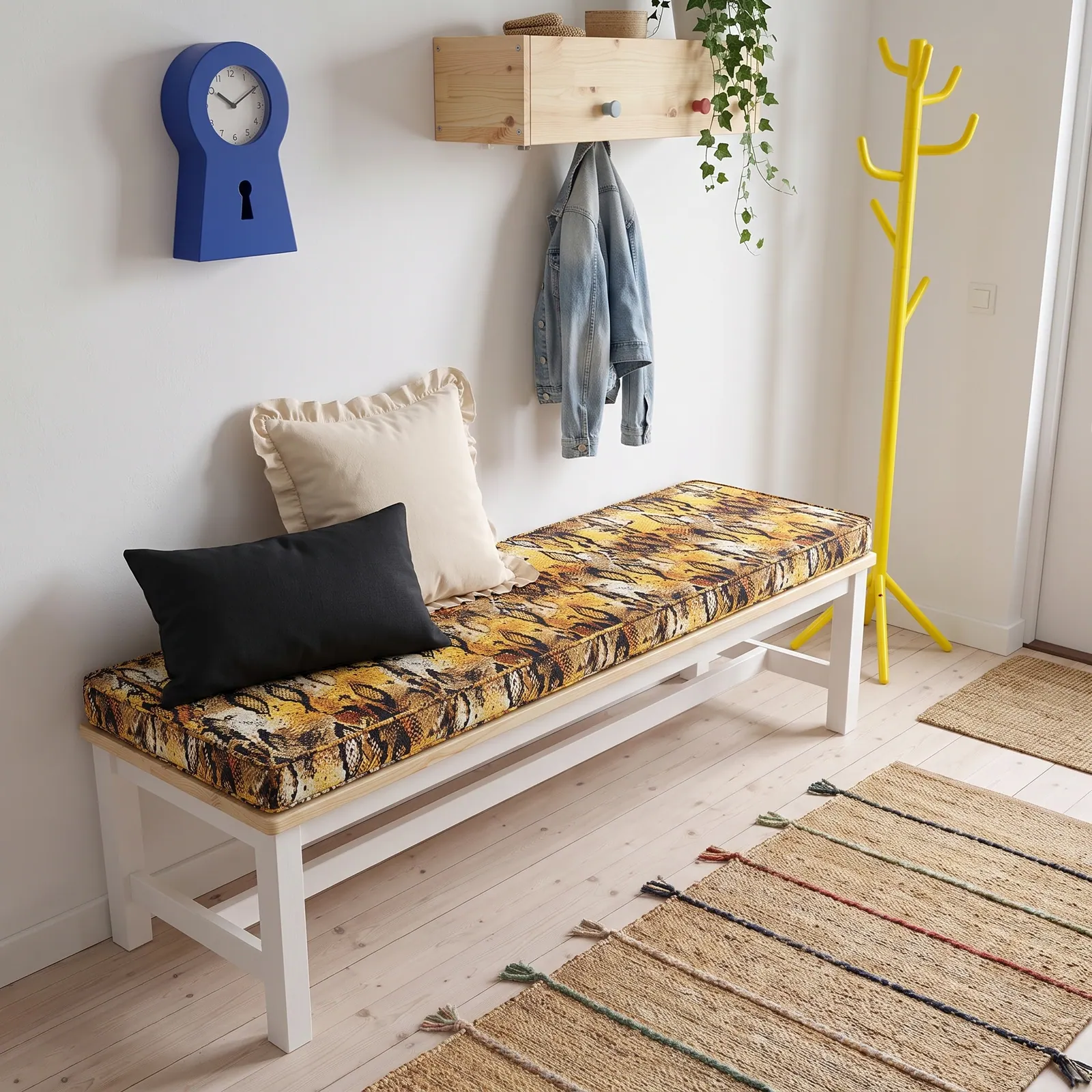
A bold print bench cushion works in an entryway when the props around it take their colors from the print. Here an ochre tiger collage sits between a cobalt clock and a yellow coat stand, a black oblong pillow in front of a cream ruffle keeps the seat clear for shoes, and jute runners repeat the tan.
Swatch strip: seven colors from one entry wall
- Tiger ochre#C98A2EThe print's main voice, set between cobalt and yellow.
- Collage black#1F1C1AThe darkest stripes, repeated in the oblong pillow.
- Keyhole cobalt#2350A6The clock's blue makes the ochre read warmer.
- Branch yellow#F0BE2CLifted from the brightest patch of the print.
- Jute tan#BE9B68The runners repeat the print's tan in a rougher texture.
- Tassel orange#E0772FSmall echoes of the print along the floor.
- Ruffle cream#F2EBDDA soft pause behind the black pillow.
Why every prop on this wall stays
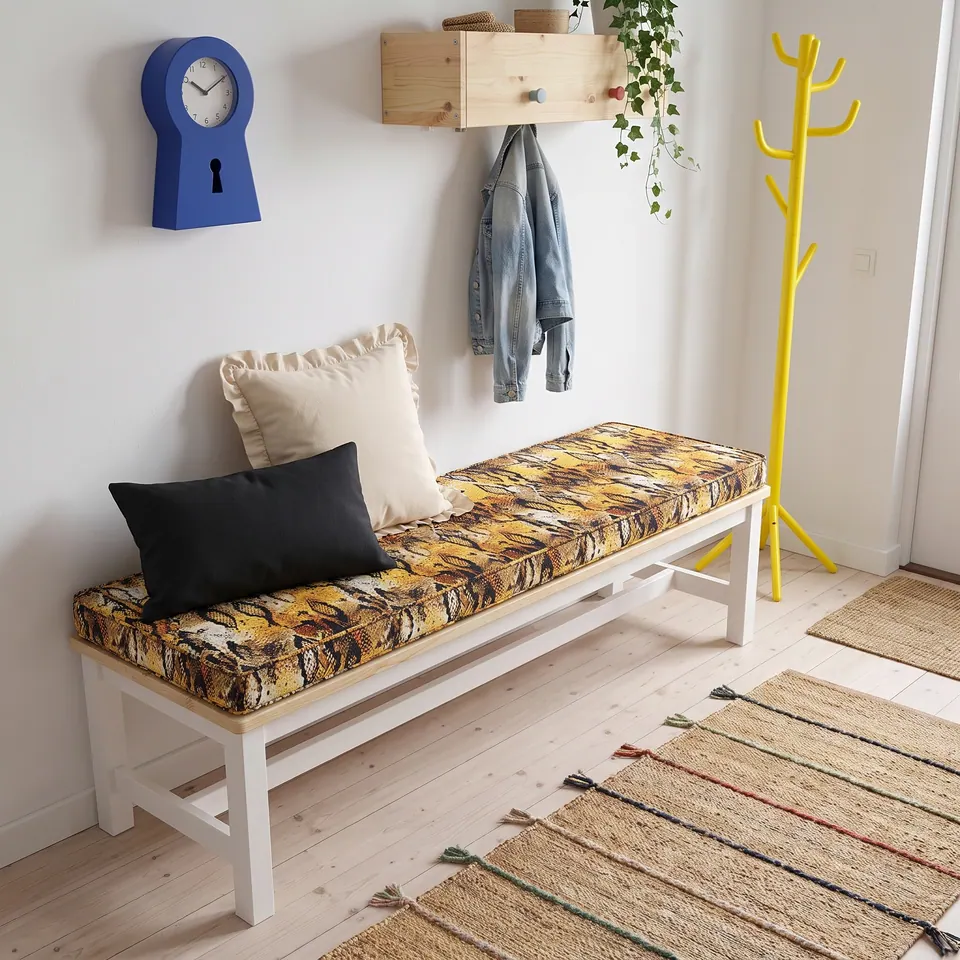
Start with the cushion. An ochre and black tiger collage on cotton canvas, box-edged, with self piping cut from the print, so the outline is drawn by the pattern itself and not by a contrast cord. It runs the full length of the white bench, end to end, and the tiger never looks cut short.
Now the wall. A cobalt keyhole clock hangs high on the left; a yellow branch coat stand holds the right. Two loud colors, and the tiger print sits between them as the middle note. Cobalt pushes the ochre warmer. The yellow is lifted straight from the brightest patch of the print. Let one color speak and the others listen: here the print speaks, and the clock and the stand answer.
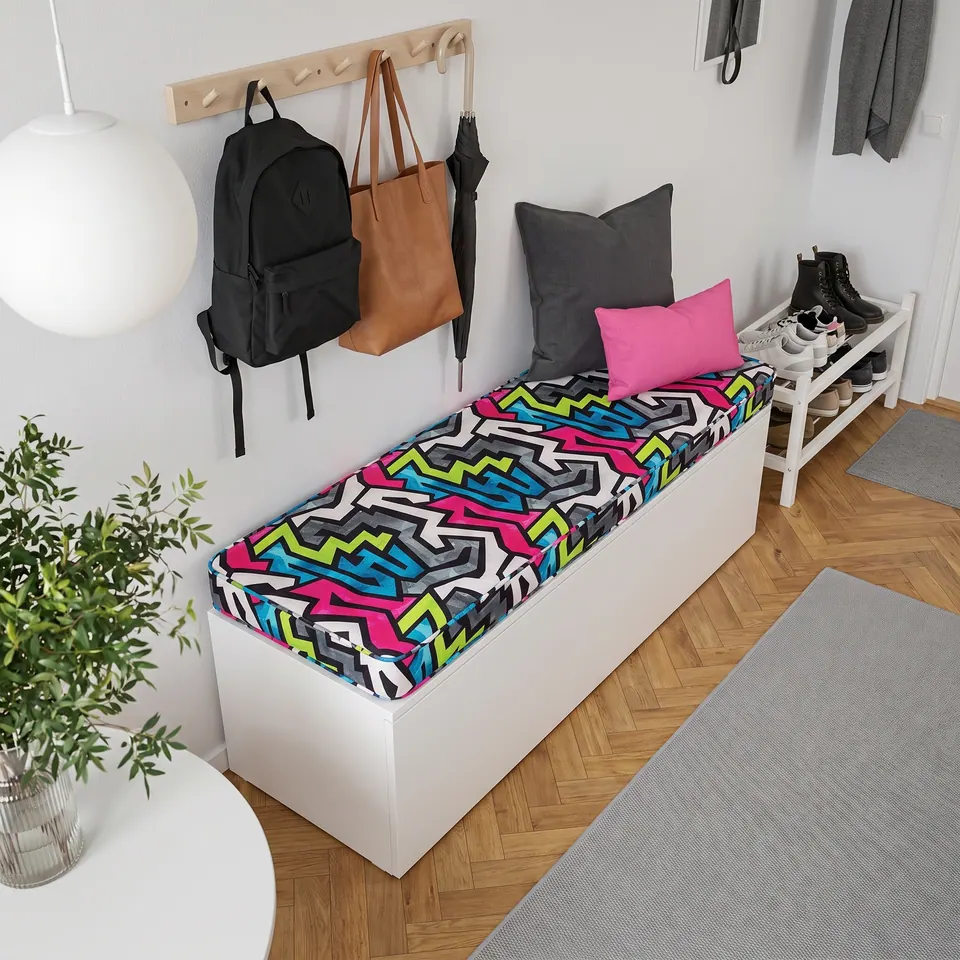
The pillows are chosen for use before looks. A cream ruffled pillow leans at the back for softness. A black oblong pillow sits in front of it, low and flat, so there is still a seat to perch on while you pull on boots. The black repeats the darkest stripes of the tiger, so it never looks like an afterthought. The lumbar and throw pillow pattern explains the pairing.
The pine wall box with knob hooks holds a denim jacket, which tells you this is a working entry, not a staged one. Denim is a washed blue that bridges the cobalt and the white wall. The trailing pothos brings the only green, a small cool counterweight to all that warmth. Tasselled jute runners on the pale pine floor repeat the print's tan and orange in a rougher, quieter texture.
Bright white daylight does the rest, and daylight never lies the way a screen can; check any print against your own window with the screen versus daylight pattern.
To copy it: if you already own one bright accessory, choose a print that contains that color and one next to it on the color wheel. Then take the pillow colors from the print's darkest and lightest notes. What is the loudest thing already hanging in your entry, my friends?
Pinned by Élodie: five props and their reasons
Five pins, from the cobalt keyhole clock to the tasselled jute runner at the bench's foot.
- Ochre tiger collage
The print sits between the cobalt clock and the yellow stand and ties the wall together.
- Cobalt keyhole clock
Its strong blue makes the ochre print look even warmer.
- Yellow coat stand
The yellow is taken from the brightest part of the print.
- Black oblong pillow
It sits in front of the ruffle so the seat stays usable for pulling on shoes.
- Tasselled jute runner
Colored tassels repeat the print colors in a quieter texture.
- Ochre tiger collageThe print sits between the cobalt clock and the yellow stand and ties the wall together.
- Cobalt keyhole clockIts strong blue makes the ochre print look even warmer.
- Yellow coat standThe yellow is taken from the brightest part of the print.
- Black oblong pillowIt sits in front of the ruffle so the seat stays usable for pulling on shoes.
- Tasselled jute runnerColored tassels repeat the print colors in a quieter texture.
Two backrests where the shoulders go
A buyer wrote to the workshop about a bench that ran along a window, with a wall at each end. The obvious plan was one long backrest, 59.5 in (151 cm), across the window.
They asked for something else: two backrest pillows, 25 in (63.5 cm) wide each, set against the end walls. The shop confirmed the arrangement and noted that the pillows stand about 15.75 in (40 cm) tall. The buyer had forgotten to list the color codes, so the shop added them to the order after it was placed.
A backrest belongs where people lean, not only along the longest wall. In an entry that is often the corner, where you sit sideways to tie a shoe. The back cushion height pattern helps size them, and the mudroom bench sketches show more layouts.
Buyer questions: thickness, slanted sides and quotes
- A common question
Which thickness should I choose for a bench or window seat, and does thicker cost more?
The workshop's answerStandard options are 2, 3, 4 and 5 in (5, 7.5, 10 and 12.5 cm), all at the same price. Most buyers choose 3 or 4 in: 3 in gives a neater, lower profile on a window seat, and 4 in gives more cushioning. The listing photos are mostly 3 to 4 in, and the default seat is about 4 in (10 cm).
- A common question
Do I have to measure the slanted sides of my bay window seat myself?
The workshop's answerNot really. The bottom length, top length, depth and any straight end pieces fix the slant, and the shop calculates it to check your numbers. A 90 in (229 cm) bottom, 52 in (132 cm) top, 27 in (69 cm) depth and 6 in (15 cm) straight ends give a slant of about 28 in (71 cm): 19 in across and 21 in up. A measured 24 in slant would mean another number is off. Taping along an old cushion usually reads 1 to 1.3 in long, because the tape follows the curve.
- A common question
What would a custom bench cushion cost in my size?
The workshop's answerIt depends on size and fabric, so each one is quoted on its own. Real quotes have covered an 18.5 x 11.5 x 4 in (47 x 29 x 10 cm) linen pad with piping, a 17 x 73.5 in (43 x 187 cm) bench cushion, a 22 x 60 x 4 in corduroy seat and a pair at 62.375 and 45.5 in long, both 16.5 in deep and 3 in thick. Send length, depth, thickness and fabric for a price.
On the cutting table: the tiger bench
| Product | Entryway bench cushion |
|---|---|
| Fabric | Ochre and black tiger collage print on cotton canvas |
| Edge | Box edge |
| Piping | Self piping in the print |
| Fit | Full length of the bench, end to end |
| Thickness choices | 2, 3, 4 or 5 in (5 to 12.5 cm), same price |
| Most chosen | 3 or 4 in (7.5 or 10 cm) |
| Pillows | Cream ruffle behind, black oblong in front |
| Best for | Mudrooms and entries where people sit to put on shoes; more in bench cushions |

Have it made
Have this made — ask Élodie’s workshop
A fabric reads one way at noon and another at dusk. Mention your light, and the workshop will weigh it with you. — Élodie
Leave your details and the workshop will call you to confirm measurements, fabric, foam and piping. No prices, dates or payment on this page: it is a request, not an order.
An entryway bench cushion still has to seat someone. A low black oblong pillow set in front of a ruffle keeps the seat clear for pulling on boots.
Élodie
Questions buyers ask next
How do I choose pillows for an entryway bench?
Choose for use first. Keep one low, flat pillow in front, such as a black oblong, so there is room to sit and pull on shoes, and one softer pillow behind it. Take both colors from the cushion print's darkest and lightest notes.
What print works beside a bright blue clock or a yellow coat stand?
Pick a print that already contains one of those colors and a neighbor on the color wheel. Here the tiger collage carries ochre, tan and yellow, the coat stand takes its yellow from the print, and the cobalt clock makes the ochre look warmer.
Does a bold print bench cushion need contrast piping?
Not usually. On a busy print like this tiger collage, self piping cut from the same fabric lets the pattern draw the outline. A contrast cord would add one more line to a surface that already has plenty.
Can backrest pillows sit at the ends of a bench instead of along the back?
Yes. One buyer skipped a single 59.5 in (151 cm) backrest and ordered two 25 in (63.5 cm) wide pillows, about 15.75 in (40 cm) tall, for the two end walls, where people actually lean.
With color and care — Élodie