A Reading by ÉlodieBench Cushions
A black awning-stripe entryway bench cushion, and why its piping is cut from the same stripe
Élodie's notebook on a back-door bench in black-and-cream awning stripe: three ways to finish the edge, and why the same stripe wins here.

 Save
The quick answer
On a wide black-and-cream awning stripe, self piping cut from the same fabric is usually the right edge for an entryway bench cushion, because the stripe runs straight over the edge without a second outline. Contrast black piping frames the box more heavily; no piping softens it. Whichever you choose, restate the final body and piping codes in one message.
Notebook, morning light: a stripe that reads from the doorway
Broad stripes are the loudest thing you can put by a back door, and the most useful.
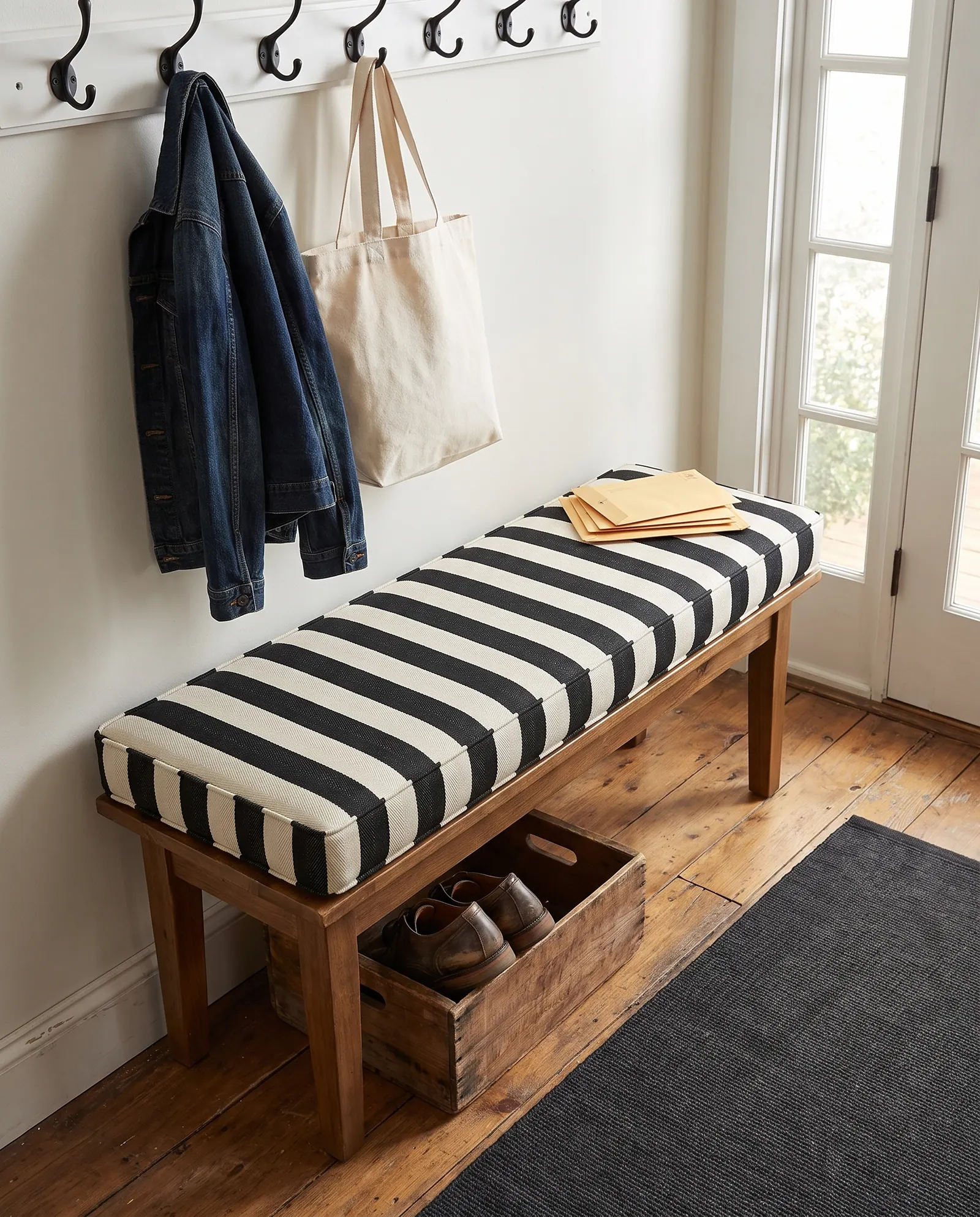
The photograph: a pine bench on tapered legs, a sunny glazed French door beside it, wide pine planks underfoot. On the bench sits a box cushion in soot black and unbleached cream, the stripes running front to back and falling straight down the front gusset. It is the first thing you see as the door swings open.
Every prop has a job, my friends. - Black iron hooks on a white rail hold a denim jacket and a canvas tote. Their black is the stripe's black, so the scheme looks decided rather than found. - Kraft envelopes dropped on the seat tell the truth about an entry bench: it holds envelopes and parcels as often as it holds a person. - A wooden crate underneath takes the leather shoes, so boots never sit on the cushion. - A charcoal doormat grounds all that stripe at floor level.
The box cushion has enough spring for unlacing boots, and the stripes hide what a back door brings in. Let one color speak and the others listen: black speaks here; pine, cream and denim listen.
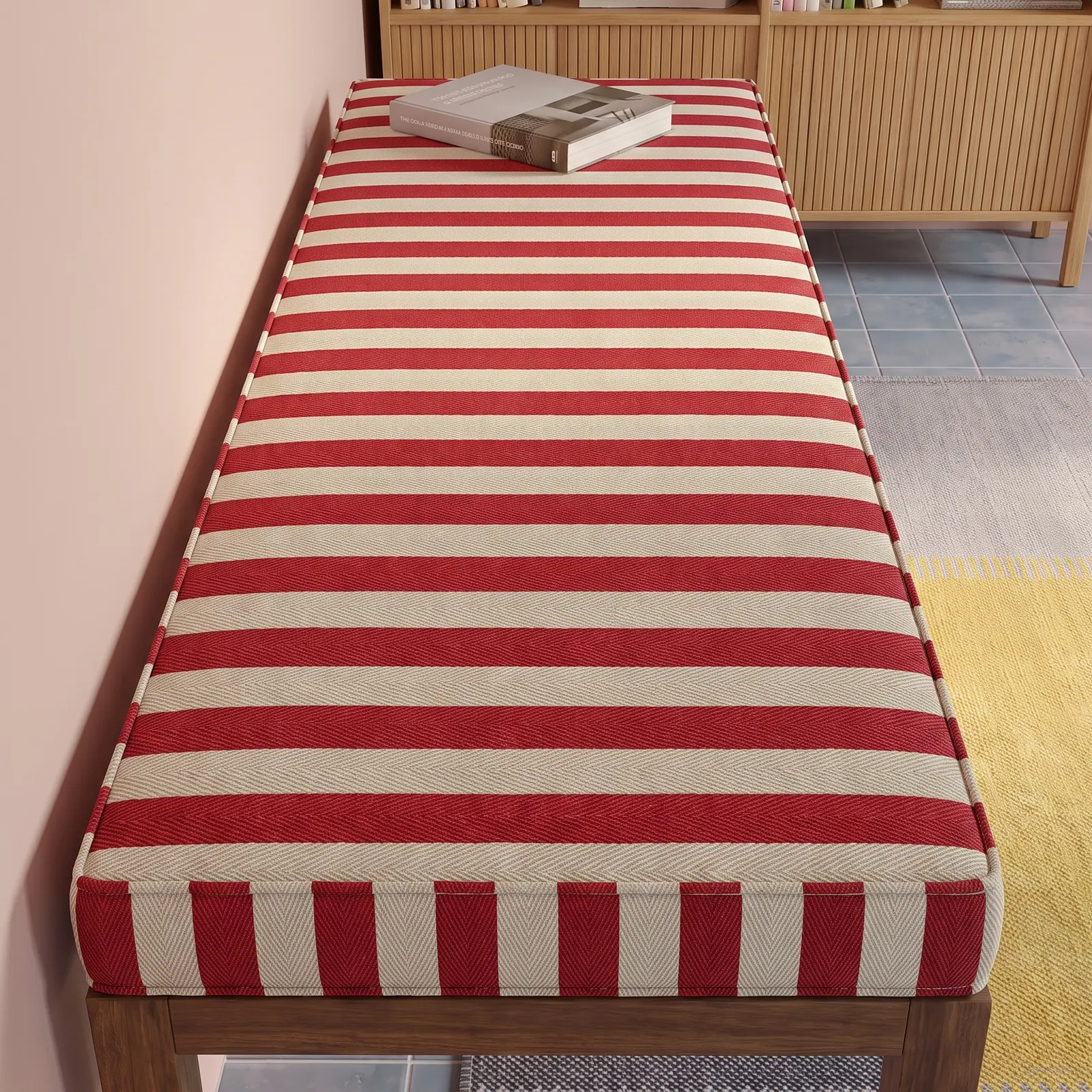
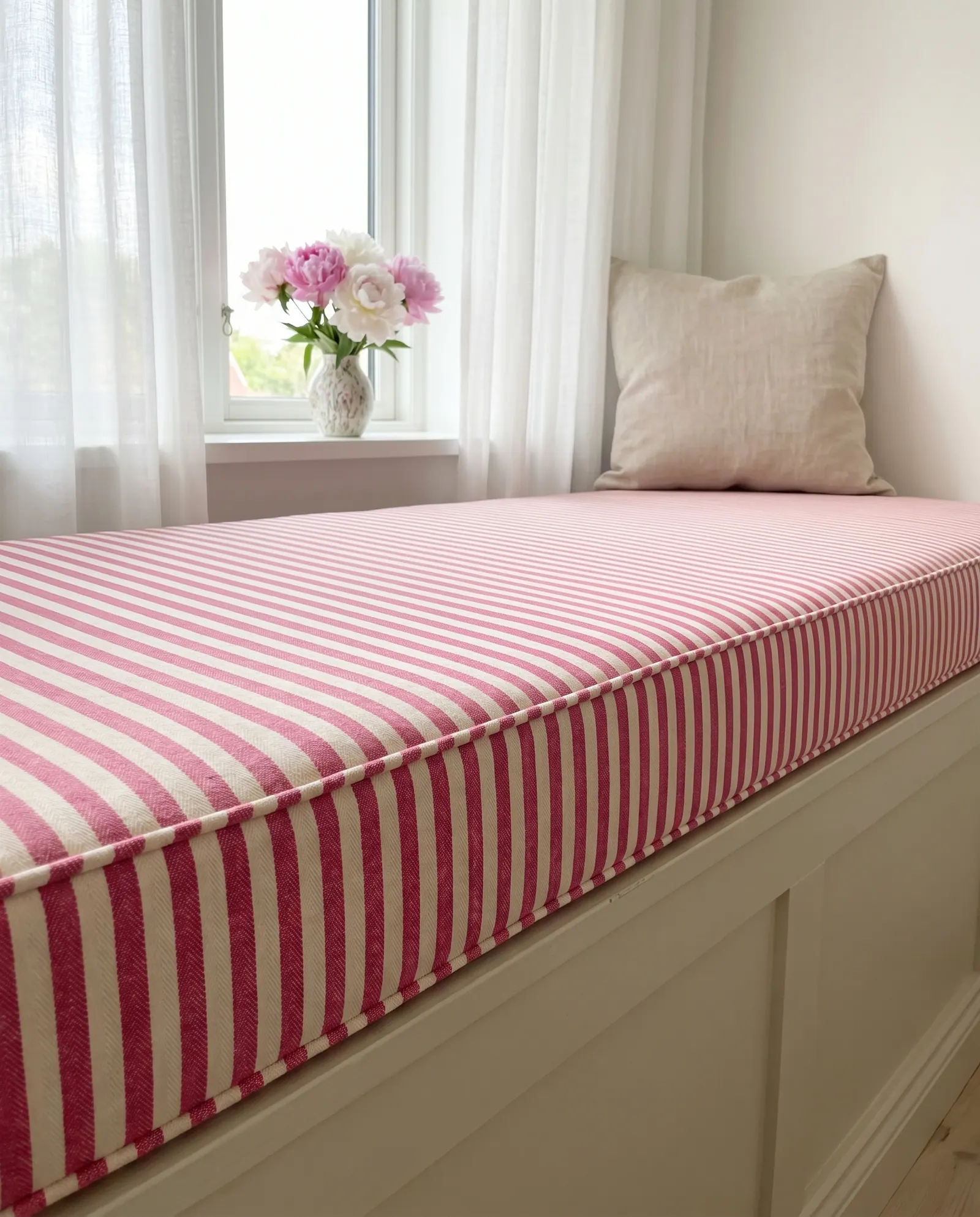
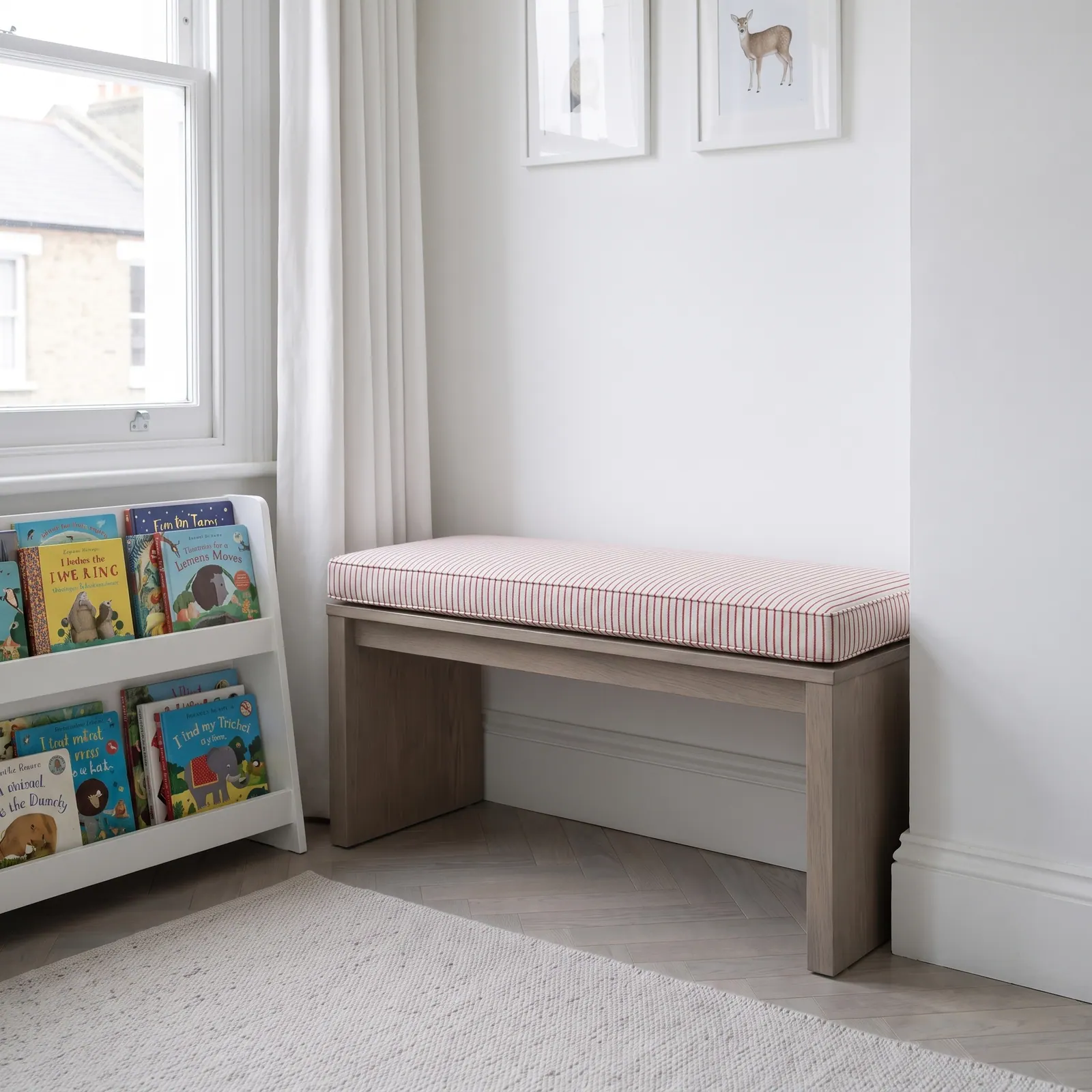
Now the edge. Piping is a pencil line drawn around a cushion. On a plain linen, a contrast cord is often the best idea in the room. On a broad awning stripe the pattern is already drawing lines, so a solid black cord would be a second drawing over the first. Self piping keeps the eye on the stripe and lets the box read as one shape from the doorway. Want an outline anyway? Choose cream, the lighter color, so the edge whispers.
Which would your own doorway ask for? Compare them in matching, contrast or no piping, check which way a stripe should run, and browse mudroom and entryway bench cushions and the striped cotton and ticking shelf.
Notebook table: three edges on one awning stripe
| Edge finish | What it does to the line | On a wide black-and-cream stripe |
|---|---|---|
| Self piping, same stripe | Finishes the edge without adding a new line | The stripe carries on over the edge; the box reads as one clean shape |
| Contrast piping, solid black | Draws an outline around the whole box | A second black line on a pattern already full of black; heavier and more formal |
| Contrast piping, cream | A soft outline in the lighter color | Frames the box gently without competing with the stripe |
| No piping, plain seam | Softer, rounder edge | Relaxed and cottage-casual; the box looks less crisp from across the room |
Pinned by Élodie
Five pins, from the awning stripe on the seat to the charcoal doormat that anchors it.
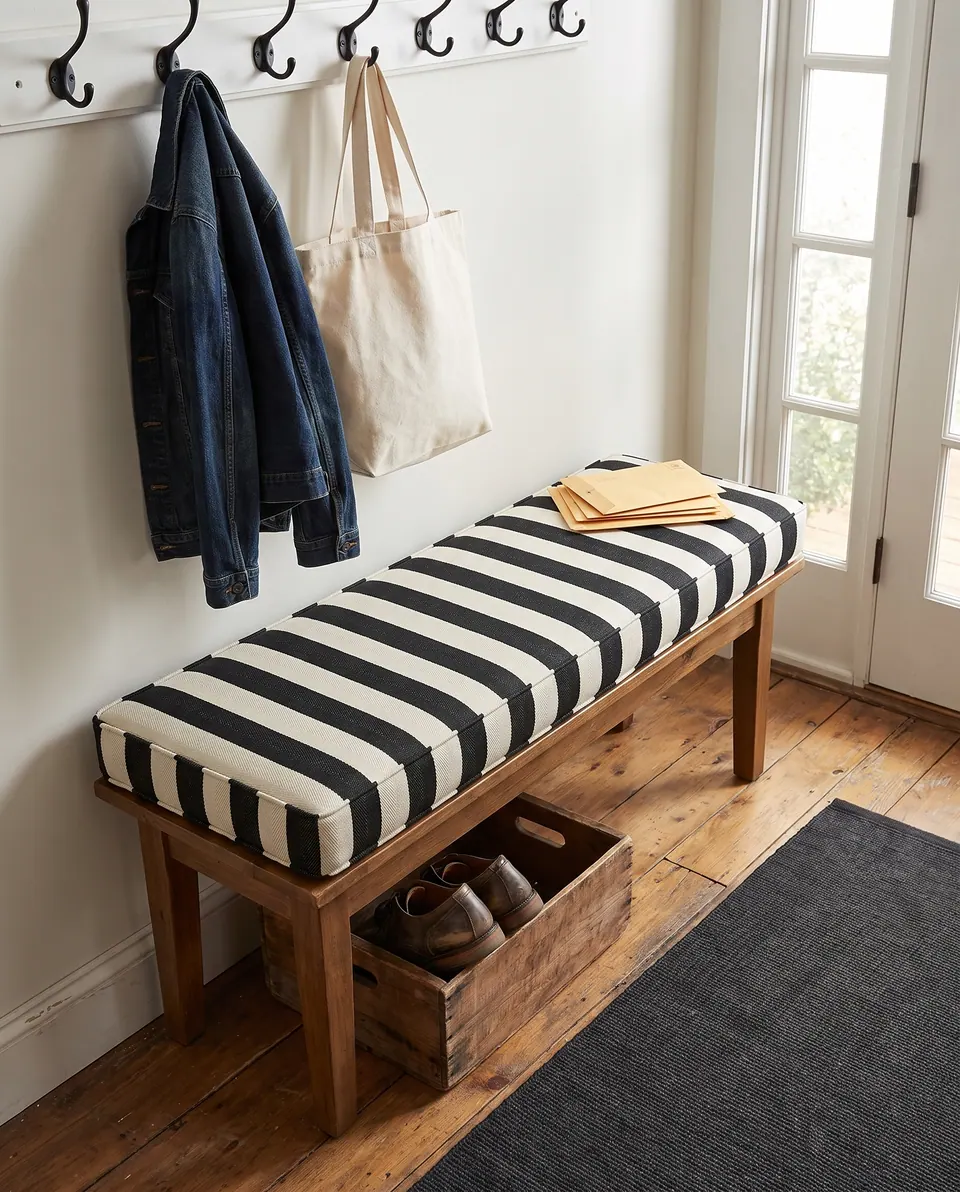
- Black awning stripe
Wide black-and-cream stripes read from across the room and hide everyday marks.
- Kraft envelopes
Post dropped on the seat shows how an entry bench is really used.
- Denim on iron hooks
Black hooks repeat the stripe's black, making the scheme look deliberate.
- Crate for shoes
A wooden crate under the bench keeps shoes off the cushion.
- Charcoal doormat
A dark mat underfoot grounds the strong stripe.
- Black awning stripeWide black-and-cream stripes read from across the room and hide everyday marks.
- Kraft envelopesPost dropped on the seat shows how an entry bench is really used.
- Denim on iron hooksBlack hooks repeat the stripe's black, making the scheme look deliberate.
- Crate for shoesA wooden crate under the bench keeps shoes off the cushion.
- Charcoal doormatA dark mat underfoot grounds the strong stripe.
A second fabric in the messages, a floral cover in the box
A buyer got in touch about a bench cushion and, somewhere in the conversation, asked about a second fabric. The order was meant to be velvet T-312. What arrived was a floral cover.
The workshop first read the floral as a mix-up over a free gift, then checked and confirmed it had simply used the wrong fabric. It remade only the cover, in the fabric the buyer circled on a photo, and moved the order to the front of the line.
The lesson I copy onto every notebook page: when a conversation has wandered through several fabrics, finish with one clear line. Body fabric, code. Piping fabric, code. Nothing else. For a two-fabric cushion, that single line is the order.
Buyer questions: angled bays, L-shaped benches and back cushions
- A common question
My bay window has angled sides. How do I get a price for a shape like that?
The workshop's answerAngled bay shapes are priced through the trapezoid template listing. Pick the size closest to yours to see the price, for example a seat 47 in (120 cm) along the back, 14 in (35 cm) deep and 54 in (137 cm) along the front, then write the exact dimensions, thickness and fabric in the personalization box.
- A common question
For an L-shaped bench, is one connected cushion better than two separate ones?
The workshop's answerFor large sizes, two separate cushions work better: they are easier to handle and sit more neatly than one connected piece. Each is ordered at its own size, so subtract the overlap where they meet in the corner, or one piece comes out too long.
- A common question
How do I order a back cushion to go with my seat cushion?
The workshop's answerOrder each piece as its own item, adding the backrest at its own size through the same listing. If the back has the same dimensions as a seat piece, order two of that size and note which one is the back. An item with two different sets of measurements is paused until you confirm which is right.
On the cutting table: the back-door bench
| Cushion | Single box bench cushion |
|---|---|
| Fabric | Wide black-and-cream awning stripe in cotton |
| Piping | Self piping, cut from the same stripe |
| Stripe direction | Front to back, straight down the front gusset |
| Edge | Box edge with enough spring to sit and unlace boots |
| Bench | Pine, tapered legs, open underneath |
| Under the bench | Wooden crate for shoes |
| Order line | Final body code and piping code, restated in one message |
| Best for | Back-door entries and mudrooms |

Have it made
Have this made — ask Élodie’s workshop
Color is easier to settle in a conversation than on a screen. Tell the workshop about the room and the light it gets, and the fabric choice follows. — Élodie
Leave your details and the workshop will call you to confirm measurements, fabric, foam and piping. No prices, dates or payment on this page: it is a request, not an order.
On a wide awning stripe, pipe the bench cushion in the same stripe; a solid black cord adds a second outline the pattern never needed.
Élodie
Questions buyers ask next
Does contrast piping suit a striped cushion?
It can, but it works best on narrow stripes or when the cord matches the lighter stripe. On a broad black-and-cream awning stripe, a solid black cord adds a heavy second outline, so self piping or no piping usually looks cleaner.
What keeps an entry bench cushion looking clean?
Give shoes their own place. A crate or basket under the bench keeps boots off the seat, a dark doormat catches grit before it travels, and a patterned or darker fabric hides the everyday marks a back door brings in.
What should my final message say after discussing several fabrics?
One closing line with the final body fabric code and the final piping code. A buyer who had asked about a second fabric once received a floral cover instead of velvet T-312; a restated code prevents exactly that.
With color and care — Élodie
More photographs to read
 Save
 Save
 Save
 Save
 Save
 Save