A Reading by NateBench Cushions
Anatomy of a lilac velvet bench cushion built to seat a crowd
A bench seats more people than chairs ever will, as long as the backs come apart. Here is the parts list for this one, from the rug up.

 Save
The quick answer
A velvet bench cushion for hosting works best as one box-edge seat with several separate back cushions, so each guest can shift, turn or remove a back without disturbing the others. Keep the stronger color in the piping, leave a strip of bench bare at one end for drinks or books, and set a folded cloth under mugs to protect the pile.
The cushion, cut open
Cover fabric. A removable, zippered cover. Machine wash at 86°F (30°C) on a gentle cycle and air dry.
Piping. A fabric-covered cord sewn into the seams. It sits on the seam line, so it does not change the size.
Fiber wrap. Polyester fiber (Dacron) batting around the foam: it fills the cover out and softens the edges.
Foam core. About 2.0 lb/ft³ (32 kg/m³) high-resilience foam, firm to medium-firm, cut to the ordered size.
Zipper. Along the back band, as hidden as possible. The zipper side faces down or toward the wall.
Base panel. The underside of the cover. A non-slip fabric backing can cover the whole of it instead.
Parts list, from the rug up
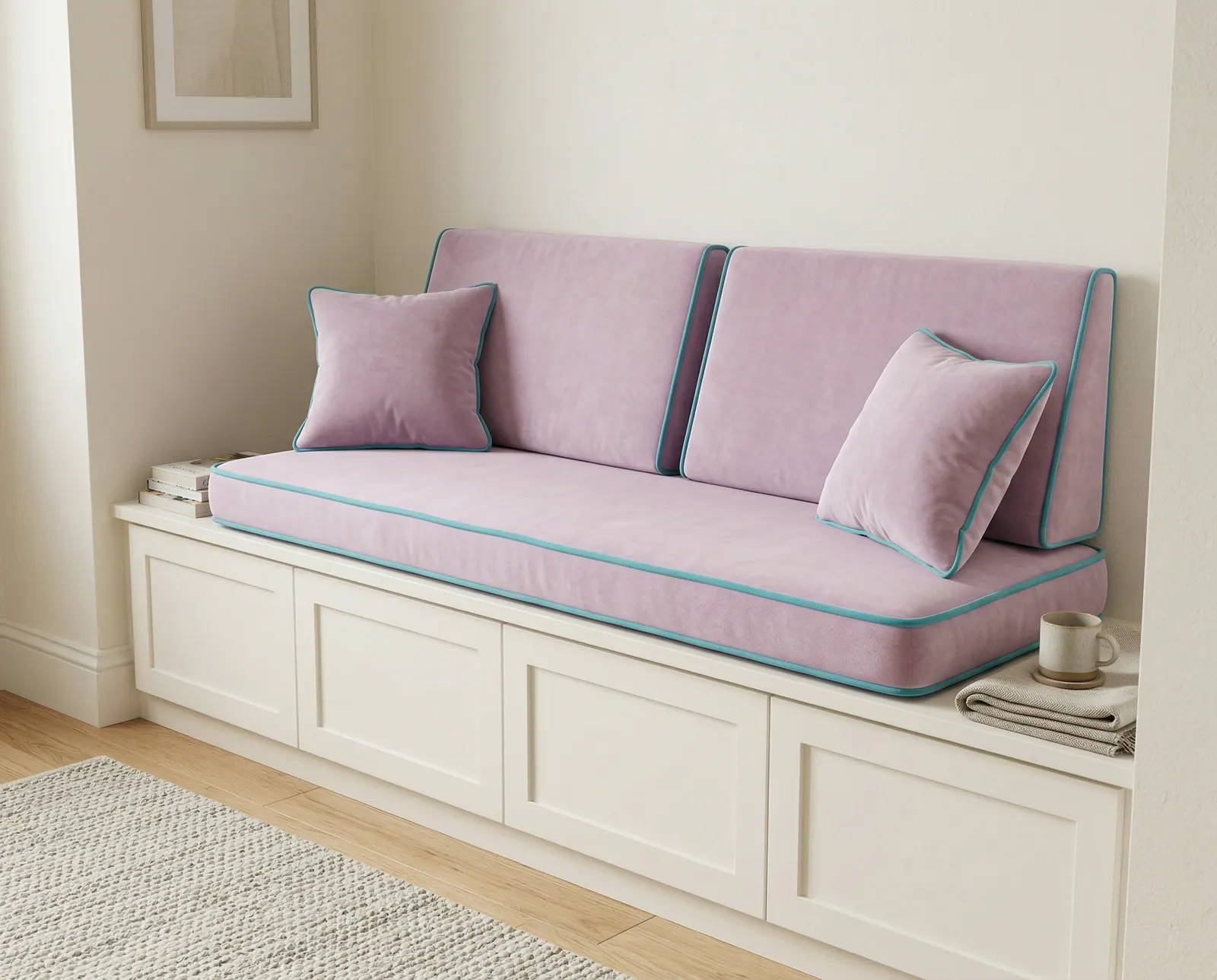
Start at the floor and work up. A gray flatweave rug. A cream shaker storage bench built into a plain wall recess. A lilac velvet box cushion on top, piped in teal. Two rectangular lilac backrests against the wall, butted together, piped teal. Two lilac pillows in front, piped teal again. Framed art above. Seven components, one accent color, used three times.
The backs are the hosting detail. They are separate rectangles, not one long panel, so one guest can pull a back forward or turn it without the other moving. The recess is solid wall rather than a window, so the backs can stand fairly upright.
Now the ends. The seat cushion stops short of the left wall and leaves a bare ledge for a stack of books. On the right, a folded linen sits under a mug. That cloth is doing real work: velvet pile and wet mug bottoms do not get along. If you host, plan a landing spot at each end before you plan the pillows. Care notes are in velvet bench cushion care, and the cloth itself is in the velvet library.
The color logic is plain engineering. Lilac is soft and pale; teal is cool and dark. Put the dark color where the line is thinnest, the piping, and a little goes a long way. Swap them and the bench turns heavy. More on welts in piping: matching, contrast or none, and more seating in living room cushions. How many people sit on your bench at a holiday table?
Pinned by Nate: five parts of a guest bench
Five pins, from the teal piping on the seat edge to the books parked on the bare left end.
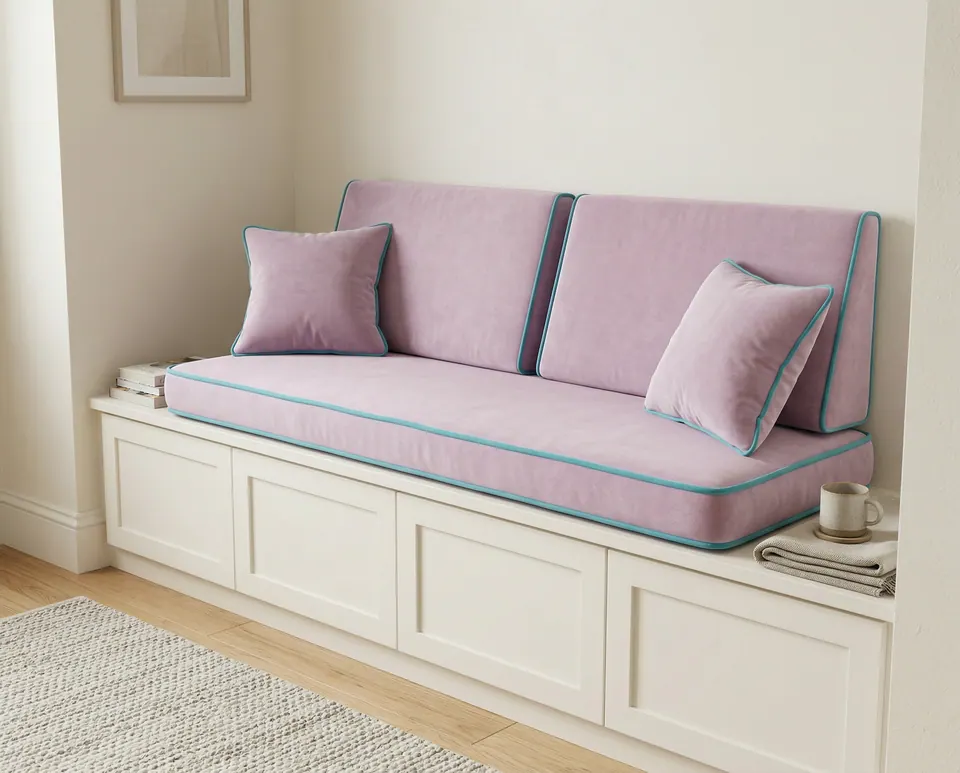
- Teal contrast piping
A cool teal cord sharpens soft lilac velvet at every edge.
- Rectangular backrests
Two backs that butt together can be moved or turned independently.
- Piped lilac pillow
The pillow uses the same teal cord, so the accent appears in threes.
- Folded linen and mug
A folded cloth under the mug keeps drinks off the velvet.
- Books on the bench end
The cushion stops short of the left wall, leaving a ledge for books.
- Teal contrast pipingA cool teal cord sharpens soft lilac velvet at every edge.
- Rectangular backrestsTwo backs that butt together can be moved or turned independently.
- Piped lilac pillowThe pillow uses the same teal cord, so the accent appears in threes.
- Folded linen and mugA folded cloth under the mug keeps drinks off the velvet.
- Books on the bench endThe cushion stops short of the left wall, leaving a ledge for books.
One long back or separate backs, for a full table
| Situation | One long back | Separate backs |
|---|---|---|
| A guest leans forward | The whole panel shifts | Only that guest's back moves |
| One piece gets a stain | The whole back goes to be cleaned | Clean or swap just that piece |
| Fitting an odd wall | One exact length | Mix widths to fill the run |
| Carrying and storing | One long, awkward piece | Short pieces that stack |
Seven backs, 168 in of banquette
One buyer wrote in needing only back pillows for a kitchen banquette that already had its seat. Seven pieces, all 14 in (35.5 cm) tall and 3 in (7.5 cm) thick, in three widths: three at 21 in (53 cm), three at 26 in (66 cm) and one at 27 in (68.5 cm). Charcoal gray linen, matching piping, no tufting.
Add it up: 63 + 78 + 27 = 168 in (427 cm) of back across seven pieces, about 24 in (61 cm) per piece on average. That is a banquette built for a crowd. Split it that way, partner, and every diner owns a back.
The buyer looked at a standard-size floor sofa style along the way. That style can't be customized, so the custom bench-cushion style stayed. The quote and the invoice didn't look alike at first, because the marketplace showed the total in another currency. The lesson the shop took: read a quote back line by line, and flag any currency conversion, before the buyer pays. Production was 4 to 6 business days.
Measure twice; the fabric remembers. The bench cushion builder handles mixed widths, back cushion height and sizing covers the 14 in question, and the full family is in bench cushions.
Buyer questions: reading corners, covered porches and a brown stripe
- A common question
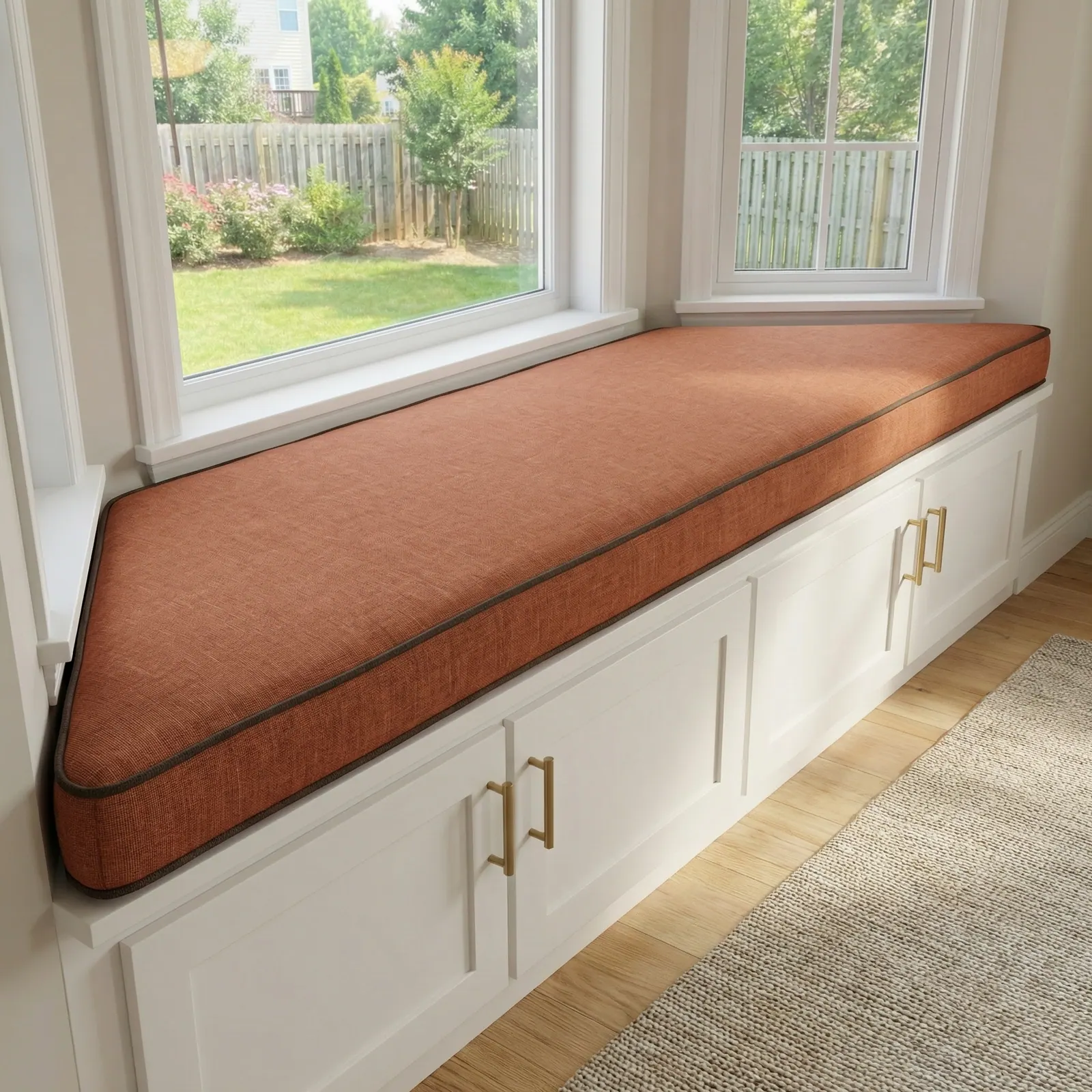
Could you make a reading cushion to fit the corner bay window in my daughter's room?
The workshop's answerYes. Send the measurements and a photo of the space, and the shop makes the cushion to fit that corner.
- A common question
Is your regular fabric fine for a covered outdoor area, or do I need the waterproof one?
The workshop's answerRegular fabric is fine under cover, but it is not waterproof. Water-repellent outdoor fabrics are available, and one buyer chose a cream. If you don't specifically need waterproofing, the shop's view is that the soft fabric is the nicer one to sit on.
- A common question
What piping color goes with a textured brown striped fabric?
The workshop's answerThree routes. Self piping in the same stripe for a clean, seamless look. Cream or beige for a classic contrast. Dark brown or black for a sharper, framed outline.
On the cutting table: the lilac guest bench
| Product | Box-edge bench seat cushion with two separate backrests |
|---|---|
| Fabric | Lilac velvet |
| Piping | Teal contrast piping on seat, backs and pillows |
| Backrests | Two rectangles butted at the center, free to move |
| Pillows | Two lilac velvet pillows with teal piping |
| Bench | Cream shaker storage bench in a wall recess |
| Ends | Bare ledge for books on the left; folded cloth under a mug on the right |
| Best for | Living room seating for guests and long evenings |

Have it made
Have this made — ask Nate’s workshop
Precision starts on the phone. Give the workshop your measurements and they will read them back to you, edge by edge. — Nate
Leave your details and the workshop will call you to confirm measurements, fabric, foam and piping. No prices, dates or payment on this page: it is a request, not an order.
On a velvet bench cushion, put the bolder color in the piping: a teal cord around lilac velvet sharpens every edge without making the seat heavy.
Nate
Questions buyers ask next
How many back cushions should a long banquette have?
Enough that each person gets one. On one banquette, seven backs covered 168 in (427 cm), about 24 in (61 cm) each. Separate backs let guests adjust their own without shifting a neighbor's.
Is velvet practical on a bench where people eat and drink?
It can be, with a couple of habits. Keep a folded cloth or a tray under mugs and glasses, and blot spills instead of rubbing them into the pile. The velvet care guide covers the rest step by step.
Where does contrast piping belong on a pale cushion?
Around every edge of the seat, the backs and the pillows, in the darker color. Repeating the same cord on three pieces ties them together, and a thin line carries a bold color that would overwhelm a whole cushion.
Should a bench cushion always run wall to wall in a recess?
Not always. On this bench the seat stops short of the left wall, leaving a bare ledge for books. A landing strip at one end is useful when a bench is used for hosting and drinks need somewhere to go.
± 1/4 in — Nate
More photographs to read
 Save
 Save
 Save
 Save
 Save
 Save