Across the Map · Europe
Outdoor cushions for Spanish patios, terraces and roof decks
In Seville the July sun shines about 369 hours, and in western Spain the midsummer sun doesn't set until after ten at night. A Spanish outdoor cushion works a long day and a late night.
- Sun & UVIntense
- HumidityModerate
- WinterMild
- CoastSalt air nearby
- Typical seatsWhitewashed masonry patio bench, azotea roof-terrace sofa, apartment terrace chair pads
 Save
The quick answer
Outdoor cushions in Spain need UV-resistant, water-repellent outdoor fabric and a shady place to rest at midday, because Seville averages 97°F (36.3°C) July highs and about 3,089 hours of sun a year. Measure patio benches and curved rattan seats in centimeters, add ties or a non-slip base, and in rainy Galicia bring cushions in between uses.
Field notes
Weather and light in Spain
- Sun & UVIntense (level 4 of 4)About 3,089 sunshine hours a year in Seville, 369 in July
- HumidityModerate (level 2 of 4)42% in a Seville July; about 78% a year in Santiago de Compostela
- Rain & stormsModerate (level 2 of 4)0.02 in (0.6 mm) in a Seville July; about 70 in (1,787 mm) a year in Santiago de Compostela
Watch for
- Midday sun on open terraces in July and August
- Chlorine and sunscreen on poolside cushions
- Atlantic rain in Galicia and Asturias
Plain-language levels from general climate patterns, not measurements. Your own porch, shade and window exposure matter more.
97°F in Seville, 70 in of rain in Galicia
Spain gives a cushion two climates with a long coast in between. At Seville Airport, AEMET's 1991–2020 normals put July highs at 97.3°F (36.3°C) and July rain at 0.02 in (0.6 mm). The city logs about 3,089 hours of sun a year, 369 of them in July.
Galicia is another country, weather-wise. Santiago de Compostela gets about 70 in (1,787 mm) of rain a year on some 139 days, with average humidity near 78%.
And everywhere the day runs late. Spain keeps Central European Time, so sunrise and sunset fall about an hour later than they would on GMT; at midsummer the sun goes down around 22:15 in Vigo and 21:20 in Menorca.
What that does to a cushion: - Sun is the main wear. UV fades color and tires fibers, and the WHO notes that sand reflects about 15% of UV and sea foam about 25%. A beach-house terrace gets it from below as well as above. - Heat is a comfort problem. A dark cushion in full sun at four in the afternoon is too hot to sit on. - The north needs drying more than shading. In Galicia and Asturias a cushion left out gets wet far more often than it gets sunburned.
Patios, terraces and the roof over your head
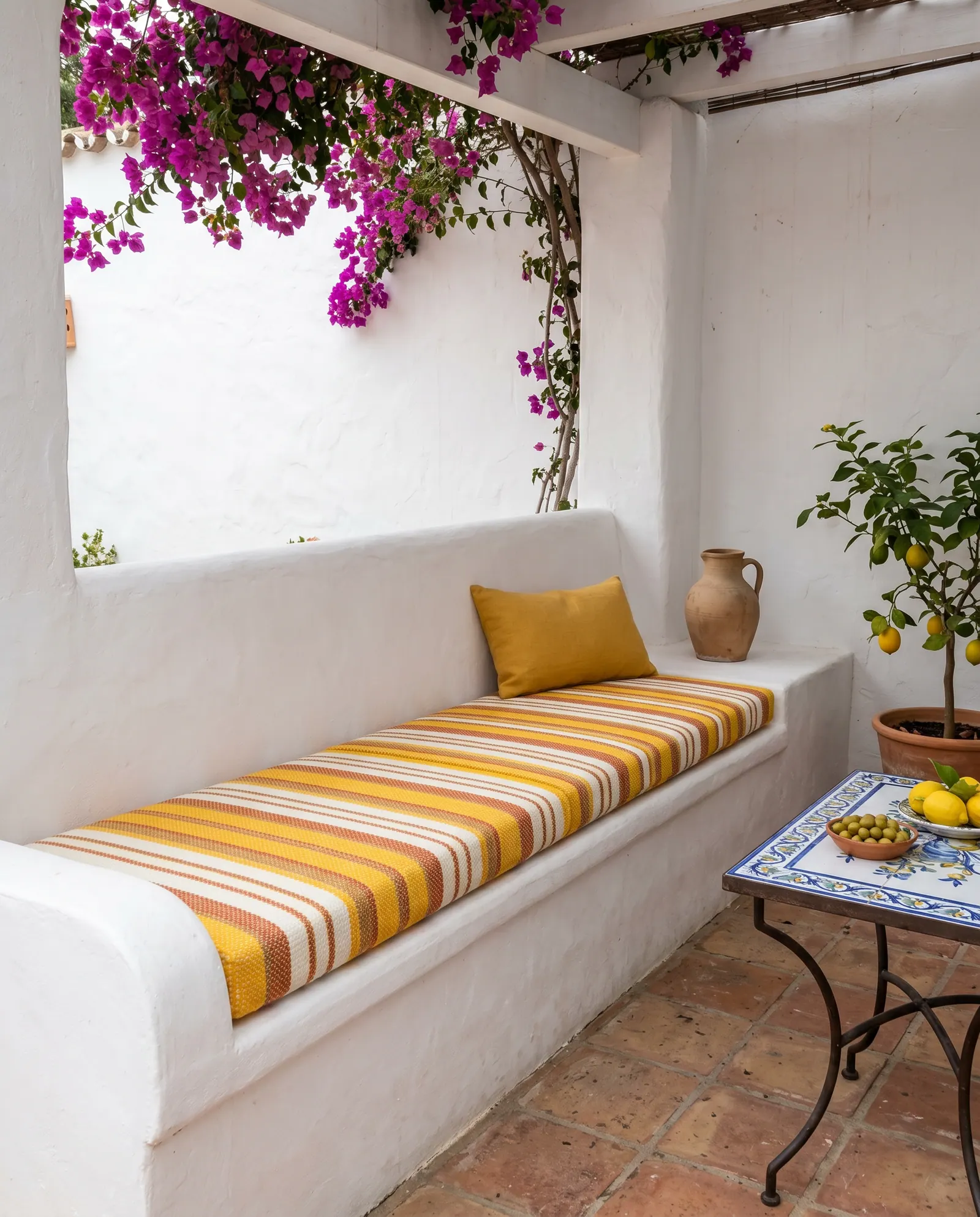
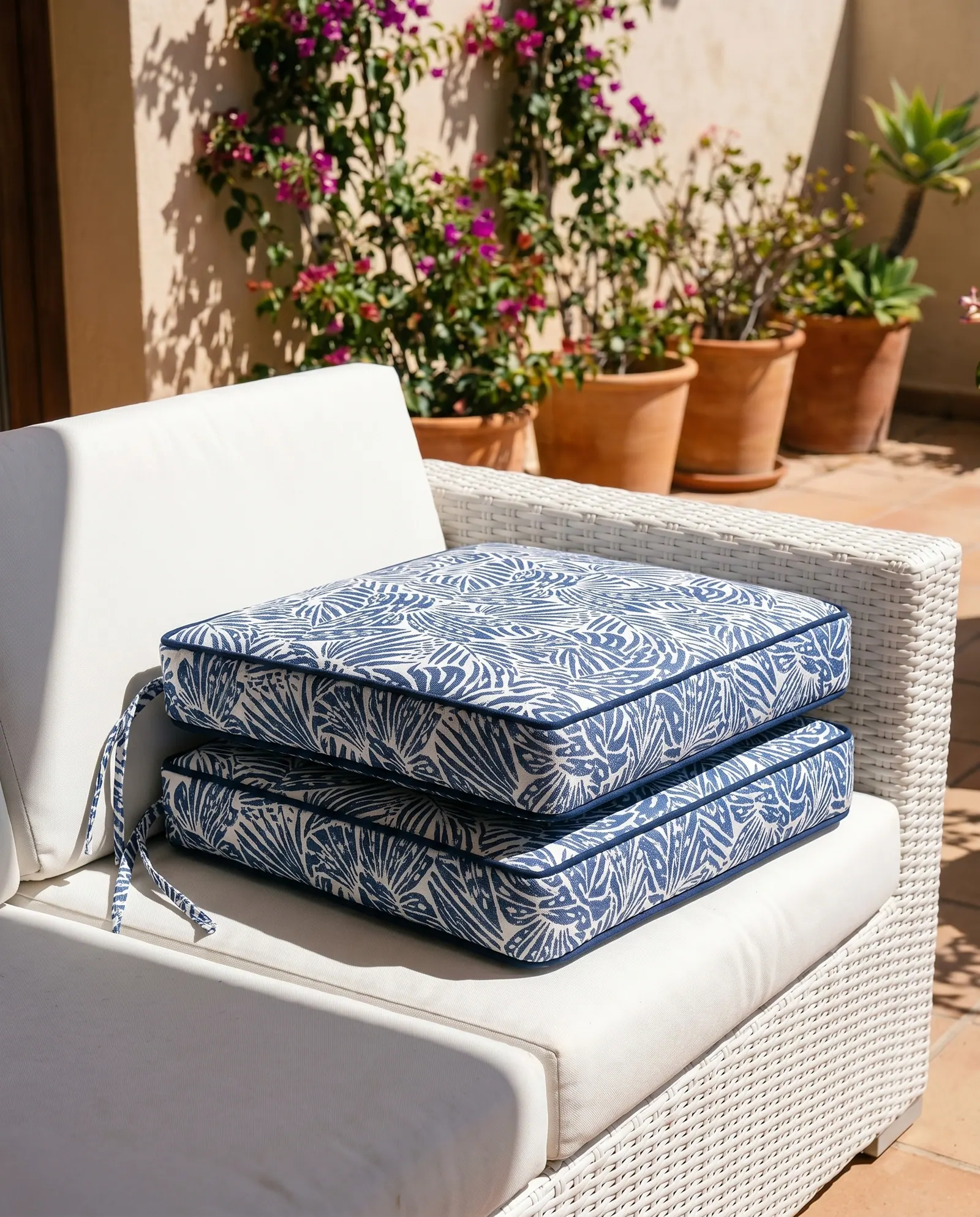
The Spanish outdoor room comes in three shapes. First the patio. In Córdoba the patio houses, family or multi-family homes around a shared courtyard crowded with plants, are the stars of a twelve-day fiesta at the beginning of May; UNESCO listed the Fiesta of the Patios in 2012. A whitewashed masonry bench against a patio wall, like the one in our photo, is Andalusia's answer to my porch swing back in Savannah: everybody ends up on it.
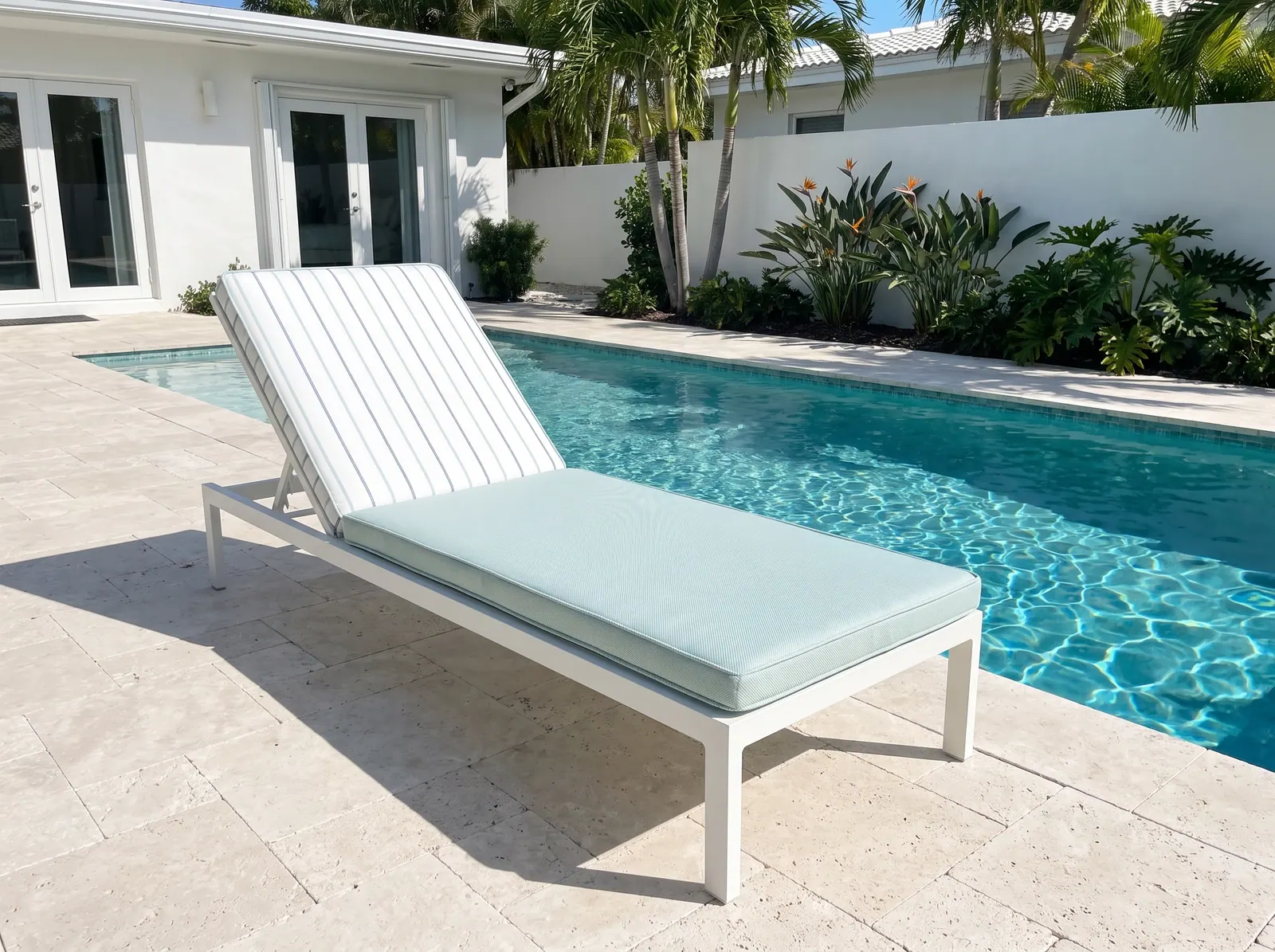
Then the apartment terrace, and above it the flat roof, the azotea, where the washing line and the evening chairs share the space. Then the coastal villa with a pool and a row of loungers.
Plaster hides a lot. Run the tape along the front lip of a masonry bench, then along the wall, then across each end; if the numbers disagree, a paper template saves a lot of letters back and forth. A bench with nothing to tie to wants a non-slip base. On a rooftop, tie everything; a loose cushion on an azotea is a kite with ambitions. The patio and porch hub shows the edges, and the bench cushion builder draws yours.
One curved cushion first, to test the fit
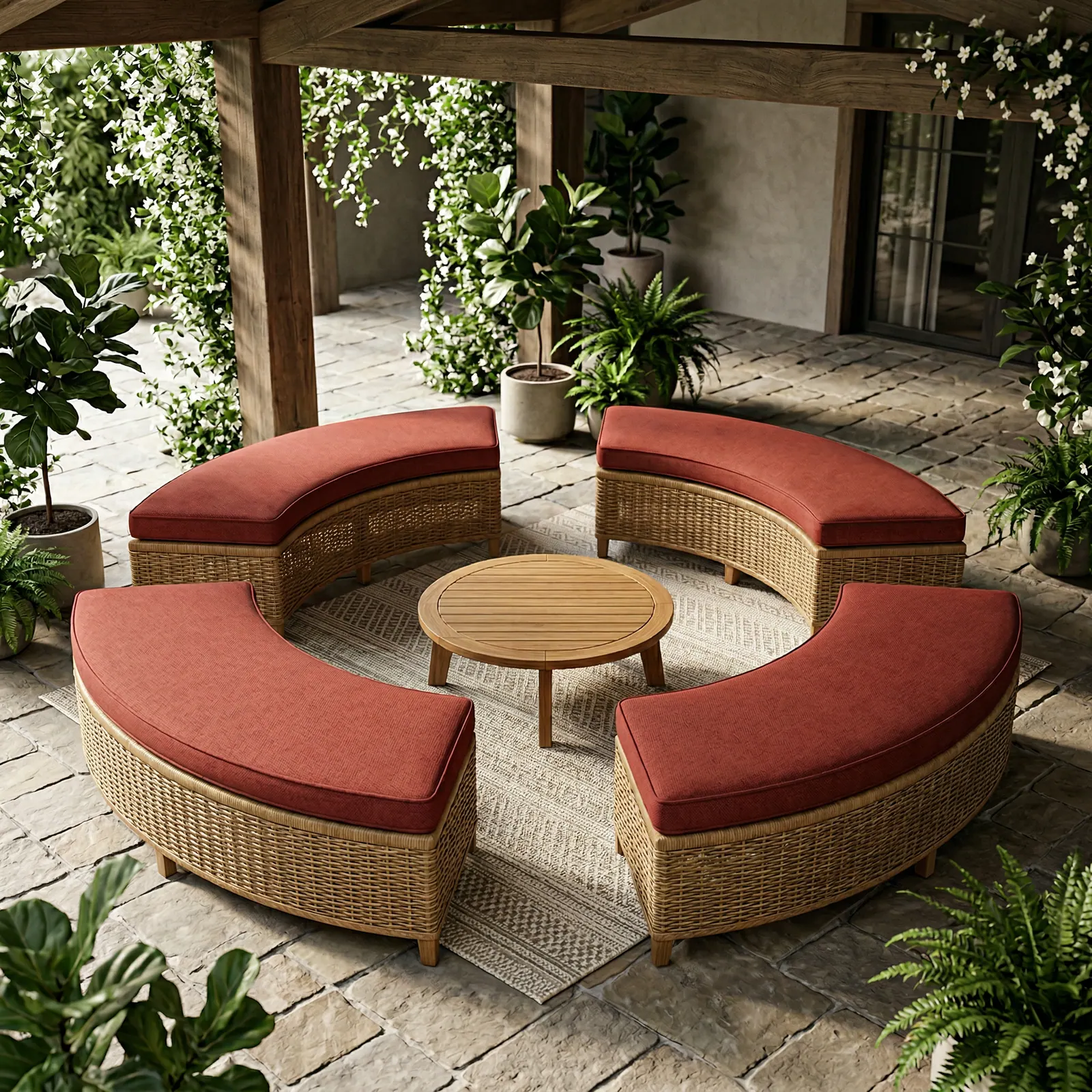
A buyer in Spain had a round rattan sofa on an outdoor terrace, the kind built from wedge-shaped segments, and needed a cushion for one of them: an outer arc of 43.25 in (110 cm), an inner arc of 17 in (43 cm) and two sides of 19.75 in (50 cm), 3 to 4 in (8 to 10 cm) thick.
That's four numbers, and the workshop asked for a fifth: the depth of the curve, measured from the middle of a straight line across the inner edge out to the arc. It was 11.5 in (29 cm). Without it, nobody can draw that curve, only guess at it.
The buyer chose a smoke-gray outdoor fabric, and here's the part I'd copy on any porch: they ordered one cushion first, to check the fit before ordering the rest. A curved seat is the one place where close enough shows every single day.
On a Spanish terrace I'd add ties to the frame for windy evenings and keep that gray in the shade in August. The curved cushion Pattern shows how to take the chord and the rise.
- Measured
- Wedge segment: outer arc 43.25 in (110 cm), inner arc 17 in (43 cm), sides 19.75 in (50 cm), curve depth 11.5 in (29 cm), 3–4 in (8–10 cm) thick
- What it taught
- For a curved edge, measure the depth of the arc as well as its length, and order one piece first to test the fit.
Patio, azotea, pool: the order sheet
| Seat | Fabric | Thickness | Hold-down |
|---|---|---|---|
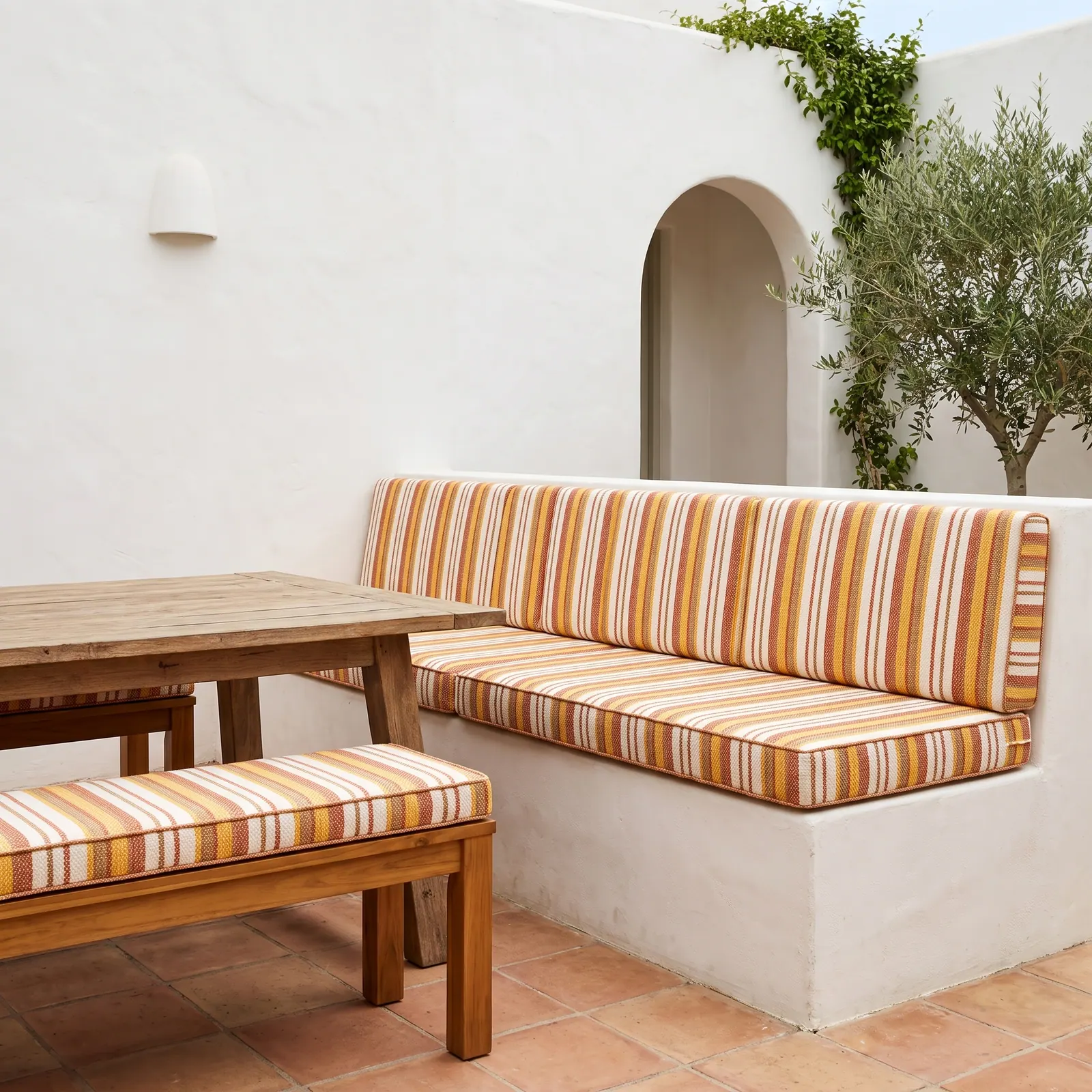
| Whitewashed masonry patio bench | UV-resistant outdoor fabric | Seat 4 in (10 cm), back 2 in (5 cm) | Non-slip base; back cushions lean on the wall |
| Azotea or roof-terrace sofa | Outdoor fabric in a light tone | 4 in (10 cm) | Ties on every piece |
| Apartment terrace chair pads | Outdoor stripe | 2 in (5 cm) | Two ties at the back corners |
| Curved rattan sofa segment | Outdoor fabric | 3 to 4 in (8 to 10 cm) | Ties to the frame |
| Poolside lounger | Water-repellent outdoor fabric | 4 in (10 cm) | Ties at the hinge and the head; rests in the shade |
| Family patio bench for kids and dogs | Outdoor fabric outside; pet-friendly weave under a roof | 4 in (10 cm) | Zip-off cover; non-slip base |
Seat foam is about 2.0 lb/ft³ (32 kg/m³). Standard outdoor cushions have no quick-dry foam or mesh base, so stand them on edge after rain or a pool splash. Cotton ticking stays indoors.
Picked for Spain
Seats to start from
Fabric families
Try it in the Studio
Built for kids, dogs and a late supper
Kids and dogs are the real quality control, and on a Spanish terrace they're on the job until late. Build for them:
- Zip-off covers on everything. Covers wash at 86°F (30°C) on a gentle cycle; air dry, no tumble dryer.
- Plain, not tufted, outdoors. Tufted cushions let water in, and they can't be unzipped for the wash.
- Mid-tones over white. Sand, olive or terracotta hides a paw print until wash day.
- A pet weave under the roof. Where the dog sleeps on a covered porch, the workshop's pet-friendly fabric is a tight, loop-free polyester weave. No fabric is immune to claws, but a flat weave gives them less to catch.
In the hottest hours of July and August, bring the cushions into the shade or stand them on edge under the pergola. They go back out when the family does, around the time the streetlights come on. What time does your terrace fill up, neighbor?
Whitewash, saffron and a stripe that knows its direction
Whitewash is the loudest thing on a Spanish patio at noon. Against it, pure white disappears and icy blues look harsh. The patio in our photo gets it right: saffron and burnt-orange stripes, a mustard lumbar pillow, terracotta tiles. Warm colors that already look sun-touched.
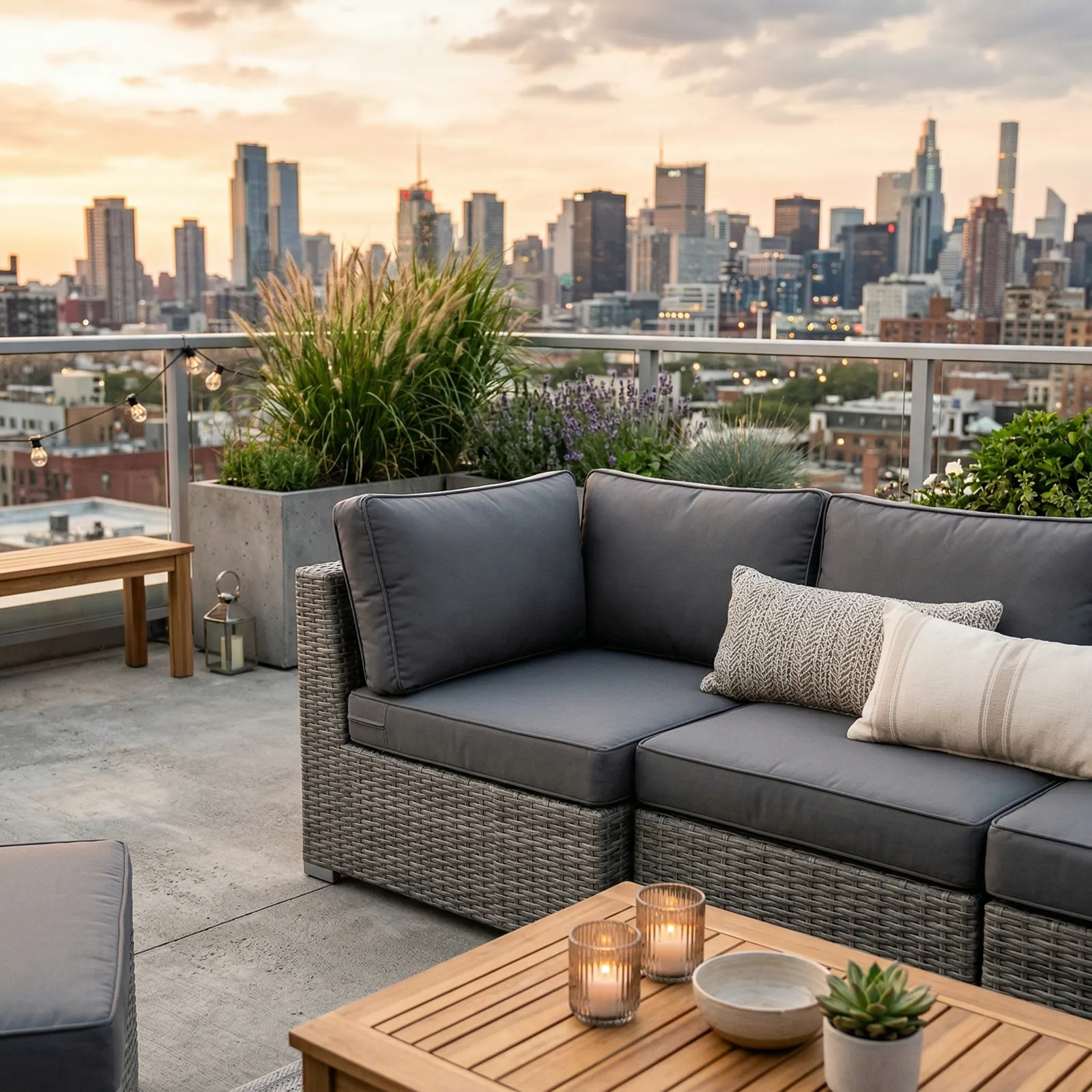
Up north, in a green Galician garden under a gray sky, turn the palette down: sage, stone, a deep blue. On a modern azotea with glass rails and concrete, charcoal and oatmeal sit calmly, but give the charcoal afternoon shade.
Stripes need a direction for every cushion. The fabric roll is about 55 in (140 cm) wide, so stripes run front to back on a long bench by default, and a stripe running the length of a cushion longer than about 54 in (138 cm) needs a seam. The stripe direction Pattern shows both ways. The workshop's ticking stripes are cotton and indoor-only; stripes for outside come from the outdoor charts.
Photographs for homes like these
Open any photograph large; each one has its own link and a Save button.
 Save
 Save
 Save
 Save
 Save
A Spanish outdoor year, south and north
- March and April: measure the benches and order before patio season; in Córdoba the patios are on show at the beginning of May.
- May and June: cushions go out; tie everything on terraces and roofs.
- July and August: rest cushions in the shade at midday, and flip and rotate them every week.
- After a swim: rinse chlorine and sunscreen off lounger covers with fresh water and stand the cushions on edge to drain.
- Galicia and Asturias: bring cushions in between uses; wet foam dries slowly under a gray sky.
- November to February: wash covers at 86°F (30°C), dry the foam completely and store it on edge, off the floor.
On a Spanish terrace a cushion works two shifts: shade by day, company by night.
Rosa
Buyer questions: stripes, backrests and second samples
- A common question
Do you have a striped fabric that works outdoors?
The workshop's answerThe ticking stripes are 100% cotton, so they're indoor-only, and that range has no outdoor version. For stripes outside, the outdoor charts include striped fabrics that are water-repellent and UV-resistant.
- A common question
Can you make a backrest to match my bench cushion?
The workshop's answerYes. For a 74 in (1.88 m) bench, the workshop made a 23.5 x 74 x 4 in (60 x 188 x 10 cm) seat and a 15.75 x 74 x 4 in (40 x 188 x 10 cm) backrest, with a contrasting burgundy piping line.
- A common question
What size are your standard back pillows, and what do you need from me?
The workshop's answerThe standard backrest is about 16 in (40 cm) high and about 4 in (10 cm) thick, so the workshop only needs the length of each pillow and how many you want.
- A common question
None of the samples match the cushions I already have. What now?
The workshop's answerThe workshop sends a second round of samples free of charge. One buyer found the first shades too light or the wrong tone, tried warmer browns and olive stripes, and found a match that worked.
- A common question
I picked the wrong fabric or piping color. Do I have to cancel?
The workshop's answerNo. Tell the workshop what you actually want before production starts and the order is updated, with no cancellation or refund needed. Piping swaps and full color changes have both been made this way.

Have it made
Have it made for your home — ask Rosa’s workshop
Every good cushion I know started with a long porch chat. This is the short version: leave your number and the workshop will call. — Rosa
Leave your details and the workshop will call you to confirm measurements, fabric, foam and piping. No prices, dates or payment on this page: it is a request, not an order.
Questions buyers ask next
What fabric holds up to a Seville summer?
Outdoor fabric with a UV-resistant, water-repellent finish, in a light or mid-tone. Even so, months of direct sun fade any color, so rest cushions in the shade at midday in July and August and flip them often. Velvet, linen-look and cotton ticking belong indoors.
Do outdoor cushions in Galicia need different care than in Andalusia?
Yes. In the rainy northwest the risk is wet foam, not fading. Bring cushions in between uses, stand them on edge to dry after rain, and store them indoors from late autumn. Standard outdoor cushions have no quick-dry foam, so drying takes time.
How do I keep cushions from blowing off a roof terrace?
Tie them. Ties can be sewn at the corners or along the back of a cushion, in the positions you name in the order. On a masonry bench with nothing to tie to, choose a non-slip base, and carry loose pillows in when the wind picks up.
Is a masonry patio bench measured differently from a wooden one?
Yes. Plastered masonry is rarely square, so measure the front edge, the wall edge, both ends and the depth at each end. If the numbers disagree, send a paper template or a photo with the tape measure lying on the bench, and ask for a non-slip base.
Porch light's on — Rosa
The atelier
Keep going
Across the Map
Nearby places
Close by on the map