Across the Map · Canada
Custom cushions for New Brunswick homes, cottages and coastal porches
Old New Brunswick houses keep their secrets in the corners: a bay that isn't quite symmetrical, a bench that dips at one end. I measure them the way I learned to measure my own mistakes: slowly, and twice.
- Sun & UVModerate
- HumidityHumid
- WinterLong and hard
- CoastSalt air nearby
- Typical seatsVictorian bay window seat, mudroom boot bench, farmhouse kitchen bench

 Save
The quick answer
Custom cushions in New Brunswick should fit old, out-of-square houses and survive fog, snow and a short porch season. Saint John has fog on about 93 days a year and Moncton averages about 128 in (325 cm) of snow. Measure window seats at several points, give mudroom benches a zippered, washable cover, and store porch cushions before the first frost.
Fog on 93 days, and snow that lingers into May
Saint John records fog on about 93 days a year, most of them in July and August, by Environment and Climate Change Canada's 1981 to 2010 normals. Cold Bay of Fundy air meets warmer air inland, and onshore winds carry the fog ashore. The tide at Saint John rises and falls about 28 ft (8 m).
Summer mornings there average above 90% relative humidity from July through September, and the city sees about one day a year above 86°F (30°C). Inland runs warmer and snowier: Moncton averages about 128 in (325 cm) of snow a year, Fredericton about 99 in (252 cm).
For custom cushions in New Brunswick, that means porch cushions rarely dry outdoors in a foggy week, and a mudroom takes a whole winter of snowmelt. Choose covers that zip off and wash. Then plan the porch season around frost: Moncton's first fall frost averages October 4, Fredericton's September 25.
Saint John brick, Fredericton window seats, Shediac cottages
After the Great Fire of 1877, Saint John rebuilt in brick and stone, and its uptown still shows Victorian, Romanesque Revival and Second Empire styles; Trinity Royal became the city's first heritage conservation area in 1982. Fredericton, along the Saint John River, runs from Victorian to modern. Old houses mean old window seats, and none of them are square.
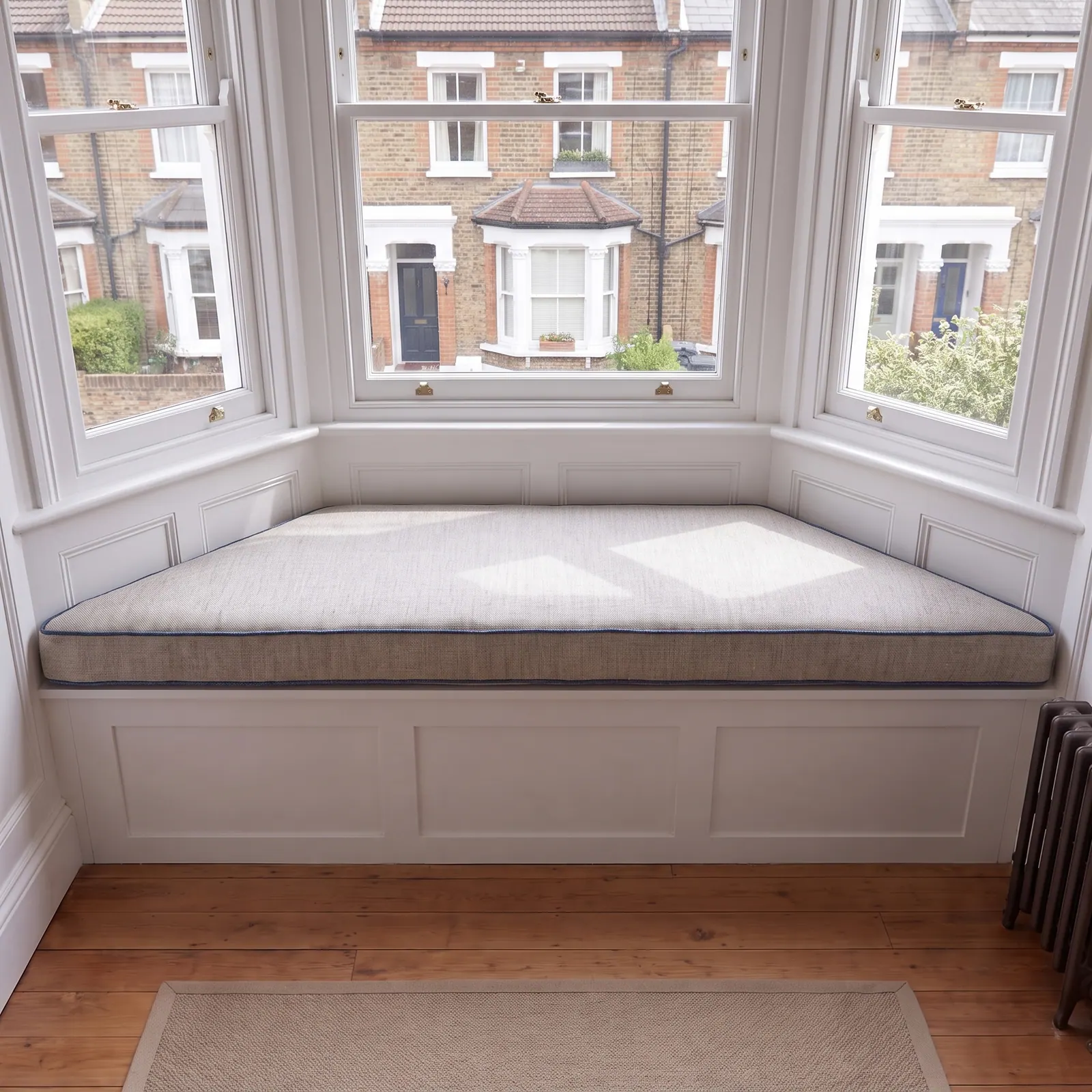
Measure the width at the back wall and at the front edge, and the depth at left, middle and right, all from the face of the trim. Write every number on one drawing. For an angled bay, the bay window calculator turns wall lengths into a cuttable shape, and the bay window cushions hub covers the rest. I once cut a bay seat to the middle depth and spent an afternoon apologizing to both corners.
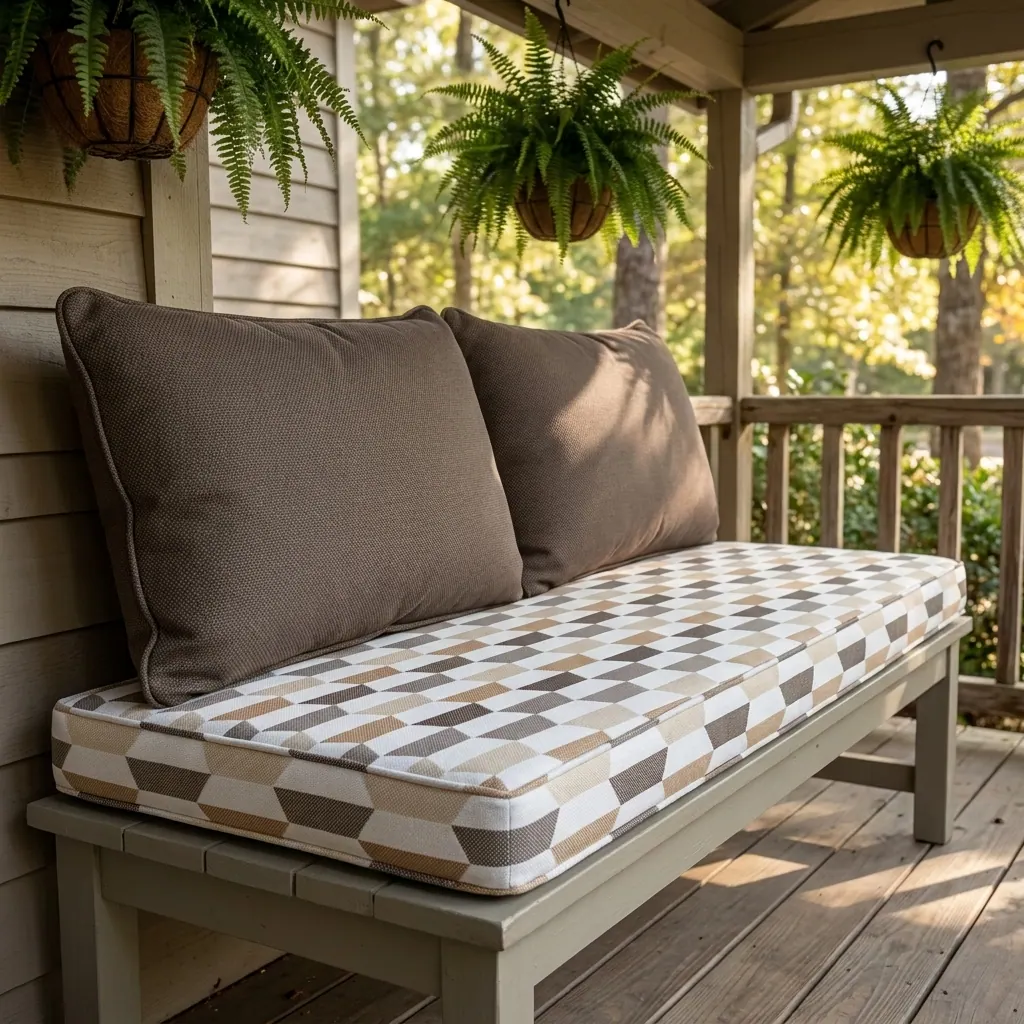
On the Acadian shore, where Acadians first settled Shediac in 1751, the town is known as the Lobster Capital of the World, and nearby Parlee Beach on the Northumberland Strait has the warmest salt water beaches north of Virginia. Cottage porch benches there want outdoor fabric: water-repellent and UV-resistant, not waterproof. Next door, Maine and Nova Scotia know the same fog, and custom cushions in Canada covers the other provinces.
The mudroom bench, where boots and snowmelt live
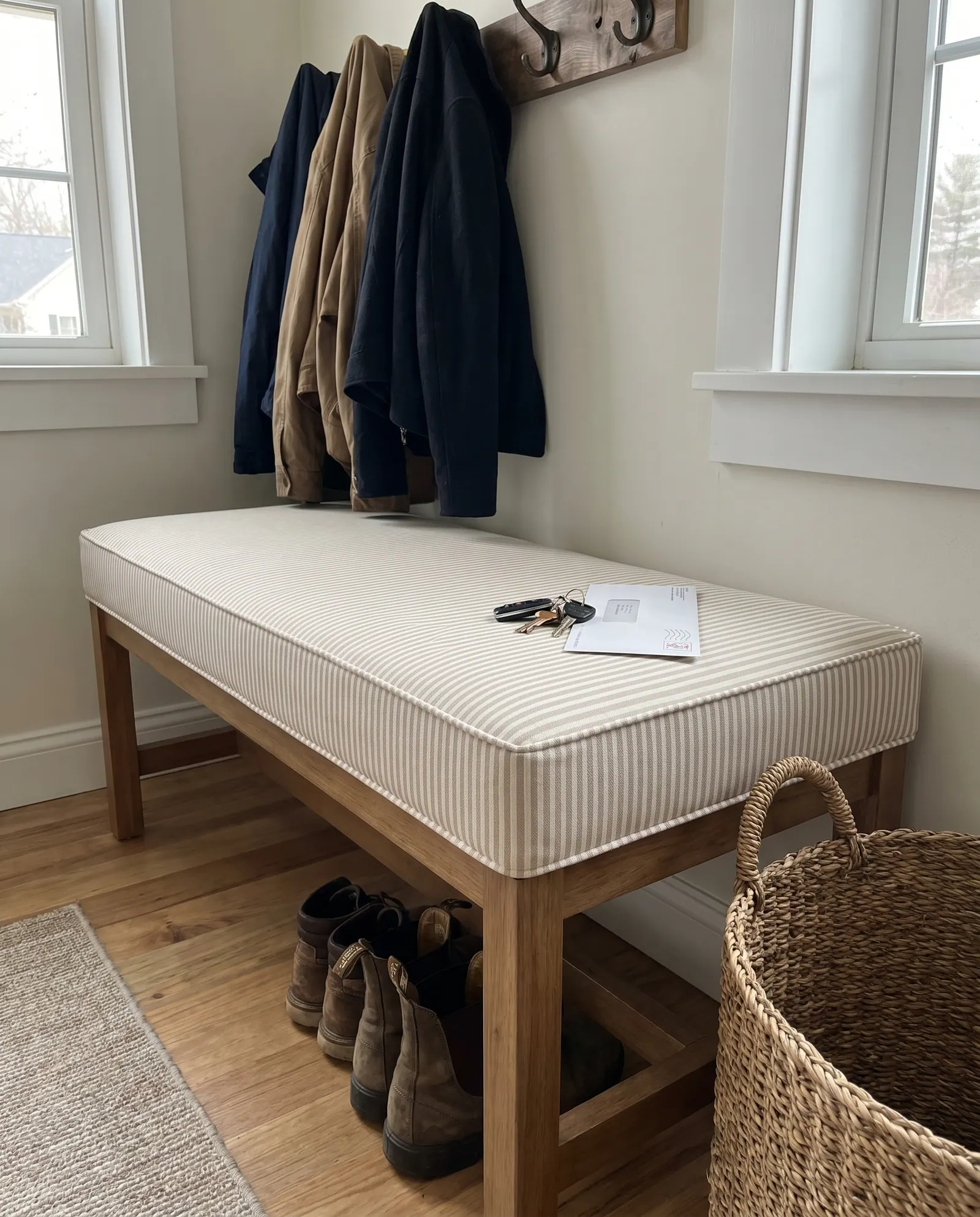
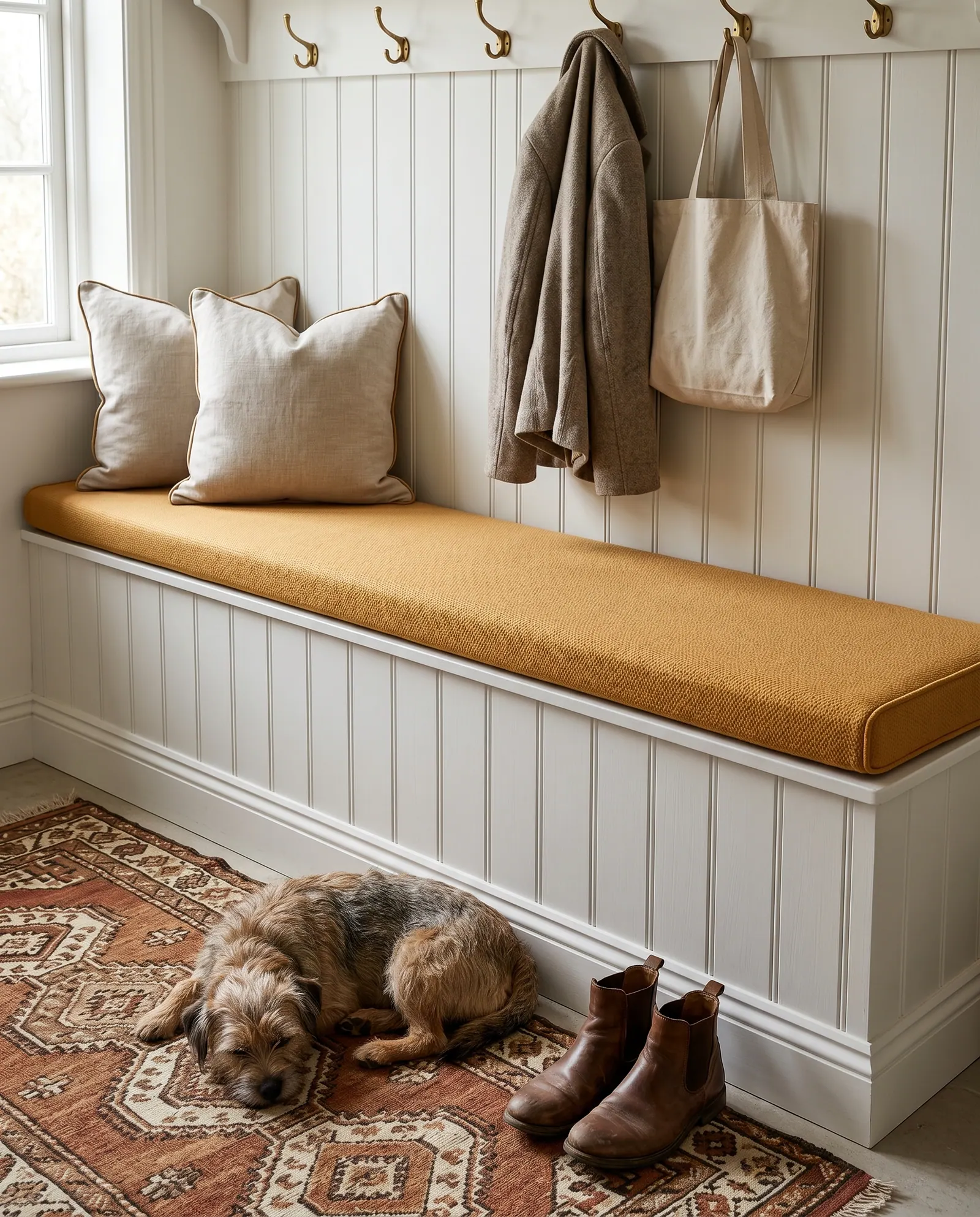
A mudroom bench cushion takes wet mittens, salty boots and whoever sits down to pull them off. A buyer in Canada asked for exactly that: a tufted entry bench cushion 64 x 17.7 in (162.4 x 45 cm) in mustard, in something durable that wasn't velvet. The workshop pointed to its soft-touch poly-cotton, a durable, easy-clean best seller, and said plainly that tufted covers can't come off; a zippered cover is possible without tufting. The buyer chose tufted.
I would have argued, dear, gently. In a mudroom I want the zipper, so the cover can go in the machine at 86°F (30°C) and dry on a rack. Mid-tones like mustard, olive or heathered taupe hide grime far better than white. More in mudroom bench cushions and tufted or plain.
Two bench cushions, one 1880 farmhouse kitchen, and 6 missing inches
A buyer in Canada was restoring an 1880 farmhouse kitchen for a magazine shoot and first asked for covers only, but the workshop makes filled cushions. So they ordered two blue velvet seat cushions, 4 in (10 cm) thick, for a bench 16.5 in (42 cm) deep: one 63.4 in (161 cm) long and one 45.5 in (115.5 cm) long, with ties at the ends where they meet and on one side.
The 45.5 in (115.5 cm) cushion arrived 6 in (15 cm) short. The workshop remade that piece at 45.5 x 16.5 in (115.5 x 42 cm), and the buyer kept the first one. My advice: put a tape on both cushions the day the box arrives, before anyone sits down.
- Measured
- 63.4 x 16.5 x 4 in (161 x 42 x 10 cm) and 45.5 x 16.5 x 4 in (115.5 x 42 x 10 cm)
- What it taught
- When two cushions meet on one bench, add ties at the join and measure both on arrival.
Bay, boot bench, porch: what goes on the cutting table
| Seat | Fabric | Build | Piping |
|---|---|---|---|
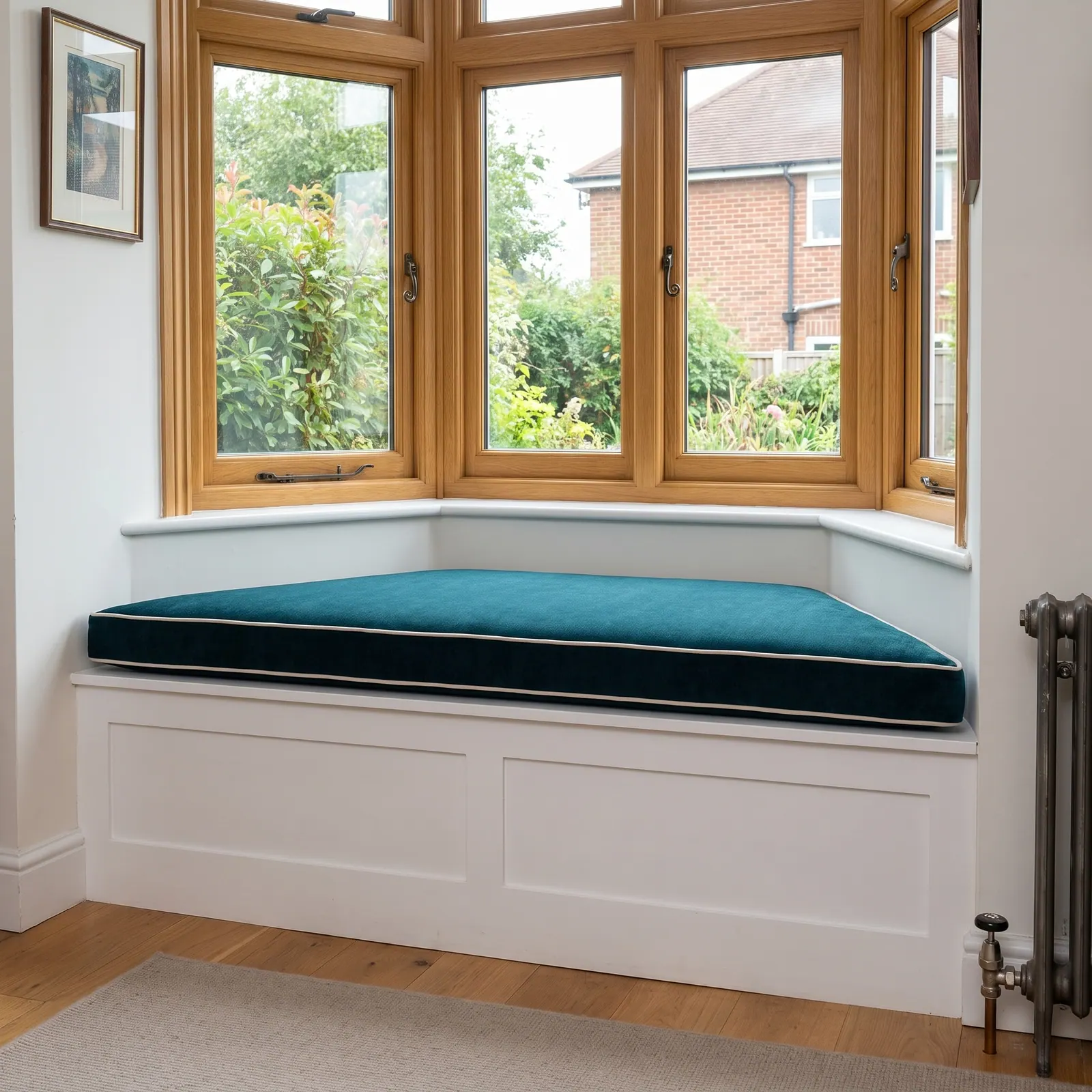
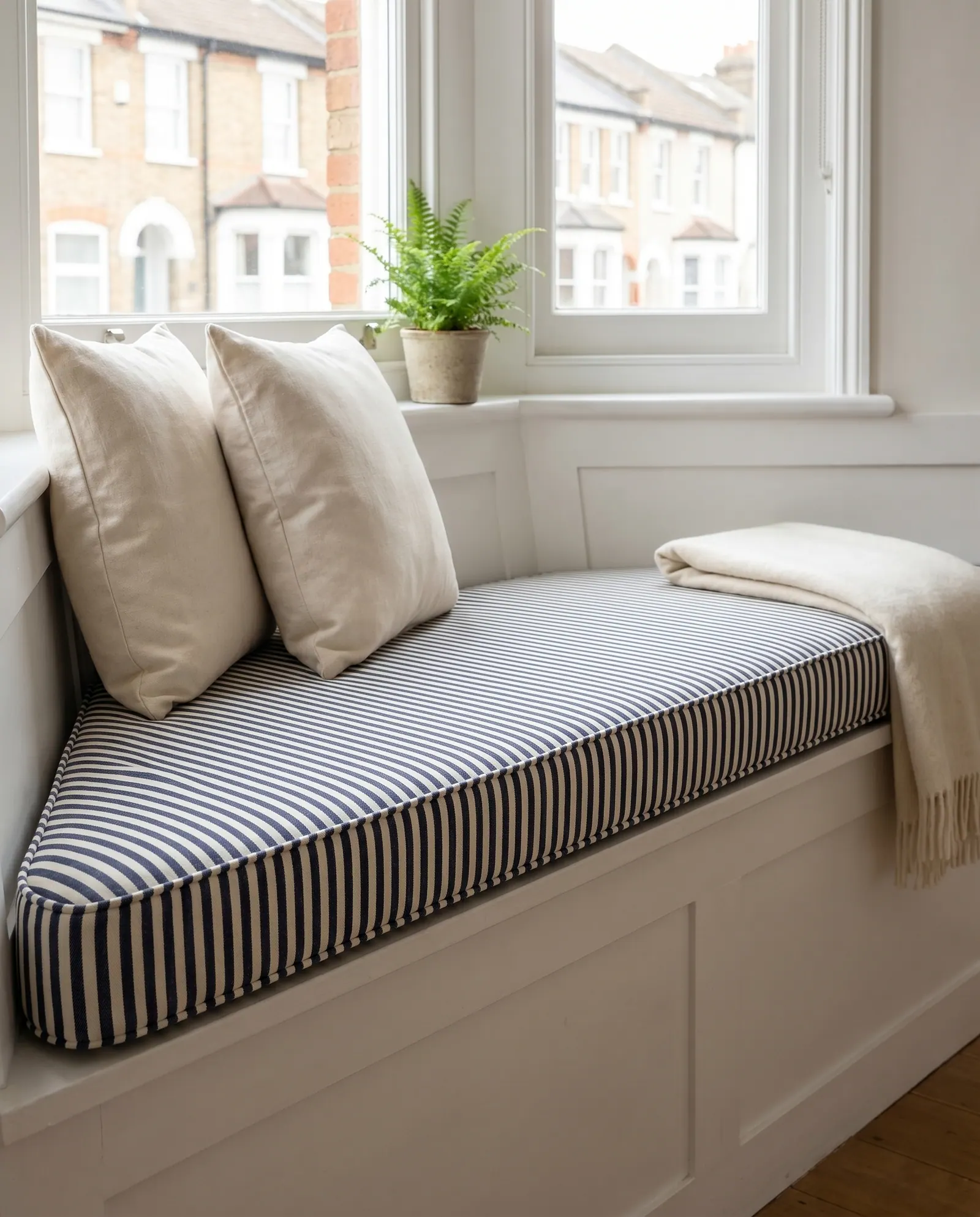
| Victorian bay window seat | Linen-look in deep teal or oatmeal, or a soft performance weave | 3 to 4 in (7.5 to 10 cm), clipped or trapezoid to the bay | Contrast ivory or indigo to trace the angles |
| Mudroom boot bench | Durable poly-cotton in a mid-tone | 3 in (7.5 cm) on a standard bench; zippered, untufted | Self piping hides wear |
| Farmhouse kitchen bench | Velvet or poly-cotton | 4 in (10 cm); ties where two pieces meet | Self or contrast |
| Shediac cottage porch bench | Outdoor fabric, water-repellent and UV-resistant | 4 in (10 cm); ties or a non-slip base | Self piping |
Covers zip off and wash at 86°F (30°C) on a gentle cycle; air dry them. Keep a non-slip base out of the machine.
Maggie's porch-to-attic checklist
- Mid-May, after the last frost (around May 16 in Saint John, May 22 in Moncton): wash covers and carry the porch cushions out.
- Foggy weeks: stand porch cushions on edge each morning so air reaches the foam.
- Late September: watch the forecast, since Fredericton's first frost averages September 25.
- Before the first frost: wash covers at 86°F (30°C), air dry them, and dry the foam to the core.
- Store indoors, off concrete, in breathable covers; never seal a damp cushion in plastic.
- All winter: shake out the mudroom cushion weekly and wash the cover when boot salt shows.
Photographs for homes like these
Open any photograph large; each one has its own link and a Save button.
 Save
 Save
 Save
 Save
 Save
Measure the bench, not the cushion you used to have. In an old house the bench has had a century to settle; the old cushion simply got used to it.
Maggie
Buyer questions: benches, bays and honest sizes
- A common question
What size cushion should I order for a mudroom bench niche?
The workshop's answerWork back from seat height. For a niche 17 x 35.75 in (43 x 91 cm) and 15 in (38 cm) high, a 3 in (7.5 cm) cushion gave the 18 in (46 cm) seat height the buyer wanted. Choose the nearest size and write the exact dimensions in the note.
- A common question
Can you work out the sizes from my photos?
The workshop's answerNo. Please write out the exact measurements, because sizes guessed from a photo lead to mistakes. A simple paper drawing with every edge measured is clearest; an unreadable or incomplete one comes back for a clearer copy.
- A common question
How exact is the finished size, and can you err on the small side?
The workshop's answerSizes can vary by about 1 in (2.5 cm). When a buyer said 24 in (61 cm) was the absolute maximum, the workshop made the cushion 23 in (58.5 cm).
- A common question
Do you offer a non-slip base so the cushion doesn't slide?
The workshop's answerYes, as an add-on. The underside of the cushion is then anti-slip material, so it stays put on a window seat or bench.
- A common question
Does the cover come off for cleaning, and where is the zipper?
The workshop's answerYes. Covers have a hidden zipper and come off easily. On bench cushions it runs in an L shape along one long side and one short side, on the underside.

Have it made
Have it made for your home — ask Maggie’s workshop
Have the tape measure handy when they call. Old cushions shrink and sag; the seat underneath does not. — Maggie
Leave your details and the workshop will call you to confirm measurements, fabric, foam and piping. No prices, dates or payment on this page: it is a request, not an order.
New Brunswick cushion questions
When should porch cushions come in for the season in New Brunswick?
Before the first fall frost, which averages about October 4 in Moncton and September 25 in Fredericton (1981 to 2010 normals). Pick a dry day, wash the covers, let the foam dry to the core, and store everything indoors.
Does Bay of Fundy fog damage cushions on a covered porch?
Fog won't soak a cushion the way rain does, but Saint John has fog on about 93 days a year and summer mornings above 90% humidity. Use water-repellent outdoor fabric, stand cushions on edge to air, and bring them in when they stay damp.
How do I measure a bay window seat in a Victorian house?
Measure each wall section along the back, the front edge, and the depth at several points, all from the face of the trim. Put every number on one drawing; the bay window calculator turns angled sides into a cuttable shape.
Which fabric hides mudroom grime best?
A mid-tone in a durable weave, such as mustard, olive or heathered taupe, rather than white or near-black. Keep the cover zippered and untufted so it can wash at 86°F (30°C) on a gentle cycle.
Stitch straight — Maggie
Concept Sketches
Sketches for homes like these
Real projects, drawn up as ideas you can borrow.
The atelier
Keep going
Across the Map
Nearby places
Close by on the map