Concept Sketches · 8 scenes
Pew cushions for the church bench that came home with you
The pew cushion trade was built for parishes. At home it's one pew in the front hall and an old settle by the door. Eight of those benches, and what each asked of its cushion.

 Save
The quick answer
Church pew cushions for a pew at home are made like any long bench cushion: measure the seat itself, take the depth at both ends and the middle, and send a photo. Curved pews need the inner and outer curve and 2 to 3 in (5 to 8 cm) of foam. On shallow, polished seats, order a non-slip base or ties from the start.
One pew, one family, one cushion
A pew that leaves a church keeps its manners. It still wants you to sit up straight.
Most church pew cushions are made for parishes, whole rows at a time. The ones the workshop makes for homes come one at a time: a salvaged pew in a front hall, a high-backed settle in a library corner, an old meeting-house bench in a cottage. They don't come along often.
The pews buyers describe run about 48 to 60 in (122 to 152 cm) long and 13 1/2 to 14 in (34 to 36 cm) deep, and one of them curves. A seat that shallow asks for care with depth, grip and anything you lean on.
The old men in the shop I swept as a boy had a rule: measure the wood, not the pad that wore out on it. Start at the bench cushions hub for a plain pew, or the curved pew answer if yours bends. Where does your pew stand?
Eight pews and settles
 Save
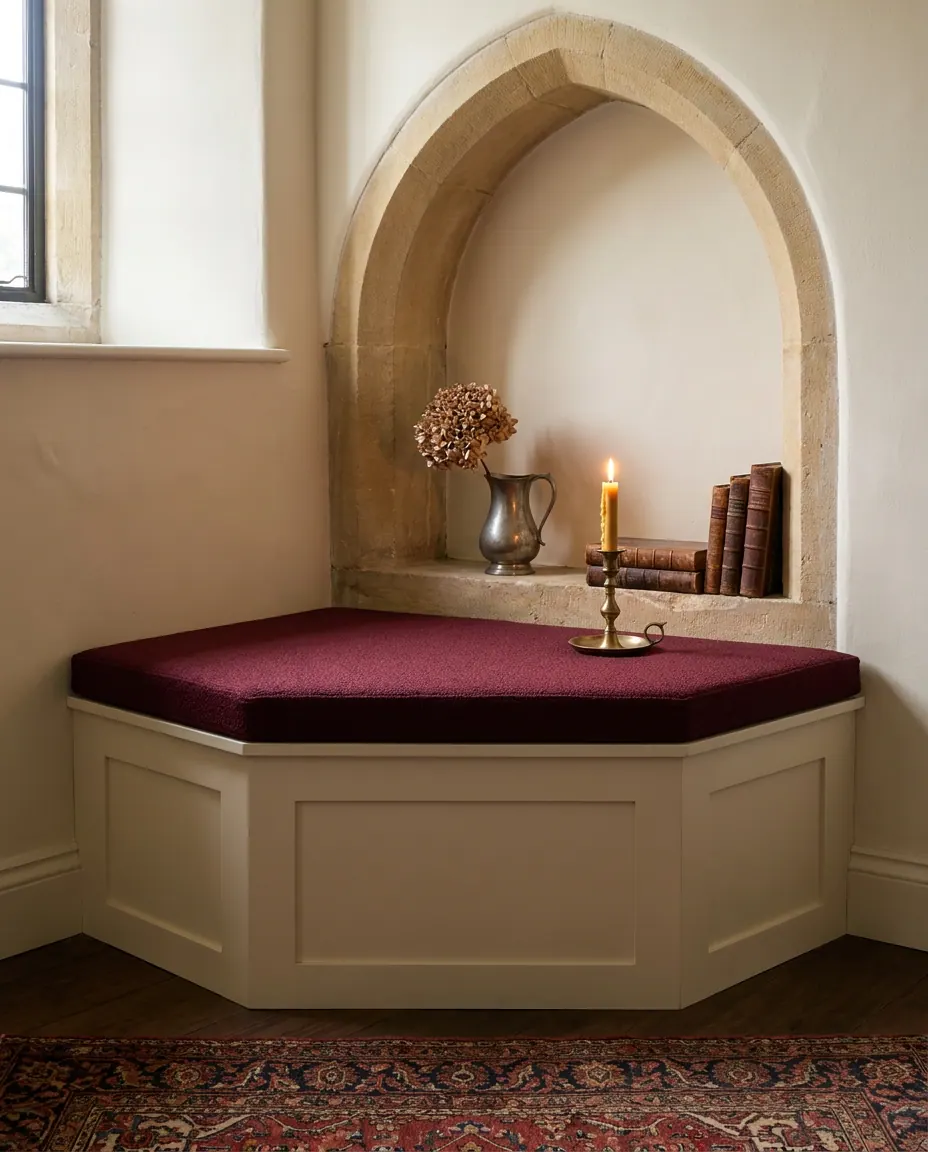
Burgundy boucle half-hexagon seat under a Gothic stone arch 01A past project
Eggplant velvet for a 59 1/2 in pew
A buyer wrote in with a church pew and a clear picture in mind: dark eggplant velvet, a gothic look, 59 1/2 x 13 1/2 in (151 x 34 cm). The workshop's first reply was a question: was the velvet in its main listing photo the one they meant? Screens are poor judges of deep colors.
The takeaway: Name the color in words and by its chart number, then hold a swatch against the pew in daylight.
Pattern sheet A 48 x 14 in pew seat drawn at 3 in (7.5 cm). 02A past project
Burgundy, 48 by 14 inches, quoted like any bench
One buyer wrote in about a church pew 48 in long and 14 in deep (122 x 36 cm), in burgundy. A straight pew seat is a rectangle, and it was quoted exactly as a bench cushion of that size would be. The word church never moved the number.
The takeaway: Price a pew as a bench: by length, depth, thickness, cloth, and any ties, piping or backrest you add.
Pattern sheet Lay paper on the seat and trace the edge, write the widest width and the front-to-back depth on the template, then photograph it flat from directly above with a tape measure in the picture. 03A past project
An old pew that curves
A buyer in the US asked whether the workshop would make a curved cushion for an old church pew. Yes, and the workshop asked first for a drawing of the curve with its measurements and a photo of the pew. It wants the inner edge along the front and the outer edge along the back, taken with a flexible tape or a string, plus the straight distance end to end and three depths. The chord and rise Pattern shows the geometry.
The takeaway: Measure both curves and three depths, or trace the seat on paper, and plan on 2 to 3 in (5 to 8 cm) of foam.
 Save
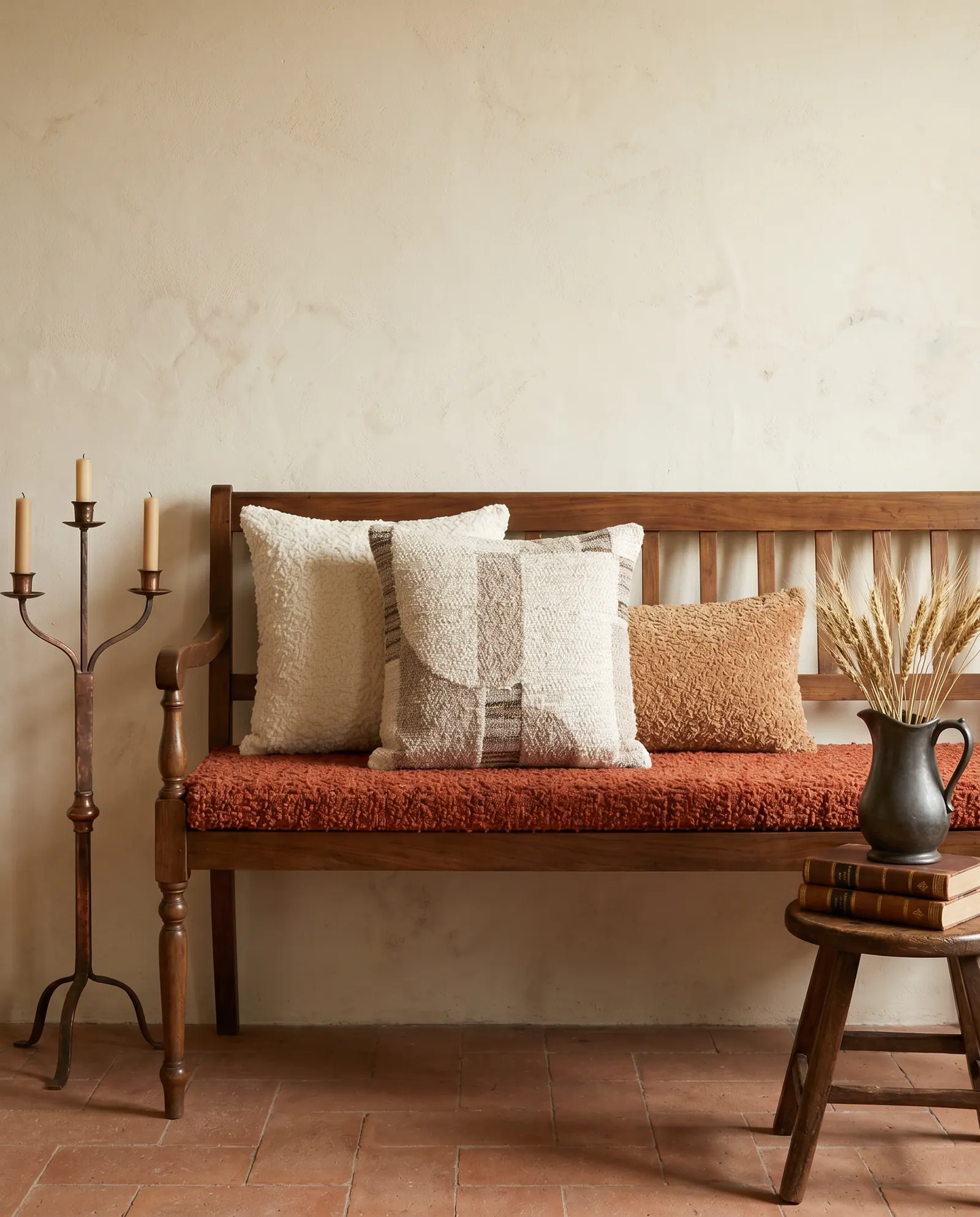
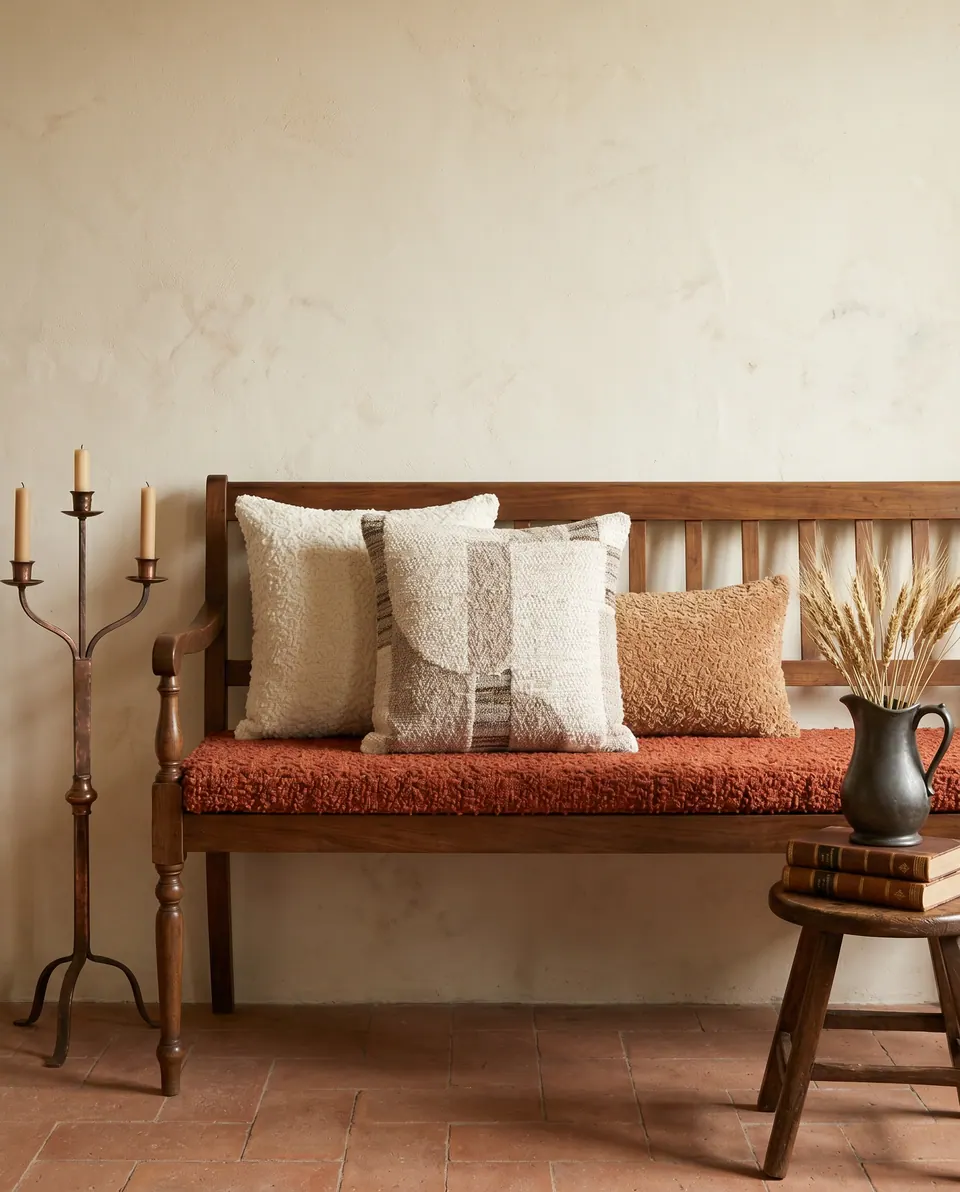
Rust boucle cushion on a dark oak slat-back settle in a limewashed hall 04A past project
A 13 in seat that wouldn't stay put
A buyer messaged the workshop about a seat 61 in long and only 13 in deep (155 x 33 cm), and wanted it slim, 2 to 3 in (5 to 8 cm), to keep clear of the window. It was made to the exact measurements given, and it still slid off the front edge. The workshop offered a remake at cost, a slightly larger size, or a non-slip base. A pew seat is just as shallow, and often polished.
The takeaway: On a shallow seat, plan the grip from the start: a non-slip base on smooth wood, ties where there's a rail.
 Save
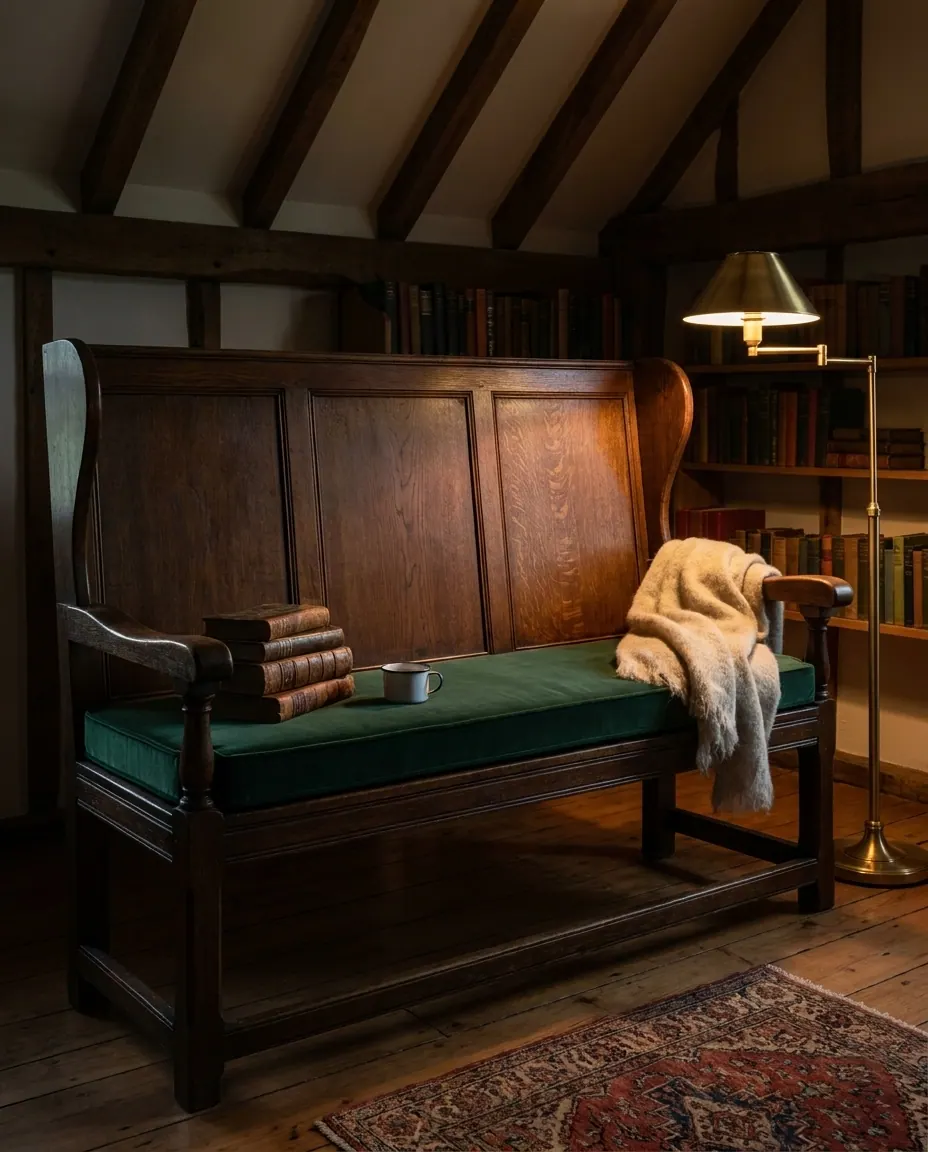
Forest green velvet cushion on an antique high-backed oak settle 05A past project
Green velvet and two bolsters for arms
A buyer in the US wanted a light green velvet, but that chart carried only one green, so she settled on another shade with piping in a second color. She also wanted a cylinder at each end to lean on, like arms: two bolsters 17.7 in long and 6 in across (45 x 15 cm), same velvet and piping, added after the seat order.
The takeaway: A pew end with no armrest takes a bolster well. Order it with the seat so the velvet comes off one roll.
Pattern sheet An antique bench seat, 66 x 13 in, drawn at 3 in (7.5 cm). 06A past project
A meeting-house bench that measured 66 in
A buyer in the US had an old meeting-house bench, 13 x 66 in (33 x 168 cm). No size menu carries that number, so the workshop told them to pick the 13 x 61 in option and it would make it 66. They chose an ice-blue soft fabric with tan linen piping. Mixing two fabric types is fine.
The takeaway: Old benches never match a menu. Choose the nearest option and write the true length in the note.
 Save
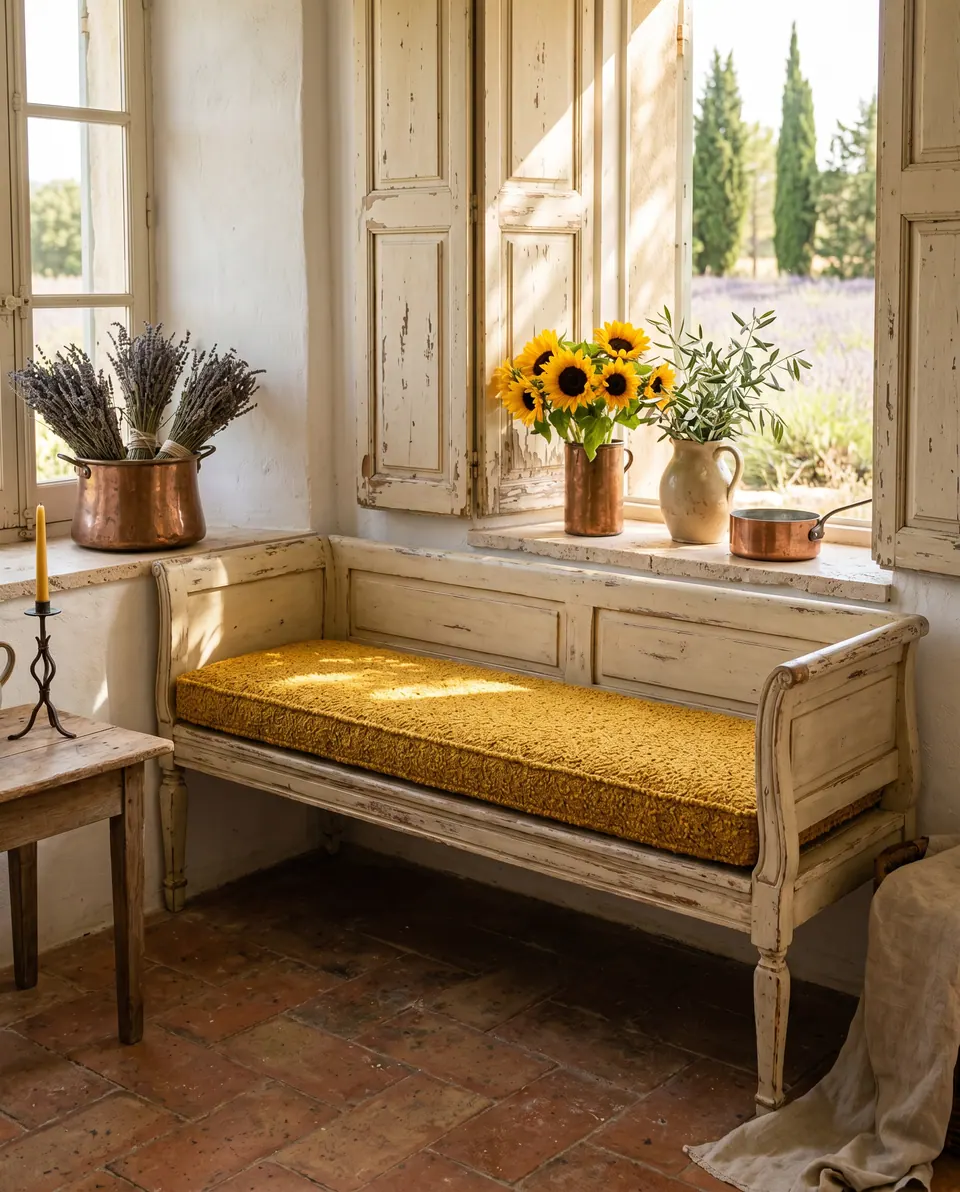
Mustard boucle cushion fitted inside the arms of a painted farmhouse settle 07A past project
A painted bench with wood jutting out at the ends
A buyer messaged the workshop about a painted bench with wood sticking out at both ends. They chose a warm neutral from the soft-fabric chart, which washes easily, and the cushion went through the custom-shape listing with their photos. At the final check the workshop found a small flaw and remade the cover before it left the workshop. It cost them a few days, and they thanked the workshop for the honesty.
The takeaway: Arms, posts and jutting ends make a custom shape. Send photos and let the maker cut around them.
Pattern sheet Side view. The back cushion stands on the seat cushion, so its height is the frame height minus the seat thickness. 08A past project
The back cushion she decided against
A buyer wrote to the workshop about a small bench, about 45 x 16 in (115 x 40 cm), with a matching back cushion of 45 x 12 in (115 x 30 cm) in lavender. On reflection she dropped the back: it would have eaten too much of a small seat. The workshop had mixed up inches and centimeters in its first reply, and confirmed the units before cutting.
The takeaway: A back cushion takes depth from the seat in front of it. On a 14 in pew, measure what is left for sitting.
When the pew is longer than one cushion
Pews still standing in churches run long. In the pew trade, runners of about 71 to 138 in (1.8 to 3.5 m) are common, and the longer ones come as jointed sections.
The workshop recommends about 79 to 91 in (200 to 230 cm) per piece, often as two equal halves that are easier to lift and wash, though one piece up to 138 in (350 cm) has been made on request; see the one-piece answer. For a built-in run of 141 in (358 cm) the workshop proposed two halves, and the buyer went to a local upholsterer who could sew it whole. Right call, and the workshop said so.
Order both pieces on one day. Each roll of velvet is dyed in its own batch, and a piece cut months later can sit a shade apart. Velvet remembers. The one piece or two Pattern shows where to split.
Ties or a non-slip base on old oak
Both keep a cushion on a pew; the wood decides which. The sliding Pattern covers both.
| Question | Fabric ties | Non-slip base |
|---|---|---|
| How it holds | Tied around a rail, slat, spindle or leg | A grippy fabric bottom panel that holds by friction, with no adhesive |
| What the pew must offer | Something to tie around; a solid seat between closed ends may offer nothing | A smooth, flat seat, like polished oak or painted wood |
| Where it goes | Sewn into the seams at the corners or back, wherever you mark | The whole underside of the cover, leaving no residue |
| Best for | Turned-leg settles and slatted benches | Shallow pew seats and settles with solid tops |
If the pew is going back to church
Now and then a pew cushion is headed for a chapel, a parish hall or another public room. Stop there, my friend, and ask before you pick a color.
Insurers and fire codes for public buildings can call for fire-rated foam, with paperwork to prove it. We don't claim that rating for these cushions. Ask the workshop what documents exist for the exact foam and fabric, and let the building's insurer decide; the commercial seating Pattern lists the questions.
A pew cushion is priced like any bench cushion of its size. The word church changes the story, not the quote.
Harlan
Pew and settle questions
- A common question
Our old pew has a curved seat. How do we measure it for a cushion?
The workshop's answerTake the inner curve along the front edge and the outer curve along the back with a flexible tape, or lay a string along each and measure it flat. Add the straight distance end to end, the depth at both ends and in the middle, and a photo. The shop recommends 2 to 3 in (5 to 8 cm) for curved benches, redraws the curve for approval, and makes very long curves as matching segments.
- A common question
What exactly is the non-slip base, and will it leave anything on an old wood finish?
The workshop's answerIt replaces the bottom panel of the cover with a grippy non-slip fabric covering the whole underside. It holds by friction, not adhesive, so it leaves no residue and doesn't show once the cushion is down. It's part of the cover, not a separate mat, and can come off the order before production.
- A common question
The pew sits between two carved ends. How close to my measurements will the cushion come out?
The workshop's answerHandmade cushions can vary by about 1 in (2.5 cm) either way, and long ones vary most. If a size is a hard maximum, say so: when one buyer said 24 in was the absolute limit, the cushion was made at 23 in. Measure thickness only after the foam has fully expanded.

Have it made
Have an idea like this made — ask Harlan’s workshop
The best cushions I have known began with somebody asking one more question. Ask yours here. — Harlan
Leave your details and the workshop will call you to confirm measurements, fabric, foam and piping. No prices, dates or payment on this page: it is a request, not an order.
More about pew cushions at home
How thick should a church pew cushion be?
The workshop's standard for everyday seating is 4 in (10 cm). A 3 in (7.5 cm) cushion gives a neater, lower line on bench seats, and 2 to 3 in (5 to 8 cm) is the recommendation for curved benches. A pew's seat height is fixed, so try the seat height calculator before going thicker.
Can I add a back cushion to a salvaged pew?
Yes, as a separate piece. A back cushion doesn't stand on its own; it leans on the pew back, and fabric ties can hold it to the seat cushion. It also takes depth from a seat that may be only 13 to 14 in (33 to 36 cm) deep.
What fabric holds up best on a pew that gets daily use?
Velvet or linen. The workshop steers heavy-use buyers toward those two over corduroy, whose ribs can split under hard wear, and velvet is easy to clean. Order a swatch first and see it on the wood. The velvet page covers care.