The Pattern Room · a measuring pattern
Replacement cushions for a nursery glider, piece by piece
A nursery glider wears out in order: the seat first, the arm pads next, the parents' patience last. Here's how to measure every piece so the new set fits the chair you already love.
 Save
The quick answer
To replace glider rocker cushions, measure each piece on its own: the seat's front width, back width and depth; a T-seat's letters so A + B + B = C; the back's top width, bottom width and height; each arm pad's length, width and drop; and the ottoman top. Send a lettered sketch with photos, and approve the redrawn plan before anything is cut.
Two gliders, and this page is about the one indoors
Say "glider cushions" on my porch and folks picture the metal glider bench out front. Say it in a nursery and they mean the upholstered rocker on a gliding base, the chair that has heard more lullabies than any radio. Glider rocker replacement cushions are for that second chair. The porch kind is a bench pad, and it lives with the porch swing cushions.
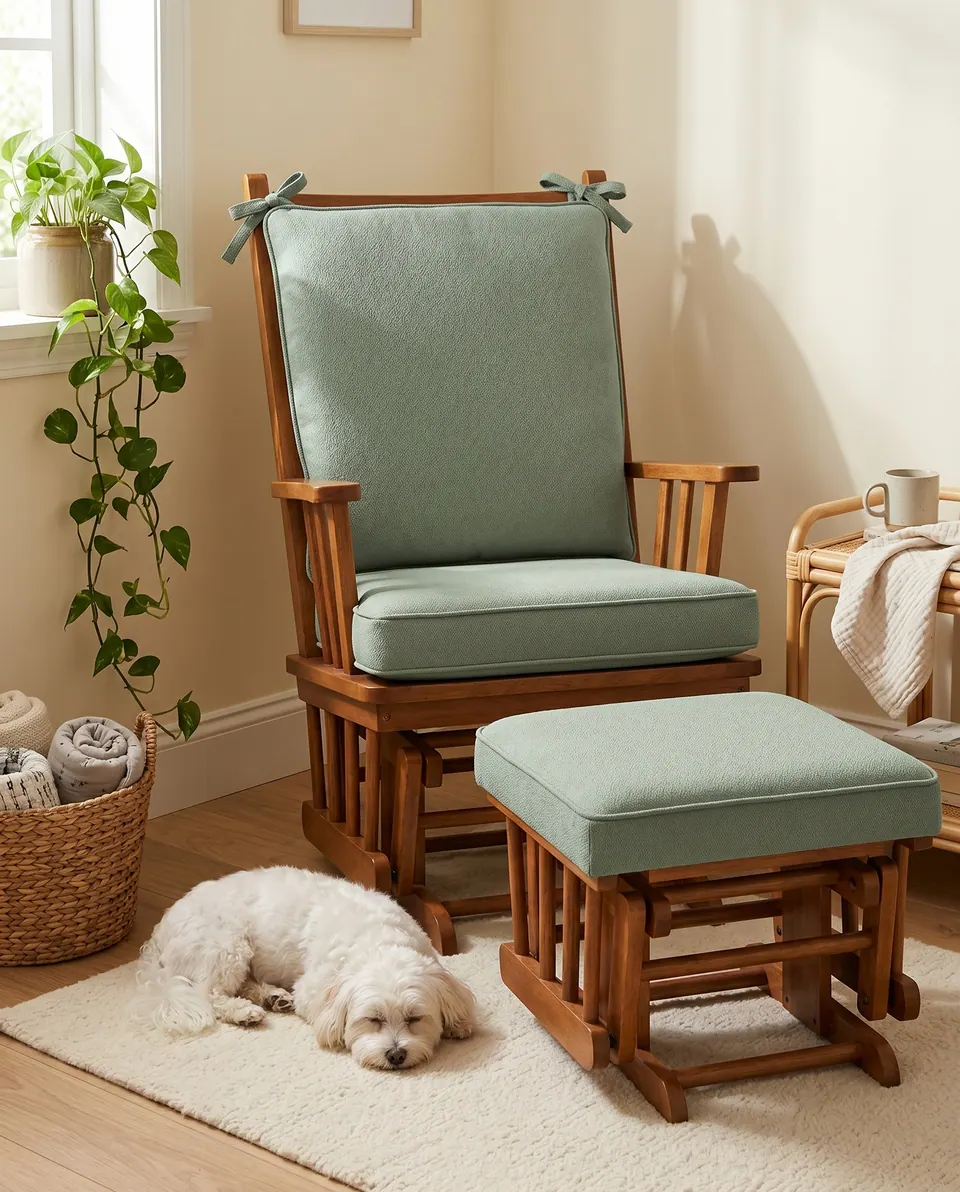
Stock replacement sets come three ways: high-back or wingback sets, low-back sets, and ottoman cushions sold on their own. A custom set follows your chair instead of a catalog, one piece at a time. Wooden rockers have their own hub, rocking chair cushions.
So tell me, neighbor: is yours a square-top back, or a round top with wings?
Every piece of a glider set, and what it needs
| Piece | Measure | How stock sets fasten it | From the workshop |
|---|---|---|---|
| Seat, square or tapered | Front width, back width, depth, thickness at rest | Zipped, with ties at the back | Cut to your numbers; ties on request |
| T-seat | A back width, B each ear, C front width; D ear depth, E depth behind the ears, F total depth | Zipped, with ties at the back | Redrawn from your lettered sides and checked before cutting |
| Back cushion | Top width, bottom width, height from the top of the seat cushion | Zipped at the bottom, ties at each side | Firm foam or pillow-style fill; 16 in (40 cm) is the bench standard, but a glider back is cut to the chair |
| Wingback top | A paper template of the curve | Part of the back cushion | Curved pieces are reviewed by the craftsmen and take longer than rectangles |
| Arm pads | Length along the arm, width across it, drop down each side | Hook-and-loop | Ties on request; for hook-and-loop, ask the workshop |
| Ottoman top | Width, depth, thickness, corner shape | Sold separately | Cut like a seat pad; order it with the set |
Stock-set fastenings are from published glider replacement sets, shown for comparison.
Measuring the glider, one cushion at a time
Photograph the chair first
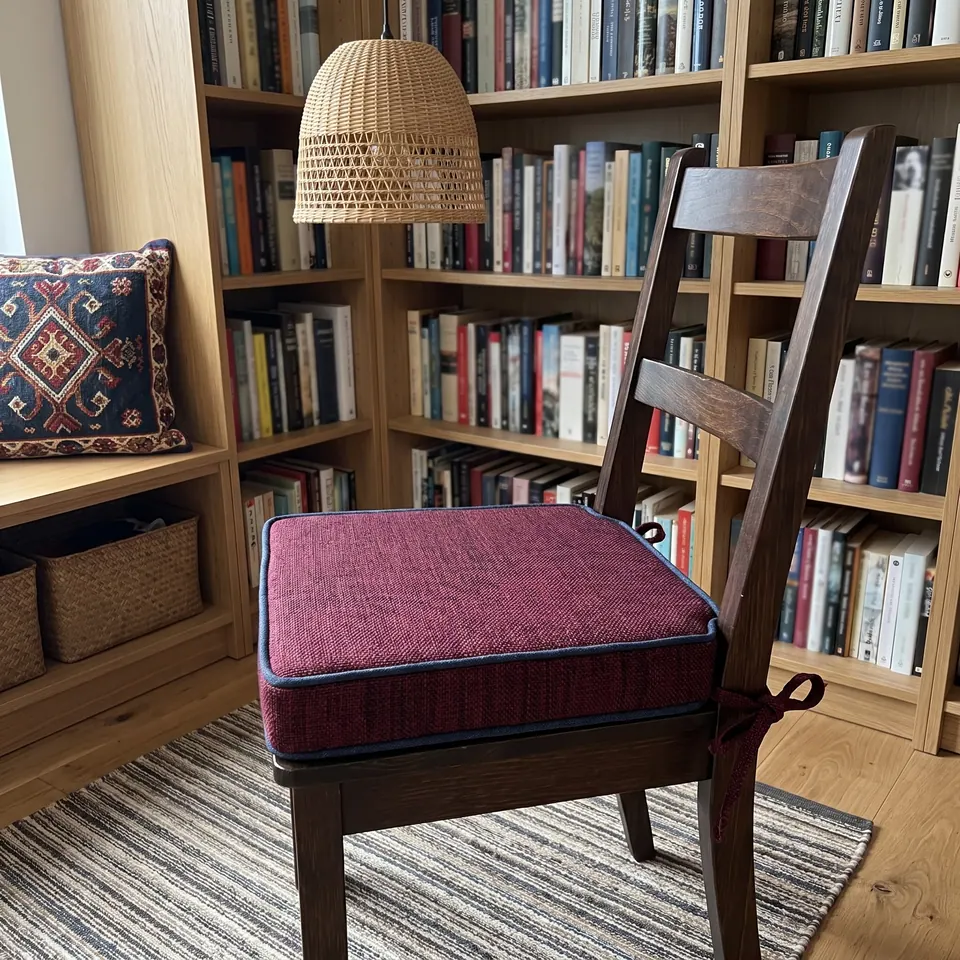
Before anything comes off, take a photo from the front, one from the side and one straight down on the seat. Then photograph how each cushion is held on: ties, zipper, hook-and-loop. The chair's overall size won't make a cushion; photos and piece-by-piece numbers will.
Seat: front width, back width, depth
Measure the seat deck where the cushion sits: across the front, across the back, and front to back down the middle. If the two widths differ, write both; replacement sets ask for each for that reason. Measure the old cushion's thickness at rest, not squeezed.
Pattern sheet The seat from above: front width, back width and depth, with ties at the back posts and the zipper on the back edge. T-seat: letter it and close the sum
If the seat steps out in front of the arms, it's a T. A is the back width between the arms, B is how far each ear steps out, C is the front width ear to ear: A + B + B must equal C. D is the ear depth, E the depth behind the ears, F the total depth: D + E = F. Measure the left and right ears separately. If a sum won't close, measure again before you send it; the T-cushion Pattern runs the same check on an armchair seat.
Back cushion: top width, bottom width, height
Measure the back where the cushion hangs: the width across the top, the width at the bottom, and the height from the top of the seat cushion to where the back cushion should stop. Height starts at the seat cushion, not the frame. On a round-top back, take the height at the center and at each side.
Wings and curves: trace them
A wingback curve won't describe itself in numbers. Lay paper over the old back cushion, trace the outline, cut it out, and write the widest width and the height on it. Photograph it flat from directly above beside a tape measure; there's no need to mail the paper. The paper template Pattern has the details.
Pattern sheet Trace the curved piece, write its widest width and its height or depth on the paper, and photograph it flat from above with a tape measure in the shot. Arm pads: length, width, drop
Measure each arm from the front of the armrest to the back, the width across the top, and how far the pad should drop down each side. Do both arms. Stock sets hold arm pads with hook-and-loop; the workshop sews ties on request, and for anything else, ask the workshop.
Ottoman top: width, depth, corners
Measure the top across and front to back, and note the corner shape: square, rounded or clipped. For rounded corners, mark how far from each corner the curve begins. Order it with the rest of the set.
Write the fastenings down
For every piece, say how it holds: how many ties, where they go and how long they are, and which edge the zipper should sit on. The zipper normally hides on the back edge or the underside, and you can choose the side.
Send the lettered sketch
Put everything on one page, each piece drawn with its letters and numbers, plus the photos. The workshop checks the geometry, works out any missing side, flags anything that doesn't add up and sends back its own drawing. Nothing is cut until you say yes. See what to send for an odd shape.

Have it made
Measured it? Have Rosa’s workshop make it
Swings sway, rockers rock, dogs circle three times. Tell the workshop what your seat goes through, and they will plan for it. — Rosa
Leave your details and the workshop will call you to confirm measurements, fabric, foam and piping. No prices, dates or payment on this page: it is a request, not an order.
High back or low back, foam or fiber
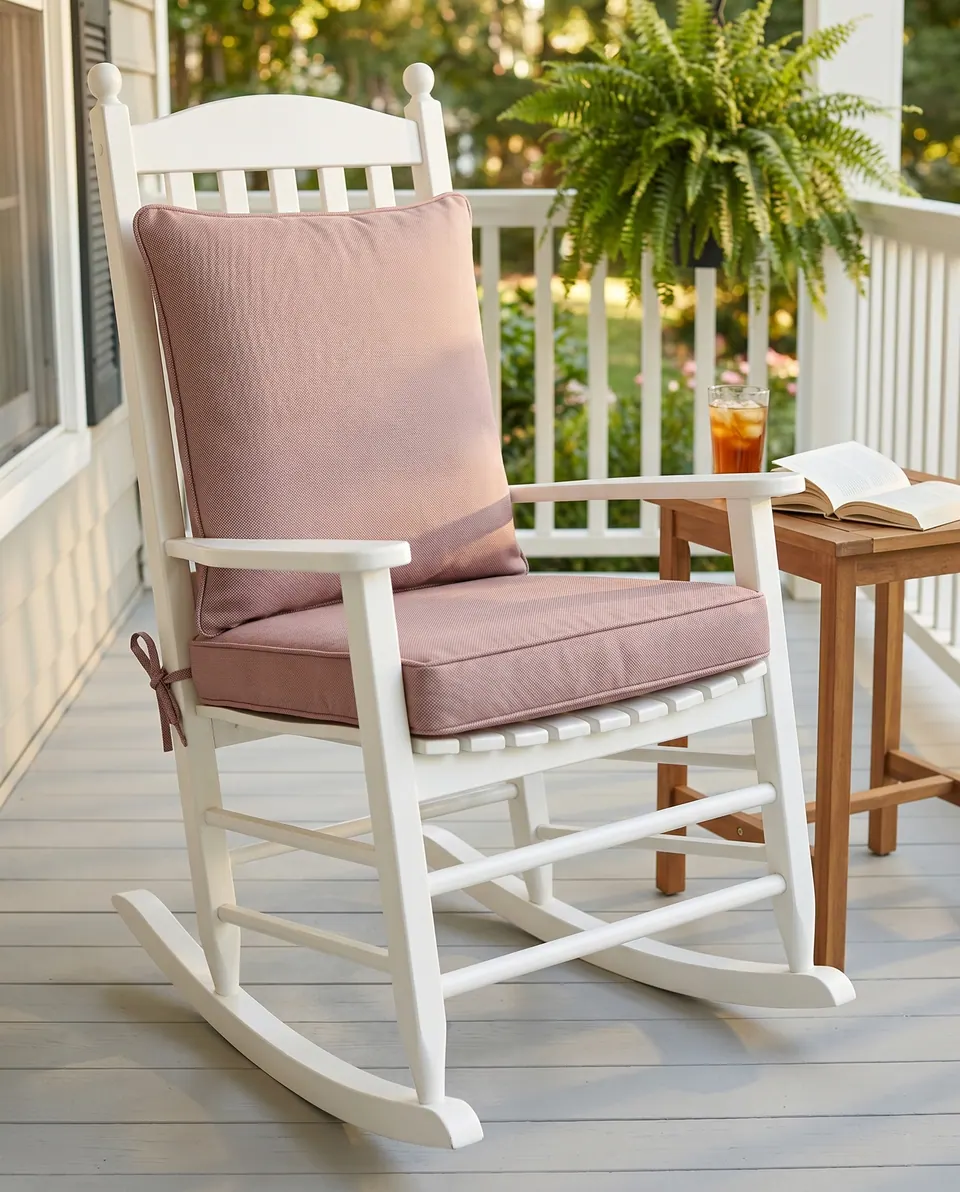
A high-back or wingback set runs the back cushion up behind your head, which is where a sleepy parent wants it at three in the morning. A low-back set stops around the shoulders and looks tidier in a small room. Measure what your chair has; don't redesign it by mail.
Seats and backs want different fills. Stock sets offer a 3 in (7.5 cm) foam seat as an upgrade over polyester fill. The workshop's seat foam is a firm 32 kg/m³; a back can be firm foam, which holds its shape, or a pillow-style fiber fill, which is softer and still works as a backrest. A firm seat under a softer back is a fine pairing.
You don't have to replace the lot, either. A back cushion can be made on its own, or a seat on its own, in any size and color. In a nursery, choose covers that unzip and wash at 86°F (30°C) and air-dry; velvet and the linen-look performance weaves both take that care. Tufted cushions are sewn through the filling, so their covers don't come off.
The nursery armchair that set the thickness
A parent in the US wrote to the workshop about an armchair headed for the nursery. Not a glider, but the same job: long sits, a baby in one arm, and cushions that had to be right the first time.
The old cushions measured about 5 in (13 cm) thick, and that one number set everything else. The new seat became 20 x 22 x 5 in (51 x 56 x 13 cm) and the back 21 x 27 x 5 in (53 x 69 x 13 cm), both filled with fiber and silicone balls. To pick the color, the parent bought one sample pack with several swatches. When the first pack couldn't be traced in the mail, the workshop sent another.
Measure what you're replacing. Comfort lives in the thickness.
- Measured
- Seat 20 x 22 x 5 in (51 x 56 x 13 cm); back 21 x 27 x 5 in (53 x 69 x 13 cm)
- What it taught
- Copy the old cushion's thickness, measured at rest, unless the chair always felt wrong.
Where glider orders go sideways
- Sending the chair's overall width, depth and height instead of each cushion's numbers.
- Measuring a T-seat without checking that A + B + B = C.
- Measuring the back cushion from the floor or the frame instead of from the top of the seat cushion.
- Measuring the old cushion squeezed flat instead of at rest.
- Assuming ties come standard. Write how many, where and how long.
- Choosing a tufted set for a nursery; tufted covers don't come off for washing.
- Ordering the ottoman months later. Dye batches can differ slightly, so order the set together.
Measure a glider one cushion at a time, letter every edge, and make the sums close before anything gets cut.
Rosa
Buyer questions: seats, backs and awkward shapes
- A common question
What do you need from me to make seat and back cushions for my chairs?
The workshop's answerThe chair's overall size isn't enough for a good fit. Measure the width between the armrests, the seat depth and the back-cushion height you want, and send those with photos of the chairs. Seat and back cushions can be made in any size, boxed and piped, with ties at the back corners to keep them in place.
- A common question
My chair has an awkward shape. How should I send the measurements?
The workshop's answerSend photos plus a hand-drawn sketch on paper with every dimension written on it; lettering the sides A, B, C and so on works well. For a back cushion, include the height above the seat, and give the narrowest and widest points if a piece is uneven. The workshop asks about any missing side, sends back its own drawing and waits for your OK before production.
- A common question
Can I order just the back cushion, or just the seat?
The workshop's answerYes. Back cushions are made on their own in any size and color, and a seat can be ordered without a back. A backrest with a zippered, removable cover is possible only in the non-tufted style.
- A common question
Are the seat, back and arm pieces attached to each other?
The workshop's answerNo. In the workshop's seat, back and armrest sets the pieces are separate, not sewn or fixed together, so each can be moved or used on its own. If you want them held together, ties can be sewn on the corners so the pieces tie to each other.
- A common question
Can you copy a curved chair cushion exactly from my photos?
The workshop's answerMild curves are possible, but no curved or shaped piece is promised until the craftsmen have reviewed a measured drawing and photos. The workshop has declined a rocking-chair seat pad that had to fit a shaped chair exactly, because it couldn't be made accurately without the chair in hand. A complex S-curved bench edge, first declined, was made once the buyer sent a full template.
Glider cushion questions from the front step
How thick should a glider seat cushion be?
Match the cushion you're replacing, measured at rest. Stock glider sets offer a 3 in (7.5 cm) foam seat as an upgrade over fiber fill. The workshop's thinnest standard foam is 2 in (5 cm) and its usual seat thickness is 4 in (10 cm); one nursery armchair took 5 in (13 cm).
Can glider cushion covers go in the washing machine?
Zippered covers come off and machine-wash at 86°F (30°C) at most, inside out, on a gentle cycle with mild detergent and no bleach. Air-dry them instead of tumble-drying. Tufted cushions are sewn through the filling and can only be spot-cleaned.
Should the ottoman cushion be ordered with the chair cushions?
Yes. Color reads differently in daylight, lamplight and on screens, and dye batches can differ slightly, so an exact match across separate orders isn't guaranteed. One order for the whole set is the surest way to keep chair and ottoman matching.
What about cushions for a metal porch glider?
That's a different product: a bench-style seat pad on a metal frame, often reversible and tied on, in sizes from a single seat up to about 6 ft (1.8 m). Measure it like a bench and see the porch swing cushions hub for sizes and ties.