A Reading by MaggieDining Chair Cushions & Pads
Ordering a taupe striped seat pad for a cast-aluminum garden chair
Maggie takes apart a striped outdoor pad on a bronze scroll-back chair, layer by layer, and lists what your first message should say.

 Save
The quick answer
To order a chair cushion with ties for a metal garden chair right the first time, send the width between the armrests, the seat depth and the back height you want, not the chair's overall size. Add the fabric code, the stripe direction and whether the back corners need notching around the arm posts. The workshop suggests 3 to 4 in (8 to 10 cm) for the seat.
The cushion, cut open
Cover fabric. A removable, zippered cover. Machine wash at 86°F (30°C) on a gentle cycle and air dry.
Piping. A fabric-covered cord sewn into the seams. It sits on the seam line, so it does not change the size.
Fiber wrap. Polyester fiber (Dacron) batting around the foam: it fills the cover out and softens the edges.
Foam core. About 2.0 lb/ft³ (32 kg/m³) high-resilience foam, firm to medium-firm, cut to the ordered size.
Zipper. Along the back band, as hidden as possible. The zipper side faces down or toward the wall.
Base panel. The underside of the cover. A non-slip fabric backing can cover the whole of it instead.
Anatomy of a striped garden pad
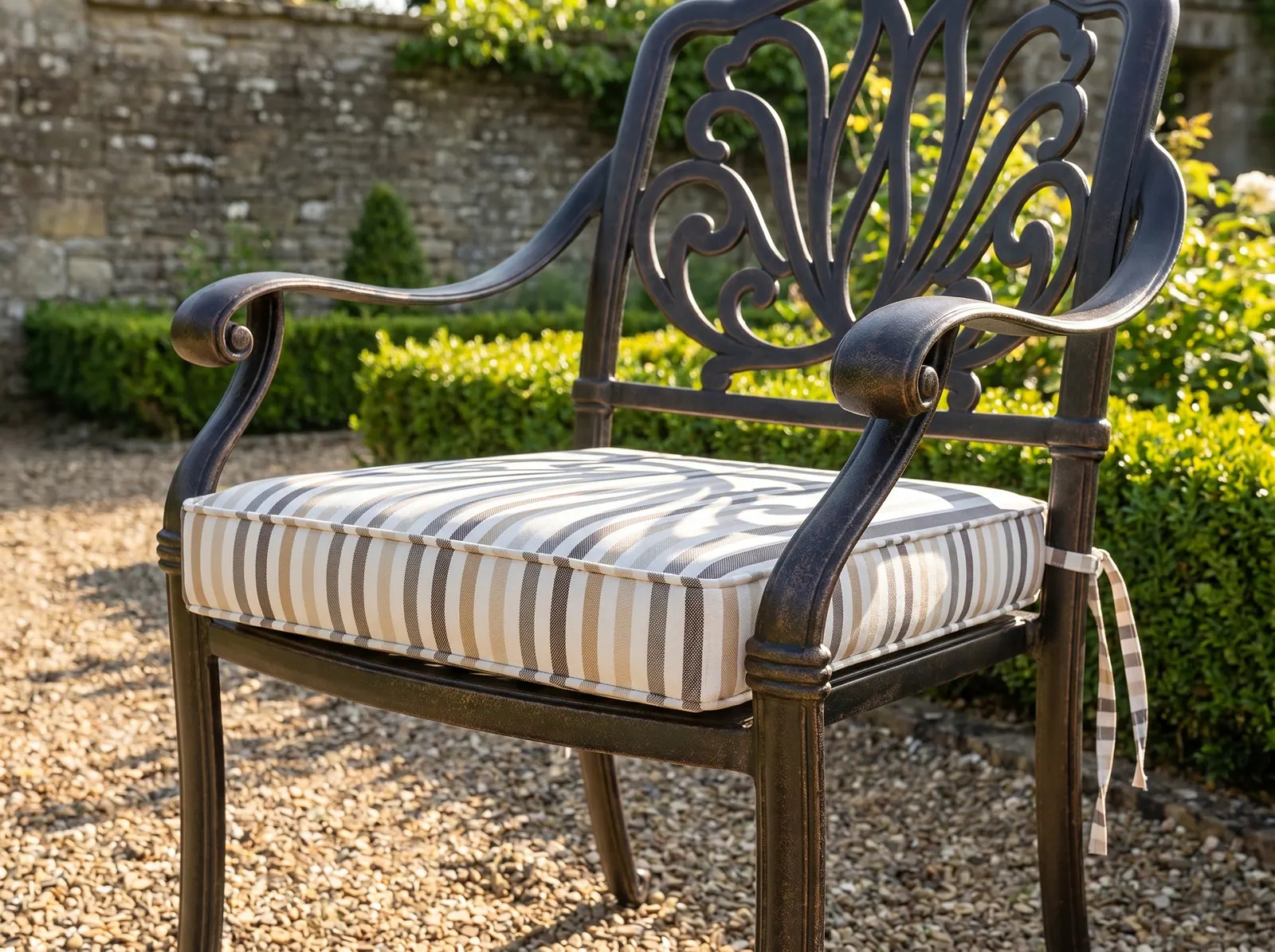
A cast-aluminum chair is a handsome, unforgiving thing. The back is all scrolls and curls, and the seat is hard metal, often slightly dished. The pad on it has to be firm, plain in outline and quietly patterned, and this one is all three.
Take it apart layer by layer.
- The face. A taupe, ivory and dove gray stripe in outdoor acrylic, code 5070. The stripes run front to back, which leads the eye straight to the scroll-work.
- The box edge. The side band shows the stripe in section, so the corners must be matched or the stripe will jog. On a box edge, every corner is an exam.
- The welt. Self piping in the same stripe. A straight welt is a kind of honesty, and this one keeps the outline crisp without adding a new color.
- The ties. Cut from the stripe too and looped round the back leg, where they almost disappear.
- The inside. Firm, because a soft pad sinks into a dished seat and loses its shape.
The garden does its part. Clipped box hedging behind makes the taupe and ivory look crisp, while the pea gravel and old stone wall repeat its neutrals. A calm stripe balances the busy casting, which is the whole trick of dressing an ornate chair.
Before you order, get a swatch and look at it in daylight, under your evening lamps and against the chair's bronze finish; the swatch pattern explains why. The stripe direction pattern settles the other question, and the outdoor acrylic shelf and the dining chair cushion atlas hold the rest.
Pinned by Maggie: the courtyard chair
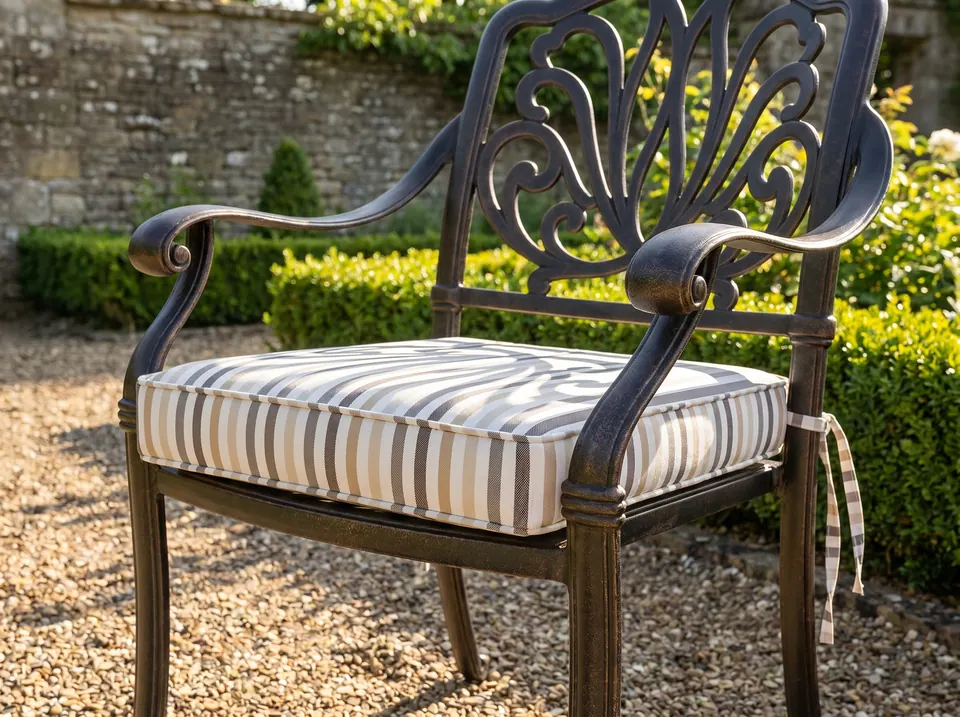
Start at the striped seat, then follow the pins to the boxed edge, the tie on the back leg, the scroll-work and the hedge behind.
- Striped seat pad
Stripes run front to back, leading the eye to the ornate chair back.
- Boxed striped edge
The box edge shows the stripe in section, so matched corners matter.
- Striped tie hanging
Ties in the same stripe loop round the back leg and almost vanish.
- Cast scroll-work back
A calm stripe balances the busy cast pattern of the back.
- Clipped box hedge
Clipped green behind makes the taupe-and-ivory stripe look crisp.
- Striped seat padStripes run front to back, leading the eye to the ornate chair back.
- Boxed striped edgeThe box edge shows the stripe in section, so matched corners matter.
- Striped tie hangingTies in the same stripe loop round the back leg and almost vanish.
- Cast scroll-work backA calm stripe balances the busy cast pattern of the back.
- Clipped box hedgeClipped green behind makes the taupe-and-ivory stripe look crisp.
What your first message should say
- The width between the armrests, the seat depth and the back height you want, measured once the chairs are home
- The fabric code for the body, and a separate code for the piping or ties if they differ
- Which way the stripe runs: front to back, or side to side
- Whether the back corners should be notched or rounded around the arm posts
- The thickness: 3 to 4 in (8 to 10 cm) is what the workshop suggests for garden armchairs
- Ties at the two back corners, and what they will knot around
- A photo of the chair, so the maker can see the dish in the seat
Six floor seats and a corner nobody had claimed
A buyer in the US, ordering cushions online for the first time, wrote to the workshop about a freshly renovated living room. They wanted L-shaped floor seating along two walls: at least six floor seats plus tall back pillows, like the listing photo, in velvet of the same color. They were not sure what to measure.
The workshop explained that L seating is really separate cushions placed side by side. It asked for each wall's length drawn on paper, then checked whether the sizes ran end to end so it could handle the corner overlap. The runs came to 140 in (356 cm) and 115 in (292 cm), and the tufted set was quoted with backrests and armrests.
The lesson is the same one this garden pad teaches: say what you mean before the scissors do. For L-shaped seating, measure the usable run on each wall and decide which run owns the corner. The L-shaped measuring pattern shows how.
On the cutting table: the garden pad
| Piece | Tie-on seat pad for a cast-aluminum garden armchair |
|---|---|
| Fabric | Outdoor acrylic stripe in taupe, ivory and dove gray, code 5070 |
| Stripe | Runs front to back |
| Edge | Box edge with matched stripe corners |
| Piping | Self piping in the same stripe |
| Fastening | Two striped ties looped around the back legs |
| Thickness | 3 to 4 in (8 to 10 cm) suggested for garden armchairs |
| Weather | Water-repellent, not waterproof |
| Best for | Metal patio chairs with hard or dished seats |

Have it made
Have this made — ask Maggie’s workshop
Numbers first, fabric second, piping last. Jot down what you have, and the workshop will go down the list with you, item by item. — Maggie
Leave your details and the workshop will call you to confirm measurements, fabric, foam and piping. No prices, dates or payment on this page: it is a request, not an order.
Buyer questions: chair sizes, one small cushion and rain
- A common question
All I have are the overall chair dimensions. Is that enough to make seat and back cushions for metal garden armchairs?
The workshop's answerNot for a good fit. Once the chairs arrive, measure the width between the armrests, the seat depth and the back-cushion height you want. The workshop recommends a seat 3 to 4 in (8 to 10 cm) thick in 32-density high-resilience foam wrapped in polyester batting, with ties at the back corners. Boxed cushions with piping are no problem.
- A common question
Can you make just one small cushion, around 15 x 15 in (38 x 38 cm)?
The workshop's answerYes. Choose the smallest size on the listing and write your exact size and colors in the note. Small pieces cannot go below the listing's minimum price; one 13 3/4 x 13 3/4 in (35 x 35 cm) cushion, 2 to 3 in (5 to 8 cm) thick, was made this way for a stone stool. Several small cushions ordered together earn a discount.
- A common question
Are your outdoor cushions waterproof?
The workshop's answerThe outdoor fabrics are made for outdoor use and are water-repellent, which makes them durable against the weather. For families with messy kids, there are also premium fabric charts that are water-resistant and easy to wipe clean.
Overall chair size will not fit a garden chair cushion: send the width between the armrests, the seat depth and the back height you want.
Maggie
Questions buyers ask next
Which way should stripes run on a garden chair seat pad?
Front to back is the classic choice for a chair, because it leads the eye toward the back. Whichever you prefer, write it in your order note, since the maker cannot guess and a box edge shows the stripe on every side.
Why does a cast-aluminum chair need a firm pad?
Cast-aluminum seats are hard and often slightly dished. A soft pad sinks into the dip and loses its shape, while a firm one bridges it and keeps a flat, plain outline under the busy scroll-work.
Can a garden seat pad be notched around the arm posts?
Yes. Ask for the back corners to be notched or rounded, and give each notch's distance from the nearest corner, its width and its depth, so the pad lies flat between the arms.
How should I judge a striped outdoor fabric before ordering?
Ask for a swatch and look at it in daylight, under evening lamps and against the chair's own finish. Two colors can match under one light and drift apart under another, and a stripe carries several at once.
Stitch straight — Maggie