A Reading by MaggieDining Chair Cushions & Pads
A striped chair cushion with ties, and the piping cut from its own stripe
A letter about one square pad laid flat on a lawn, and the small decision along its edge that most buyers rush.

 Save
The quick answer
On a striped chair cushion with ties, self piping cut from the same stripe is the safest choice: it finishes the edge without drawing a new color around the pad. Pick a contrast cord when you want the square outline to stand out against the chair. Skip piping when you want a softer, more relaxed edge.
Newport ·
Dear reader,
A letter about the stripe that pipes itself
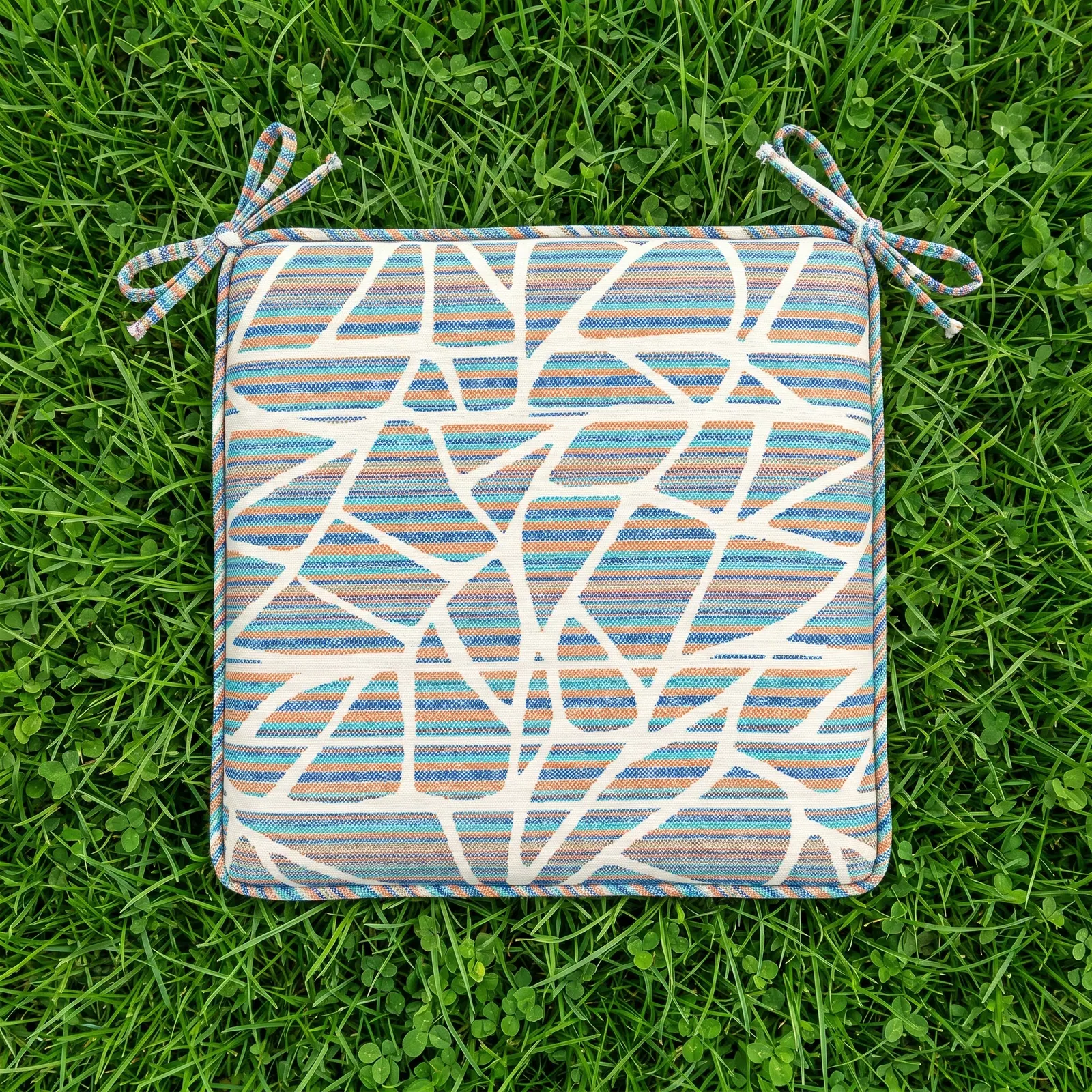
A striped piping cord can carry three colors at once, and the chair pad in this photograph wears one all the way around.
Right, then, dear. This picture settles an argument I have with buyers more often than I'd like. It is a flat lay, shot from straight above on a clover lawn: one square chair pad with softly rounded corners, stripes of cornflower blue, orange and aqua, and a white crackle of network lines over the top.
Now the edge. The piping is self piping, cut from the same stripe, so the cord reads as a thin line of every color at once. It outlines the square without announcing it, which is the whole job of piping on a patterned pad. The Pattern on matching, contrast or no piping goes further.
The two ties come off the back corners, where a spindle-back chair gives them posts to hold. Cut from the stripe, they read as design; in a contrast color they would read as a repair. To order a chair cushion with ties like this, trace the seat on paper and mark where the back posts rise. Those marks are the tie positions. Where do the posts sit on your chair? The chair cushion builder takes it from there.
The grass does the photographer a favor and you a disservice. Bright green pushes blue and orange louder than they will look on a wooden chair or a shaded patio, so hold outdoor acrylic swatches against the real chair. I once chose a cord color from a photo shot on a lawn. Once.
Pinned by Maggie: five points on a flat lay
Five pins, from the white crackle over the stripes to the clover under the pad.
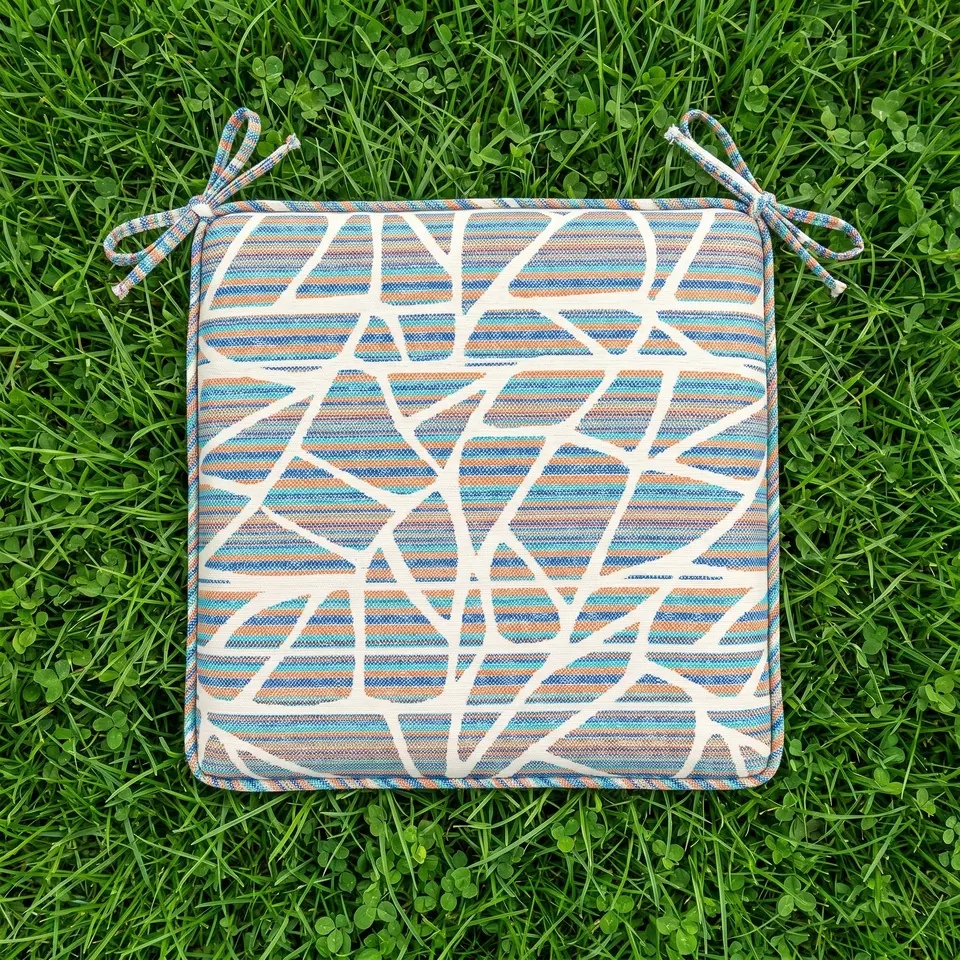
- Network pattern
White crackle lines break up the stripes so the pad looks lively without loud color.
- Left corner tie
Ties sit at the two back corners, the usual place for spindle-back dining chairs.
- Right corner tie
Both ties are made from the same striped cloth for a neat finish.
- Striped piping
Self piping cut from the stripe gives a thin multicolour edge.
- Green lawn
Bright grass exaggerates the blue and orange; expect softer colors indoors.
- Network patternWhite crackle lines break up the stripes so the pad looks lively without loud color.
- Left corner tieTies sit at the two back corners, the usual place for spindle-back dining chairs.
- Right corner tieBoth ties are made from the same striped cloth for a neat finish.
- Striped pipingSelf piping cut from the stripe gives a thin multicolour edge.
- Green lawnBright grass exaggerates the blue and orange; expect softer colors indoors.
Self, contrast or none: piping on a striped chair pad
| Piping | What the edge does | Choose it when |
|---|---|---|
| Self piping | Finishes the edge quietly and holds the box shape | The fabric is already busy, like this stripe |
| Contrast piping | Draws a crisp line and makes the square the point | The body is a solid and you want a tailored look |
| No piping | A softer, rounder edge; the pattern runs over it | You want a relaxed, slipcovered look |
No cushions, a curved front, and a sofa to measure from
A buyer wrote to the workshop with a two-seater sofa frame and nothing on it: the seat and back cushions had been lost. They wanted curved seat cushions in seaweed green velvet, and the photos came by message when the upload failed.
With no old cushion to copy, the workshop asked for two numbers: the straight side length before the curve begins, and the depth of the front curve. The craftsmen worked out the rest from the sofa itself. For any curved seat, a paper template of the seat deck beats a tape measure.
Buyer questions: trim, thickness and a tricky green
- A common question
Can you make pads for my Cesca-style chairs a little smaller, so the wood trim still shows?
The workshop's answerYes. Product pages rarely list detailed seat measurements, so measure your chairs by hand and size the pads as much smaller as you like. If the seat is not a rectangle, upload a drawing or photo with measurements.
- A common question
I need a new seat and back cushion for an armchair, both 22 x 22 in. Does going to 4 in thick lower the price?
The workshop's answerYes. Both can be made at 22 x 22 in (56 x 56 cm), and the pair costs less at 4 in (10 cm) than at 6 in (15 cm). Same-color piping came at no extra charge. That buyer chose charcoal linen L35 and said the pair fit perfectly.
- A common question
Will olive green 123 clash with my curtains? I can't judge greens on a screen.
The workshop's answerColor 123 shifts with the light: yellow-lime under white light, much calmer under warm light. Greens, sage above all, are the hardest colors to judge on a screen, so check close-ups in your own room's light or order samples first.
On the cutting table: the lawn pad
| Cushion | Square tie-on chair pad, softly rounded corners |
|---|---|
| Edge | Box edge |
| Fabric | Outdoor acrylic stripe, blue, orange and aqua, white network overlay |
| Piping | Self piping cut from the stripe |
| Ties | Two, at the back corners, in the body fabric |
| To measure | Trace the seat; mark the back posts |
| Best for | Spindle-back dining and patio chairs |

Have it made
Have this made — ask Maggie’s workshop
Have the tape measure handy when they call. Old cushions shrink and sag; the seat underneath does not. — Maggie
Leave your details and the workshop will call you to confirm measurements, fabric, foam and piping. No prices, dates or payment on this page: it is a request, not an order.
Self piping cut from a striped fabric turns the edge of a chair pad into a thin line of every color in the stripe, finishing the pad without adding a new color.
Maggie
Questions buyers ask next
Should the ties on a chair pad be cut from the cushion fabric?
Usually, yes. Ties cut from the body fabric read as part of the design, while a tie in another color tends to look like an afterthought. The exception is a deliberate trim, where the ties repeat a contrast piping color.
Where do the ties go on a square chair pad?
At the two back corners, beside the back posts or spindles, the standard layout for spindle-back dining chairs. Trace the seat on paper and mark where the posts rise; those marks set the tie positions.
Why does my chair pad look brighter in photos than on the chair?
Outdoor photos often set the pad on grass or in full sun, and bright green makes blue and orange look louder. On a wooden chair or a shaded patio the same fabric reads softer, so judge color on a swatch at the chair.
Stitch straight — Maggie
More photographs to read
 Save
 Save
 Save
 Save
 Save
 Save