A Reading by NateBench Cushions
A sand velvet custom bench cushion, one step darker than the limewash
Five surfaces, one color family and a low evening sun that shows the difference. Nate lays out the tone ladder and the single rule it proves.

 Save
The quick answer
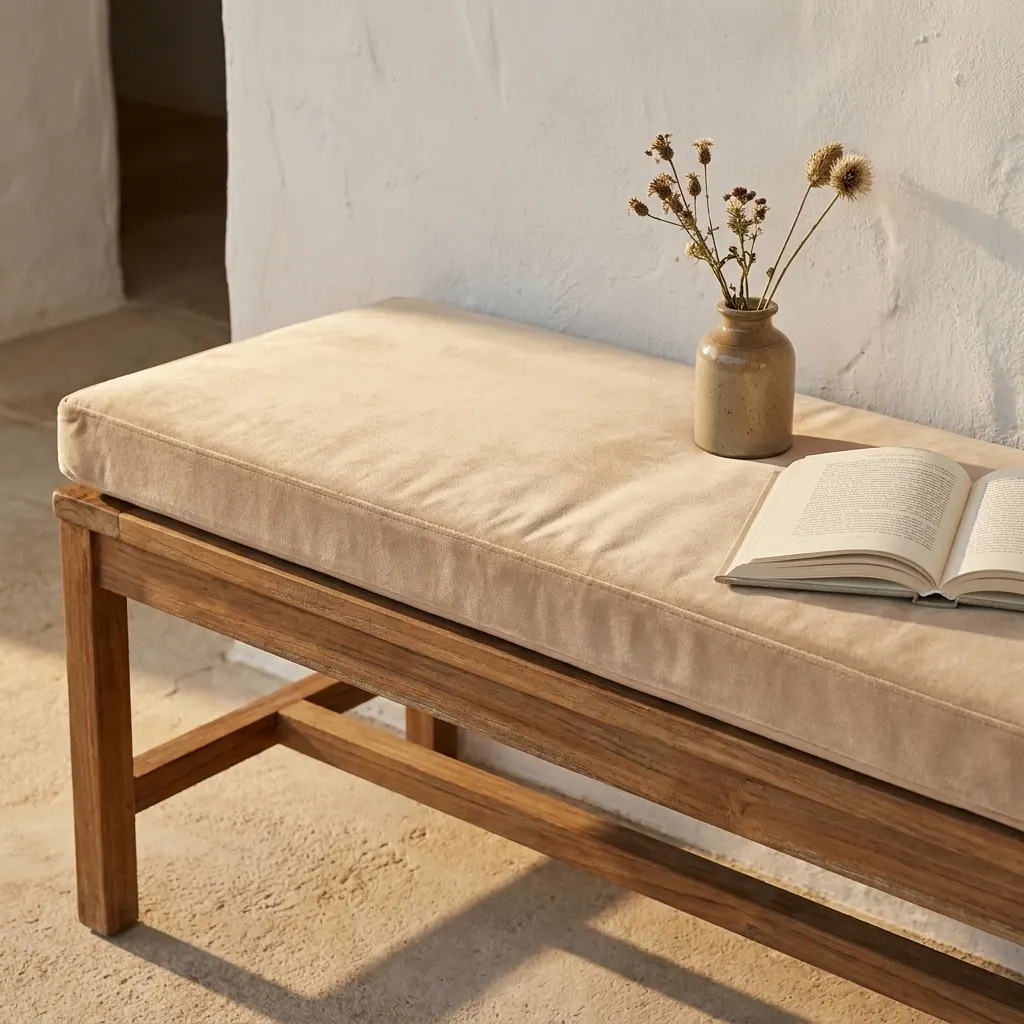
For an entryway, choose a custom bench cushion one step darker than the wall. Here sand velvet sits on weathered teak against chalk-white limewash, and because every surface shares a warm-gray undertone, texture does the work color usually does. Self piping keeps the box edge soft but clear, and two natural objects on a diagonal finish the bench.
One color family, five textures
Low evening sun rakes across this hallway bench, and nothing in the frame changes color. Only texture changes. That is the whole trick.
Sand velvet, a stoneware bottle, dried seedheads, limewashed plaster and weathered teak all sit in the same warm-gray family. The silvering teak and the sand pile share an undertone, which is why the cushion looks like it grew on the bench instead of arriving in a box.
Velvet is the right cloth for the job. Its pile catches the raking light along the top and goes a shade deeper on the front face, so one color reads as two. A flat weave in the same sand would look like cardboard at this hour.
The self-piped box edge is the only drawn line in the picture. It is soft, but it runs straight and repeats the teak rails below, the way a pencil line repeats a ruler.
Two props sit on a diagonal. The bottle vase of thistle and scabious seedheads holds the back corner and adds height without adding a color. The open paperback on the front corner balances it. Count them, partner: two. A third object would start a conversation this bench doesn't need.
What color is your entry wall? Hold that swatch up and step one shade darker for the seat. More seats like this are in mudroom and entryway bench cushions, the whole family lives under custom bench cushions, and the pile is covered in the velvet bench cushion care notes.
The tone ladder on one hallway bench
| Rung | Material | Job on the bench |
|---|---|---|
| Wall | Chalk-white limewash | The lightest rung; sets the scale |
| Seat | Sand velvet, self piped | One step darker than the wall |
| Vase | Glazed stoneware | The sand tone again, in a hard material |
| Stems | Dried thistle and scabious | Height with no new color |
| Frame | Weathered teak | Warm gray; shares the velvet's undertone |
Pinned by Nate: five points on a diagonal
Five pins, from the teak leg at floor level to the seedheads at the top of the frame.
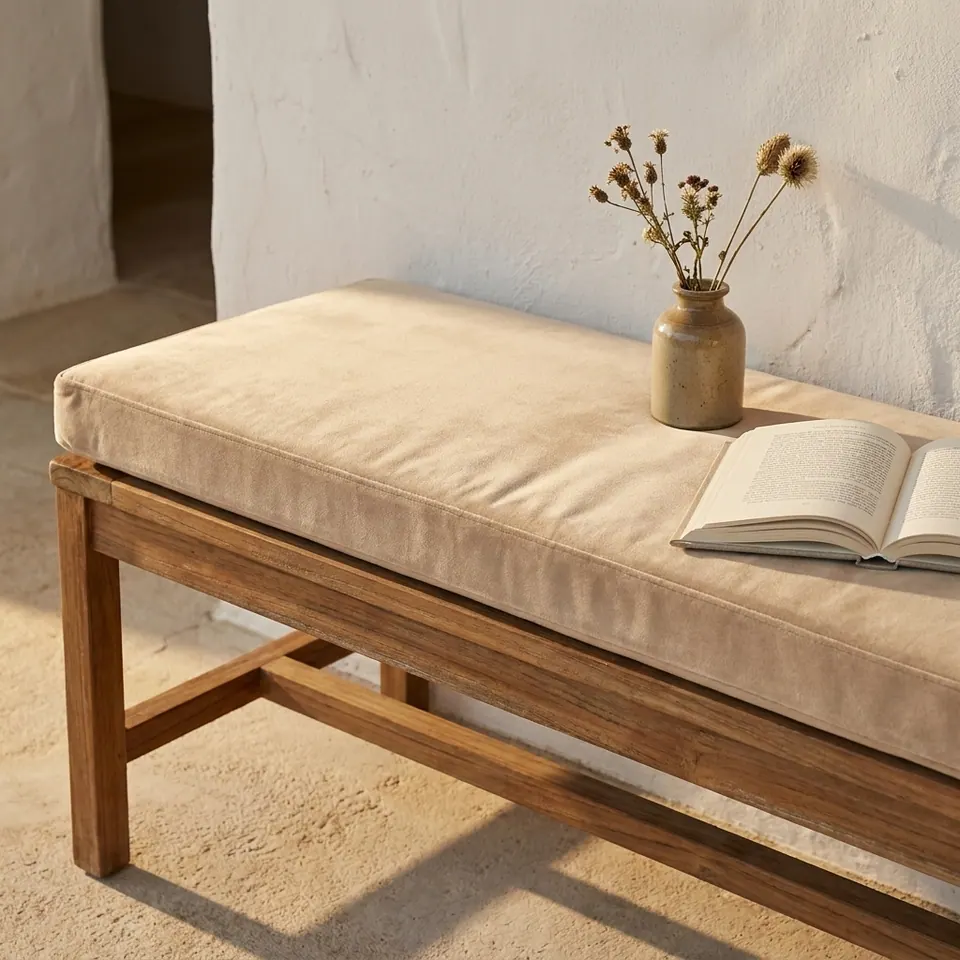
- stoneware bottle vase
A glazed stoneware bottle repeats the cushion's sand tone in a harder material.
- dried seedheads
Dried stems add height without introducing another color.
- open book
Placed on the front corner, the book balances the vase at the back.
- self-piped front edge
A soft matching welt echoes the straight teak rails below.
- teak bench leg
Silvering teak and sand velvet share the same warm-gray undertone.
- stoneware bottle vaseA glazed stoneware bottle repeats the cushion's sand tone in a harder material.
- dried seedheadsDried stems add height without introducing another color.
- open bookPlaced on the front corner, the book balances the vase at the back.
- self-piped front edgeA soft matching welt echoes the straight teak rails below.
- teak bench legSilvering teak and sand velvet share the same warm-gray undertone.
Three inches, not seven: a nook bench that was already tall
A couple wrote to the workshop about a breakfast nook bench and sent a hand-drawn diagram. They wanted a teddy corduroy seat cushion at 85 x 20 in (216 x 51 cm), an 85 in (216 cm) backrest and a narrower 20 in (51 cm) side arm cushion.
The shop suggested a 6 to 7 in (15 to 18 cm) seat. They needed only 3 in (7.5 cm), because the bench was already high. The foam-filled cushions came with removable covers, and they switched the color from brown to beige.
The special size took longer to make. The first parcel was lost by the courier and remade, and a wrong item arrived before the correct cushions shipped. The part worth copying: measure floor to seat before you choose foam depth. The seat height calculator does the subtraction.
Buyer questions: back pillows, cream matching and a hot iron
- A common question
Could you make back cushions for my banquette that I'd hold in place with Velcro?
The workshop's answerThe workshop recommended soft-filled, pillow-style backs over foam, because they look better and are more comfortable. For an 88 in (224 cm) back with 27.5 in (70 cm) angled sides, 12.5 in (32 cm) high, it suggested four pillows: two at 44 x 12.5 in (112 x 32 cm) for the back and two at 26 x 12.5 in (66 x 32 cm) for the sides. Splitting a long back keeps it from sagging, and about 1.5 in (4 cm) of allowance lets plump pillows nest into the corners.
- A common question
Which of your cream linens comes closest to my dining chairs for a breakfast nook bench?
The workshop's answerFrom a photo of the chairs, the shop suggested L-02, while noting that an exact tone match is nearly impossible. L-02 is a forgiving base that works with almost any piping, and same-fabric piping is the safest, cleanest choice. Note that L-37 is a very dark gray rather than black; L-38 is the true black.
- A common question
Is it safe to iron my linen cushion cover?
The workshop's answerCarefully. The linen range is a linen-look synthetic, and one buyer's cover melted the instant a hot iron touched it. Iron only at a properly lowered temperature, or use steam to lift compression creases.
On the cutting table: the teak hallway bench
| Product | Box-edge custom bench cushion for an entryway |
|---|---|
| Fabric | Sand beige velvet |
| Piping | Self piping on the box edge |
| Frame | Weathered teak bench |
| Wall | Hand-limewashed plaster, chalk white |
| Color rule | Cushion one step darker than the wall |
| Styling | Two objects on a diagonal: vase at the back, book at the front |
| Thickness | Measure floor to seat height first |
| Best for | Hallways and mudrooms built from natural materials |

Have it made
Have this made — ask Nate’s workshop
Every edge and both diagonals, to the nearest 1/4 in. If the numbers do not close, the workshop will say so on the call. — Nate
Leave your details and the workshop will call you to confirm measurements, fabric, foam and piping. No prices, dates or payment on this page: it is a request, not an order.
Choose an entryway bench cushion one step darker than the wall and let texture carry the contrast: sand velvet on weathered teak needs no second color.
Nate
Questions buyers ask next
Why is the sand velvet cushion one step darker than the limewash wall?
A seat the same color as the wall disappears, and one much darker jumps out of a quiet hallway. One step darker gives the bench a clear outline while keeping the entry in one color family, so texture can do the rest.
Is velvet practical on a teak hallway bench that gets used every day?
It can be. The workshop points families to its velvet for heavy daily use because it is strong and cleans up easily. When a wipe isn't enough, zip the cover off and wash it at 86°F (30°C) on a gentle cycle.
How do I style a narrow entryway bench without crowding the seat?
Use two objects at most. Put a taller one, such as a stoneware bottle of dried stems, at one back corner and a flat one, such as a book, at the opposite front corner. The diagonal looks deliberate and leaves room to sit.
± 1/4 in — Nate