A Reading by NateBench Cushions
Three velvet pads on one oak bench: measuring a custom bench cushion seat by seat
Sage, rose and mink, one pad per person. Nate takes the tape to this bench and marks the three places where the numbers usually go wrong.

 Save
The quick answer
To measure a bench for separate seat pads, take the usable length at the front and back, subtract the gaps you want, and divide by the number of pads. Measure depth at both ends, round each pad down to the nearest 1/4 in (6 mm), and write the exact sizes in the order note, not only in the size menu.
What the photo is really measuring
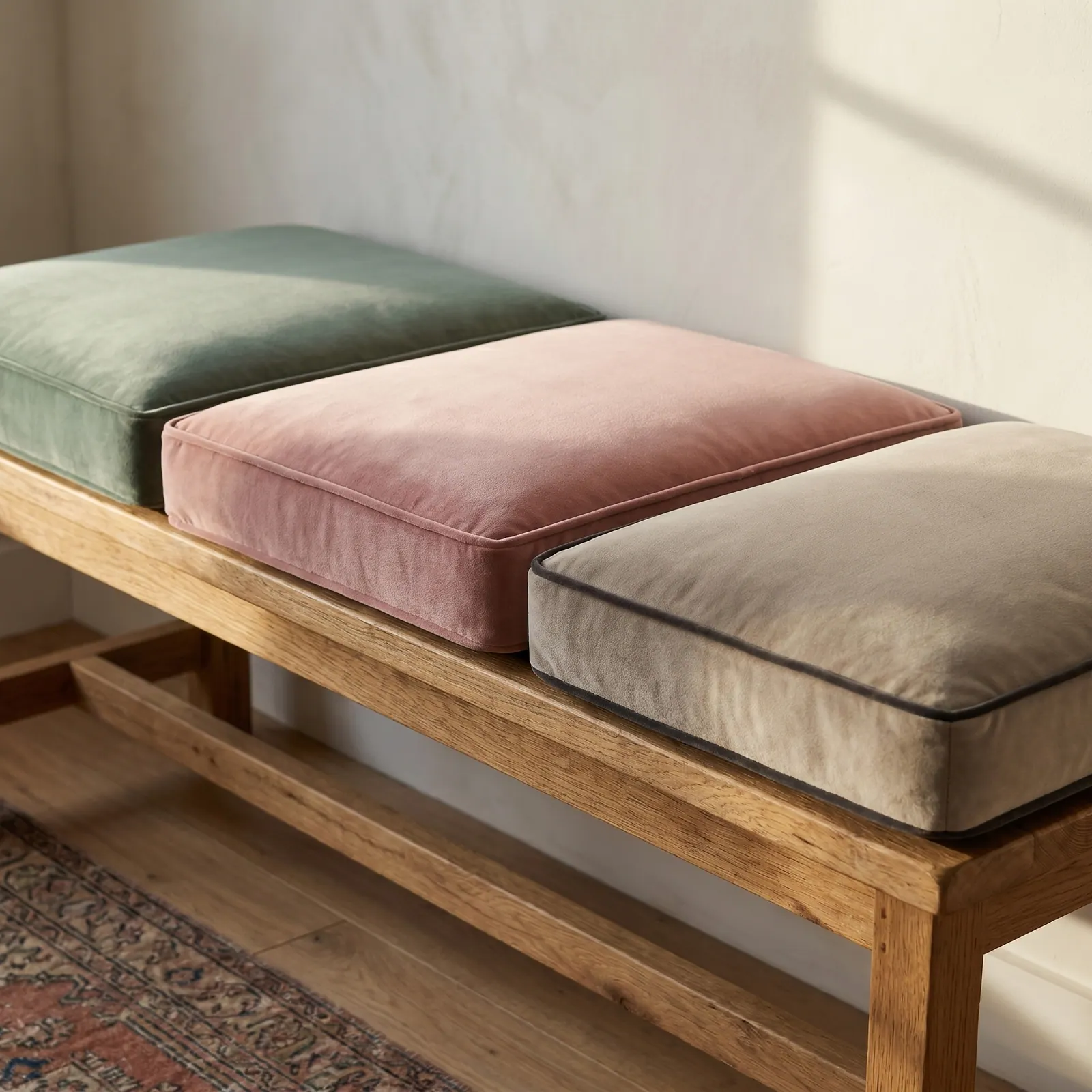
Three pads, three colors, one bench. The split is the first measurement decision, and most people skip it.
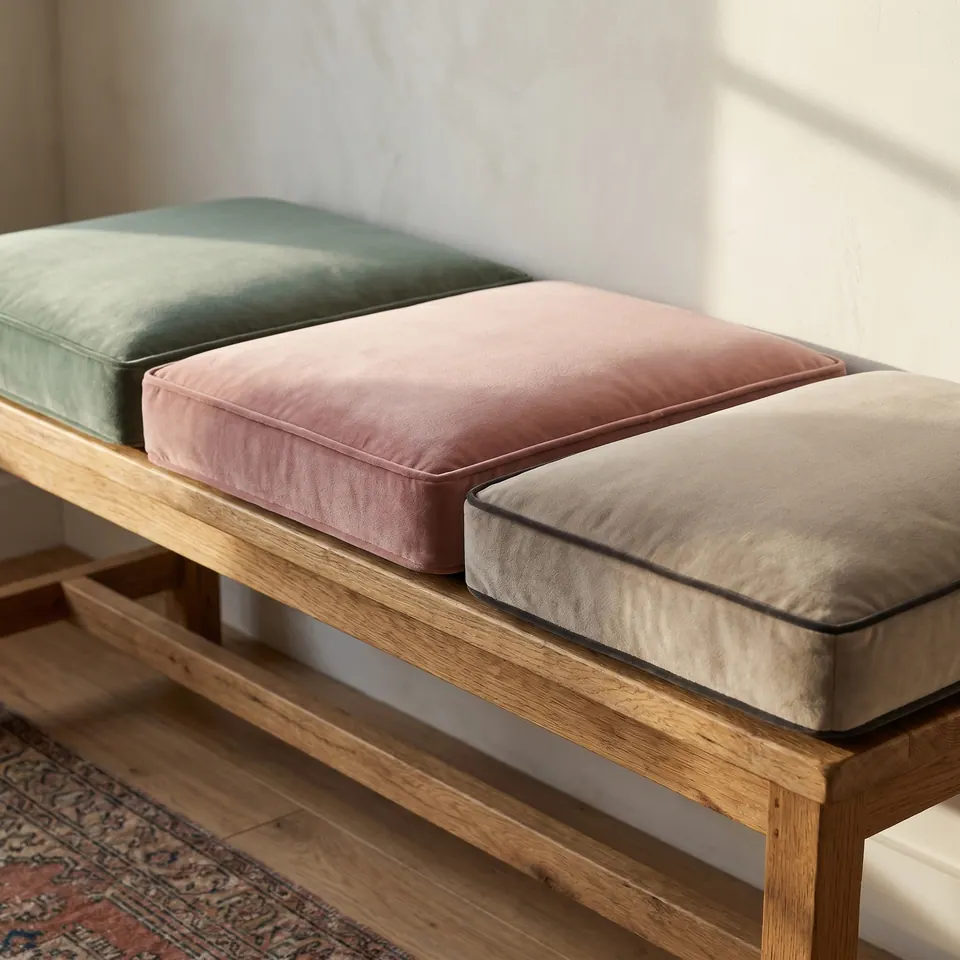
One long cushion reads as a sofa. Three square pads read as three seats. On this oak refectory bench each pad is thick, box-edged and close to square, so every person gets a defined place and every pad lifts out alone for cleaning or turning.
Look at the gaps. Small and even. That is not luck; it is arithmetic done before anyone cut foam. Uneven gaps are the first thing the eye catches on a split bench cushion.
The colors are muted mid-tones: sage, dusty rose, mink. Rose sits in the middle because it is the warmest and pulls the eye to center. Mink is the neutral that holds the set together, and it is the only pad with charcoal contrast piping. Compare it with its neighbors and you see what a dark welt does: it draws a line around a neutral and sharpens the box edge.
The oak base ties all three velvets together, the way one frame ties three prints on a wall.
Where people go wrong on a bench like this, partner:
- measuring the old cushion instead of the bench
- measuring length at the front only, when old benches are rarely square
- rounding pad sizes up instead of down
- picking a size from the menu and never writing the real number down
Tape on the oak: five readings for a three-pad bench
Usable length, front and back
Measure between the ends or arms at the front edge, then again at the back. If the two differ by more than 1/4 in (6 mm), note both and use the shorter.
Depth at both ends
Front edge to wall or back rail, left end and right end. Take the smaller number.
Pick one gap and keep it
Three pads means two gaps. Choose one width and subtract both gaps from the usable length.
Divide and round down
Example: 60 in (152 cm) minus two 1/2 in gaps is 59 in; divided by 3 is 19 2/3 in. Order 19 1/2 in (49.5 cm). Never round up.
Write it in the note
Select the nearest size in the menu, then type the exact width, depth and thickness of each pad in the personalization box. The note is what gets cut.
Pinned by Nate: three pads, one welt, one stretcher
Five pins read the bench left to right: sage pad, dusty rose pad, mink pad, the charcoal welt and the oak stretcher that ties them.
- Sage seat pad
Three separate pads let each seat be lifted, cleaned or swapped on its own.
- Dusty rose pad
The middle pad is the warmest color, so it pulls the eye to the center.
- Mink pad
Mink gray is the neutral that holds the sage and rose together.
- Charcoal contrast piping
Only the mink pad has dark piping; it draws a line and shows what contrast piping does on a neutral.
- Oak stretcher
The warm oak base ties all three colors together.
- Sage seat padThree separate pads let each seat be lifted, cleaned or swapped on its own.
- Dusty rose padThe middle pad is the warmest color, so it pulls the eye to the center.
- Mink padMink gray is the neutral that holds the sage and rose together.
- Charcoal contrast pipingOnly the mink pad has dark piping; it draws a line and shows what contrast piping does on a neutral.
- Oak stretcherThe warm oak base ties all three colors together.
104.5 inches, and no seam allowed
A buyer in the US ordered cushions for an extra-long dining bench: 104 x 18 in (264 x 46 cm) and 59 x 18 in (150 x 46 cm), in emerald velvet with double piping in pale pink velvet, plus four matching 18 x 18 in (46 x 46 cm) pillow covers.
The workshop suggested making the long cushion in two pieces, the usual call at that length. The buyer said no. No seam in the middle of the dinner table.
So it was cut in one piece, and the length went to 104.5 in (265 cm). The cushions arrived right. The pillow covers followed in a separate parcel later.
The lesson fits on a sticky note. If a center seam would bother you, say so on the order. One piece is possible; it has to be asked for.
On the cutting table: three pads, one bench
| Piece | Three separate seat pads, box edge |
|---|---|
| Colors | Sage, dusty rose and mink velvet |
| Piping | Self on sage and rose; charcoal contrast on mink |
| Pad shape | Close to square, one per seat |
| Split math | (Usable length minus gaps) divided by number of pads |
| Measuring | Nearest 1/4 in (6 mm), front and back, both ends |
| Order note | Exact size in personalization; nearest size in the menu |
| Long benches | One piece on request if a seam would bother you |
| Best for | Hall, dining and mudroom benches shared by a family |

Have it made
Have this made — ask Nate’s workshop
Precision starts on the phone. Give the workshop your measurements and they will read them back to you, edge by edge. — Nate
Leave your details and the workshop will call you to confirm measurements, fabric, foam and piping. No prices, dates or payment on this page: it is a request, not an order.
Buyer questions: backs, narrow seats and leather welts
- A common question
Could you make back cushions for my banquette that fasten with Velcro?
The workshop's answerThe workshop suggested soft-filled pillow-style backs rather than foam, since they look better and sit more comfortably. For an 88 in (224 cm) back with 27.5 in (70 cm) angled sides and 12.5 in (32 cm) of height, that meant four pillows: two 44 x 12.5 in (112 x 32 cm) for the back and two 26 x 12.5 in (66 x 32 cm) for the sides. The sides run shorter because plump pillows sit fuller than their flat size; about 1.5 in (4 cm) of allowance lets them nest in the corners.
- A common question
Your listing starts at 12 inches wide, but my bench needs an 11 inch cushion. Is that possible?
The workshop's answerYes. Choose the closest width in the dropdown and write the real size, 11 in (28 cm), in the personalization box. The cushion is cut to the personalized measurements, not to the menu.
- A common question
Can I get leather piping in cognac or saddle brown?
The workshop's answerLeather piping comes in three stock colors at no extra charge. Any other leather color can be sourced as custom piping for an added fee.
Three velvet seat pads on one bench need equal gaps: subtract the gaps from the bench length first, then divide by three.
Nate
Questions buyers ask next
Should a long bench get one cushion or separate seat pads?
Separate pads define each seat and lift out one at a time for cleaning or turning. One long cushion looks calmer and has no gaps to collect crumbs. On very long benches, one piece is still possible if you ask for it on the order.
How do I work out the width of each pad on a split bench?
Measure the usable length, subtract every gap between pads, and divide by the number of pads. Round each result down to the nearest 1/4 in (6 mm). Keep the gaps identical so the row reads as one set.
What does contrast piping do on a neutral velvet pad?
A darker welt outlines the pad and sharpens the box edge, so a quiet neutral such as mink gains definition. On a bench of mixed colors, use contrast on one pad or on all of them, but decide on purpose.
± 1/4 in — Nate
More photographs to read
 Save
 Save
 Save
 Save
 Save
 Save