A Reading by NateBench Cushions
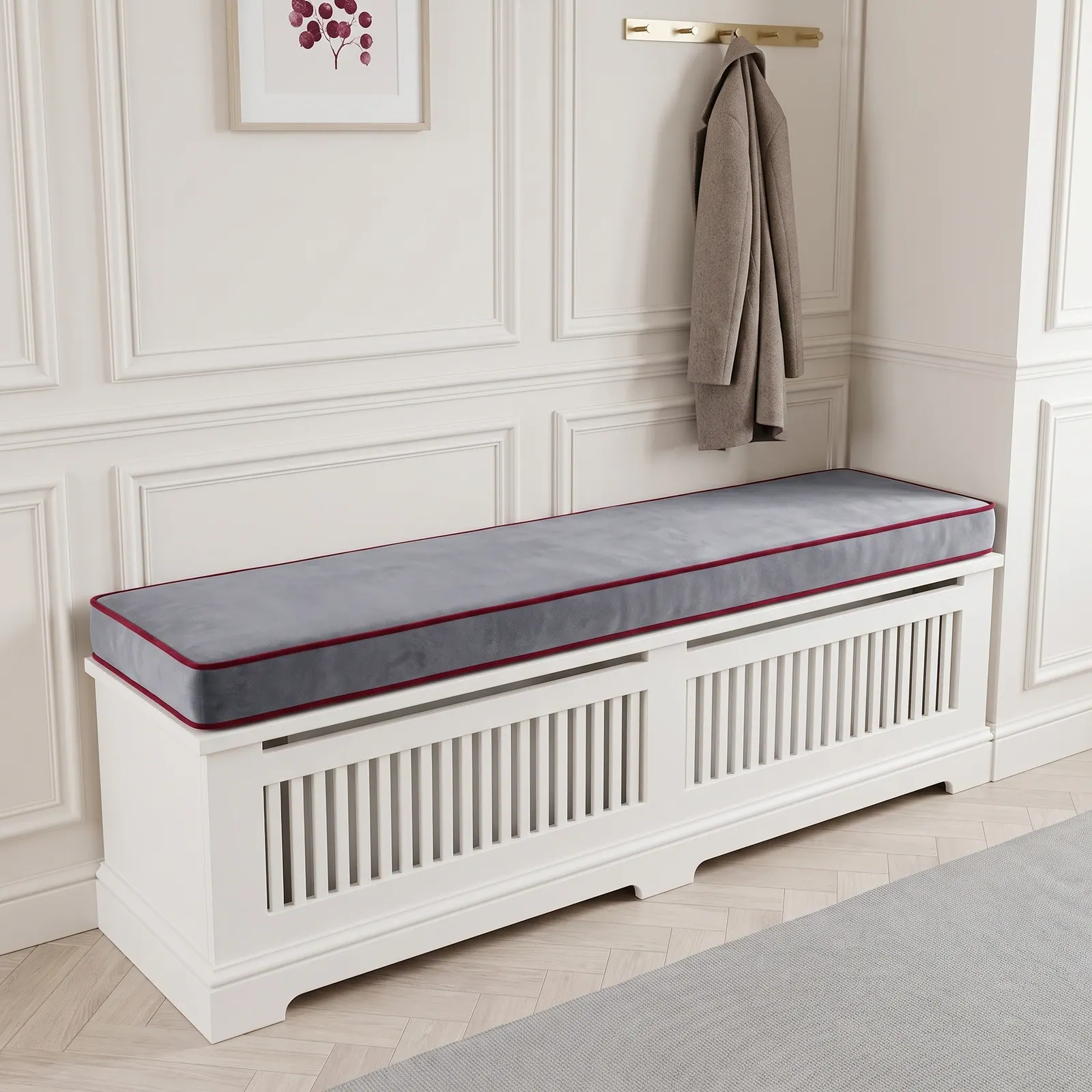
Gray velvet on a radiator cover: a custom bench cushion among slats and herringbone
Count the patterns in this hallway: slats, panels, herringbone, a botanical print. Four. The cushion is surface number five, and its job is to be the plain one.

 Save
The quick answer
A plain velvet bench cushion is the right match for a hallway full of lines: a slatted radiator cover, paneled walls and a herringbone floor. Let the cushion be the quiet surface and give it one accent, such as piping taken from the artwork above. On a shallow seat, skip the backrest; it eats seat depth.
The cushion, cut open
Cover fabric. A removable, zippered cover. Machine wash at 86°F (30°C) on a gentle cycle and air dry.
Piping. A fabric-covered cord sewn into the seams. It sits on the seam line, so it does not change the size.
Fiber wrap. Polyester fiber (Dacron) batting around the foam: it fills the cover out and softens the edges.
Foam core. About 2.0 lb/ft³ (32 kg/m³) high-resilience foam, firm to medium-firm, cut to the ordered size.
Zipper. Along the back band, as hidden as possible. The zipper side faces down or toward the wall.
Base panel. The underside of the cover. A non-slip fabric backing can cover the whole of it instead.
Pinned by Nate: five coordinates in the hall
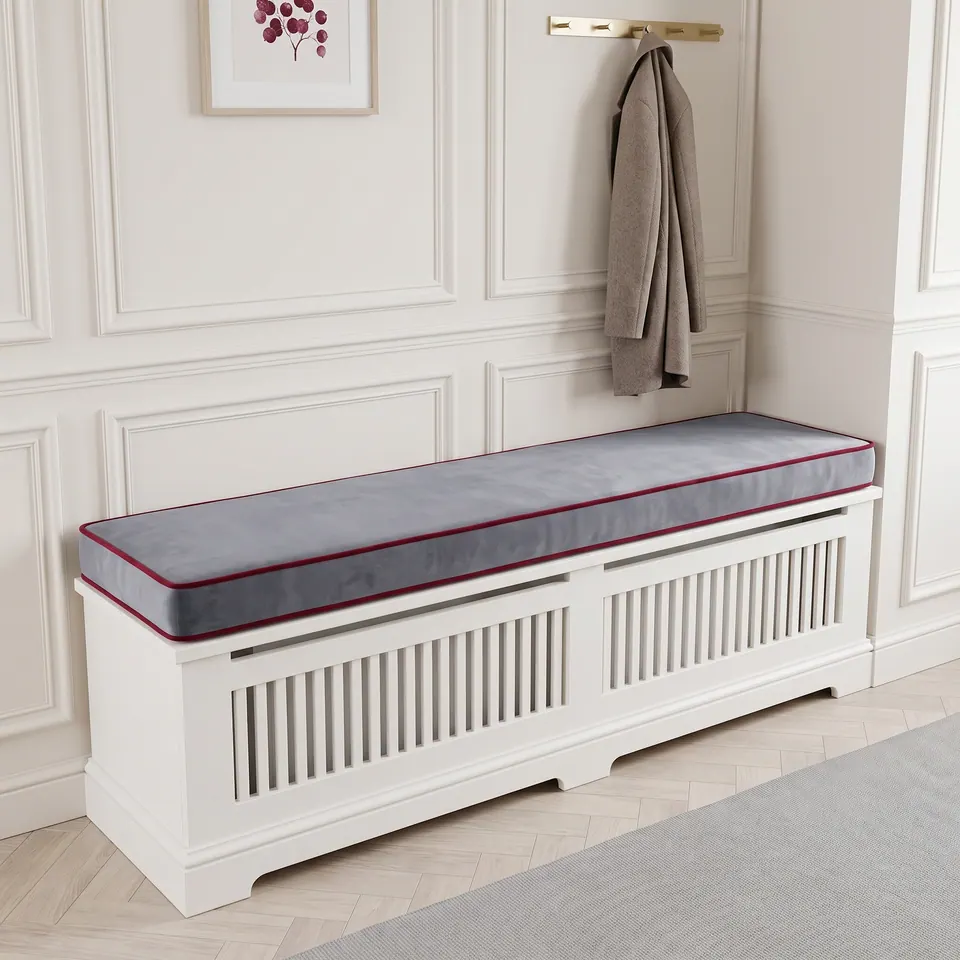
Five pins, from the berry print at the top of the frame to the slatted front below the seat.
- Cool gray velvet
Gray blends into the white paneling so a long seat doesn't dominate a narrow hall.
- Cranberry piping
The piping color is lifted straight from the berry print above the seat.
- Slatted radiator cover
The cushion runs the full length of the cover so the whole top becomes seating.
- Berry botanical print
One artwork supplies the accent color for the entire corner.
- Brass peg rail
Brass pegs and a taupe coat add warmth above a cool gray seat.
- Cool gray velvetGray blends into the white paneling so a long seat doesn't dominate a narrow hall.
- Cranberry pipingThe piping color is lifted straight from the berry print above the seat.
- Slatted radiator coverThe cushion runs the full length of the cover so the whole top becomes seating.
- Berry botanical printOne artwork supplies the accent color for the entire corner.
- Brass peg railBrass pegs and a taupe coat add warmth above a cool gray seat.
Cross-section of a hall seat, top to bottom
Read it like a drawing, partner, one layer at a time.
- The welt. Cranberry contrast piping runs the full perimeter. Its color is lifted from the botanical print above the seat. One artwork supplies the accent for the whole corner.
- The top panel. Cool gray velvet. Gray blends into the white paneling, so a long seat doesn't dominate a narrow hall. Velvet adds texture instead of pattern.
- The box edge. Square and even, so the cushion reads as a solid block on a very linear base.
- The case. Zipped and removable. Warmth rises through the slats, so a cover that comes off is the sensible spec here.
- The base. A white slatted radiator cover. The cushion runs its full length, so the whole top becomes seating while the slatted front stays on show.
Now the pattern math. Slats run vertical. Paneling makes rectangles. The pale floor is herringbone at 45 degrees. That is three line systems plus a print. Add a striped or printed cushion and the eye has nowhere to rest. A plain pile with one colored line gives it that rest. Brass pegs and a taupe coat on the rail add the warmth a cool gray seat needs.
Measure the top of the cover, not the cabinet front: how to measure a bench for a cushion. Then try the numbers in the bench cushion builder. More seats like this live under mudroom and entryway bench cushions and bench cushions; the cloth is in velvet. How many line systems does your hallway already have?
Five surfaces, one plain seat
| Surface | Pattern | Direction | Its job |
|---|---|---|---|
| Radiator cover | Slats | Vertical | Rhythm under the seat |
| Wall paneling | Rectangles | Vertical and horizontal | Frame for the corner |
| Floor | Herringbone | 45 degrees | Movement underfoot |
| Botanical print | Organic sprigs | None | Source of the accent color |
| Cushion | Plain velvet pile | None | Rest for the eye, with one cranberry line |
The backrest that got cut, and the unit that got checked
A buyer wrote to the workshop about a small bench with a shallow seat. The plan: a 45 1/4 x 15 3/4 in (115 x 40 cm) seat cushion and a 45 1/4 x 11 3/4 in (115 x 30 cm) back cushion, in lavender.
On reflection, she decided the backrest would take up too much of the seat. A back cushion leans into the depth you sit on, and on a shallow bench that depth is scarce. She ordered the seat cushion alone.
One more thing happened along the way. At first the workshop mixed up her centimeters and inches, and then the units were confirmed. Measure twice; the fabric remembers. Write the unit after every number. For backrests in general, see back cushion height and sizing.
Buyer questions: thickness, three-piece quotes and velvet at the table
- A common question
Is 2 in a normal thickness for a dining banquette seat cushion?
The workshop's answerThe workshop's standard is 4 in (10 cm), though 2 in (5 cm) can be made if you prefer. All covers are zippered and washable, and for everyday dining the recommendation is the soft fabric or velvet.
- A common question
Can you quote three custom seat cushions of different sizes together?
The workshop's answerYes. Send every size in one message and it comes back as one quote. Two real sets: one 26 x 44 1/2 x 4 in (66 x 113 x 10 cm) cushion plus two at 26 x 31 x 4 in (66 x 79 x 10 cm), in green with no piping or tufting; and a 48 x 19 x 5 in, 30 x 19 x 5 in and 19 x 19 x 5 in trio. Both quotes were reduced as a first purchase.
- A common question
Will velvet hold up on a kitchen banquette, or is there something tougher in a similar color?
The workshop's answerVelvet is a good choice for a kitchen banquette; ice blue 128 and minty blue 126 were two suggestions for that color family. A linen-style performance fabric was offered as the alternative.
On the cutting table: the radiator-cover seat
| Piece | Full-length box-edge seat cushion |
|---|---|
| Base | White slatted radiator cover used as a hall seat |
| Fabric | Cool gray velvet |
| Piping | Contrast cranberry, taken from the print above |
| Cover | Zipped and removable; warmth rises through the slats |
| Standard thickness | 4 in (10 cm); 2 in (5 cm) on request |
| Backrest | None; the shallow seat keeps its depth |
| Best for | Entryways, mudrooms and narrow halls |

Have it made
Have this made — ask Nate’s workshop
Send the numbers in inches: length × depth × thickness, plus any angle. The workshop checks them with you, because foam has no undo button. — Nate
Leave your details and the workshop will call you to confirm measurements, fabric, foam and piping. No prices, dates or payment on this page: it is a request, not an order.
A backrest on a shallow bench eats seat depth. On a 15 3/4 in (40 cm) deep seat, try the cushion alone before adding a back.
Nate
Questions buyers ask next
Why a zippered cover on a radiator-cover seat?
Warmth rises through the slats into the cushion. A zipped, removable case can come off for washing and airing, so the seat can be looked after through a heating season without touching the foam.
How many patterns can one hallway carry?
Count the line systems first: slats, paneling, floor pattern, art. With three or four already in play, make the cushion plain and let a single piping color carry the accent.
Should a cushion match the radiator cover's length exactly?
Yes, run it end to end so the whole top becomes seating. Measure the top surface, not the cabinet front, and give the workshop numbers to the nearest 1/4 in (6 mm).
± 1/4 in — Nate
More photographs to read
 Save
 Save
 Save
 Save
 Save
 Save