 Save
A Reading by NateL-Shaped Corner Bench Cushions
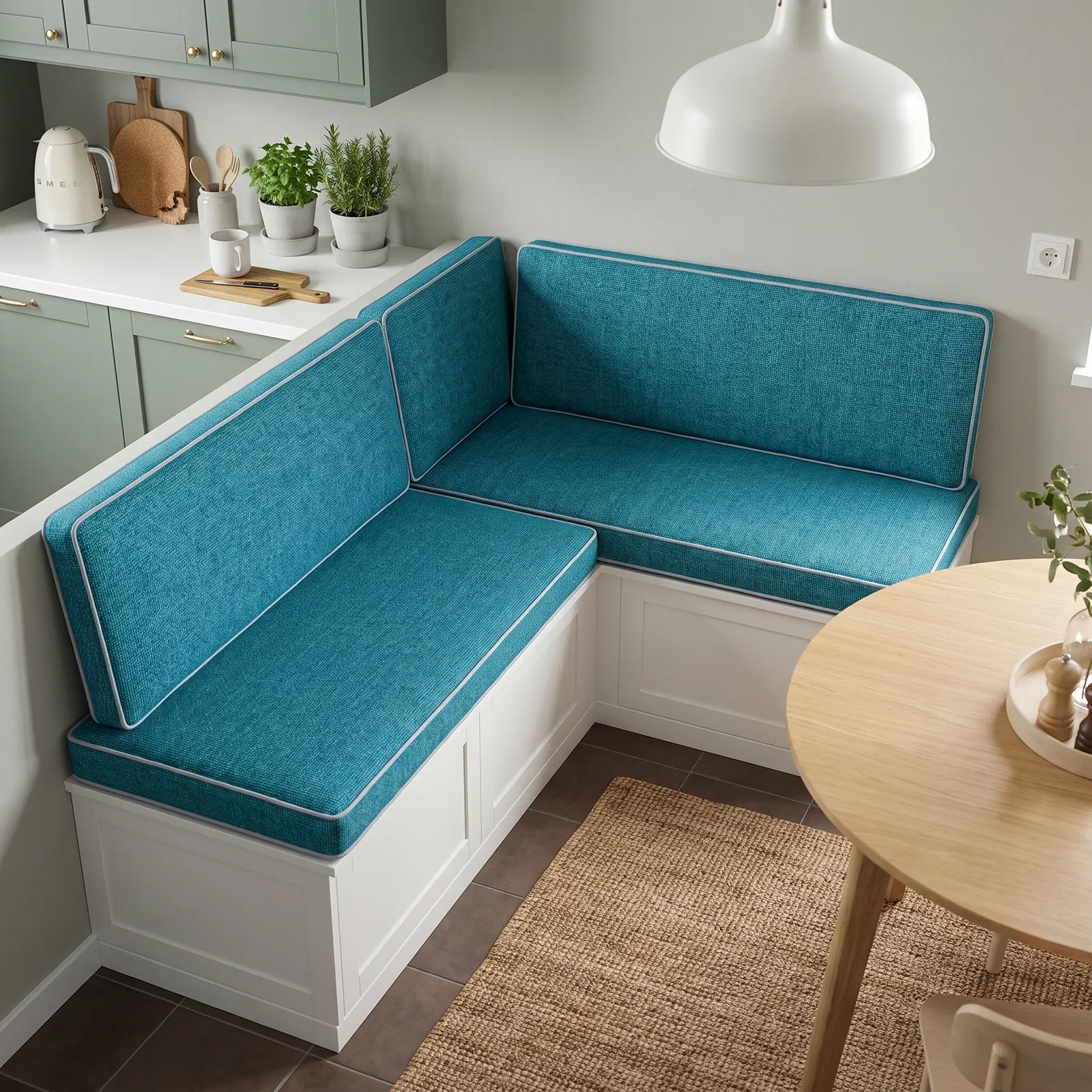
Peacock teal L-shaped banquette cushions: thickness, height and depth in a sage kitchen
Nate reads a teal kitchen corner by its palette first, then by the numbers that decide whether a banquette cushion brings you to the table at the right height.

Swatch strip measured from the photograph
- slate#60767228%
- dusty dark teal#3a4a4721%
- oatmeal#b0b0a520%
- stone#8b958c20%
- oatmeal#d3cec311%
The quick answer
An L-shaped bench cushion for a kitchen nook is sized by four numbers: bench top height, the cushion's sat-on thickness, the gap under the table and the seat depth left after the backrest. Run one seat through the corner, pick a color one step brighter than the cabinets, and use pale piping against white bench boxes.
Eight colors lifted off one kitchen corner
Named by eye from the photograph, from the cushion outward to the floor.
- Peacock teal#1D6A73The cushion body, one step brighter than the cabinets.
- Piping gray#C8CBCAThe cord that stops teal bleeding into white.
- Shaker sage#9FAF94The cabinet doors the teal has to beat.
- Bench white#F1F0EBThe L-shaped storage boxes.
- Pale oak#D3B98FThe round table and the cutting board.
- Jute#B79A6CThe rug under the banquette.
- Slate tile#3F4245The dark floor that lifts everything above it.
- Kettle cream#ECE2CAThe retro kettle, the warmest thing in view.
One step brighter than the cabinets, and the geometry under it
Peacock teal is one step brighter than the sage shaker doors behind it, and that one step is the whole design. Go two steps and the corner shouts. Go zero and the kitchen goes flat.
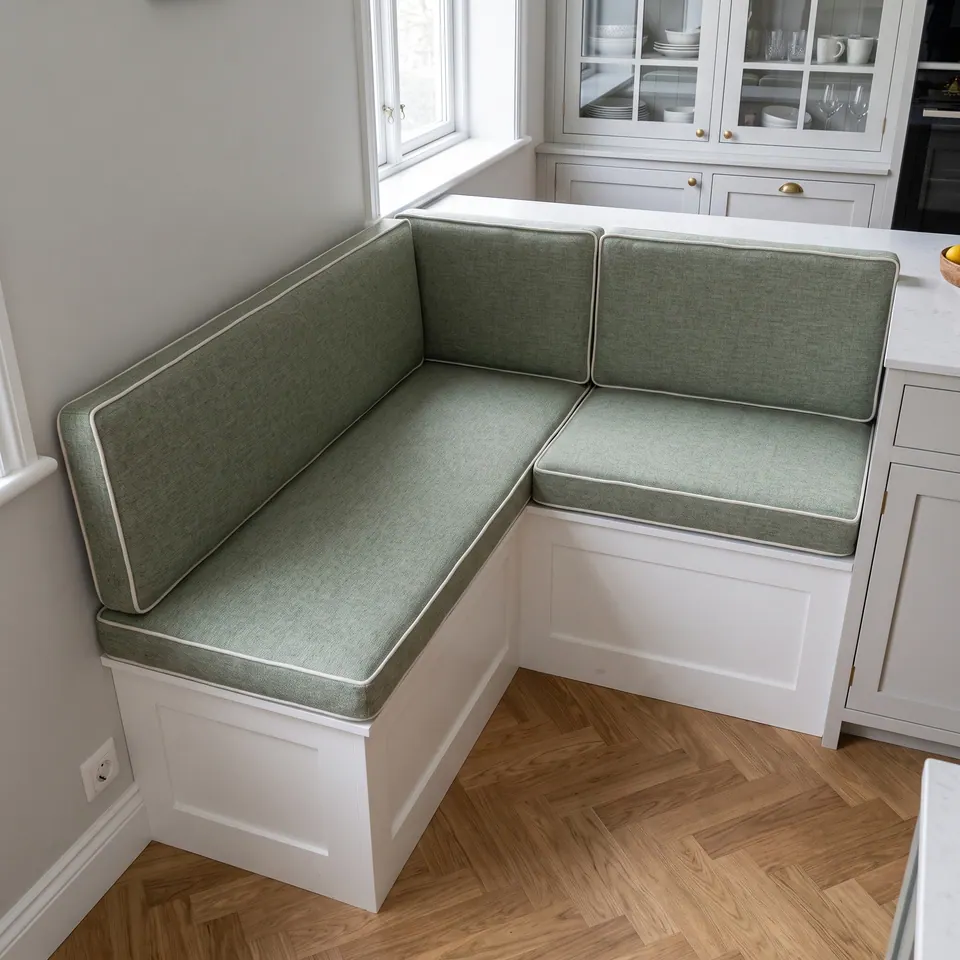
The rest is geometry. This L-shaped bench cushion set has one seat that runs straight through the corner, so there is no triangular filler piece to shift around. The short-side back meets the long back in the corner without a gap. Light gray piping draws a line between the teal and the white bench boxes, so the color stops exactly where the cushion stops.
The weave is coarse, the kind of performance fabric texture that hides a splash from breakfast. Every prop has a job: the white enamel pendant keeps the joinery looking fresh, the round pale oak table lets people slide in from either run, the jute rug softens the dark tiles, and the herbs, kettle and cutting board say someone actually cooks here.
Now the proportion, which no photo can measure for you. Four numbers settle it: - Bench top height, floor to the top of the box at the front edge. - Seat height: that number plus the cushion's thickness under a person, not as it arrives. Our thickness and seat height guide works back from about 18 in (46 cm). - Knee room: the underside of the tabletop minus the seat height. - Seat depth: front edge to the face of the back cushion, not to the wall.
Which of those four have you measured already, partner?
Pinned by Nate in the sage kitchen
Five pins: the short-side back, the long wall back, the seat through the corner, the enamel pendant and the jute rug.
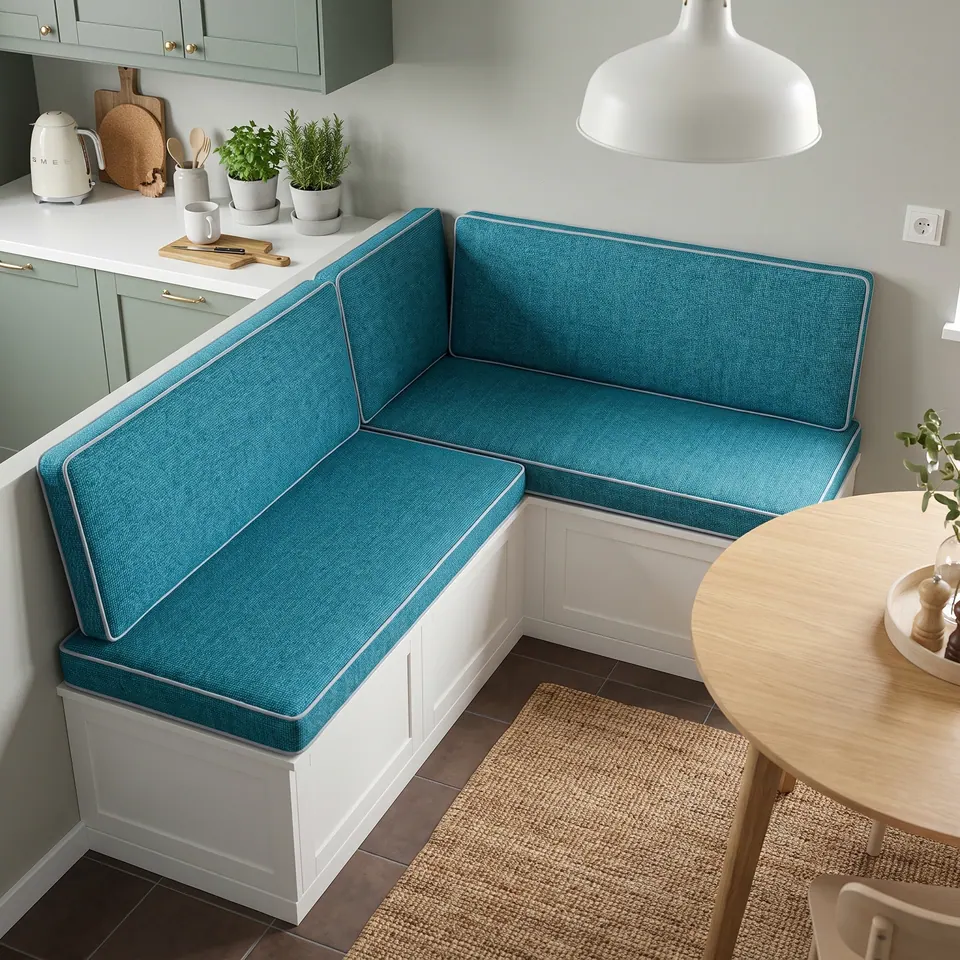
- Short-side back
The back on the short run meets the long back in the corner without a gap.
- Long wall back
Coarse teal weave brightens the sage kitchen and hides spills.
- Seat through corner
One seat runs through the corner, so there is no awkward triangular filler piece.
- Enamel pendant
A white pendant over the table keeps the joinery and bench looking fresh.
- Jute rug
Natural jute softens the dark tiles under the banquette.
- Short-side backThe back on the short run meets the long back in the corner without a gap.
- Long wall backCoarse teal weave brightens the sage kitchen and hides spills.
- Seat through cornerOne seat runs through the corner, so there is no awkward triangular filler piece.
- Enamel pendantA white pendant over the table keeps the joinery and bench looking fresh.
- Jute rugNatural jute softens the dark tiles under the banquette.
Two straight sofas, one L, and a backrest swap
A couple in the US had tried a firm floor sofa in a showroom and wanted an L-shaped sectional that could double as a guest bed. The workshop's answer was geometry, not a new product: take two straight teddy sofas, each 78 3/4 x 39 3/8 in (200 x 100 cm), and replace two corner backrests with straight ones so the pair turns the corner.
The first delivery arrived with three corner backrests and one straight. The workshop sent the missing straight cushion. The couple let every piece expand overnight after unpacking, then called the couch perfect.
The lesson carries to any L: seat modules can stay straight, and the corner is decided by which backrest sits where. Angles are just lengths in disguise. The corner joint guide applies the same logic to a kitchen banquette.
- Sizes
- Two 78 3/4 x 39 3/8 in (200 x 100 cm) teddy sofas combined into one L
The lesson: Two straight modules can be turned into a corner sectional by swapping backrest types.
Buyer questions: piping for stripes, espresso linen, embroidery
- A common question
The striped fabric I picked has no plain version. What can I use for the piping?
The workshop's answerStriped lines come only as stripes, with no solid in the same tone. Use the same stripe for the piping, or pick a solid color from another chart.
- A common question
Do you have a linen in espresso or a dark brown?
The workshop's answerThe main linen chart has no true dark brown, but the second linen chart does: code K22 is a dark espresso brown.
- A common question
Can you embroider words or a name on the cushion?
The workshop's answerNo, the workshop doesn't add embroidery or text. The piping, though, can be any fabric on the charts, or matched to the cushion body.
On the cutting table: the sage kitchen L
| Cushions | L-shaped seat and backrest set on a storage banquette |
|---|---|
| Fabric | Peacock teal, coarse performance-style weave |
| Piping | Contrast piping in light gray |
| Edge | Box edge |
| Corner | One seat runs through; the backs meet with no gap |
| Base | White L-shaped storage benches |
| Table | Round pale oak, so either run can slide in |
| Measure first | Bench top height, table underside, depth to the back cushion face |
| Best for | Kitchen nooks where the cushion leads the color |

Have it made
Have this made — ask Nate’s workshop
Precision starts on the phone. Give the workshop your measurements and they will read them back to you, edge by edge. — Nate
Leave your details and the workshop will call you to confirm measurements, fabric, foam and piping. No prices, dates or payment on this page: it is a request, not an order.
An L-shaped banquette cushion should sit one color step brighter than the cabinets: two steps and the corner shouts, zero and the kitchen goes flat.
Nate
Questions buyers ask next
Does a back cushion shorten the seat depth of a banquette?
Yes. Usable depth runs from the seat's front edge to the face of the back cushion, so a thick backrest takes inches away. Measure the bench depth, subtract the backrest thickness, and check that what remains still supports your legs comfortably.
Why run one seat through the corner of an L-shaped banquette?
It avoids a small triangular filler piece that shifts and gaps. The second seat butts against the side of the first, and the backs meet in the corner, so there is no hole for crumbs and no loose wedge to chase.
What cushion color works with sage green kitchen cabinets?
Choose a color one step brighter than the cabinets, such as peacock teal, and use a pale piping to separate it from white bench boxes. A jute rug and an oak table then soften the contrast on a dark floor.
Is a coarse weave a good idea on a kitchen banquette?
A coarse, textured weave hides small splashes and crumbs better than a smooth plain, which suits a seat used at every meal. Performance and pet-friendly charts are a sensible place to start looking.
± 1/4 in — Nate
Other banquettes and benches, other colors
 Save
 Save
 Save
 Save
 Save
 Save