 Save
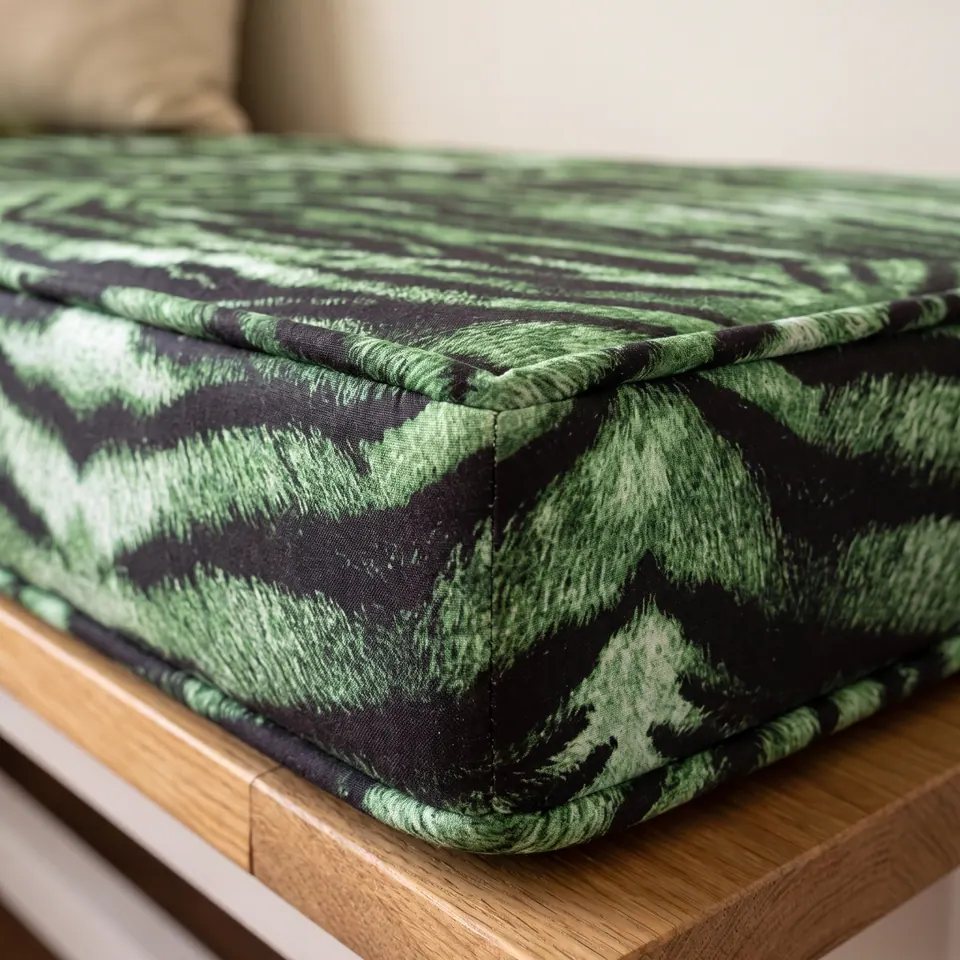
- Front gusset
From this angle the stripes can be seen flowing over the piped edge and down the gusset.
- Leaning backrest pillow
A big pillow at the wall end works as a backrest on a backless bench.
- Stripe direction
The stripes run across the width, so the pattern continues down the front face.
- Pilea on drawers
Green leaves at the far end repeat the print color.
- Red rug corner
Warm red underfoot sets off the cool green seat.
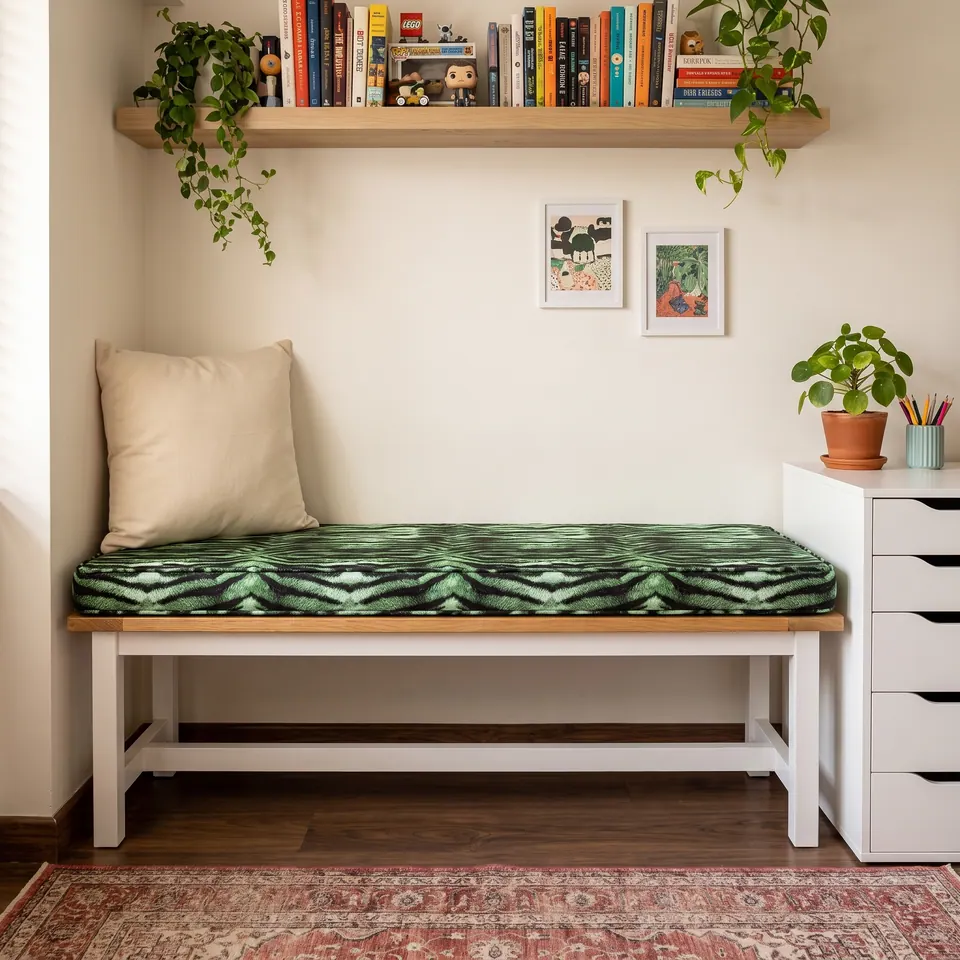
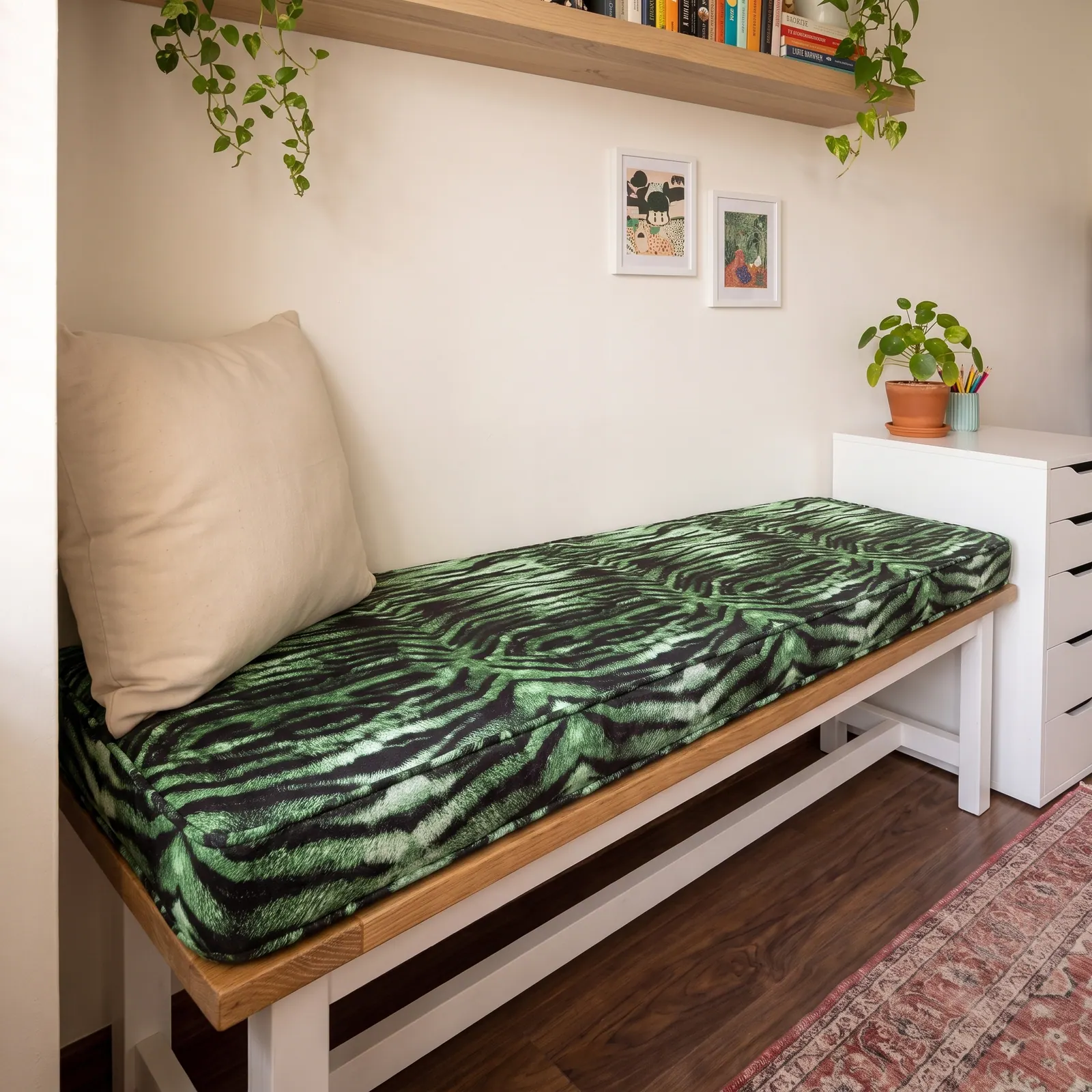
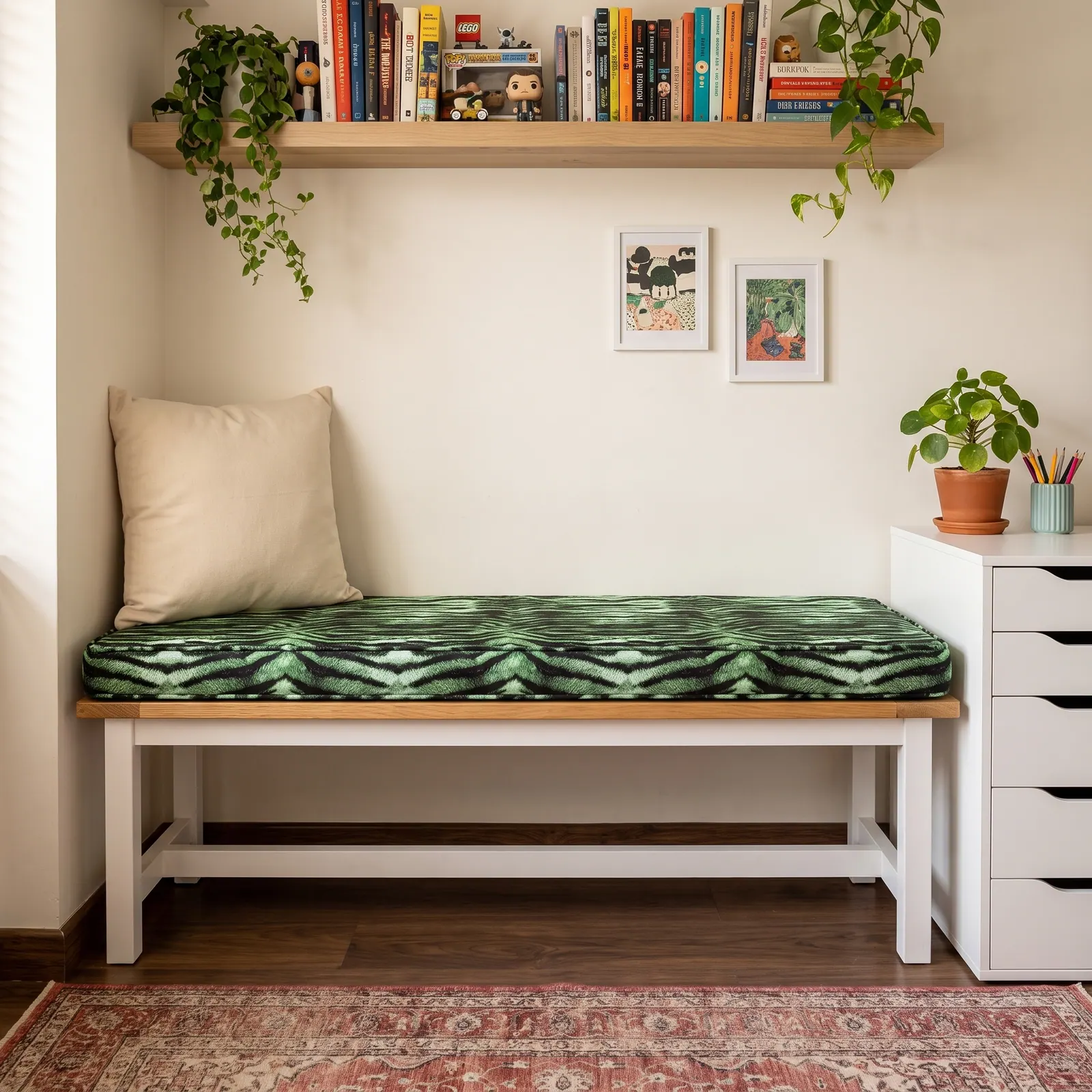
Plate Green Tiger Print Cushion Seen From the Wall End
From this angle the stripes can be seen running the full length and down the box gusset.
A Reading by MaggieBench Cushions
Measuring a green tiger-print bench cushion, read from the wall end
A three-quarter view is the honest one. It shows the gusset, the front edge and every measuring mistake a bench can hide, which is why I asked for this angle.

The quick answer
To order a custom bench cushion like this one, measure the bench top itself: length from the wall to the open end, depth from the back to the front edge, then choose thickness and fix those numbers before production. Ask for the print to run across the width so it flows down the front gusset. Handmade cushions carry about 3/8 in (1 cm) of tolerance.
Pinned by Maggie: the bench from the wall end
Five pins run from the front gusset and the print direction to the leaning pillow, the pilea on the drawers and the red rug.
The numbers match the pins on the plate.
- Front gussetFrom this angle the stripes can be seen flowing over the piped edge and down the gusset.
- Leaning backrest pillowA big pillow at the wall end works as a backrest on a backless bench.
- Stripe directionThe stripes run across the width, so the pattern continues down the front face.
- Pilea on drawersGreen leaves at the far end repeat the print color.
- Red rug cornerWarm red underfoot sets off the cool green seat.
What a low three-quarter view gives away
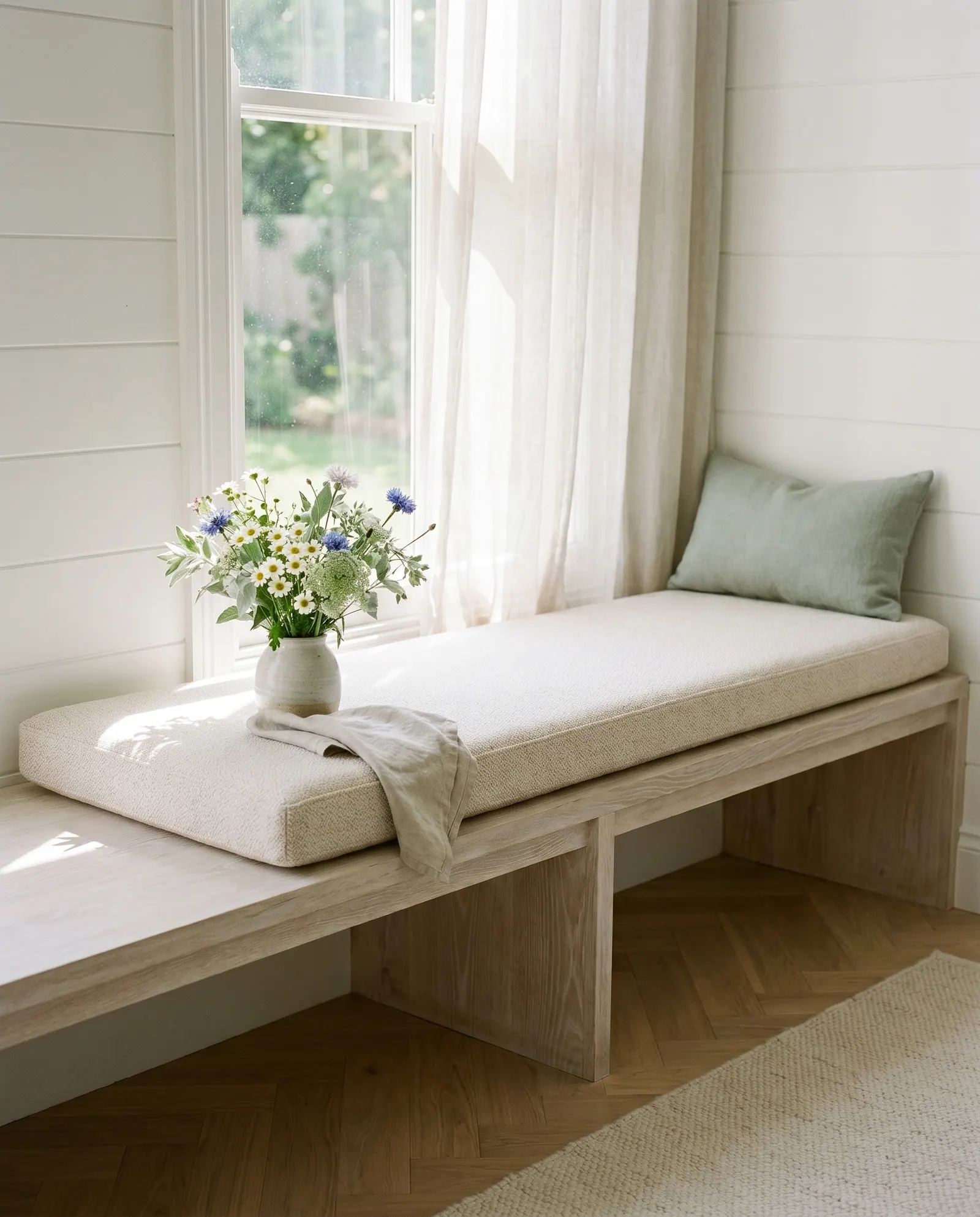
This study corner is photographed low and from the wall end. It is the angle I ask buyers to send, because it shows what a straight-on photo flattens.
First, the gusset. The box edge stands about twice as tall as the oak top is thick, which keeps the profile tidy and in proportion with the wood. Much thinner and it would read as a pad; much thicker and it would swallow the bench.
Second, the print. The emerald, black and mint tiger stripes run across the width, front to back, so they roll over the piped edge and carry straight down the front face. Self piping lets them do it without a colored line in the way. Had the print run lengthwise, it would stop dead at the front seam.
Then the room. Soft side light keeps the green cool; the red patterned rug underfoot warms it by contrast, and the dark wood floor anchors both. One oversized beige linen pillow leans at the wall end as a backrest, the only prop on the seat. Above it, a floating oak shelf with trailing pothos and two small framed prints. At the far end, a pilea in a terracotta pot on the white drawer unit repeats the print's green.
Right, then. When you order a long printed or striped cushion, write the direction on the order. The reasons are in stripe direction, the cloth sits with striped cotton and ticking, more frames are in the bench cushion atlas, and the bench cushion builder will draw yours.
What does your bench measure from the wall to its open end?
Where bench orders go wrong
- Measuring the old, flattened cushion instead of the bench top it sits on.
- Sending a new size after checkout and assuming it reached the cutting table.
- Taking length from the frame when a wall boxes in one end; measure wall to open end.
- Leaving print or stripe direction off the order for a long cushion.
- Expecting machine precision from a handmade piece; allow about 3/8 in (1 cm).
The media-unit bench and the late size change
A buyer ordered a cushion for an IKEA Besta unit used as a bench: 70 7/8 x 16 1/8 in (180 x 41 cm), in a soft performance fabric with black piping to match striped chair cushions nearby. After paying, she asked for 71 5/8 x 17 3/8 in (182 x 44 cm) instead.
Production went ahead on the original numbers. The finished cushion also came out about 3/8 to 3/4 in (1 to 2 cm) short of its 16 1/8 in depth. The workshop pointed to its 3/8 in (1 cm) handmade tolerance, then remade the cushion at no charge anyway.
I have lost that same argument to a sticky note, dear. Lock the final measurements into the order before production starts, and get a reply confirming the new size is the one being cut. The full method is in how to measure a bench, and what tolerance really means is in handmade cushion tolerance.
Buyer questions: angles, lead times and a set of four
- A common question
My window seat is a trapezoid. Which measurements do you need, and can you check my drawing before I order?
The workshop's answerThree numbers: the front length, the back length and the straight depth between them. The craftsmen work out the two angled sides and send a diagram to confirm. A seat 115 in (292 cm) along the front, 82 in (208 cm) along the back and 20 in (51 cm) deep came out with sides of about 26 in (66 cm). Upload the approved diagram in the measurement section when you order.
- A common question
How long does a custom bench cushion take to make, and then to reach me?
The workshop's answerProduction time depends on the job, and some custom jobs take longer, so get it in writing. Delivery follows dispatch; on one order it took another 2 to 4 business days.
- A common question
I need several bench cushions. Is the total lower if I order them together?
The workshop's answerUsually, yes. Multi-piece orders tend to get a lower total, as a set of four 47 1/4 x 15 3/4 in (120 x 40 cm) linen cushions with bordeaux piping did, and a banquette set too. If the checkout then shows a different total or currency, the workshop corrects the listing to the agreed amount.
On the cutting table: the study bench
| Cushion | Box cushion for a backless, oak-topped bench |
|---|---|
| Edge | Box edge with self piping |
| Gusset | About twice the thickness of the oak top |
| Fabric | Tiger print in emerald, black and mint on cotton canvas |
| Print direction | Across the width, carried down the front face |
| Measure | Bench top: wall to open end, back to front edge |
| Tolerance | About 3/8 in (1 cm) either way on handmade pieces |
| Backrest | One oversized linen pillow leaned at the wall end |
| Best for | Study corners and reading benches against a wall |

Have it made
Have this made — ask Maggie’s workshop
Numbers first, fabric second, piping last. Jot down what you have, and the workshop will go down the list with you, item by item. — Maggie
Leave your details and the workshop will call you to confirm measurements, fabric, foam and piping. No prices, dates or payment on this page: it is a request, not an order.
If you change a bench cushion size after checkout, get the new numbers confirmed on the order before production, or the old size gets cut.
Maggie
Questions buyers ask next
Which way should a print run on a long bench cushion?
Across the width, front to back. The print then flows over the piped front edge and down the gusset instead of stopping at a seam. The fabric roll is about 55 in (140 cm) wide, which is why front to back is also the default on long cushions.
Should I measure the bench or my old cushion?
The bench. Old cushions compress, spread and round off at the corners, so their size drifts away from the seat they sit on. Take length from the wall or end to the open end and depth from back to front edge, then choose thickness separately.
How exact is a handmade bench cushion?
Expect about 3/8 in (1 cm) of tolerance either way. Give exact measurements of the bench and let the maker work to them. On one order that came out slightly short of its depth, the workshop remade the cushion regardless.
Can a backless bench get a backrest cushion?
Yes. An oversized pillow leaned at the wall end works, as here, or a matching backrest can be made to length. The workshop's standard backrest is 15 3/4 in (40 cm) high and about 4 in (10 cm) thick, so it only needs the length.
Stitch straight — Maggie
More photographs to read
 Save
 Save
 Save
 Save
 Save
 Save