A Reading by MaggieBench Cushions
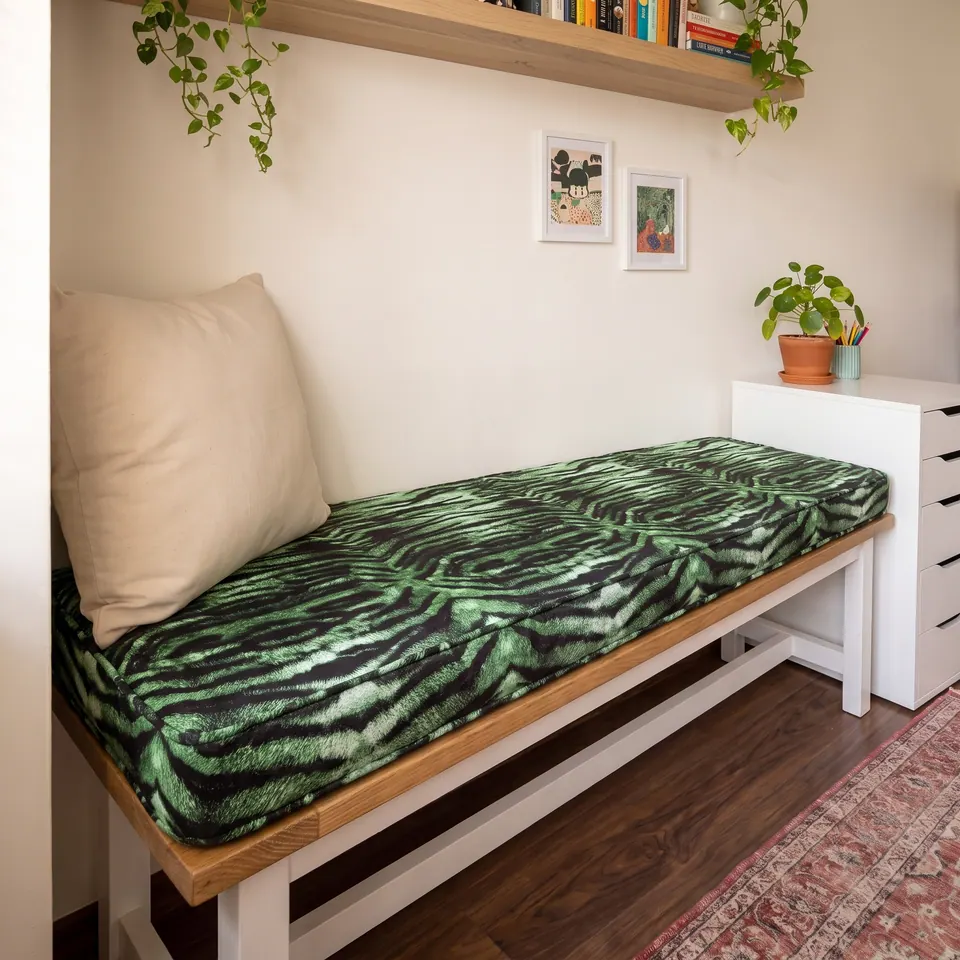
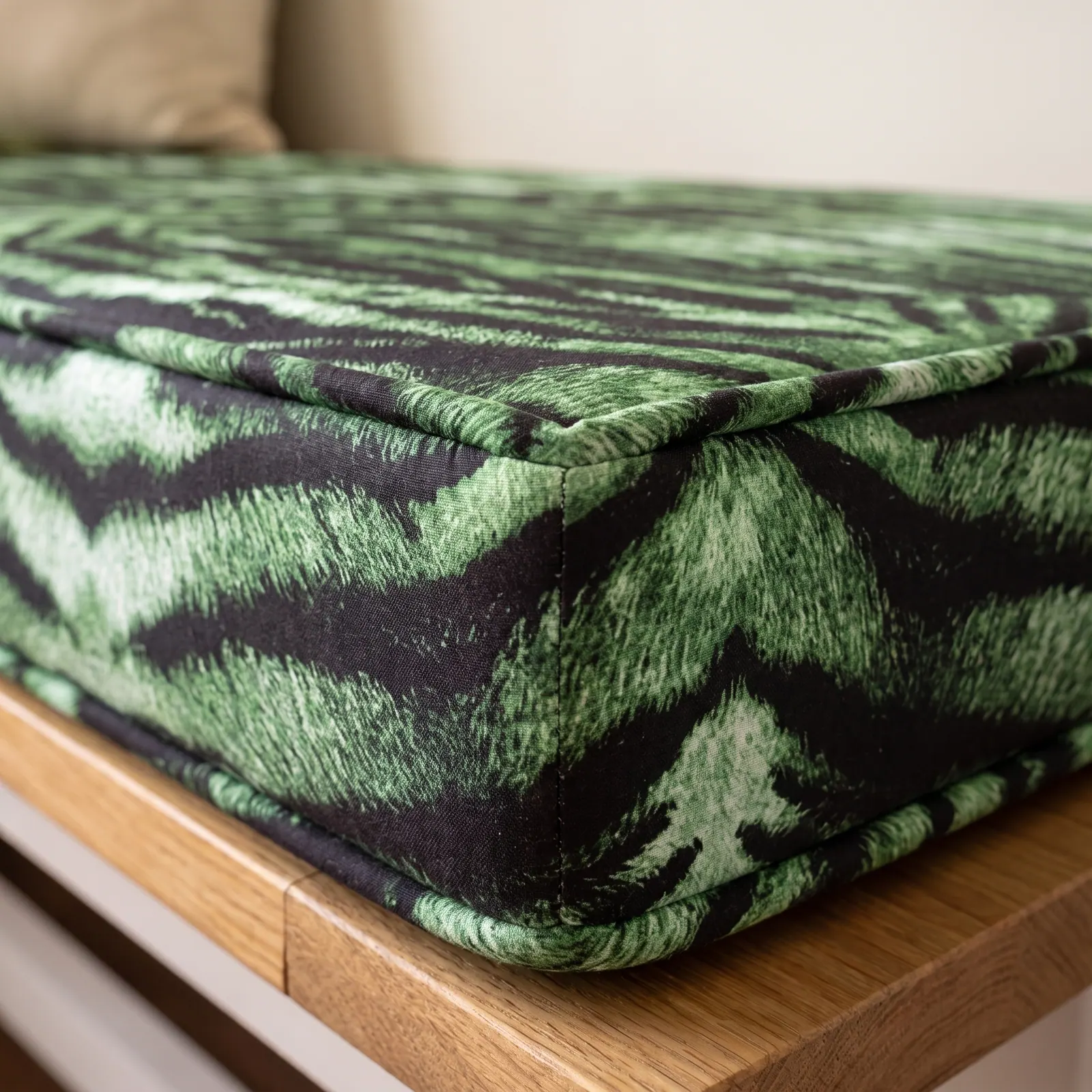
Up close on a green tiger-print bench cushion: two welts and a square corner
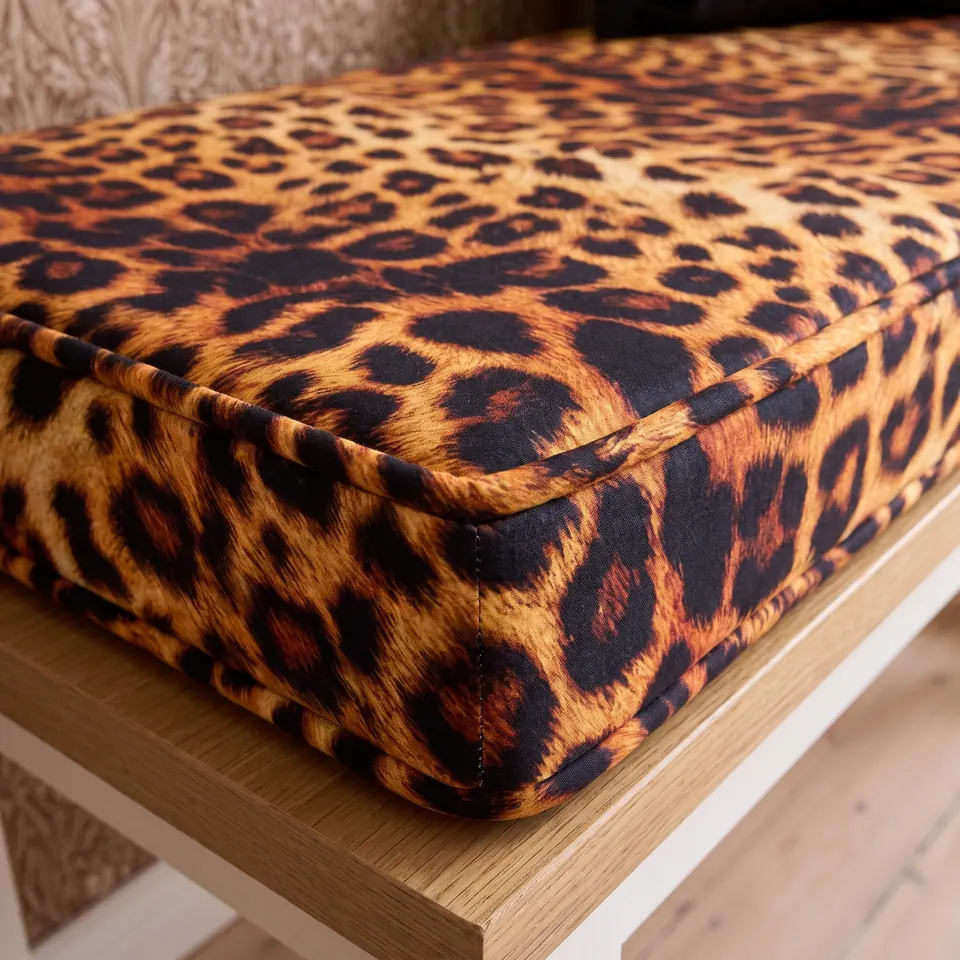
Every bench makeover starts with one corner and a hard look. This one is emerald and black on oak, and it tells you what to ask for before you order.

 Save
The quick answer
A well-made box bench cushion shows two straight welts, one at the top seam and one at the base, with a separate side strip so a print can carry around the corner. Decide thickness, piping and exact size before you order: 3 or 4 in (7.5 or 10 cm) suits a daily dining bench, and piping costs nothing extra.
The same corner, cut open
Printed cotton cover. Emerald and black tiger print on cotton canvas, zippered and removable.
Self piping, twice. Cut from the same print, at the top seam and at the base, so the edge holds its line.
Fiber wrap. Polyester fiber (Dacron) batting around the foam: it fills the cover out and softens the edges.
Foam core. About 2.0 lb/ft³ (32 kg/m³) high-resilience foam, firm to medium-firm, cut to the ordered size.
Zipper. Along the back band, as hidden as possible. The zipper side faces down or toward the wall.
Base panel. The underside of the cover. A non-slip fabric backing can cover the whole of it instead.
What one corner tells you about the whole cushion
Look where the top welt turns the corner. No puckers, no little pleats. Someone clipped the seam allowance with care, and on a print this busy a sloppy turn would jump out.
The side band, the gusset, is its own strip of fabric. Because it is cut separately, the tiger stripes run down and around the corner instead of stopping dead at the seam. Below it, a second welt runs along the base. That lower line is the one people forget, and it is what stops the middle of a cushion from doming.
The corner is sewn square to match the square edge of the oak. I once let a rounded corner go onto a square-edged bench, dear, and it looked like a loaf of bread parked on a ruler.
Is your bench edge square or rounded? Match it. For bench cushions in printed and striped cottons, the bench cushion builder lets you try a thickness first.
Four marks on the corner
Two welts, one side band and the wood they sit on.
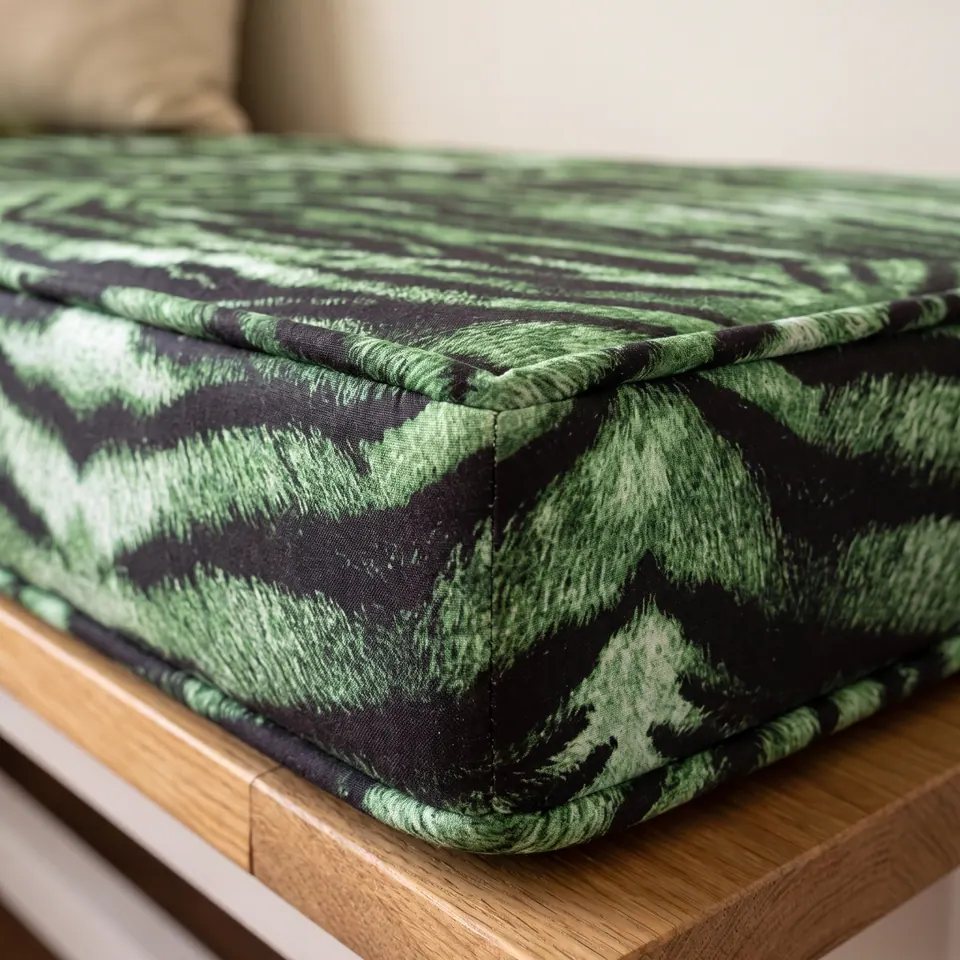
- Top piping corner
The self welt turns the corner cleanly with no puckering, which is a sign of careful clipping.
- Box gusset strip
A separate side strip lets the stripes be matched around the corner.
- Bottom piping
A second welt at the base holds the shape so the cushion does not dome.
- Oak bench top
The square corner of the cushion matches the square edge of the wood.
- Top piping cornerThe self welt turns the corner cleanly with no puckering, which is a sign of careful clipping.
- Box gusset stripA separate side strip lets the stripes be matched around the corner.
- Bottom pipingA second welt at the base holds the shape so the cushion does not dome.
- Oak bench topThe square corner of the cushion matches the square edge of the wood.
Before you order, after it arrives
| Decide before | What to write | What you see after |
|---|---|---|
| Thickness | 3 or 4 in (7.5 or 10 cm) | 3 in keeps the seat low; 4 in looks plusher |
| Piping | Same as body, a color code, or no piping | Self welts melt into a print; no piping gives flat edges |
| Size | Exact length and depth of the bench top | A square corner landing on the wood's corner |
| Legs or posts | A drawing with each notch and tie | A pad that lies flat around the legs |
The second bench, with legs in the way
A buyer who already loved a velvet bench pillow of about 12 x 75 in came back for a second bench. This one had square wooden legs rising at the corners. They wanted a thin 1¼ in pad notched around each leg, with ties so it would not slip.
The workshop sent them to the custom-shape order, which asks for a drawing with exact measurements, laid out the way the notched cushion Pattern shows. Every tie needed its position and length written on that drawing, and ties are an extra charge. Measure the bench, not the cushion you used to have.
- Sizes
- First cushion about 12 x 75 in (30 x 190 cm); notched pad 1¼ in (3 cm) thick
The lesson: For notched pads, mark each leg cut-out and each tie's position and length on the drawing.
What bench buyers asked first
- A common question
Our breakfast nook bench gets used every day. How thick should the cushion be?
The workshop's answerThree or 4 in (7.5 or 10 cm), and most buyers pick one of those two. The foam is a firm 2.0 lb/ft³ (32 kg/m³), so even 3 in gives solid support without raising the seat much. 4 in looks and feels plusher.
- A common question
My size isn't in the drop-down menu. How do I order it?
The workshop's answerSend the size. The workshop either adds it as a new option or sends a custom order link. For a small difference it may ask you to order the nearest size, say 20 x 24 in (50 x 60 cm), and then make it to your exact 22 x 22 in (56 x 56 cm).
- A common question
Does piping cost extra, and can I leave it off?
The workshop's answerIt costs nothing, and the price is identical with or without it. The contrasting border in some photos is piping. Write no piping in the personalization box for clean flat edges, or piping plus a color code.
On the cutting table
| Cushion | Box bench cushion, square corners |
|---|---|
| Fabric | Printed cotton canvas, emerald and black tiger print |
| Piping | Self piping at the top seam and the base |
| Side band | Separate gusset strip, print carried around the corner |
| Thickness | 3 or 4 in (7.5 or 10 cm) for everyday benches |
| Foam | Firm, about 2.0 lb/ft³ (32 kg/m³) |
| Piping price | None; same with or without |

Have it made
Have this made — ask Maggie’s workshop
I once cut a lovely cushion two inches short, and I have not forgotten it. That is why the workshop goes over your measurements with you on the phone. — Maggie
Leave your details and the workshop will call you to confirm measurements, fabric, foam and piping. No prices, dates or payment on this page: it is a request, not an order.
A box bench cushion needs two welts, one at the top seam and one at the base; the lower one is what stops the middle from doming.
Maggie
Questions buyers ask next
Why does a printed box cushion need a separate side strip?
The side strip, or gusset, is cut on its own, so the maker can place it to carry the print around each corner. It also gives the cushion straight sides, which suits a square-edged wooden bench.
Can a thin pad be cut to fit around bench legs?
Yes, as a custom shape. Draw the bench from above and give each cut-out its distance from the front and side edges, its width and its depth. Mark every tie too. Cut-outs at the edges are fine; holes in the middle are not made.
Should piping match a bold print or contrast with it?
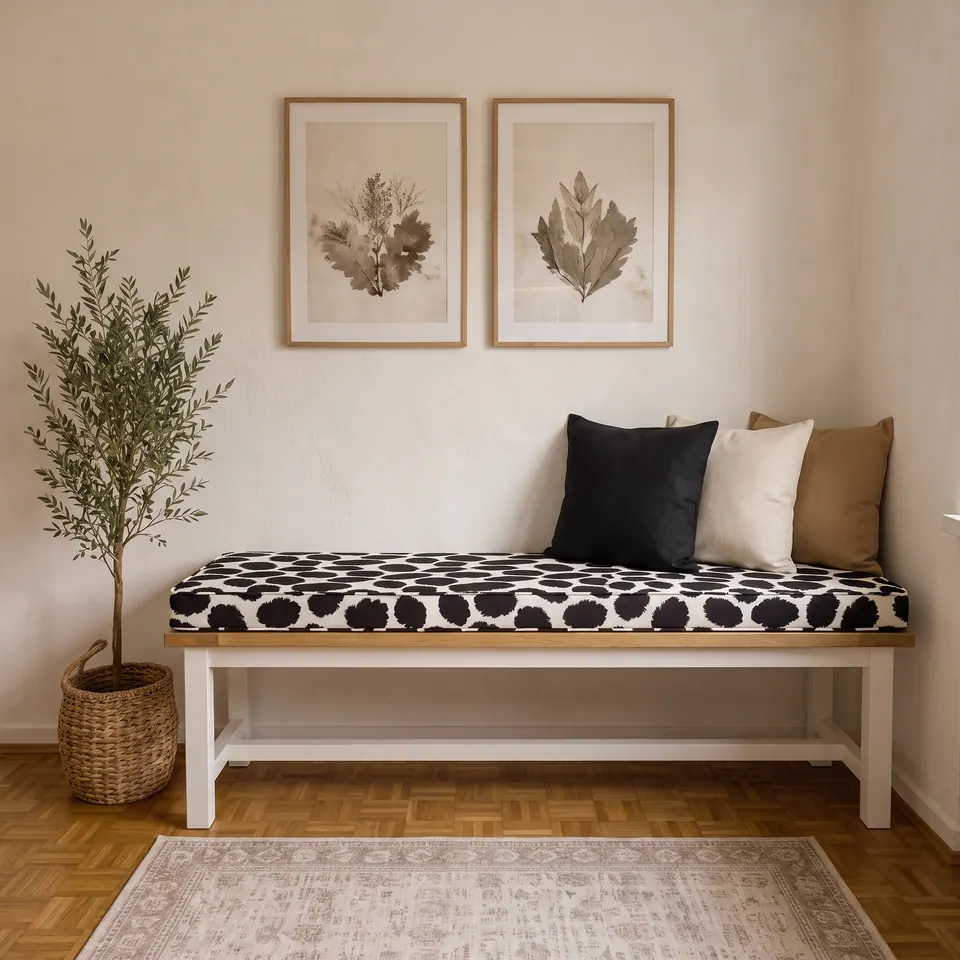
On a busy print, piping in the same fabric is the usual choice, because it outlines the edge without adding another color. Most buyers pick it, and you write same as body in the order note.
Stitch straight — Maggie
More photographs to read
 Save
 Save
 Save
 Save
 Save
 Save