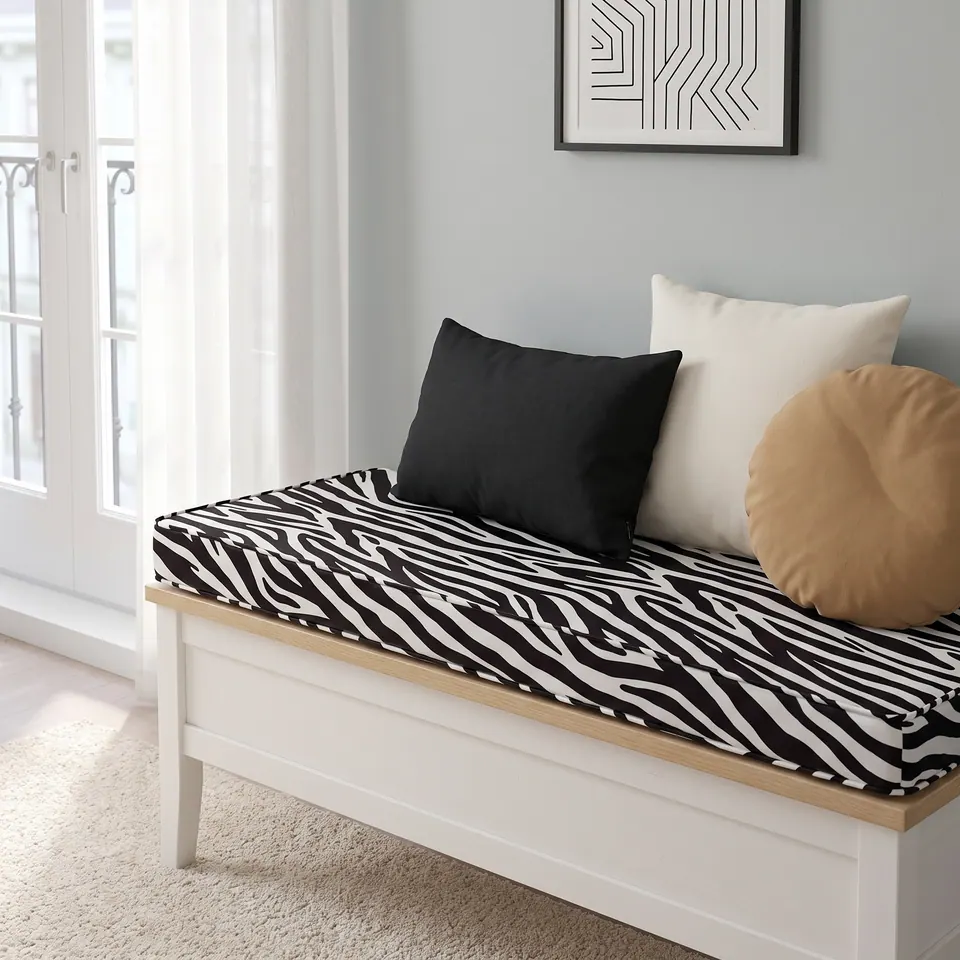
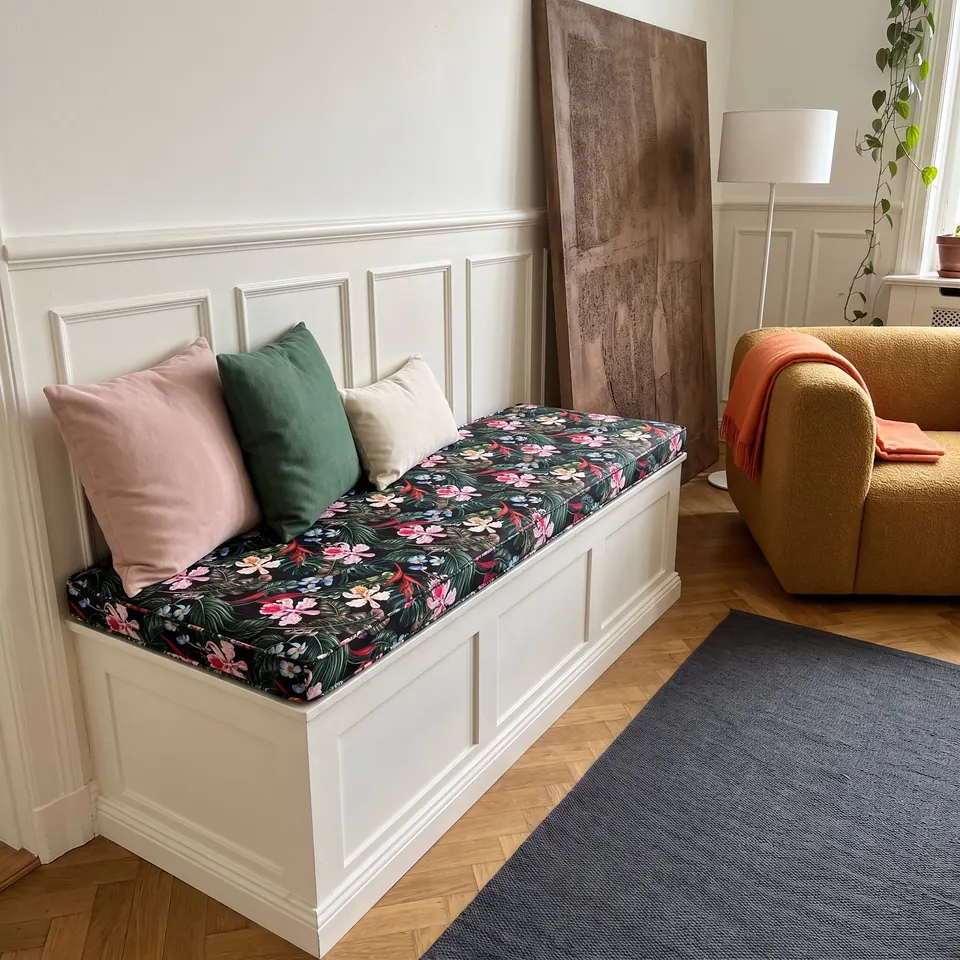
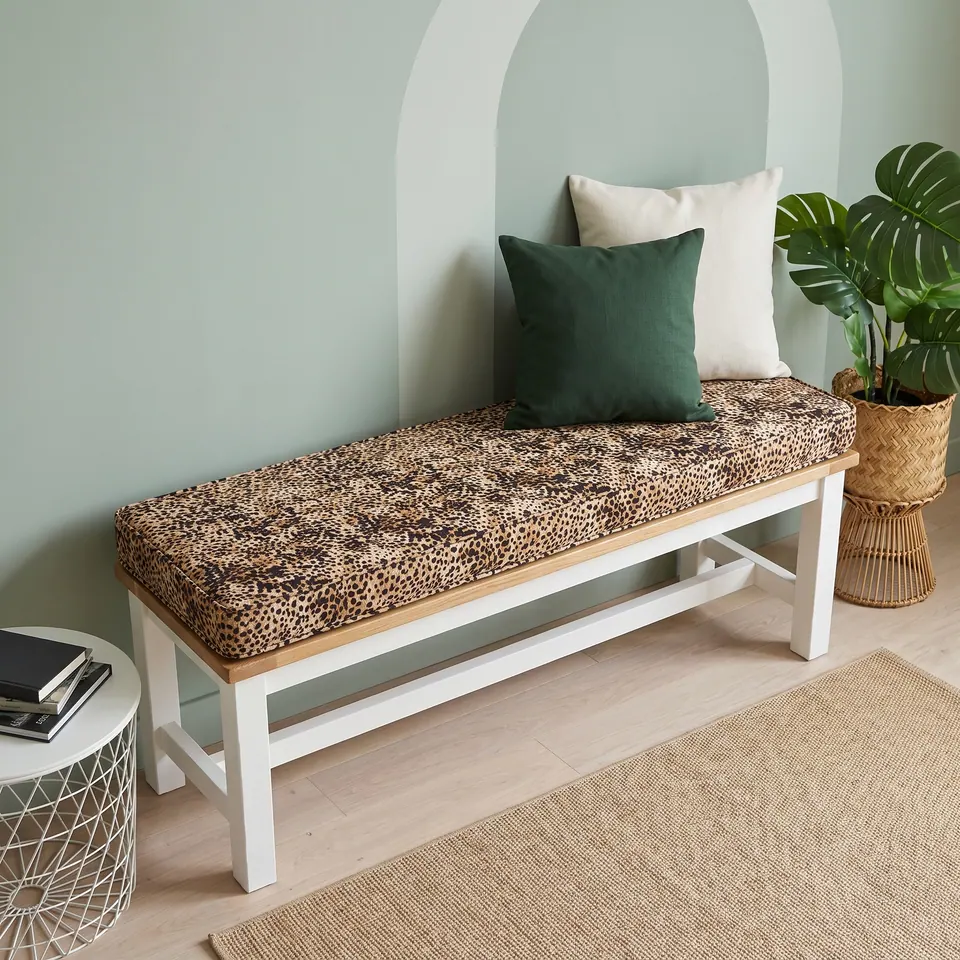
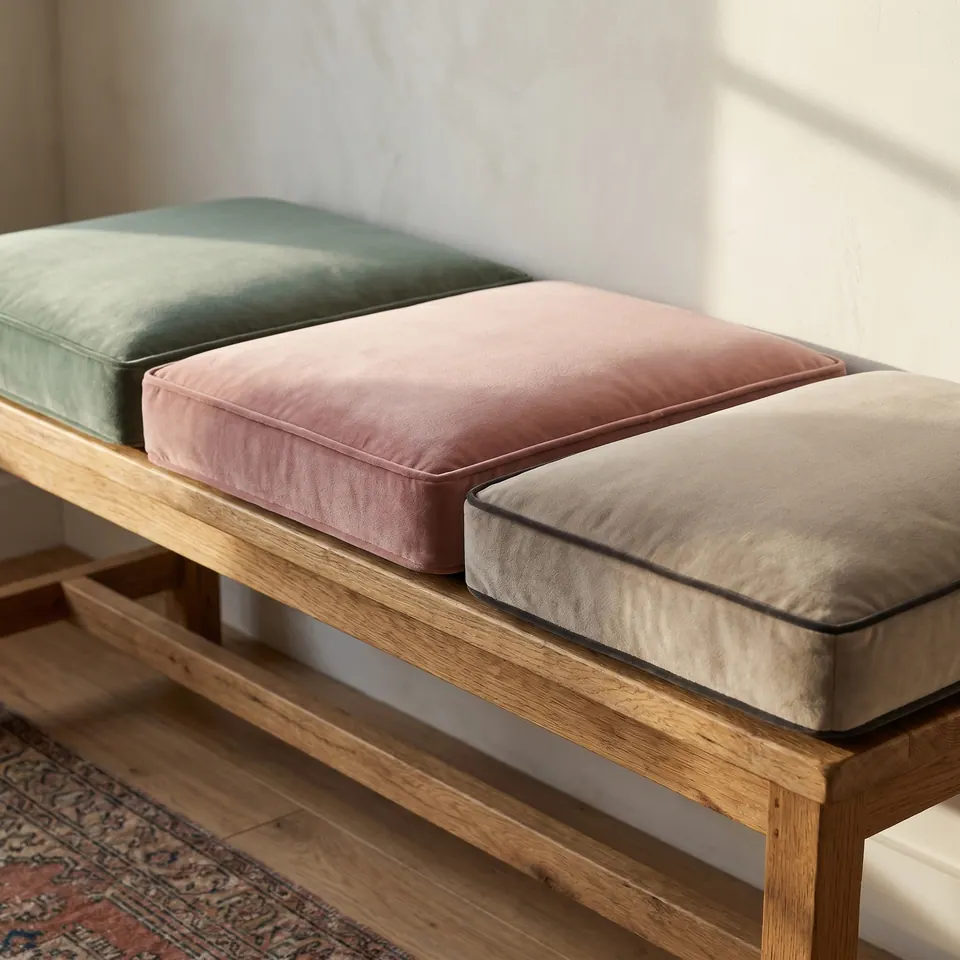
 Save
- Bold spot print
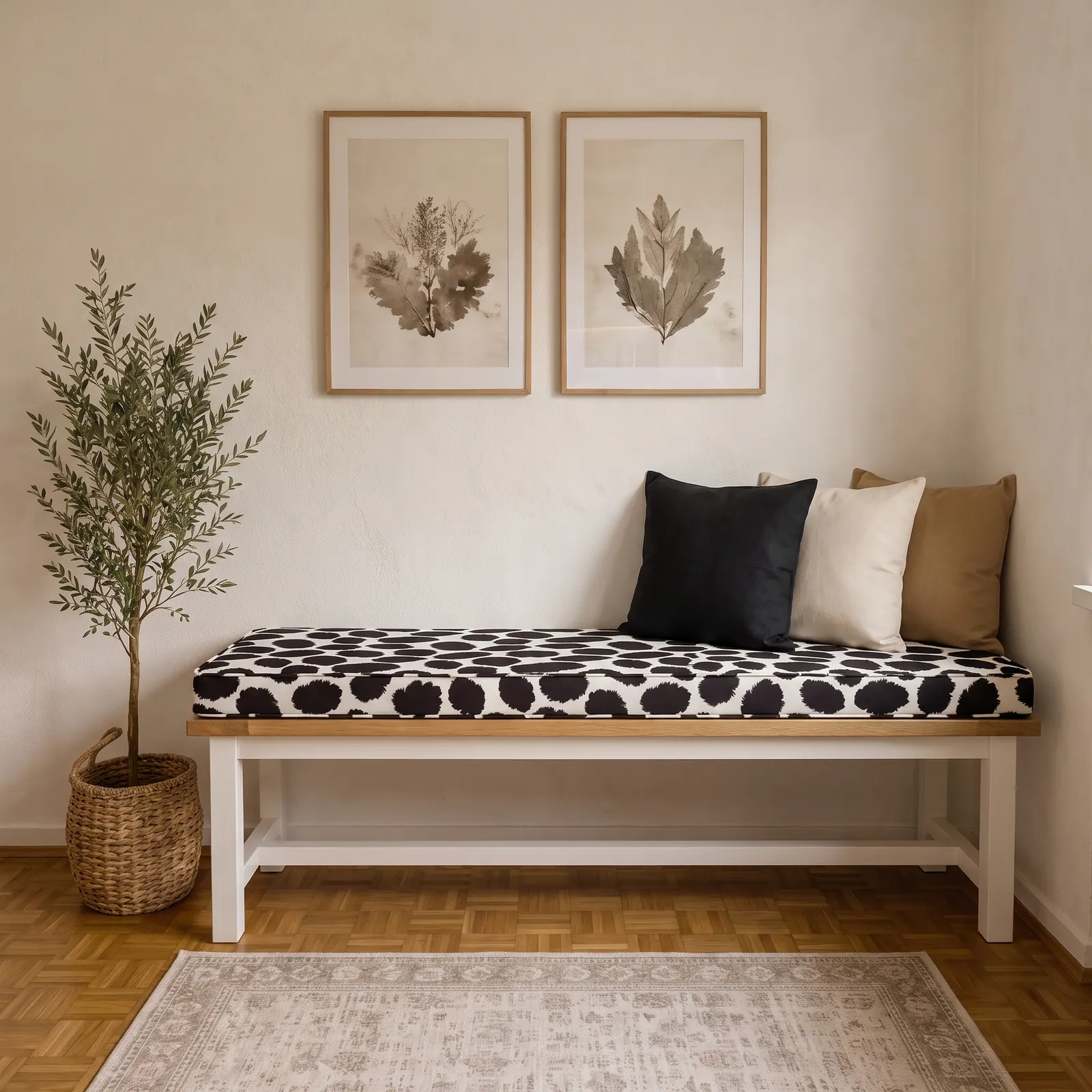
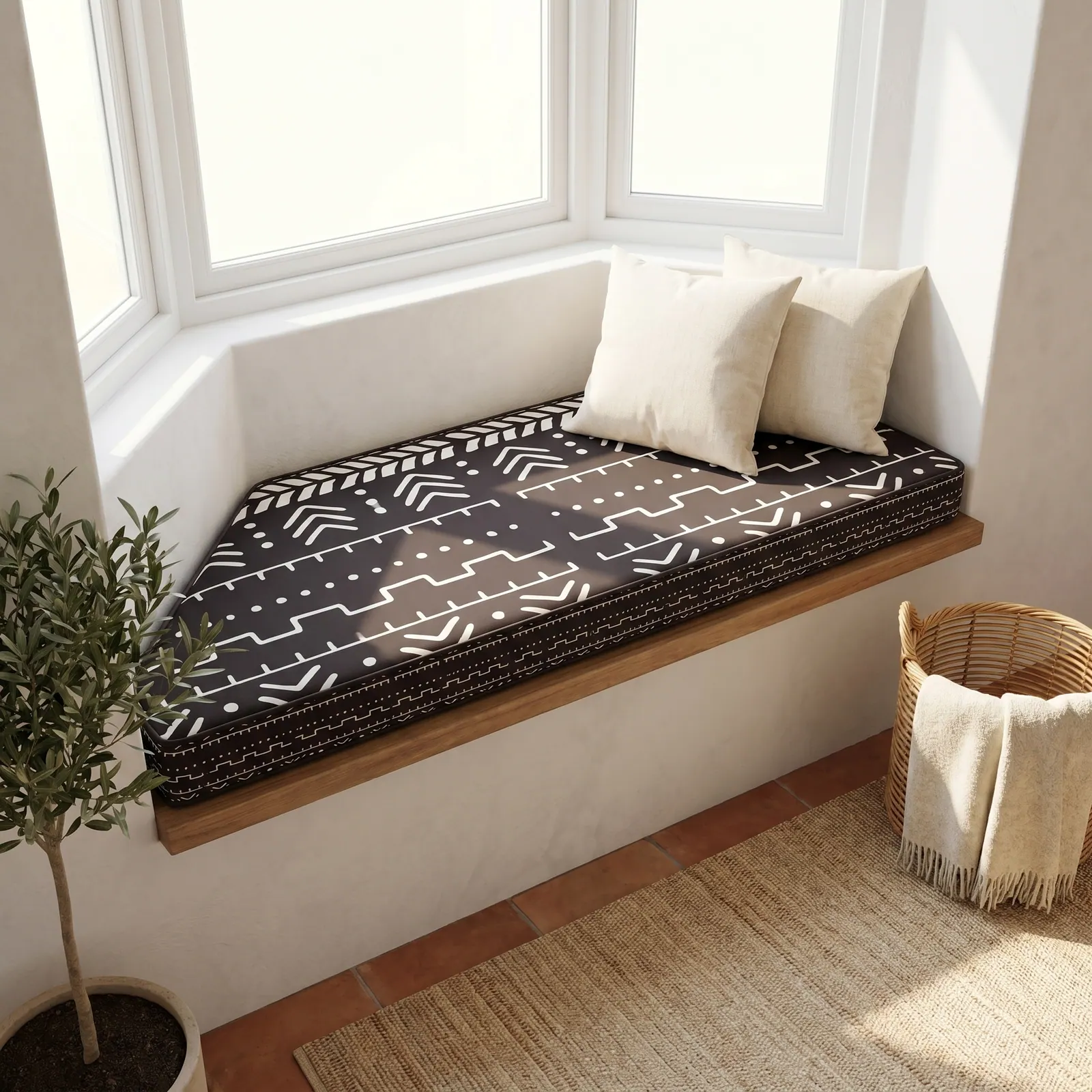
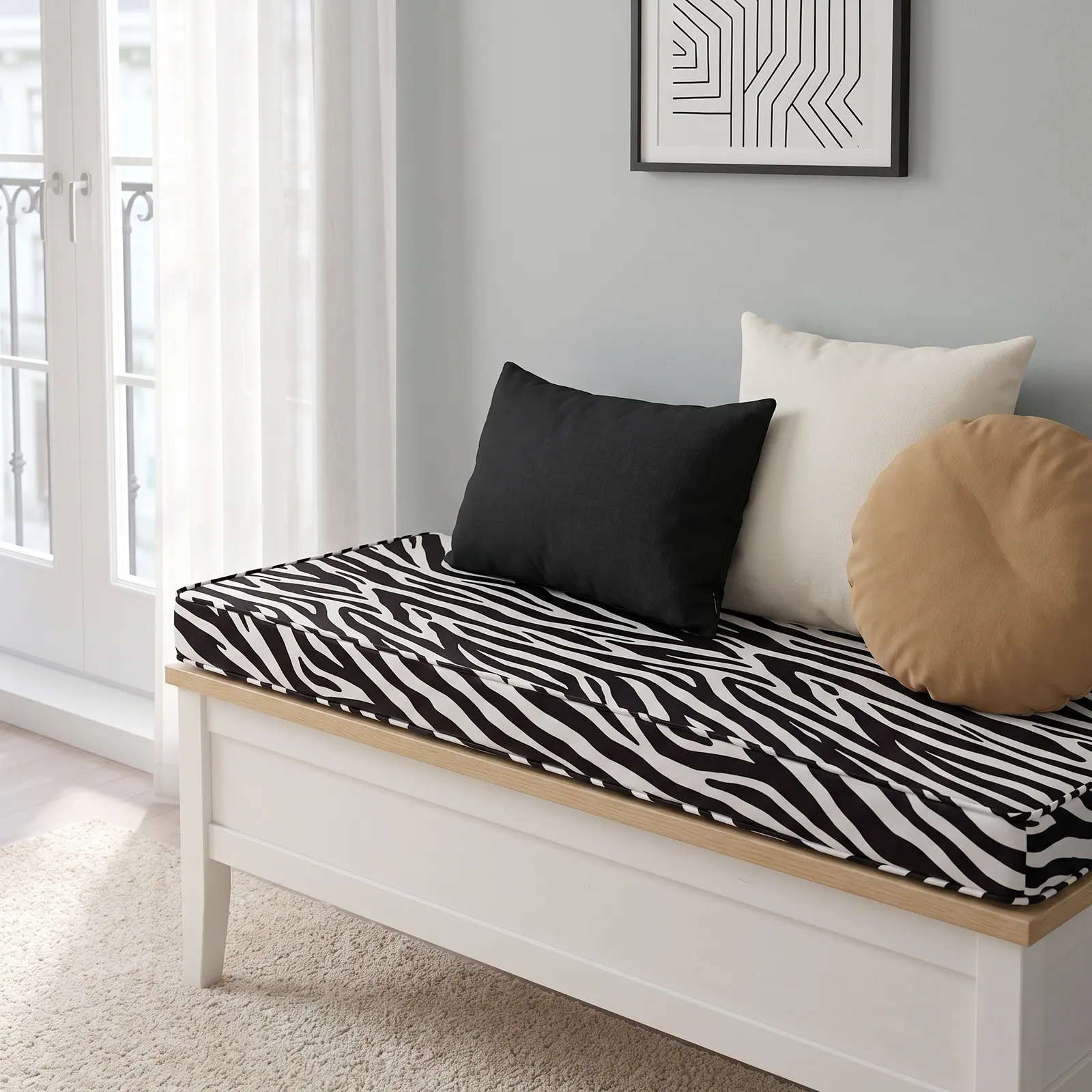
Large spots need space, so the left half of the cushion is left clear to show the pattern at full scale.
- Pressed-leaf prints
Sepia leaves in oak frames bring nature in without adding another strong color.
- Olive tree
Silvery olive leaves soften the hard black and white contrast.
- Grouped pillows
Black, ivory and tan pillows at one end leave the other end free as the actual seat.
- Faded rug
A washed-out rug adds pattern underfoot without competing with the spots.
Plate Black spot print bench cushion, self piped, under pressed-leaf prints
Large inky spots bring energy to a quiet wall of pressed-leaf prints and a potted olive tree.
A Reading by HanaBench Cushions
A black spot print bench cushion under pressed-leaf prints and an olive tree
Two colors on the cushion. Five around it. The room does the calming, so the print can stay loud.
The quick answer
A bold black spot print bench cushion works in a quiet room when everything around it is warm and soft: cream plaster, oak frames, oak parquet and a silvery olive tree. Keep the pillows at one end so half the cushion shows the full pattern, and choose pillows that step from black to ivory to tan.
Why the room around the spots is so quiet
The spots are large. A print at that scale needs room, so the wall is bare cream plaster and the rug underfoot is faded almost to nothing.
The custom bench cushion sits on a white bench with an oak top, over oak block parquet. Oak appears three times: bench top, picture frames, floor. The repetition warms the black and white without adding a new color.
Two pressed-leaf prints hang centered over the bench. Their leaves are sepia, not green. Nature comes in, quietly. The olive tree in a woven basket brings the only living green, and its leaves are silvery. They soften the hard edge of the spots.
The pillows are pushed to the right: black, then ivory, then tan linen. They step from the print's darkest tone toward the oak and the floor. The left half stays clear. There you see the pattern at full scale. There you sit.
A room that already holds strong color will argue with a print like this. Start from the walls. Matching a cushion to paint or wallpaper covers how.
Pinned by Hana
Five marks, from the leaf prints on the wall to the faded rug.
The numbers match the pins on the plate.
- Bold spot printLarge spots need space, so the left half of the cushion is left clear to show the pattern at full scale.
- Pressed-leaf printsSepia leaves in oak frames bring nature in without adding another strong color.
- Olive treeSilvery olive leaves soften the hard black and white contrast.
- Grouped pillowsBlack, ivory and tan pillows at one end leave the other end free as the actual seat.
- Faded rugA washed-out rug adds pattern underfoot without competing with the spots.
The palette, in the order the eye meets it
- Ink black#1E1D1BThe spots. The only hard color in the room.
- Chalk white#F3F0E9The cushion's ground, a touch warmer than paper.
- Cream plaster#E8DFD0The wall. Warm enough to soften the white.
- Honey oak#B48656Bench top, frames and parquet. The bridge.
- Olive leaf#9CA48ESilvery green that cools the black.
- Tan linen#C6A57CThe last pillow. It leads the eye down to the floor.
Two paint colors and a pink fleck
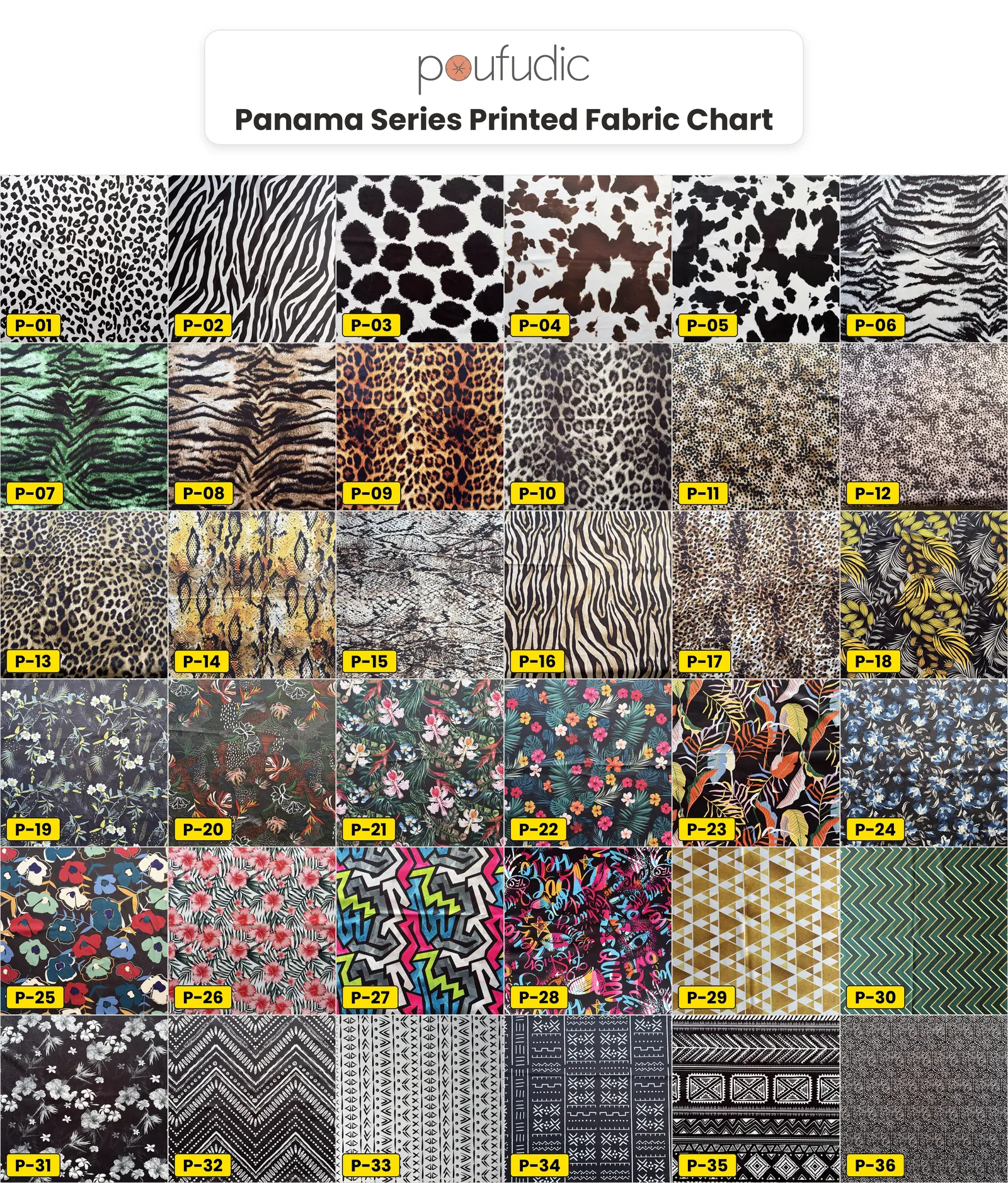
A buyer messaged the workshop wanting a pink-flecked fabric to sit with two heritage paint colors in her home. The workshop photographed two samples, P-57 and P-63, held against those paints. She chose P-57: a warm taupe base with pink flecks.
Two bench cushions followed, 72 x 17 3/8 in (1830 x 440 mm) and 48 1/4 x 18 1/8 in (1225 x 460 mm), quoted at one week of production plus 3 to 5 days of delivery. Two dog beds were added in a pet fabric. When that line was discontinued, the workshop substituted a very similar pet-suitable cloth and sent a real-life photo of the fabric before shipping.
Later she came back for two more: 24 1/4 x 77 7/8 in (61.5 x 197.8 cm) at 4 in thick, and 17 1/8 x 43 1/4 in (43.5 x 110 cm) at 2 in.
Paint first. Then fabric, in daylight, beside the paint. Then the order.
- Sizes
- 72 x 17 3/8 in and 48 1/4 x 18 1/8 in; later 24 1/4 x 77 7/8 x 4 in and 17 1/8 x 43 1/4 x 2 in
- Fabric
- P-57, warm taupe with pink flecks
The lesson: Ask for the fabric to be photographed next to your paint or furniture before you commit.
Three questions, three short answers
- A common question
Can the backrest hang on the wall like a headboard, on a French cleat?
The workshop's answerNot on a cleat, because the cushions have no rigid board inside. Ties can be sewn to the top corners instead, so the backrest hangs from hooks or a rail. It is built like the back pillows: a removable piped cover with shredded foam about 4 in (10 cm) thick, or a solid foam core wrapped in fiber for a firmer, flatter panel.
- A common question
Is K31 a soft blush or a strong pink?
The workshop's answerA soft blush, not a strong pink. There was no cushion made entirely in K31 to show, so the workshop sent a photo of it used as piping against a body fabric.
- A common question
Does the bench cushion arrive filled, or is it only a cover?
The workshop's answerFilled. Cushions ship complete with high-density comfort foam inside. Covers-only is possible if you ask. Either way the cover zips off and is machine washable.
A bold black spot print bench cushion stays calm when the wall is plain plaster, the rug is faded and oak shows up three times around it.
Hana
On the cutting table
| Cushion | Bench cushion, full length of the bench |
|---|---|
| Fabric | Cotton canvas, bold black spots on white (P-03) |
| Edge | Box edge |
| Piping | Self piping in the print |
| Pillows | Black, ivory and tan linen, grouped at the right end |
| Wall | Cream plaster, two oak-framed leaf prints |
| Floor | Oak block parquet, faded rug |
| Best for | Living rooms with quiet walls |

Have it made
Have this made — ask Hana’s workshop
Measure once, slowly. Write the numbers here. The workshop will go over them with you. — Hana
Leave your details and the workshop will call you to confirm measurements, fabric, foam and piping. No prices, dates or payment on this page: it is a request, not an order.
Questions buyers ask next
Will a bold black and white print overpower a living room?
Not if the rest of the room stays quiet. Keep the walls plain, the rug faded and the wood warm, and let the print be the only strong pattern at eye level. A plant with silvery leaves softens it further.
Where should pillows go on a long patterned bench cushion?
Group them at one end. Half the cushion then shows the pattern at full scale and stays free for sitting. Step the pillow colors from the print's darkest tone toward the wood around it.
How can I check a cushion fabric against my wall paint before ordering?
Ask for a photo of the fabric held against your paint or furniture, taken in daylight. The workshop has done this with paint samples, and it settles questions a screen can't.
— Hana
Other prints, other benches
 Save
 Save
 Save
 Save
 Save
 Save