A Reading by MaggieBench Cushions
A Leopard Print Bench Cushion, Read at the Corner Where the Piping Meets
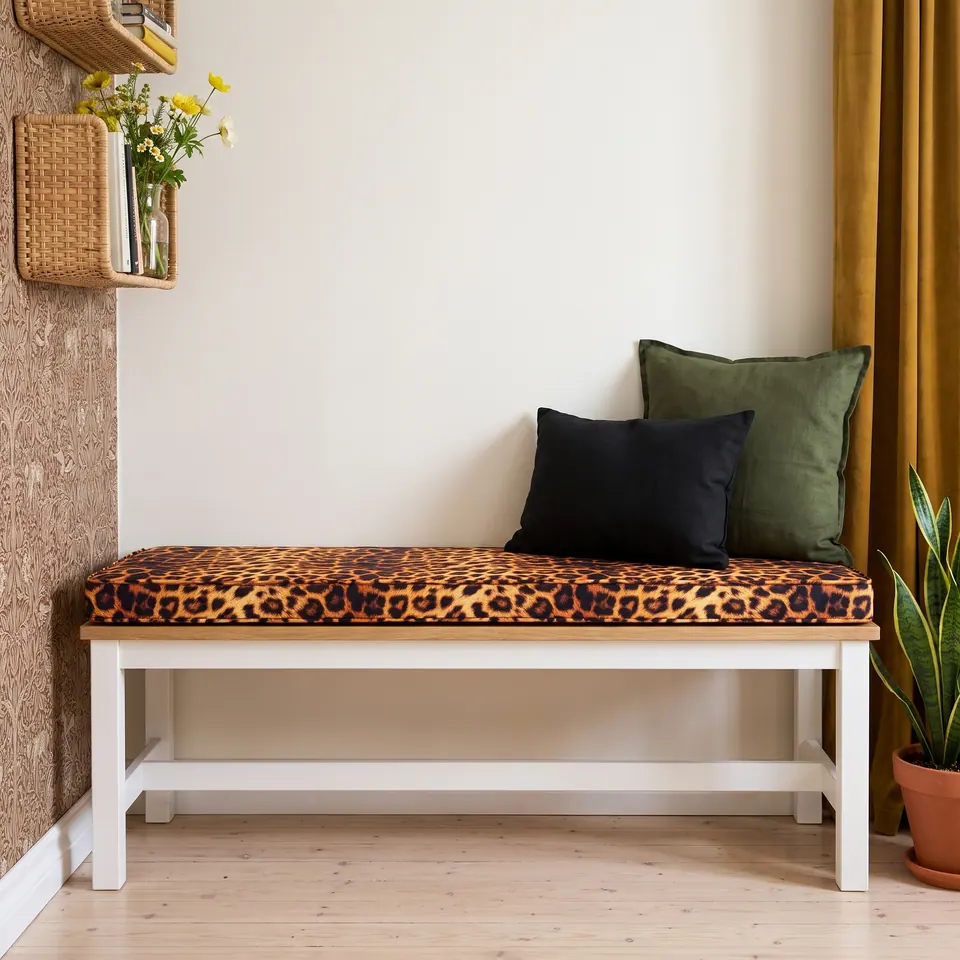
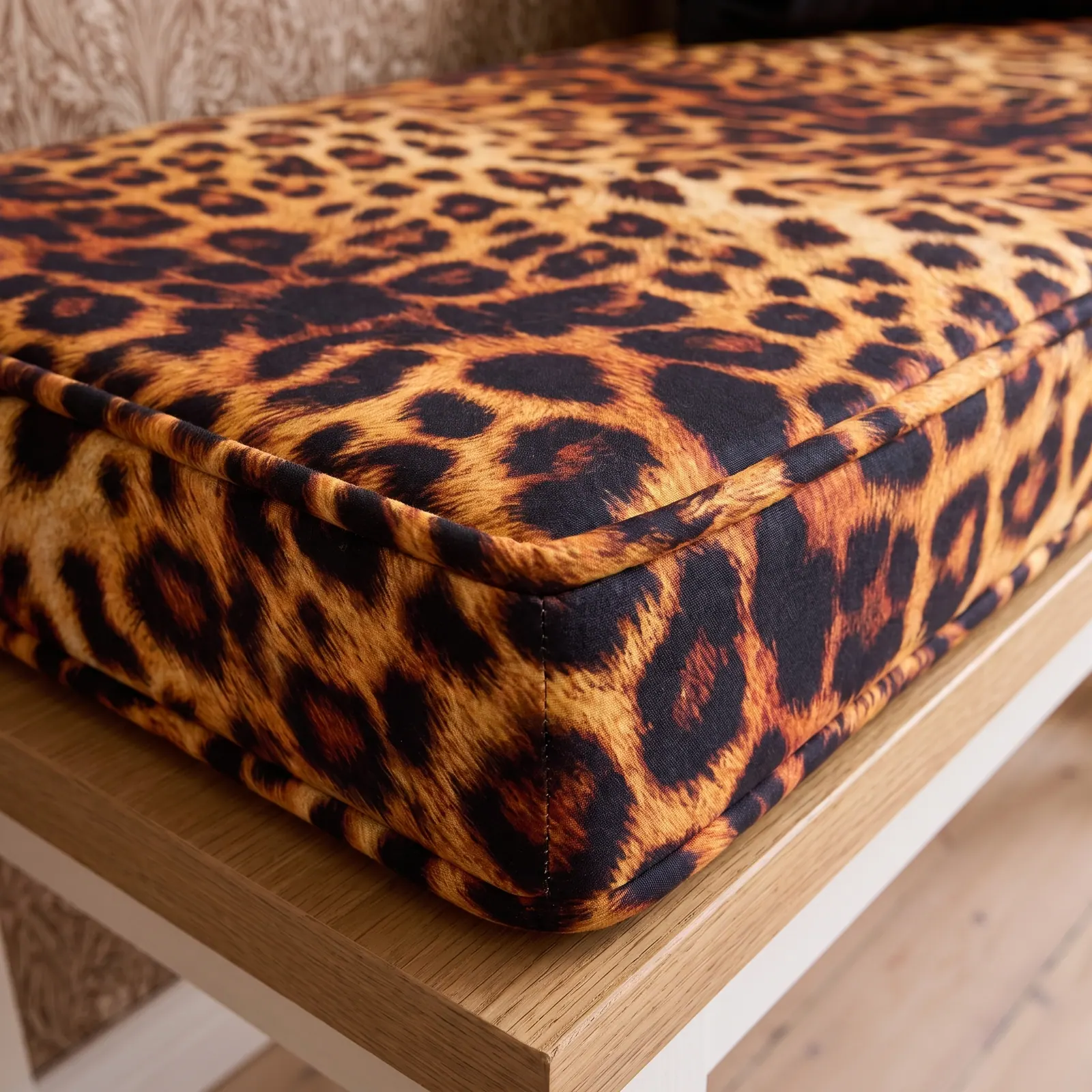
Maggie puts her nose right up to one corner of an amber leopard box cushion, because that is where a tailored cushion proves itself or gives itself away.

 Save
The quick answer
A well-made box bench cushion shows its quality at the corner: the piping turns square without bulk, the gusset seam lines up with the welts above and below, and the cushion stops just short of the bench edge. This amber leopard print cushion does all three, with self piping on both edges that keeps the side band from bowing when someone sits.
Notebook, page one: one corner, four checks
You can judge a box cushion from one corner, the way you judge a shirt by its collar. So I set my notebook down beside this one and looked nowhere else.
First check: the welt. It's self piping, cut from the same amber leopard print as the cushion, and it turns the corner square, with no pleat and no lump at the point. Second check: the gusset seam drops straight down the corner and lines up with the welts above and below. A wandering seam there is the first thing I spot from across a room, and I've sewn a few of those myself, back when I was young and in a hurry.
Third check: the print. The rosettes are printed big enough to read like real fur at arm's length, and they run over the welt and down the side band without a break. The cloth has a soft, smooth finish with a slight sheen, which is why the print looks almost touchable in warm close light.
Fourth check: where it stops. The cushion sits a little back from the front of the oak bench top, so legs don't catch the welt and a line of wood frames the seat. Behind it, damask wallpaper keeps to the same warm family, so two patterns share one wall without a quarrel.
Piping both edges earns its keep: welts at the top and bottom hold the side band straight, so the gusset doesn't bow out under weight. That's the whole case for a box edge on a daily bench cushion, and the box edge versus knife edge Pattern has the rest. For cotton cloth with the same crisp hand, browse the striped cotton and ticking family, and see how bold seats settle into living room cushions.
Four pins on a single corner
Four pins on one corner, from the square welt at the point to the strip of oak left showing in front.
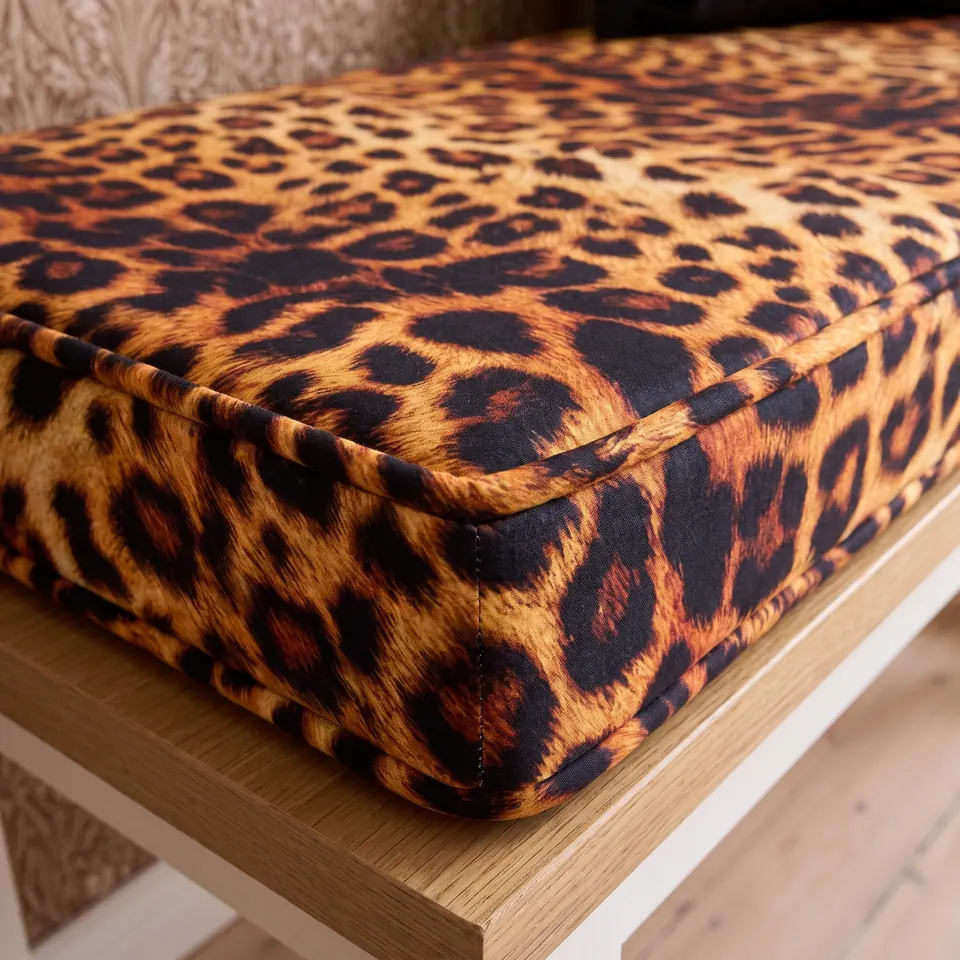
- Piped corner
The self welt meets at a square corner with no bulk, so the edge stays sharp.
- Top panel print
The rosettes are printed large enough to read like real fur at arm's length.
- Gusset seam
The corner seam lines up with the welts above and below.
- Oak top set-back
The cushion sits slightly back from the wood edge so legs do not catch the welt.
- Piped cornerThe self welt meets at a square corner with no bulk, so the edge stays sharp.
- Top panel printThe rosettes are printed large enough to read like real fur at arm's length.
- Gusset seamThe corner seam lines up with the welts above and below.
- Oak top set-backThe cushion sits slightly back from the wood edge so legs do not catch the welt.
Maggie's corner checklist, copied from the notebook
- The welt turns the corner square, with no pleat or lump at the point.
- The gusset seam runs straight down and meets the welts above and below.
- The print carries over the welt and down the side band without a break.
- Both edges are piped, so the side band stands straight under weight.
- The cushion finishes just short of the bench edge instead of hanging over it.
Thickness first, lengths second: a corner set that nearly didn't meet
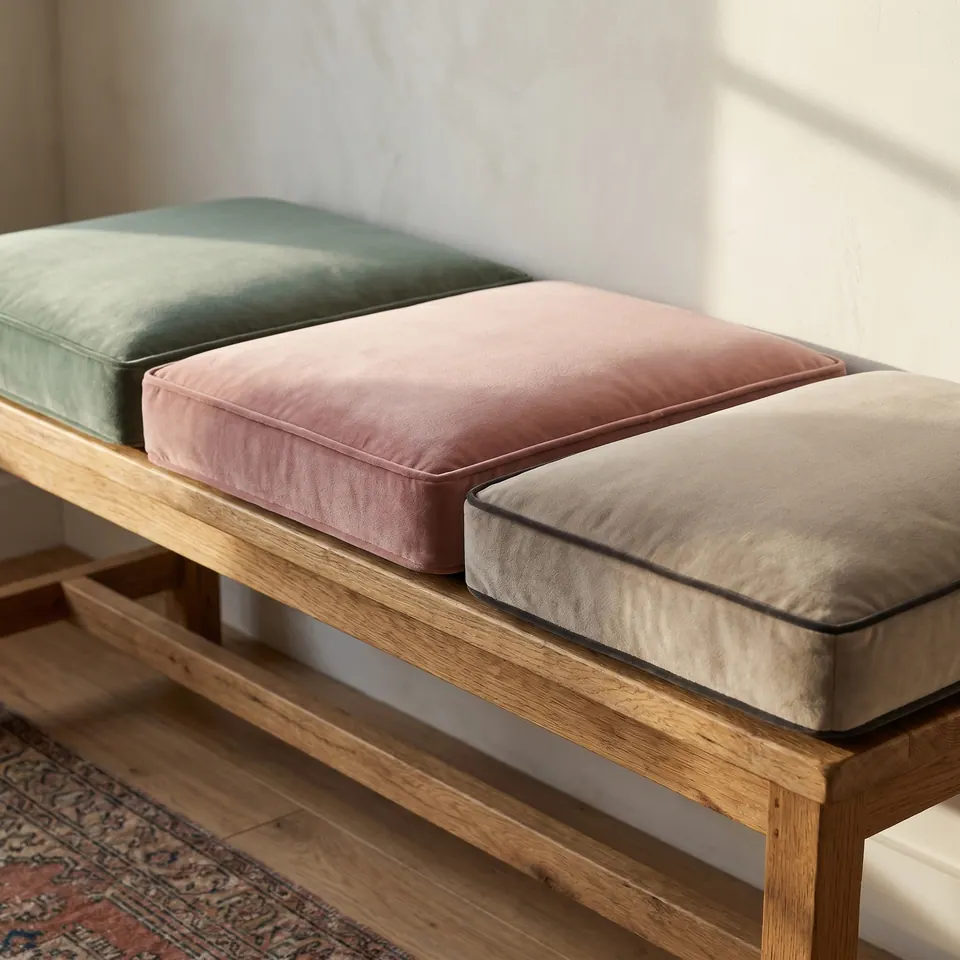
Right, then. A buyer got in touch wanting a café-style corner: one cushion on the bench and three more on a ground-level cushion in the corner. She wanted linen or cotton, not velvet, so the workshop explained that its soft fabric is a durable poly-cotton blend and sent both the linen and the soft fabric charts.
The standard thickness was 4 in (10 cm). Going to 5 in (13 cm) would have raised the price noticeably, so she kept 4 in and adjusted her measurements to suit. The final set: 58 x 24 3/4 in (147 x 63 cm) in burgundy, 58 x 15 3/4 in (147 x 40 cm) in emerald, and two 15 3/4 x 20 7/8 in (40 x 53 cm) pieces in khaki. Production took 7 to 10 days, delivery another 3 to 5.
Here's the note I underlined twice: decide the thickness before you finalize the lengths. Where corner pieces butt together, thickness changes how they meet, and a careful set of lengths can come undone over one inch. Settle the thickness, dear, and then measure. What thickness is your bench asking for?
Buyer questions: copies, steps and a swapped welt
- A common question
The store discontinued my floor backrests and the bolsters that went with them. Can you copy them?
The workshop's answerYes. The workshop makes backrests to the same measurements and suggested the closest ivory in its range. Two backrests at 15 x 38 x 14 in (38 x 97 x 36 cm) were quoted from those sizes.
- A common question
Part of my bench juts out at the front. Can the cushion follow that shape?
The workshop's answerYes. Send a simple drawing with exact measurements, especially of the part that sticks out. One stepped cushion was made straight from a buyer's marked-up drawing: 66 x 11 in (168 x 28 cm), widening to 67.5 in (171 cm) with 6.5 in (16.5 cm) more depth.
- A common question
My cushion came back with the piping fabric on the body and the body fabric on the piping. Can that be fixed?
The workshop's answerYes. When the two fabrics were swapped, the workshop remade the cover right away at no cost, with the body and piping fabrics the right way around, sized to fit over the foam already delivered.
On the cutting table: the leopard corner
| Piece | Box bench cushion |
|---|---|
| Fabric | Amber, black and brown leopard print on a smooth cotton canvas |
| Edge | Box edge with a straight gusset |
| Piping | Self piping on the top and bottom edges |
| Corners | Square, with the gusset seam aligned to both welts |
| Placement | Set slightly back from the front of the oak bench top |
| Setting | Oak bench, warm damask wallpaper behind |
| Best for | Living room benches that get sat on every day |

Have it made
Have this made — ask Maggie’s workshop
Have the tape measure handy when they call. Old cushions shrink and sag; the seat underneath does not. — Maggie
Leave your details and the workshop will call you to confirm measurements, fabric, foam and piping. No prices, dates or payment on this page: it is a request, not an order.
Self piping on both edges of a box cushion holds the gusset straight when someone sits, so the corner stays square under weight.
Maggie
Questions buyers ask next
Why pick self piping for a boldly printed box cushion?
Self piping is a welt covered in the same fabric as the cushion. It sharpens the edge without adding a new color, which suits a bold print like leopard, where a contrast cord would compete with the pattern.
Should a bench cushion hang over the front of the bench?
Usually not. Finishing the cushion just short of the front edge keeps legs from catching the welt and lets a strip of wood frame the seat. Measure the bench top itself before you order.
Can a large print carry across the corner of a box cushion?
Yes. A careful cutter can run the print over the welt and down the gusset without a visible break, as on this cushion. With a big pattern, ask your maker how it will be placed on the top and sides before cutting.
Is a box edge or a knife edge better for an everyday bench?
A box edge has a straight side band, so the front stays square and firm to sit on. A knife edge tapers to a thin rim and suits thinner pads. For a bench used daily, a piped box edge holds its shape better.
Stitch straight — Maggie