A Reading by MaggieBanquette & Kitchen Nook Cushions
Inside a red stripe banquette cushion: the cover, the box and the firm foam under a kitchen nook seat
Maggie cuts a country-kitchen banquette open on paper, from the stripe down to the foam, and explains why the seat you eat at should never be the soft one.

 Save
The quick answer
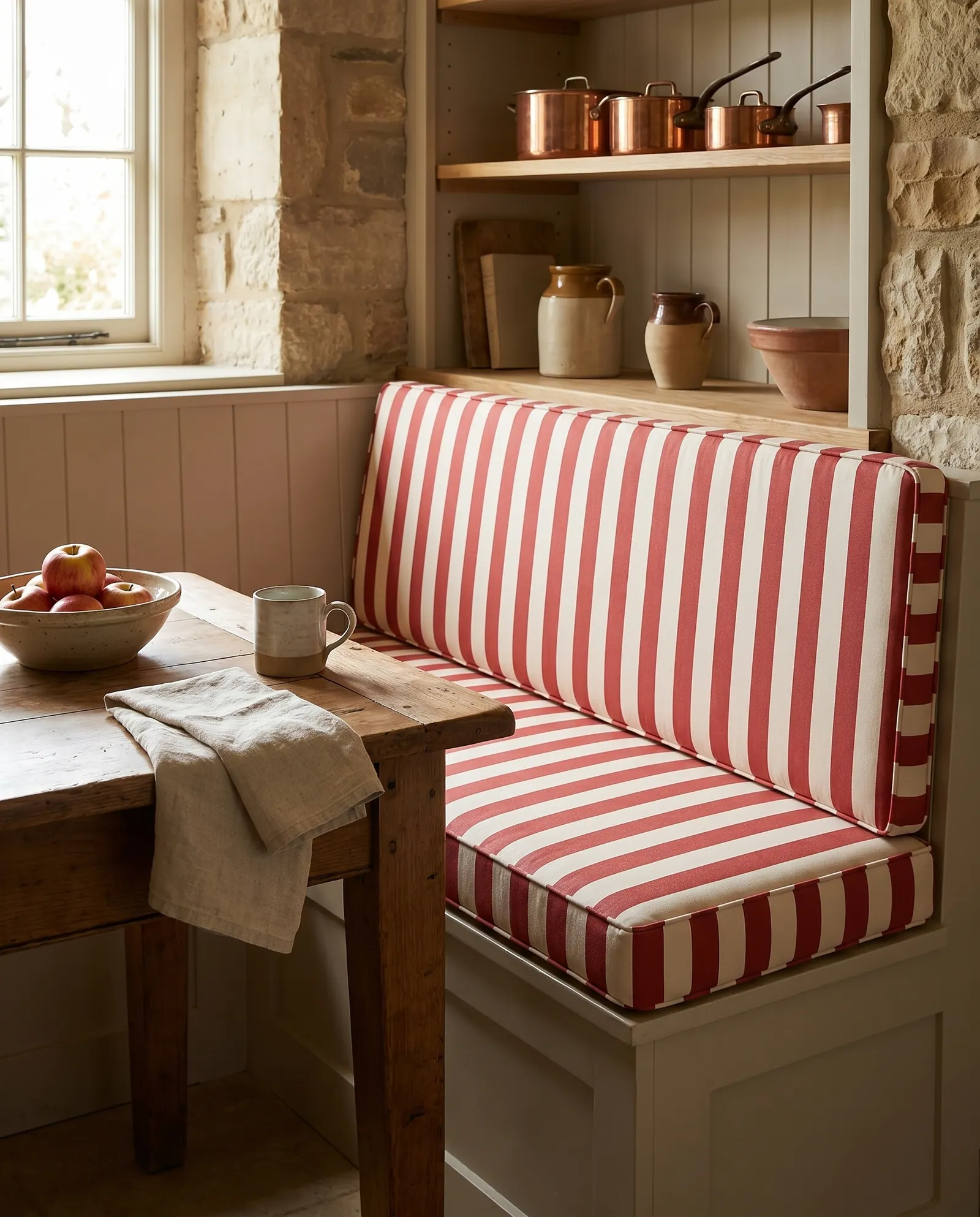
A kitchen banquette cushion should be firm, because you sit upright at a table and slide in and out sideways. This red stripe seat is a box cushion with self piping over a firm foam core; the workshop's foam is about 2.0 lb/ft³ (32 kg/m³) and holds its shape, while the separate back cushion lifts off for washing.
The cushion, cut open
Cover fabric. A removable, zippered cover. Machine wash at 86°F (30°C) on a gentle cycle and air dry.
Piping. A fabric-covered cord sewn into the seams. It sits on the seam line, so it does not change the size.
Fiber wrap. Polyester fiber (Dacron) batting around the foam: it fills the cover out and softens the edges.
Foam core. About 2.0 lb/ft³ (32 kg/m³) high-resilience foam, firm to medium-firm, cut to the ordered size.
Zipper. Along the back band, as hidden as possible. The zipper side faces down or toward the wall.
Base panel. The underside of the cover. A non-slip fabric backing can cover the whole of it instead.
Cut it open on paper: 4 layers of a banquette cushion
Right, then. Lift the seat off this banquette in your mind and slice it front to back. Here's what the knife meets.
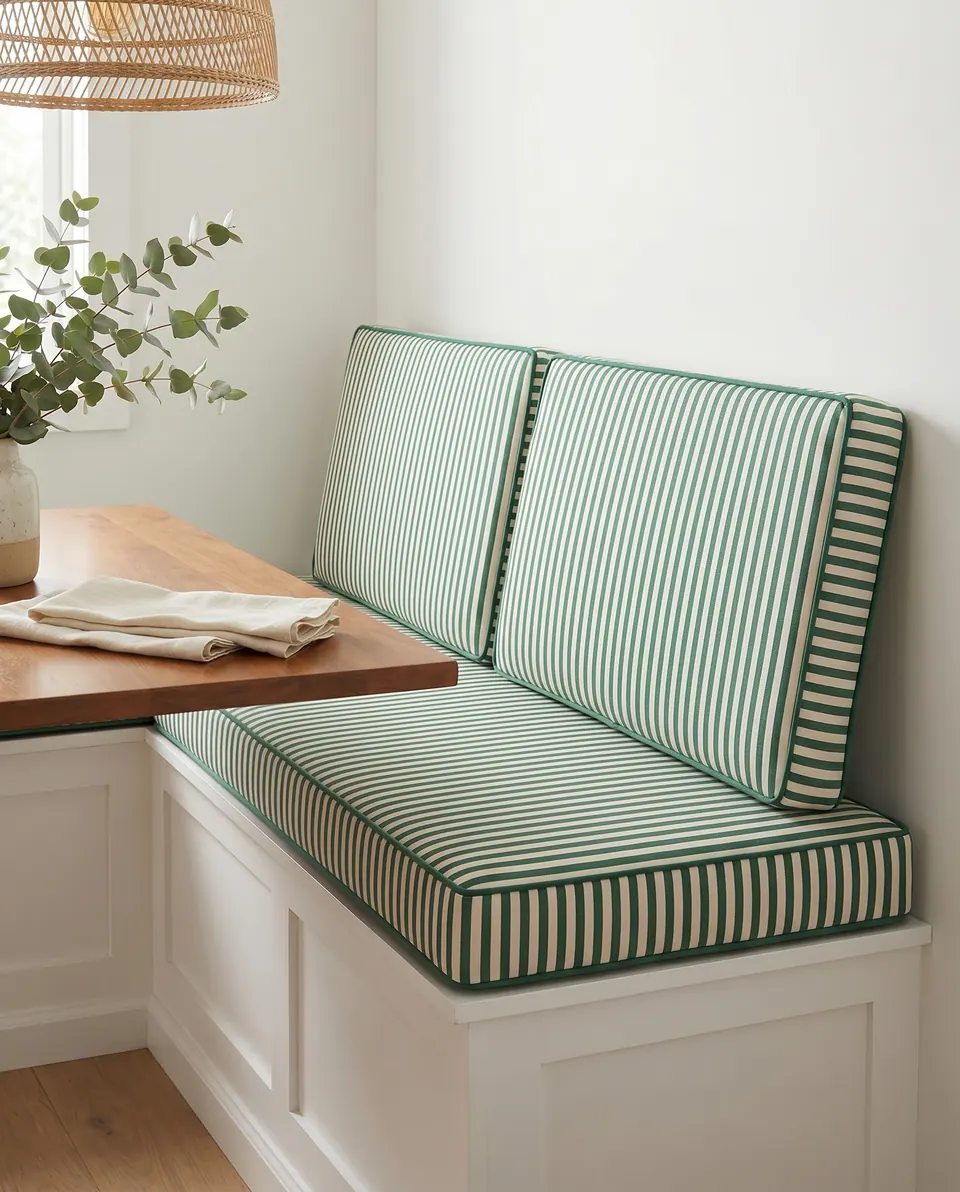
The cover. Red and ivory woven cotton stripe. On the seat the stripes run front to back; on the back cushion they stand upright, so the two meet in one line at the crease. I once ran a stripe sideways on a seat to save fabric. The customer noticed at breakfast. The customer was me.
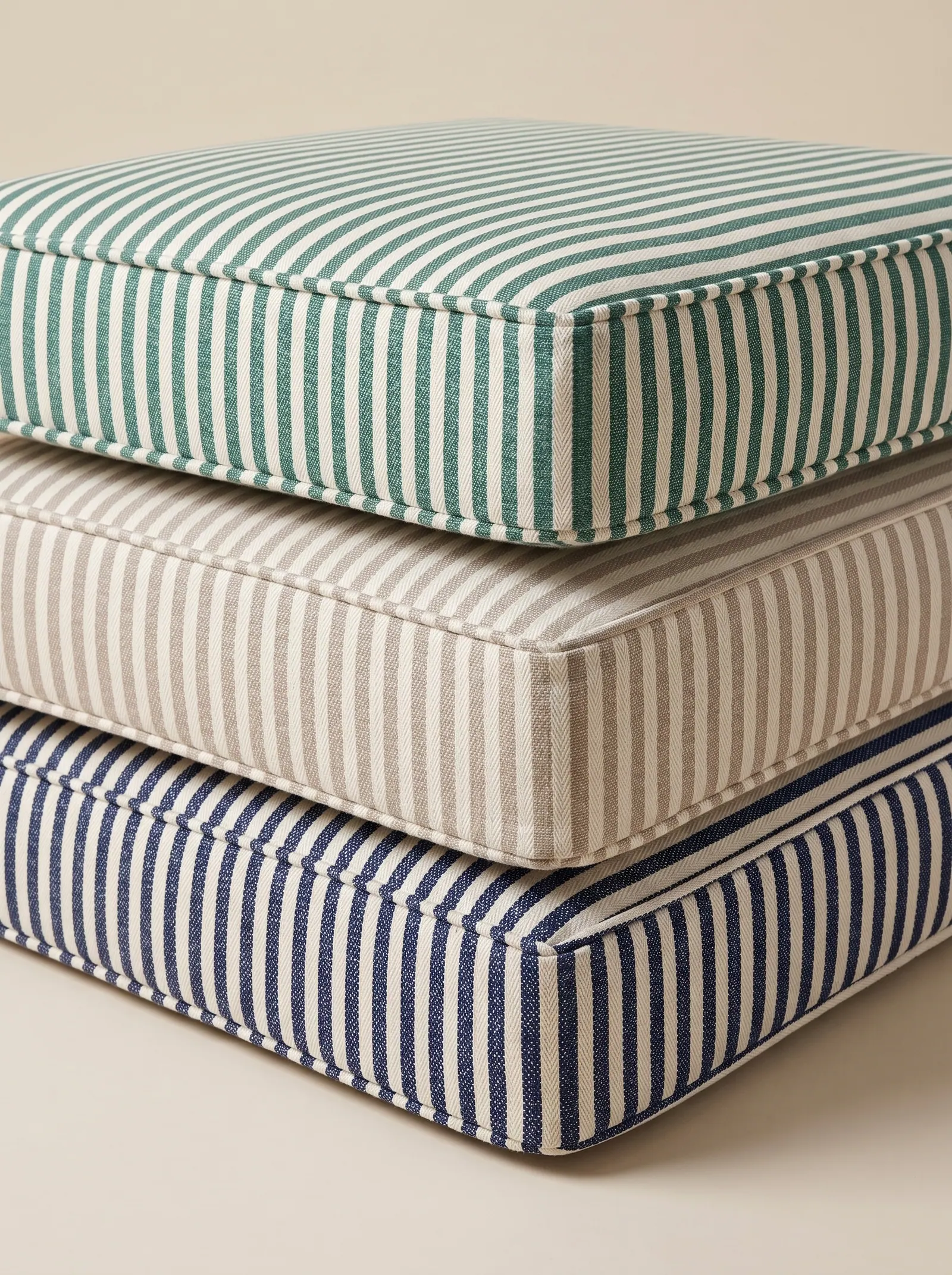
The welt. Self piping in the same stripe along the box edges. It keeps the front edge crisp where knees and the table apron rub all day.
The box. A straight side band, so the front stands square instead of rolling over. On a banquette the front edge takes your full weight every time you slide in.
The core. Firm foam. The workshop's foam works out to about 2.0 lb/ft³ (32 kg/m³) and holds its shape, which is what a seat at table height needs. Sink too far and your elbows end up level with the plates. The foam density vs firmness Pattern explains why those are two different numbers, and the foam firmness finder will steer you to one.
Pinned by Maggie: 5 marks on the cushion cross-section
Follow the pins from the seat stripe up to the back cushion and the copper shelf, then back down to the apples and the tea towel on the table.
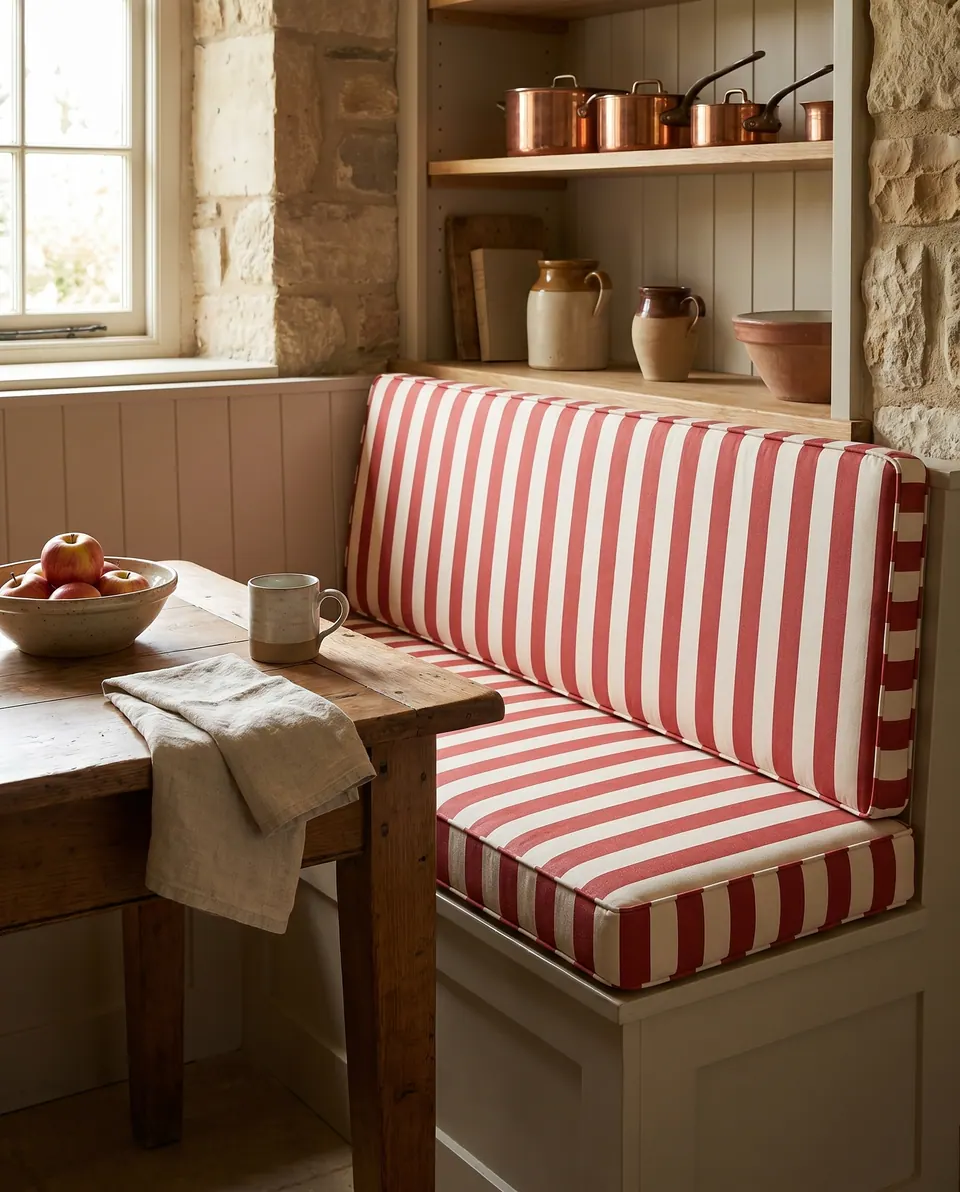
- Red stripe seat
Stripes run front to back to meet the back cushion's lines.
- Box back cushion
A separate back cushion is easy to lift off and wash.
- Copper pans on shelf
Warm copper repeats the red in the stripe.
- Bowl of red apples
Apples on the table tie the fabric to the kitchen.
- Linen tea towel
Plain linen keeps the table calm next to a bold stripe.
- Red stripe seatStripes run front to back to meet the back cushion's lines.
- Box back cushionA separate back cushion is easy to lift off and wash.
- Copper pans on shelfWarm copper repeats the red in the stripe.
- Bowl of red applesApples on the table tie the fabric to the kitchen.
- Linen tea towelPlain linen keeps the table calm next to a bold stripe.
Copper, apples and a tea towel: why the red has company
Soft daylight, a honey stone wall, painted boarding, stoneware. Everything behind the seat is a neutral, and that's deliberate: the red stripe gets to be the loudest thing in the room.
The copper pans on the open shelf repeat the red in a warmer key. The bowl of red apples on the scrubbed pine table does the same job at eye level. The plain linen tea towel sits between them so the table doesn't start arguing with the bench.
A busy stripe is practical here, too. It forgives crumbs. And the back cushion stands tall enough to reach the shelf ledge, so the nook looks upholstered without anything fixed to the wall. For height and knee room, see the banquette thickness Pattern.
How firm is the seat you eat at now? Press the front edge with your palm. If it folds, it's the foam, not you. More nooks live under kitchen nook cushions, and more stripes on the striped cotton and ticking shelf.
A designer, two cats and a stack of velvet squares
A designer in the US wrote to the workshop about a dining nook for a client with cats and small children. The question was velvet or linen.
The workshop said velvet: it washes below 86°F (30°C), cleans easily and is pet-friendly. Then came the swatch problem. Standard swatches are only about 1¼ to 1½ in (3 to 4 cm) across, far too small to set in front of a client.
So the designer asked for 4 x 4 in (10 x 10 cm) velvet squares in Forest Green 126, Burnt Orange 113, an emerald and a yellow, ordered through the samples listing with a note. Sensible. Nobody can judge a banquette from a postage stamp.
The foam decides how a seat feels; the cover decides whether it survives the cats. Settle both before you order. The banquette cushions page gathers the rest, and the kitchen banquette fabric Pattern covers the cover.
On the cutting table: the banquette, layer by layer
| Piece | Built-in banquette seat and a separate back cushion |
|---|---|
| Cover | Red and ivory woven cotton stripe (code N14) |
| Stripe direction | Front to back on the seat, upright on the back |
| Piping | Self piping in the same stripe |
| Edge | Box edge with a straight side band |
| Core | Firm foam; about 2.0 lb/ft³ (32 kg/m³) |
| Back cushion | Separate box cushion that lifts off for washing |
| Room palette | Red against honey stone, cream boarding and copper |
| Best for | A kitchen nook used at every meal |

Have it made
Have this made — ask Maggie’s workshop
I once cut a lovely cushion two inches short, and I have not forgotten it. That is why the workshop goes over your measurements with you on the phone. — Maggie
Leave your details and the workshop will call you to confirm measurements, fabric, foam and piping. No prices, dates or payment on this page: it is a request, not an order.
Buyer questions: long runs, lift-up lids and one piece or four
- A common question
Why does a custom set of replacement cushions for my built-in bench cost so much?
The workshop's answerEverything is handmade with good materials. For an 80 in (203 cm) and a 139 in (353 cm) run, each 22½ in (57 cm) deep with backs sized to the remaining height, the workshop explained that and then came down on its quote. Very long runs can be split into two equal sections.
- A common question
If I order a 40 x 80 inch cushion, does it arrive in one piece?
The workshop's answerYes, one single piece at the ordered size. If you'd rather have sections, order each smaller cushion separately, for example four cushions of 40 x 20 in (102 x 51 cm).
- A common question
My storage bench has lift-up lids. Can the cushion be split to match them?
The workshop's answerYes. The cushion can be divided at the lid lines so each section lifts with its own lid. Send a clear drawing with every edge measured. If the sections differ, even by about 1½ in (4 cm) in depth, each one needs its own drawing showing front, back, both sides and the depth at each end.
A kitchen banquette cushion should be firm: soft foam sinks you below table height, and the front edge takes your weight every time you slide in.
Maggie
Questions buyers ask next
How firm should a kitchen banquette cushion be?
Firm. You sit upright at a table and slide in sideways, so the front edge takes a lot of weight. Foam of about 2.0 lb/ft³ (32 kg/m³), as the workshop uses, keeps you at table height instead of sinking toward your plate.
Which way should the stripe run on a banquette seat?
Front to back on the seat and upright on the back cushion, so the lines meet in one continuous stripe at the crease. Running them sideways on the seat breaks that line and makes the nook look pieced together.
Why make the back cushion separate from the seat?
A separate back lifts off for washing and can be replaced on its own if it wears first. On a built-in banquette it also lets the seat sit flat on the bench while the back leans on the wall, with nothing fixed in place.
Stitch straight — Maggie
More photographs to read
 Save
 Save
 Save
 Save
 Save
 Save