A Reading by MaggieBanquette & Kitchen Nook Cushions
A multicolor pinstripe banquette cushion and the plain pads that let it lead
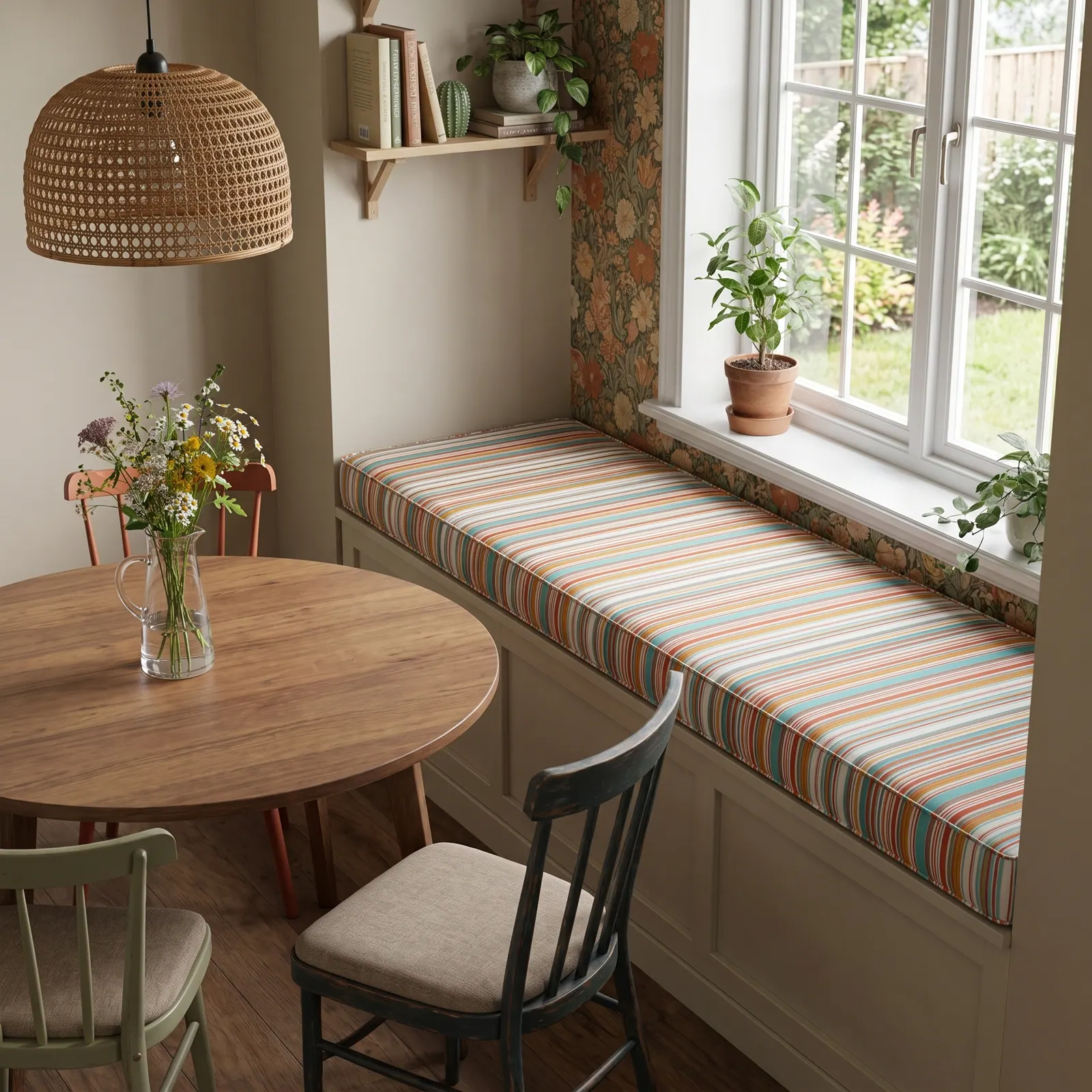
Right, then. One lively stripe at seat height, plain linen on every chair, cane overhead: this nook mixes patterns by rationing them. I once put three stripes around one table and learned that the loud way.

 Save
The quick answer
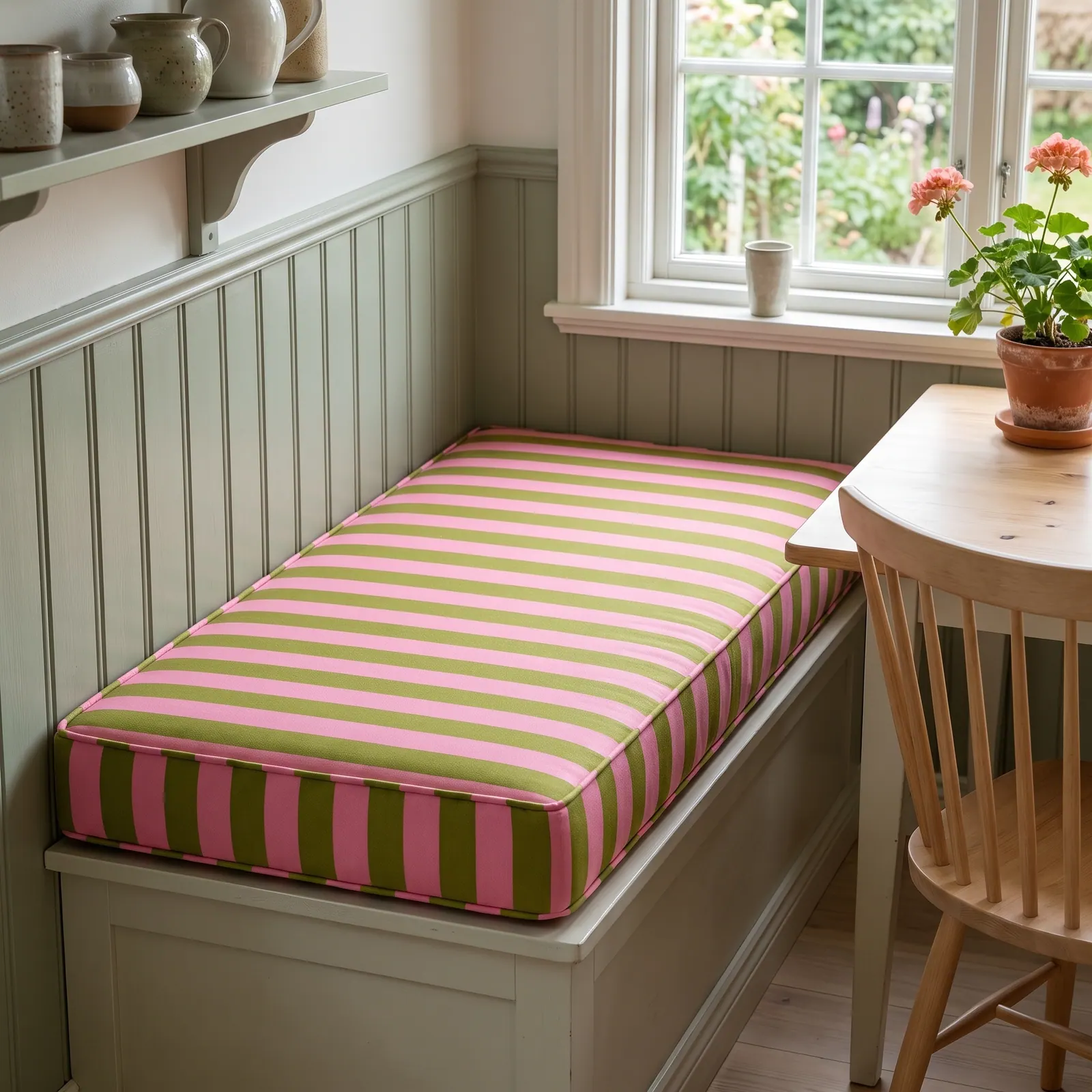
A striped banquette cushion mixes well with other patterns when at least two of its stripe colors already appear in the room and every other seat stays plain. Here the rust, teal and mustard pinstripe borrows from the wallpaper, the plants and the wildflowers, while the chairs carry plain linen pads, so the banquette is the only pattern at seat level.
The cushion, cut open
Cover fabric. A removable, zippered cover. Machine wash at 86°F (30°C) on a gentle cycle and air dry.
Piping. A fabric-covered cord sewn into the seams. It sits on the seam line, so it does not change the size.
Fiber wrap. Polyester fiber (Dacron) batting around the foam: it fills the cover out and softens the edges.
Foam core. About 2.0 lb/ft³ (32 kg/m³) high-resilience foam, firm to medium-firm, cut to the ordered size.
Zipper. Along the back band, as hidden as possible. The zipper side faces down or toward the wall.
Base panel. The underside of the cover. A non-slip fabric backing can cover the whole of it instead.
Five pins, three colors borrowed from the room
Each pin marks a stripe color, a plain or a texture that was put there on purpose.
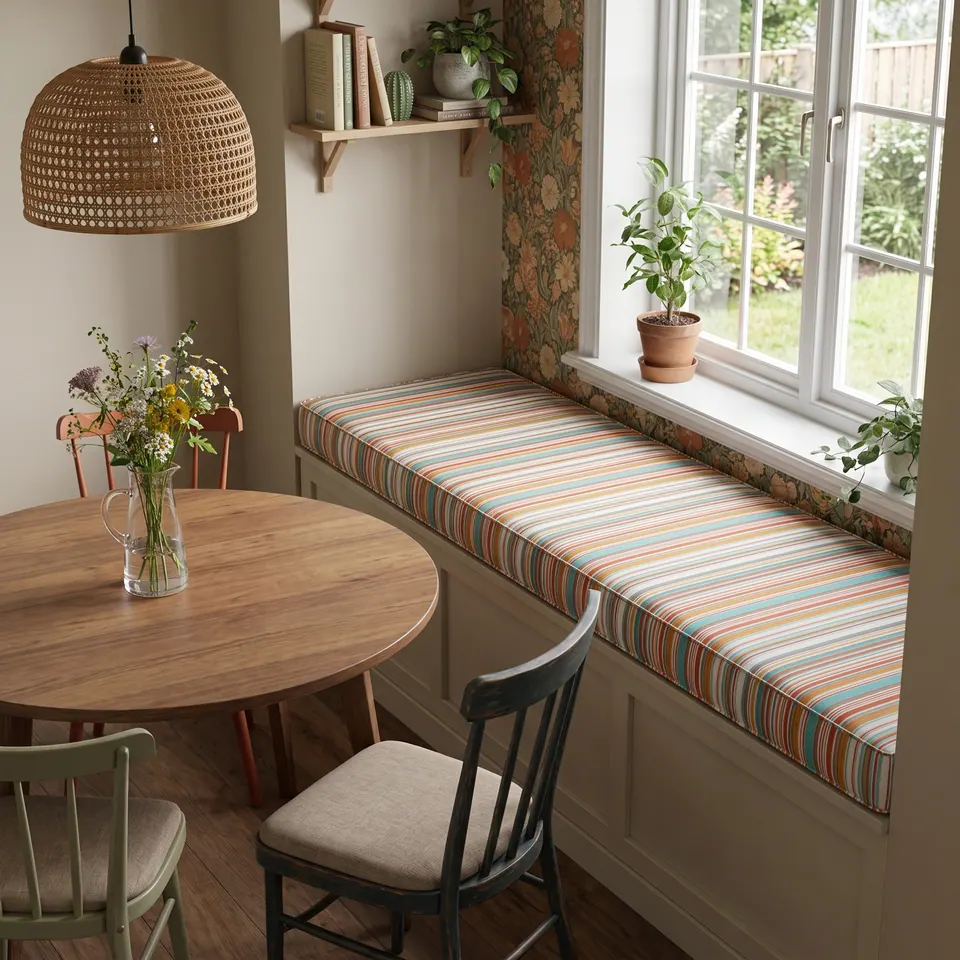
- Multicolour pinstripe
Rust, teal and mustard in the stripe all appear elsewhere in the room.
- Cane pendant
A woven pendant over the table sets a relaxed cottage tone.
- Wildflower jug
Yellow flowers repeat the mustard stripe at table height.
- Linen chair pad
Plain linen pads on the chairs leave the banquette as the only pattern at seat level.
- Floral wallpaper
The wallpaper's rust and green are the source of the stripe's colors.
- Multicolour pinstripeRust, teal and mustard in the stripe all appear elsewhere in the room.
- Cane pendantA woven pendant over the table sets a relaxed cottage tone.
- Wildflower jugYellow flowers repeat the mustard stripe at table height.
- Linen chair padPlain linen pads on the chairs leave the banquette as the only pattern at seat level.
- Floral wallpaperThe wallpaper's rust and green are the source of the stripe's colors.
Anatomy of the cushion, from top panel to piping
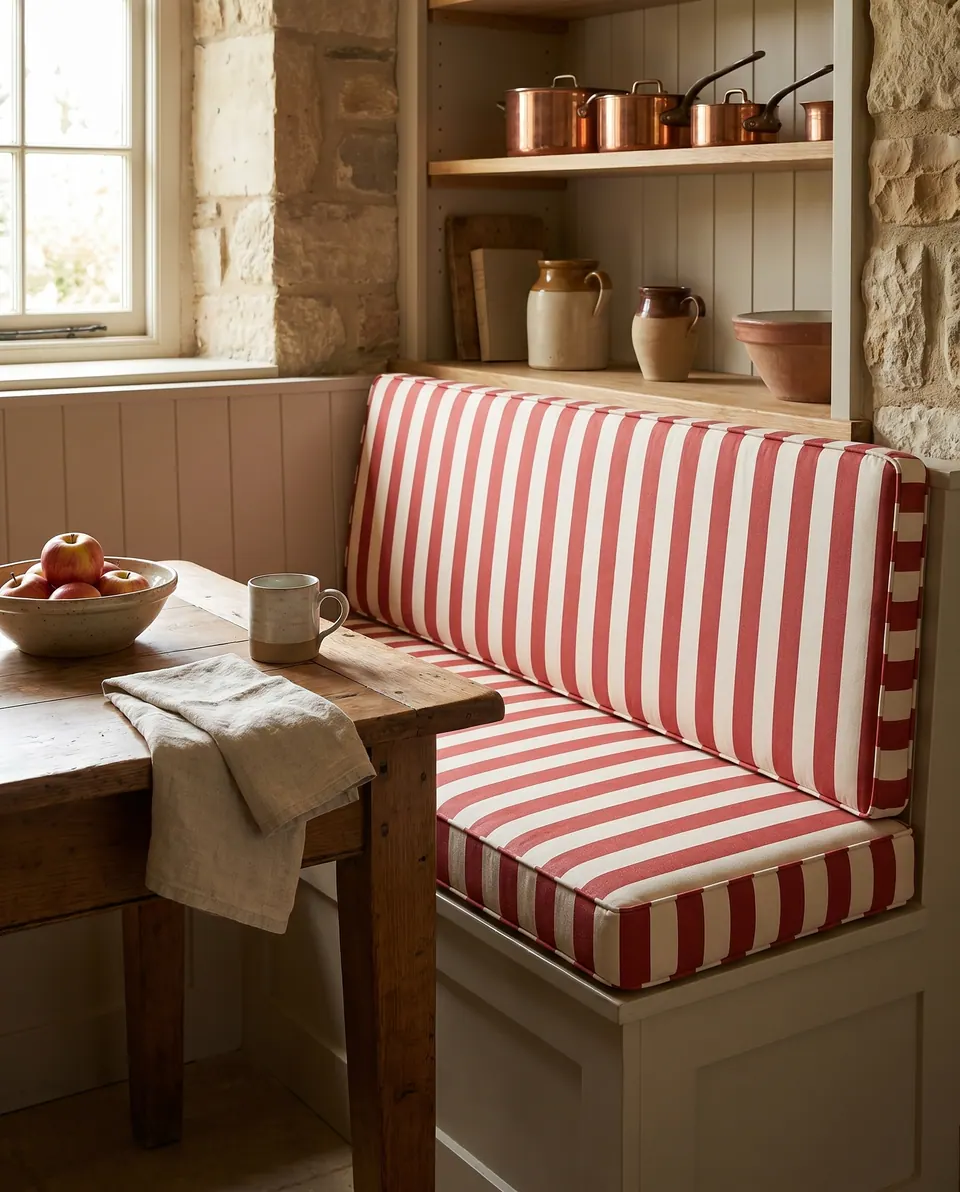
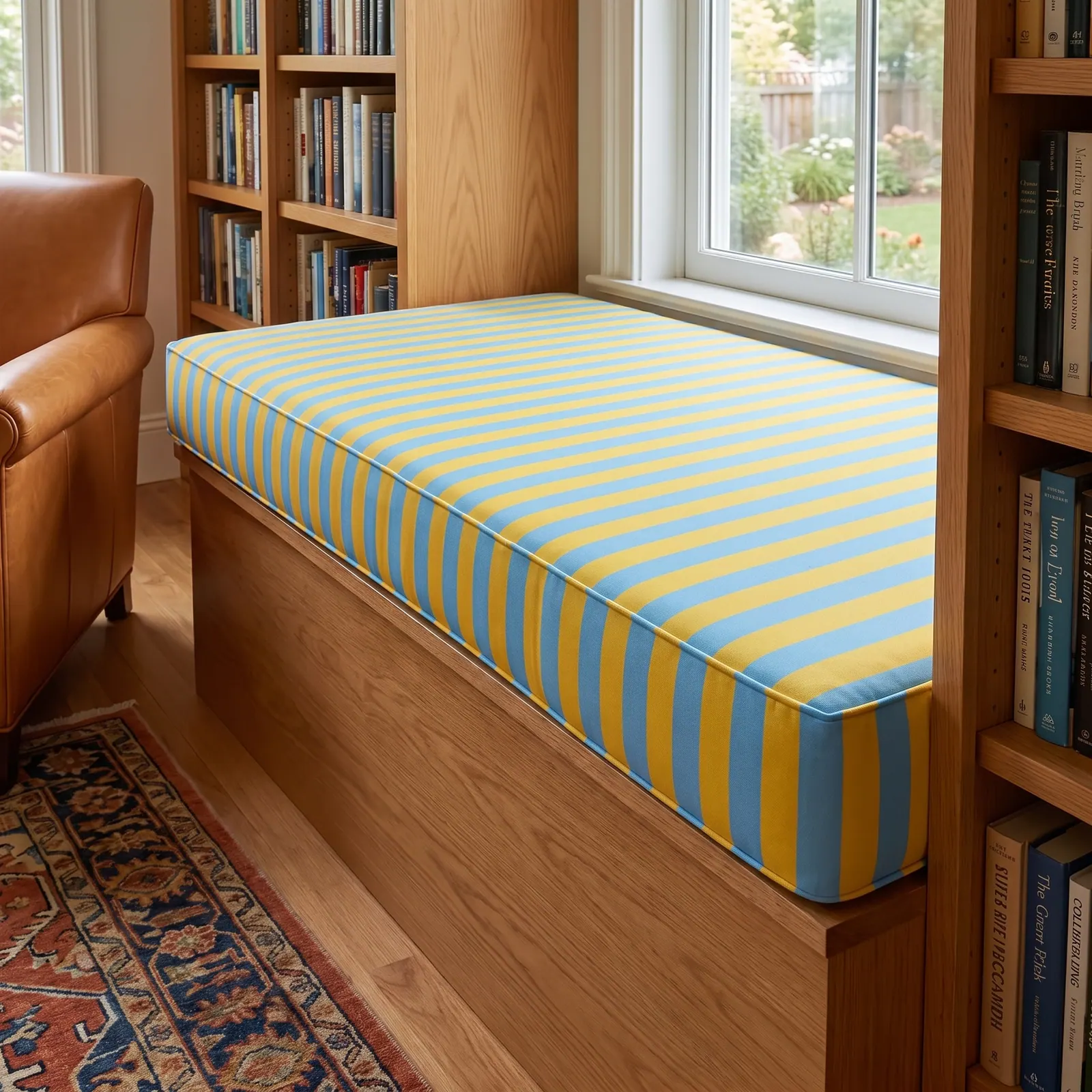
Start with the construction, because pattern mixing rides on it. This is a box cushion: top panel, bottom panel and an upright side band (the gusset), with self piping in both seams. The box edge keeps the front face straight, so from the doorway the stripe reads as one tidy band under the window.
The piping is cut from the same pinstripe, so rust, teal and mustard run over the edge instead of stopping at a solid line. A contrast welt would add one more strong line to a busy room; self piping keeps the banquette cushion reading as one piece of cloth.
Stripe, plain, texture: the ration that keeps a nook calm
Every color in the stripe already lives in the room. Rust and green come from the floral wallpaper panel, green again from the pots on the sill and the trailing plant on the shelf, mustard from the wildflowers in the glass jug. A busy fabric calms down once the room has introduced its colors.
Then the plains. The black and sage spindle chairs carry plain linen pads, so the banquette is the only pattern at seat level. The wallpaper is the second pattern, at eye level and a larger scale. Texture does the job a third pattern would do badly: cane pendant, oak grain, linen weave, book spines.
Stand in your own doorway, dear, and count. How many patterns sit at seat height in your kitchen nook? My checklist before any stripe goes on a banquette:
- Two of the stripe's colors already appear in the room.
- One pattern at seat height; chair pads stay plain.
- The second pattern sits higher and larger.
- Texture stands in for a third pattern.
- Piping decided in writing: from the stripe, or none.
See striped cotton and ticking, kitchen nook cushions and the Pattern on matching cushions to paint and wallpaper.
Forest green without a pattern at all
Not every nook wants a stripe. A buyer wrote to the workshop wanting a forest-green look for a kitchen banquette with seat and back cushions. The print P-65 looked too blue in close-ups, and P-60 with green piping was weighed next. After close-ups and the samples link, the buyer chose a sage linen, L-24, with darker L-25 piping.
The seat measured 90 x 16.5 x 3 in (229 x 42 x 7.5 cm); the backs were 90 in (229 cm) long, 18 in (46 cm) tall and 4 in (10 cm) thick. Tone-on-tone greens gave the forest look with no pattern at all.
Three banquette questions
- A common question
My window seat is three irregular trapezoids with no parallel sides. Can I mail you a paper template?
The workshop's answerRather than mailing it, send a digital file or clear photos of the template in the chat, or attach the files when you place the order.
- A common question
Can you make an L-shaped set of box cushions for a built-in banquette, with hidden zippers and piping on the top and bottom edges?
The workshop's answerYes. The workshop makes box-style seat and back cushions with piping on both edges, hidden zippers along the back edge and high-density foam, including performance fabrics in olive and moss greens.
- A common question
Can I have solid piping in the same taupe as my striped fabric, with no stripes in it?
The workshop's answerNot always. For one striped taupe fabric, solid piping wasn't possible, so the workshop sent a photo of piping cut from the striped fabric, and the buyer could choose that or no piping. If no piping option is picked, the workshop asks before production.
On the cutting table: the pinstripe banquette
| Cushion | Banquette box cushion, one long seat |
|---|---|
| Fabric | Multicolor cotton pinstripe: rust, teal and mustard on cream |
| Piping | Self piping cut from the stripe, top and bottom seams |
| Edge | Box edge with an upright side band |
| Borrowed colors | Rust and green from the wallpaper, mustard from the wildflowers |
| Best for | Cottage dining nooks and breakfast banquettes with one busy wall |

Have it made
Have this made — ask Maggie’s workshop
Numbers first, fabric second, piping last. Jot down what you have, and the workshop will go down the list with you, item by item. — Maggie
Leave your details and the workshop will call you to confirm measurements, fabric, foam and piping. No prices, dates or payment on this page: it is a request, not an order.
A multicolor striped banquette cushion settles into a room when at least two of its stripe colors already show up in the paint, wallpaper, plants or flowers.
Maggie
Questions buyers ask next
Can a pinstripe banquette cushion sit under floral wallpaper?
Yes, when the two patterns differ in scale and height. A fine stripe at seat level and a larger floral at eye level read as separate layers, and shared rust and green tie them together.
Should dining chair pads repeat the banquette stripe?
Not necessarily. Plain pads in a color pulled from the stripe keep one pattern at seat height, which looks calmer around a small table than several striped pieces competing.
What does self piping do on a multicolor stripe?
Self piping is cord covered in the cushion's own fabric. On a stripe it carries the colors around the edge instead of drawing a solid outline, so the cushion reads as one piece.
Stitch straight — Maggie
More photographs to read
 Save
 Save
 Save
 Save
 Save
 Save