 Save
A Reading by MaggieBanquette & Kitchen Nook Cushions
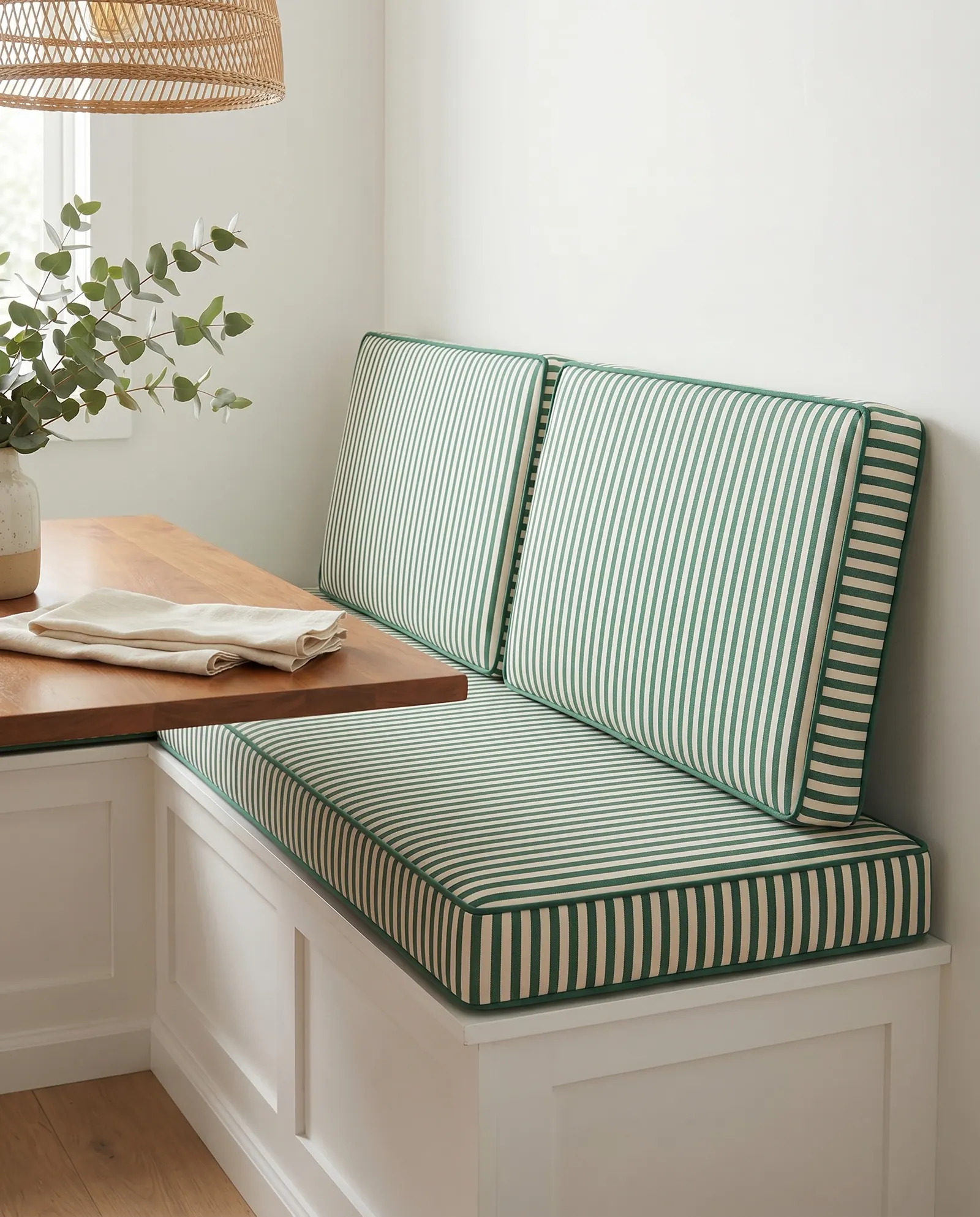
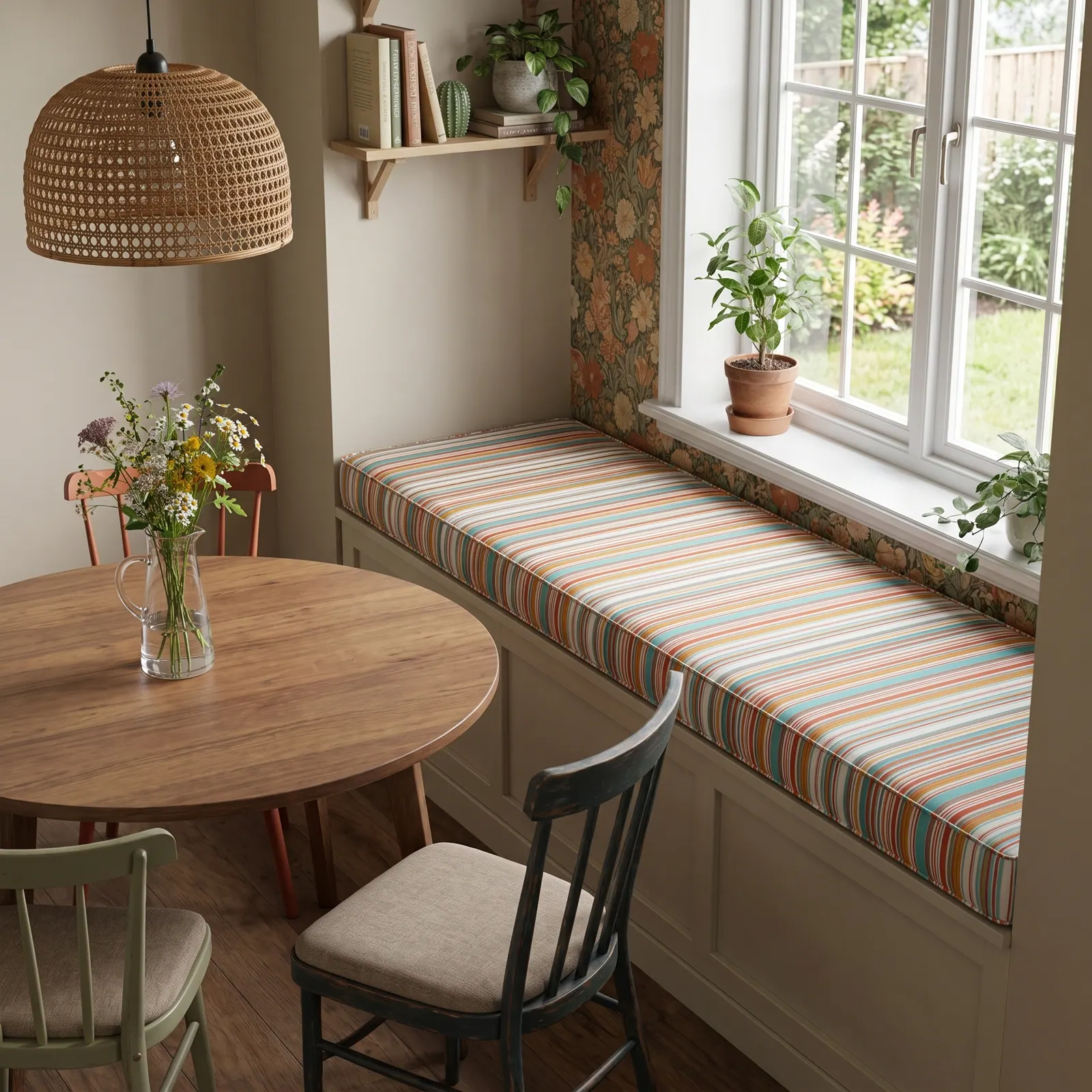
Forest green stripe banquette cushions, piped in solid green, under a rattan pendant
Six colors, one welt. On a white built-in banquette, green piping draws every box edge like a pen line, and that line is what makes striped cushions look tailored.

Swatch strip measured from the photograph
- oatmeal#bcbfb226%
- mist#e0e2dc22%
- taupe#98948419%
- umber#71675418%
- sand#ad9e8d15%
The quick answer
Banquette cushions look tailored when each piece has a box edge outlined in piping that contrasts with the bench, like the solid forest green welt on this white built-in. Order one long seat with separate back cushions, run the stripes front to back on the seat and upright on the backs, and add a third back rather than stretching two.
Six colors from one breakfast corner
- Forest green#2E4A36The stripe and the welt. Deep enough to outline every edge against white.
- Ivory#F1ECDDThe ground between the stripes, a shade softer than the paneling so the seat doesn't vanish.
- Paneling white#F7F6F1The bench base. Plain white lets the piping act as a drawn line.
- Honey oak#B98A55Table and floor. Warms the green so it reads fresh, not cold.
- Rattan straw#C8A46EThe pendant. Its weave repeats the woven texture of the cotton.
- Eucalyptus#8FA193Gray-green stems soften the darkest note in the stripe.
Why the welt is green and the bench is white
Start with the edge, because that's where this banquette earns its keep. Every cushion is box-edged and outlined in solid forest green piping, and against white paneling the welt reads like a pen line drawn around each piece. A straight welt is a kind of honesty. On a white bench, a wandering one would show from the doorway.
I learned that the hard way. Years ago I piped a white window seat in white and spent a week wondering why it looked unfinished. It had no outline. This one does.
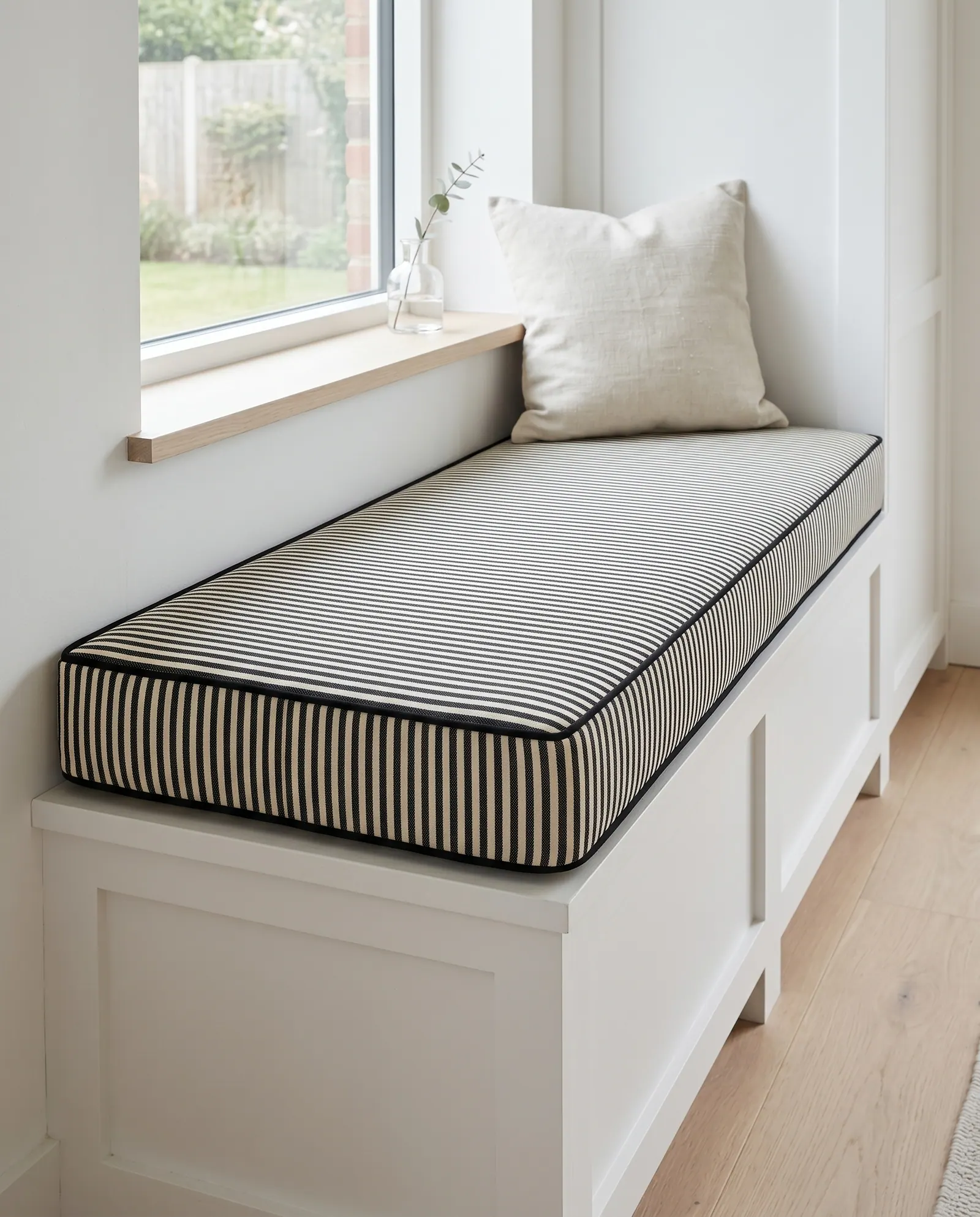
The layout is the classic one for banquette cushions: one long seat, two separate backs. Each back lifts out without disturbing the seat, which matters at a table where syrup happens. The stripes run front to back on the seat and upright on the backs, so they meet at the crease; more in which way stripes should run.
The props stick to natural textures: rattan in the pendant, eucalyptus in a stoneware vase, folded linen napkins, an oak table on an oak floor. All of it suits a striped cotton better than a sheen would.
The edge-and-shape checklist I'd pin above any banquette order: - Box edge on the seat, so the piping has a face to frame. - Separate backs, one per section of bench. - On a longer run, a third back rather than two stretched ones. - Seat depth equal to the bench, with no overhang at the front. - On a corner, two straight cushions meeting flush instead of one L.
What does your bench measure from the wall to the front edge, dear?
Five pins across seat, backs and light
Five pins, from the striped seat up to the rattan pendant, marking where the edge and the palette do their work.
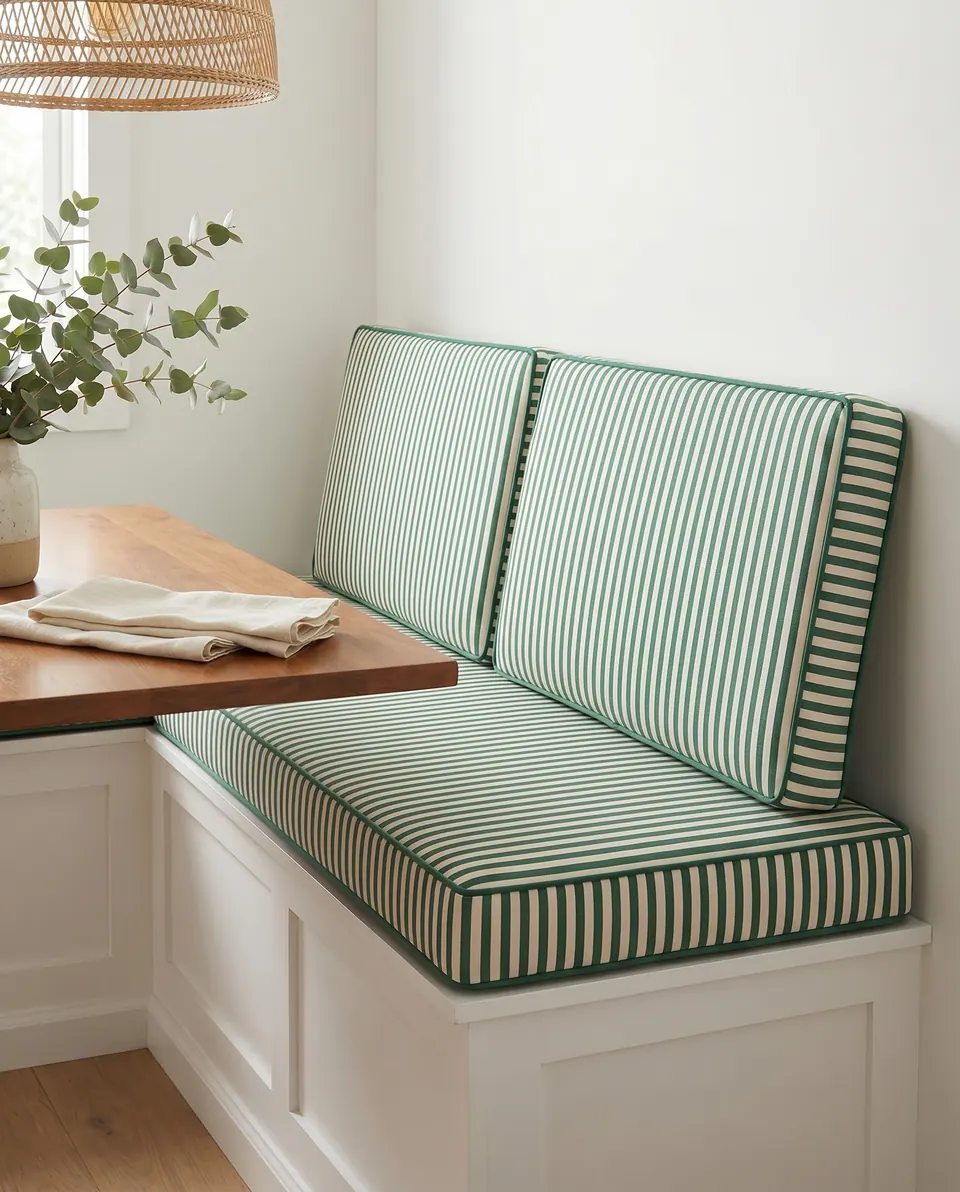
- Green stripe seat
One long seat with stripes running front to back.
- First back cushion
Separate backs lift out for cleaning without moving the seat.
- Solid green piping
A dark welt outlines the cushion against white panels.
- Rattan pendant
Woven light repeats the natural textures around the table.
- Eucalyptus stems
Gray-green leaves echo the stripe color.
- Green stripe seatOne long seat with stripes running front to back.
- First back cushionSeparate backs lift out for cleaning without moving the seat.
- Solid green pipingA dark welt outlines the cushion against white panels.
- Rattan pendantWoven light repeats the natural textures around the table.
- Eucalyptus stemsGray-green leaves echo the stripe color.
Samples first, then a corner in two straight pieces
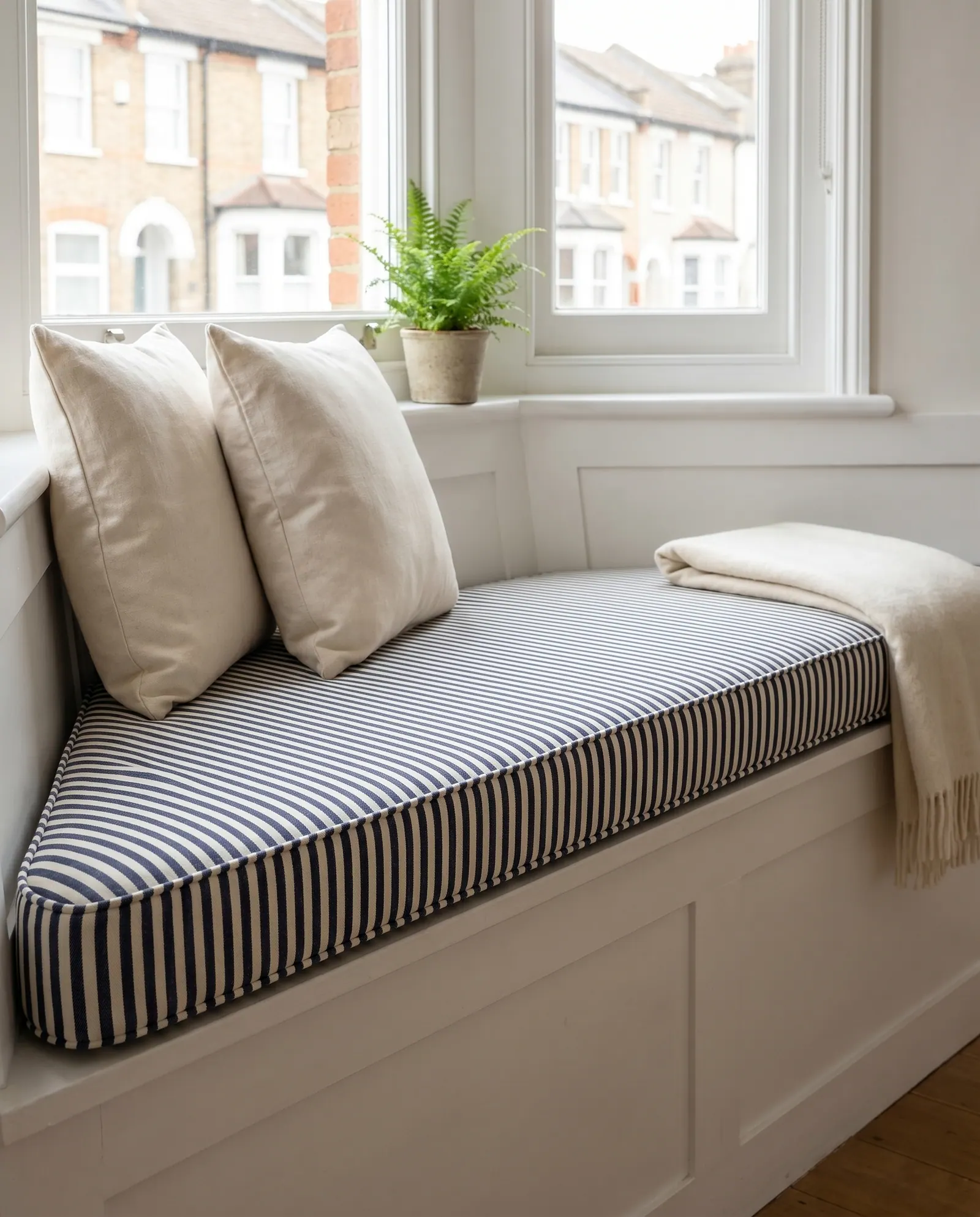
A buyer in the US ordered fabric samples first, which I always applaud. Then they asked for cushions on an L-shaped corner bench in striped fabric N05, about 3 in (8 cm) thick.
The workshop made it as two cushions meeting flush at the corner rather than one L-shaped piece. The final sizes were 16.5 x 62.4 in (42 x 158 cm) and 16.5 x 45.5 in (42 x 116 cm), ordered through the 17-20 x 61-63 in and 17-20 x 44-46 in size ranges with the exact numbers written in.
Two straight pieces cut square, their covers come off without a fight, and they butt together cleanly. For which piece runs into the corner, see corner joints on L-shaped cushions.
- Sizes
- 16.5 x 62.4 in and 16.5 x 45.5 in, about 3 in thick
- Fabric
- Striped fabric N05
The lesson: Split a corner bench into two butt-jointed cushions for easier covers and a cleaner fit.
Three edge-and-fit questions
- A common question
If the backrest sits on top of the seat cushion, how tall is the whole set?
The workshop's answerThe seat cushion is 4 in (10 cm) thick and the standard backrest 16 in (41 cm) high, so 20 in (51 cm) together. Backrest height can change (one was made 15 in high), and seat depth should suit the bench: 22 in rather than 24 in avoids a 2 in overhang.
- A common question
My bay window seat has three lids that flip up. One cushion or three?
The workshop's answerThree. Send clear photos and measurements, and the workshop recommends a separate cushion for each flip-up section so the cushions match the lids.
- A common question
Ties won't work around the hinges on my old cedar chest. How else can the cushion stay put?
The workshop's answerThe cushion can be cut to sit inside the lid's bevel, for example 42 x 18 in (107 x 46 cm), and a non-slip base helps in normal use. Honestly, when the lid lifts, the cushion can still slide and may stop the lid opening fully. That comes with any lifting lid.
On the cutting table: the green stripe banquette
| Layout | One long seat cushion with two separate back cushions |
|---|---|
| Fabric | Forest green and ivory stripe, striped cotton (code N20) |
| Piping | Contrast welt in solid forest green on every edge |
| Edge | Box edge with square corners |
| Stripe direction | Front to back on the seat, upright on the backs |
| Seat thickness | 4 in (10 cm) is the standard bench seat |
| Backrest | Standard 16 in (41 cm) high, adjustable to order |
| Best for | Built-in kitchen banquettes against white paneling |

Have it made
Have this made — ask Maggie’s workshop
Have the tape measure handy when they call. Old cushions shrink and sag; the seat underneath does not. — Maggie
Leave your details and the workshop will call you to confirm measurements, fabric, foam and piping. No prices, dates or payment on this page: it is a request, not an order.
Banquette back cushions made as separate pieces lift out for washing without moving the long seat; on a long run, add a third back instead of stretching two.
Maggie
Questions buyers ask next
Should banquette piping match the fabric or contrast with the bench?
Contrast with the bench. Solid forest green piping on a green and ivory stripe draws a clean outline against white paneling. Self piping in the pale ground color would melt into the white and hide the box edge that makes the set look tailored.
Which way should stripes run on a banquette seat and its backs?
On this bench the stripes run front to back on the seat and upright on the back cushions, so the lines meet at the crease where seat and back join. The whole banquette then reads as one piece of cloth.
How many back cushions does a long banquette need?
Enough that each stays in proportion. Two backs suit this bench; on a longer run, add a third rather than stretching two, so the cushion widths and the stripe spacing still look balanced from across the kitchen.
What does a box edge add to a kitchen bench cushion?
Structure. A box edge gives the cushion straight sides, square corners and a front face for the piping to frame, so it reads as upholstery rather than a pad. A knife edge tapers to a single seam and looks softer.
Stitch straight — Maggie
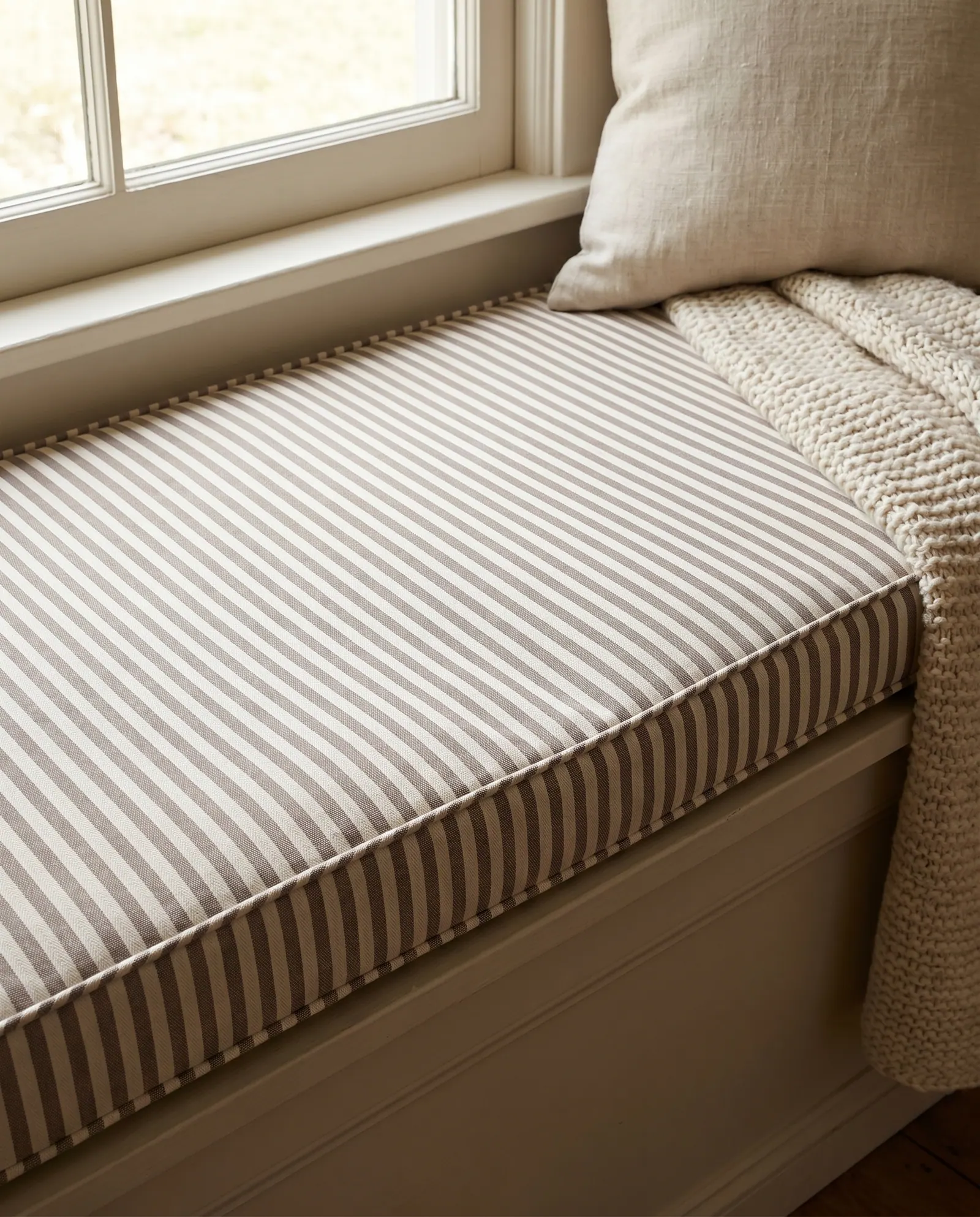
More stripes on window seats and benches
 Save
 Save
 Save
 Save
 Save
 Save