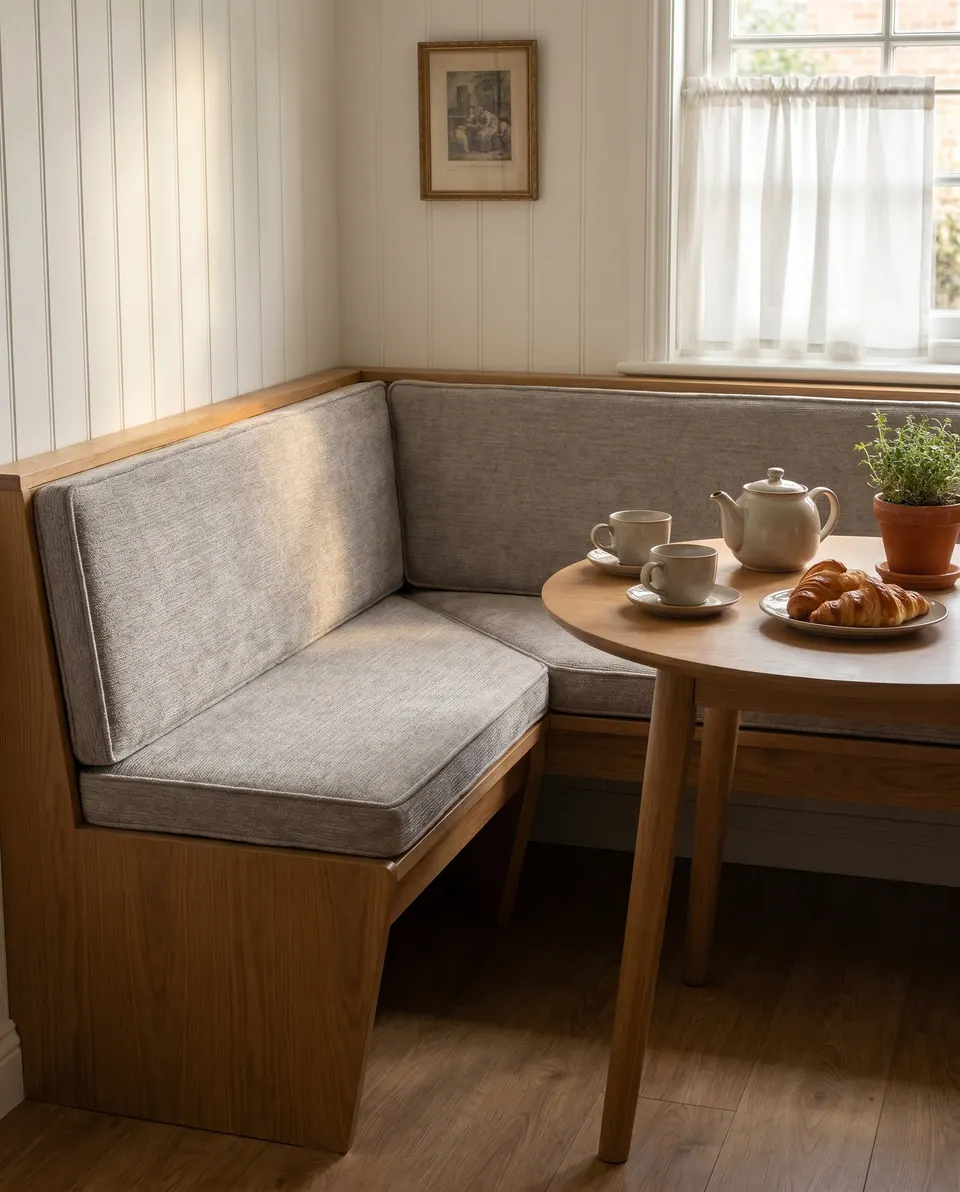
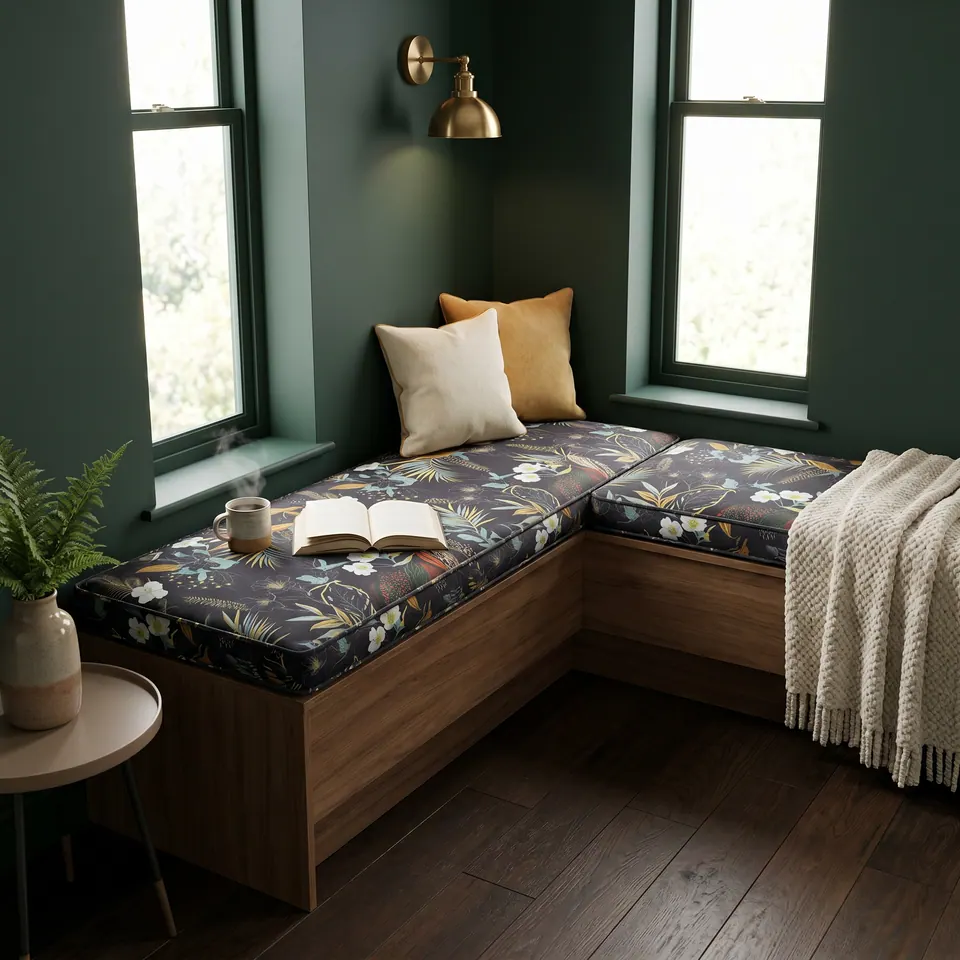
A Reading by NateL-Shaped Corner Bench Cushions
An oatmeal bouclé L-shaped bench cushion, and why the piping matches
Two cushions, one corner, three possible edge lines. Nate takes the piping decision apart on a tonal kitchen banquette around a round oak table.

 Save
The quick answer
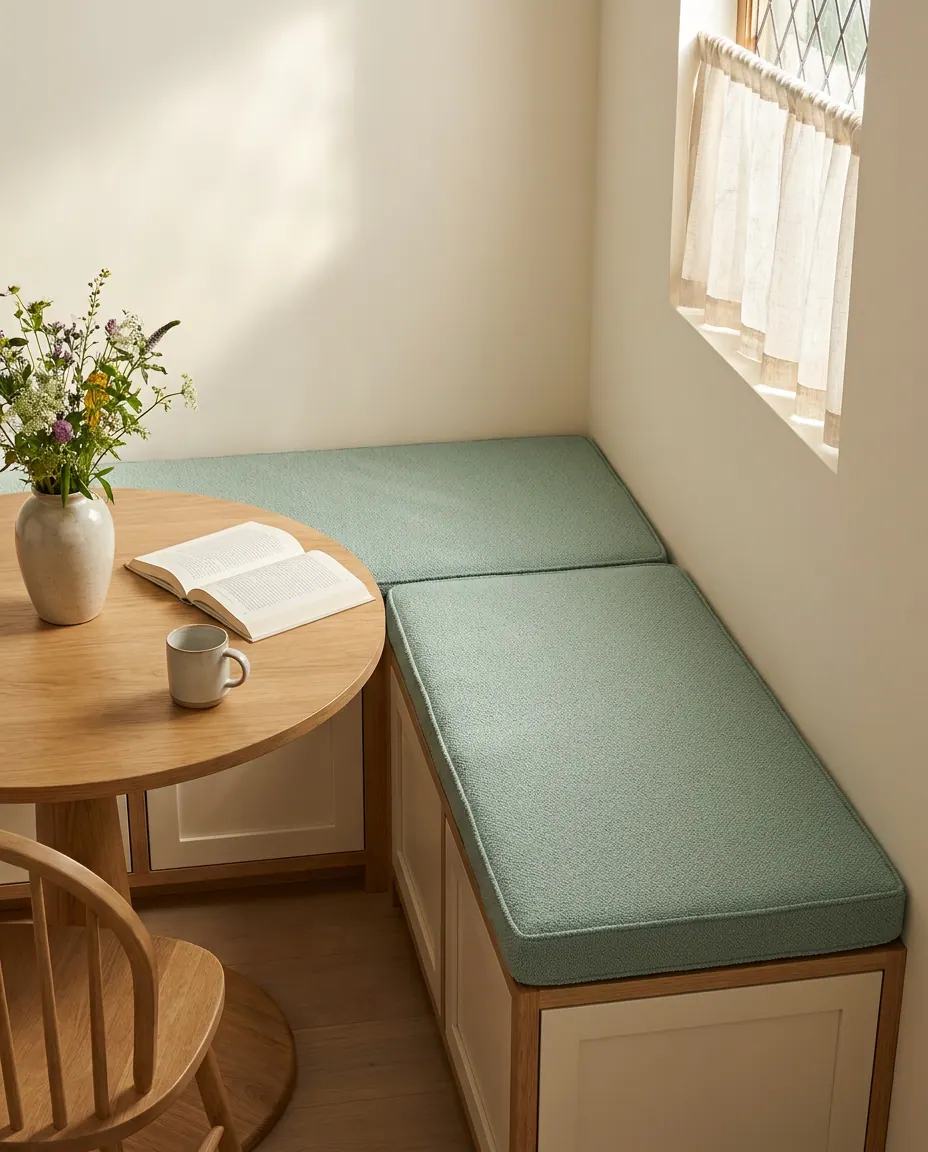
On an oatmeal bouclé L-shaped bench cushion, self piping is the right call: it keeps a soft, even edge, so the long run and the short return read as one block. Contrast piping would outline the corner joint and every lid split. Size the runs so one cushion owns the corner, and let a single chocolate lumbar be the dark accent.
The cushion, cut open
Cover fabric. A removable, zippered cover. Machine wash at 86°F (30°C) on a gentle cycle and air dry.
Piping. A fabric-covered cord sewn into the seams. It sits on the seam line, so it does not change the size.
Fiber wrap. Polyester fiber (Dacron) batting around the foam: it fills the cover out and softens the edges.
Foam core. About 2.0 lb/ft³ (32 kg/m³) high-resilience foam, firm to medium-firm, cut to the ordered size.
Zipper. Along the back band, as hidden as possible. The zipper side faces down or toward the wall.
Base panel. The underside of the cover. A non-slip fabric backing can cover the whole of it instead.
Three edge lines, one corner joint
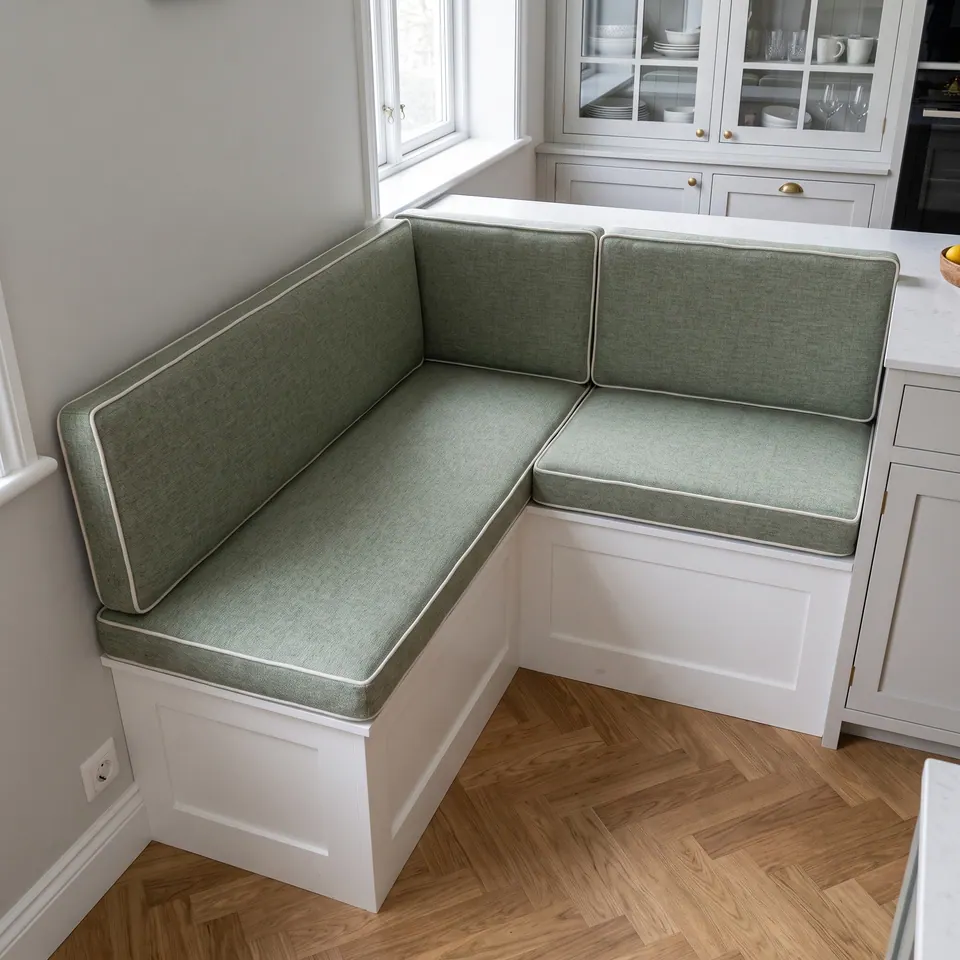
Two cushions meet in this corner: a long run and a short return. Each one lifts on its own to reach the storage below, so the joint between them is a working seam you will see every day. The piping decides how loudly it shows.
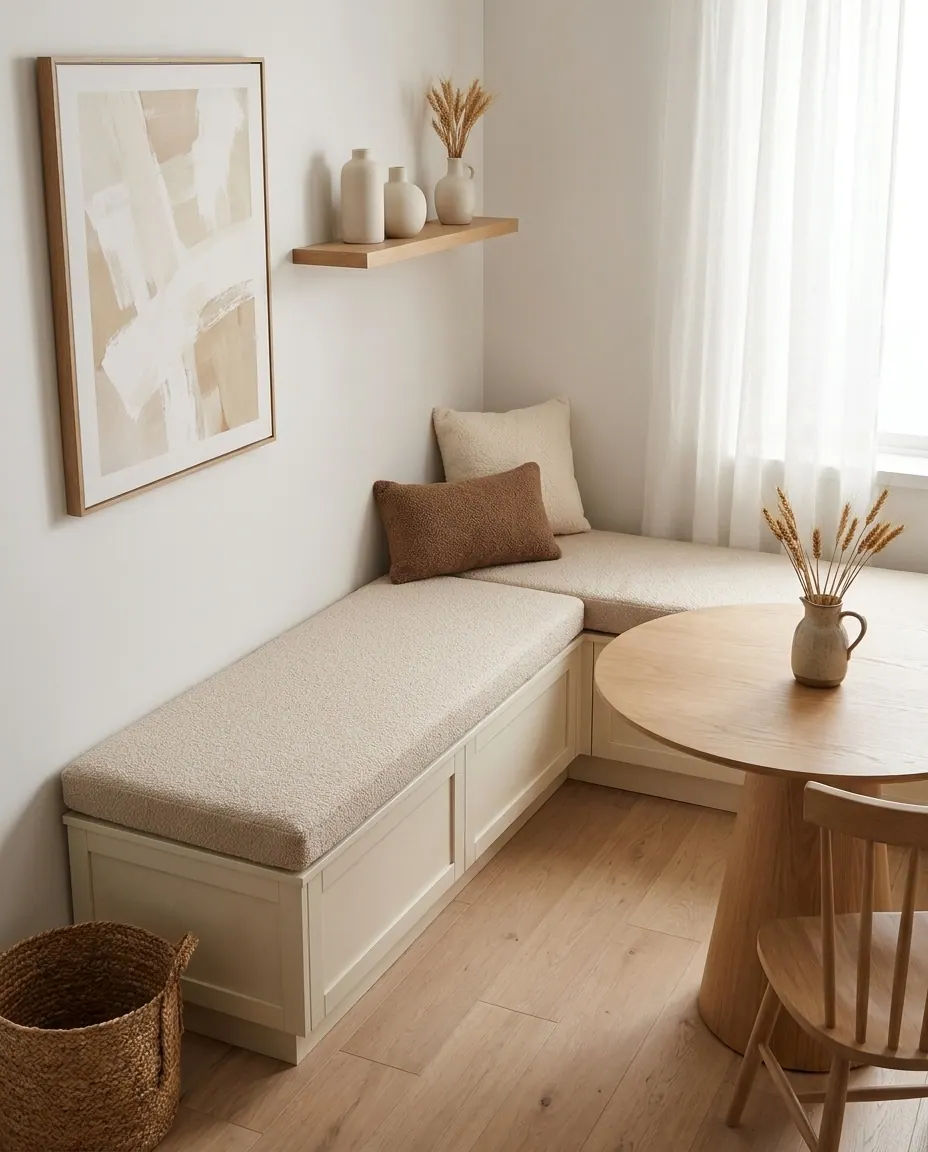
Here it is self piping, oatmeal on oatmeal. On bouclé that is a soft decision: the loops half-bury the welt, so the edge reads as a gentle rounded line rather than a drawn one. Oatmeal on a cream base is nearly tone on tone, and the banquette reads as one soft block.
Run the other two options through the same corner, partner. Contrast piping, say in chocolate, draws a dark rectangle around each cushion and a double line right at the joint. Handsome on a straight bench; on an L it advertises the split. No piping leaves the bouclé loops to define the edge on their own, and loops don't hold a crisp line.
The accent went somewhere better. One chocolate bouclé lumbar gives the eye a full stop in an all-neutral corner, beside a cream bouclé square. The round oak pedestal table leaves no sharp corner to squeeze past. Dried wheat in a ceramic jug ties oak to oatmeal, the spindle-back chair and beige artwork stay pale, and the wicker basket adds texture at floor level without adding color.
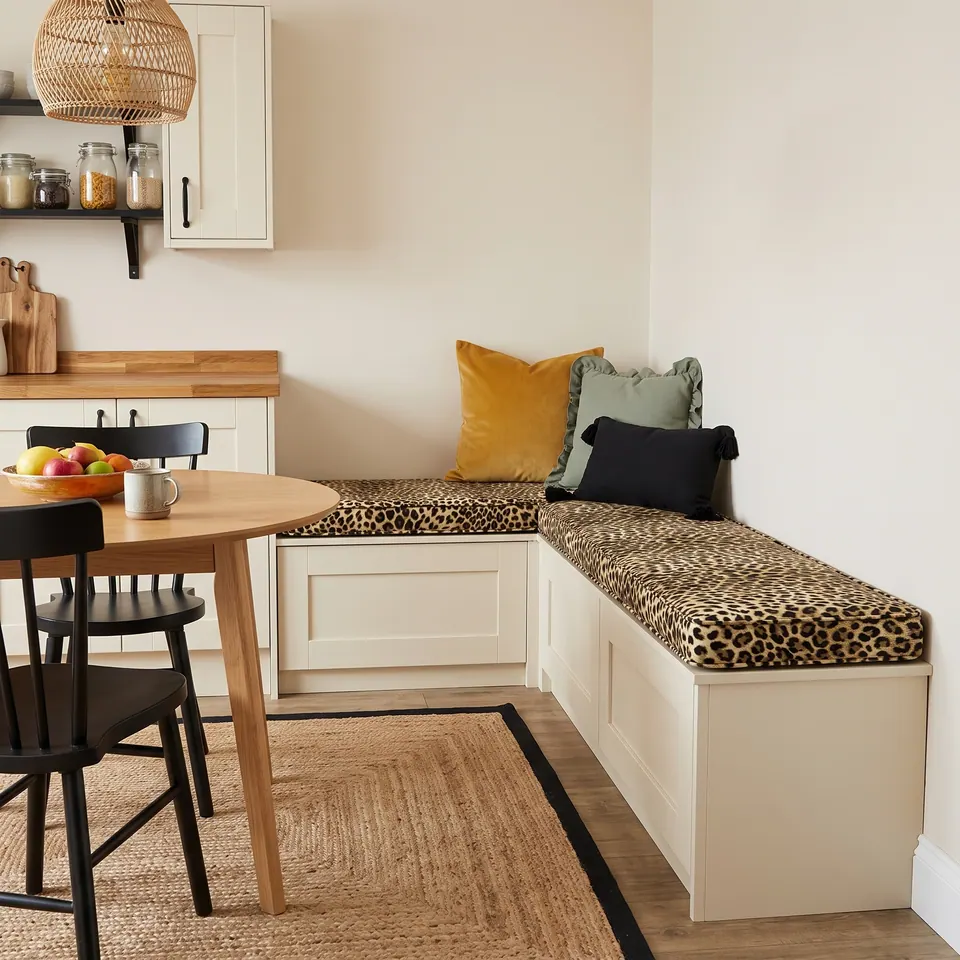
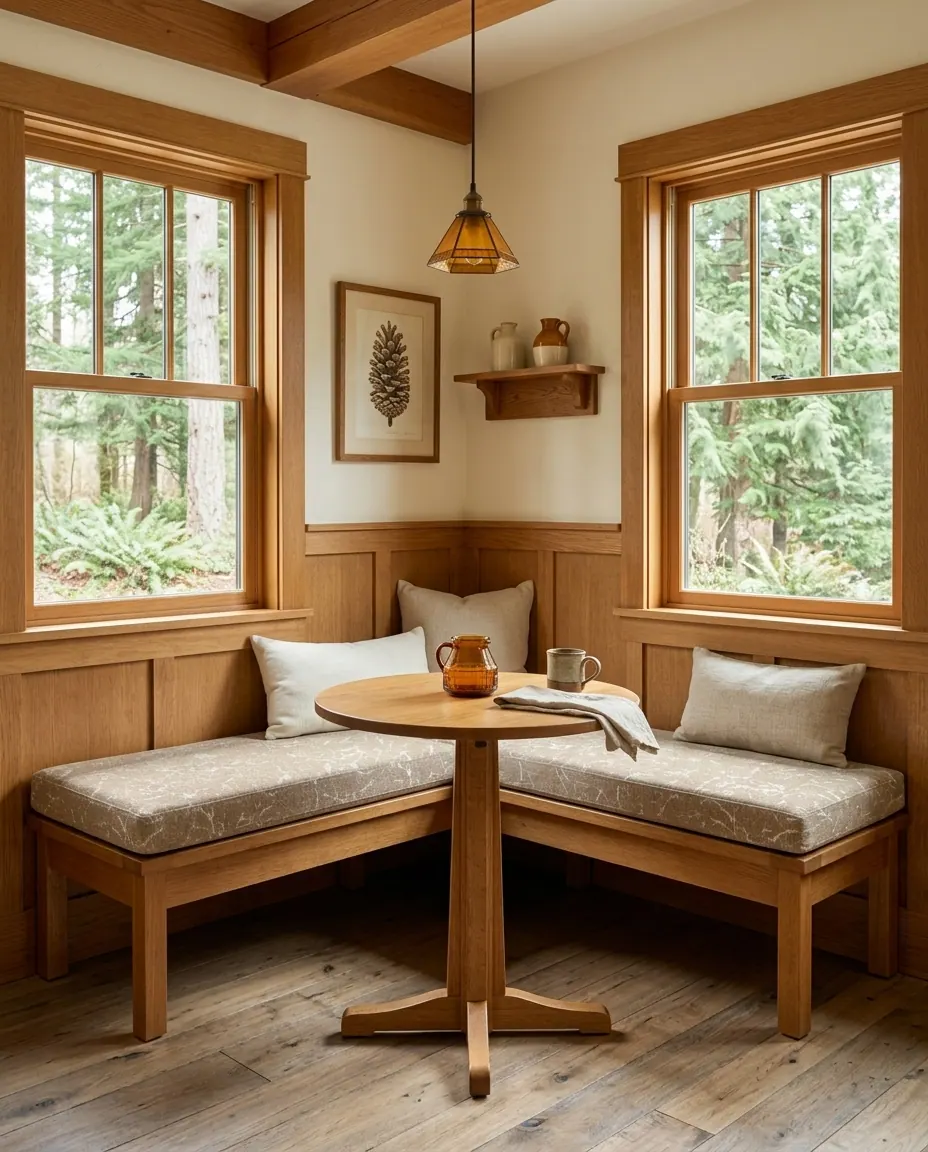
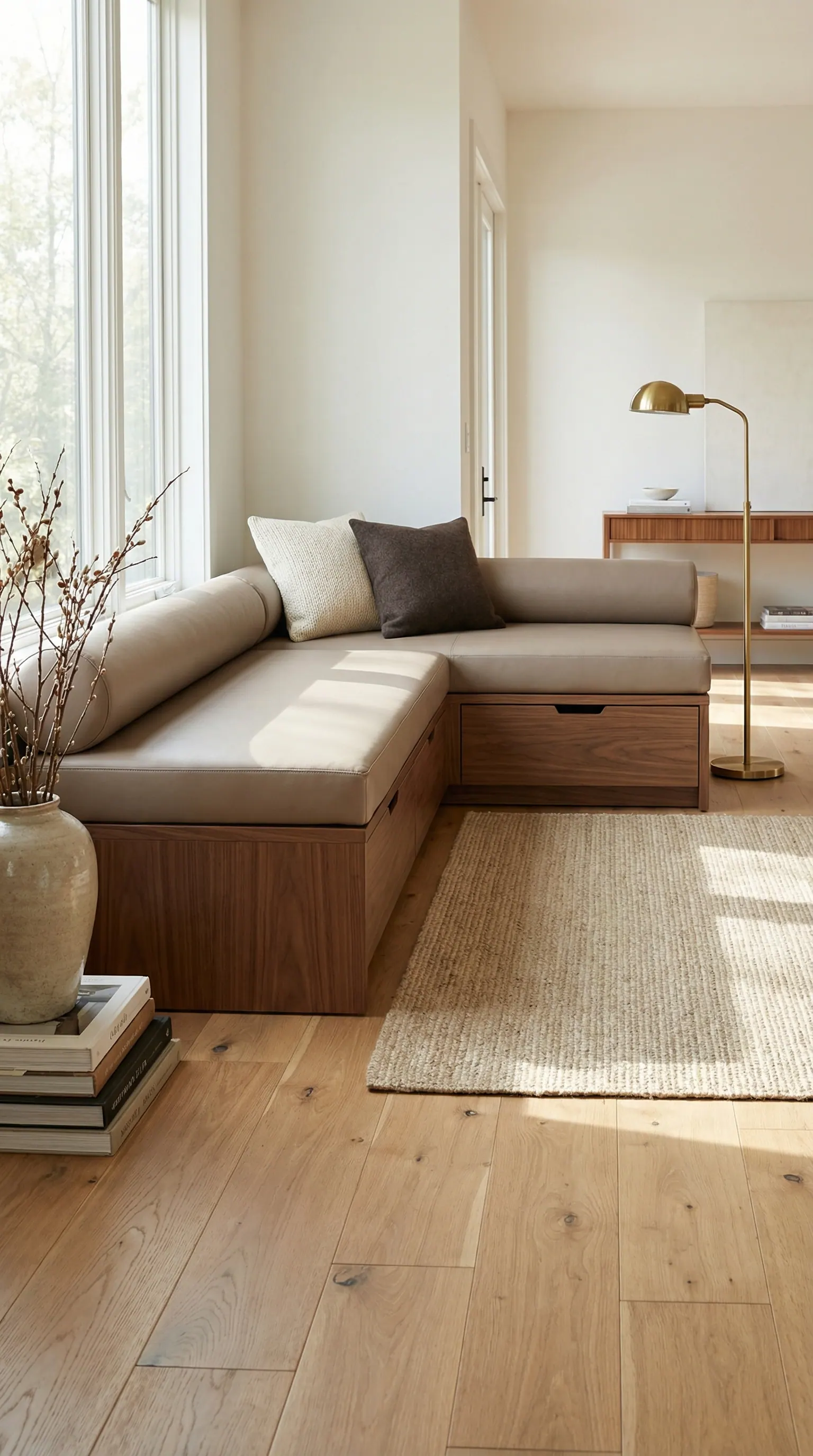
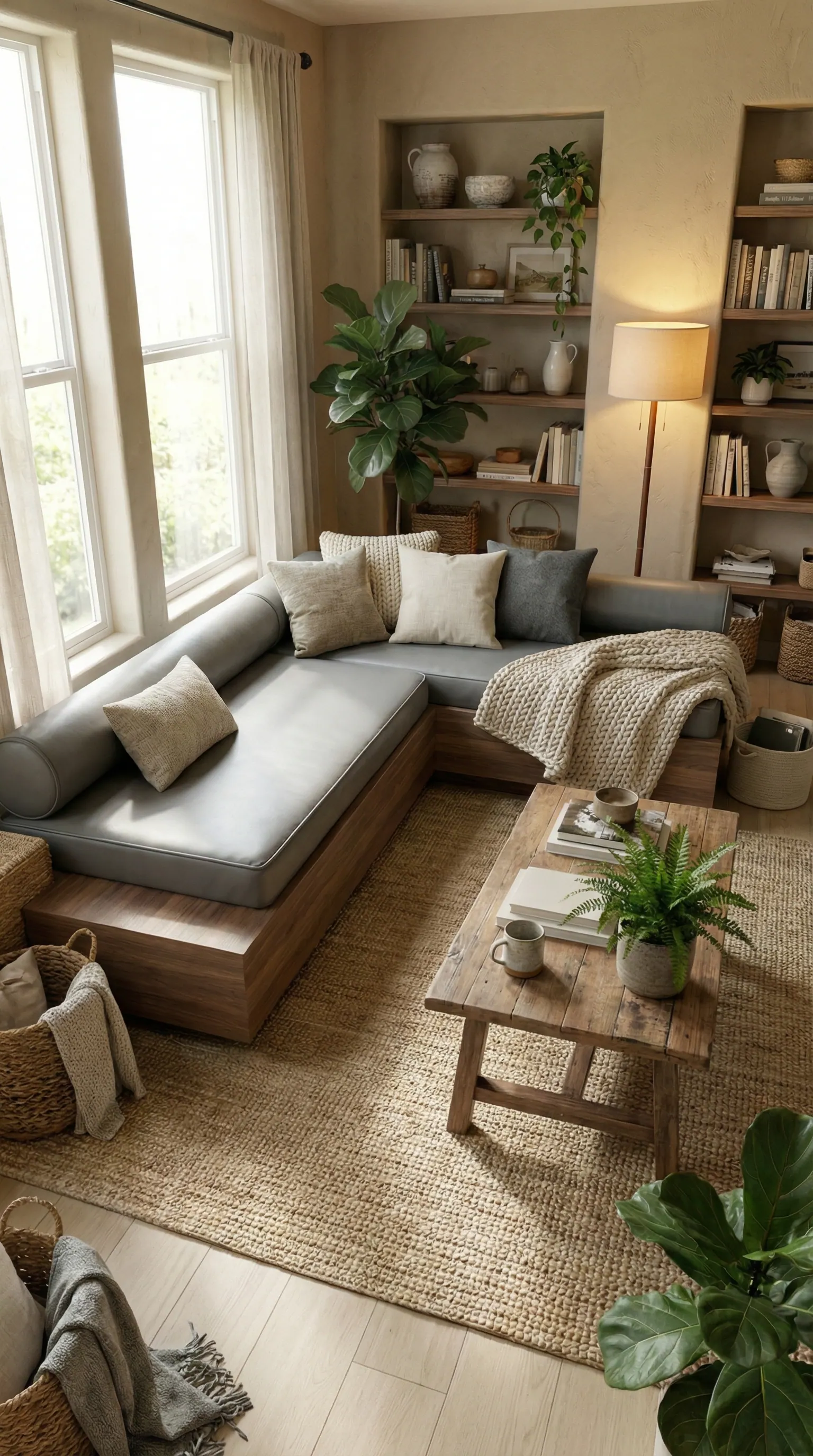
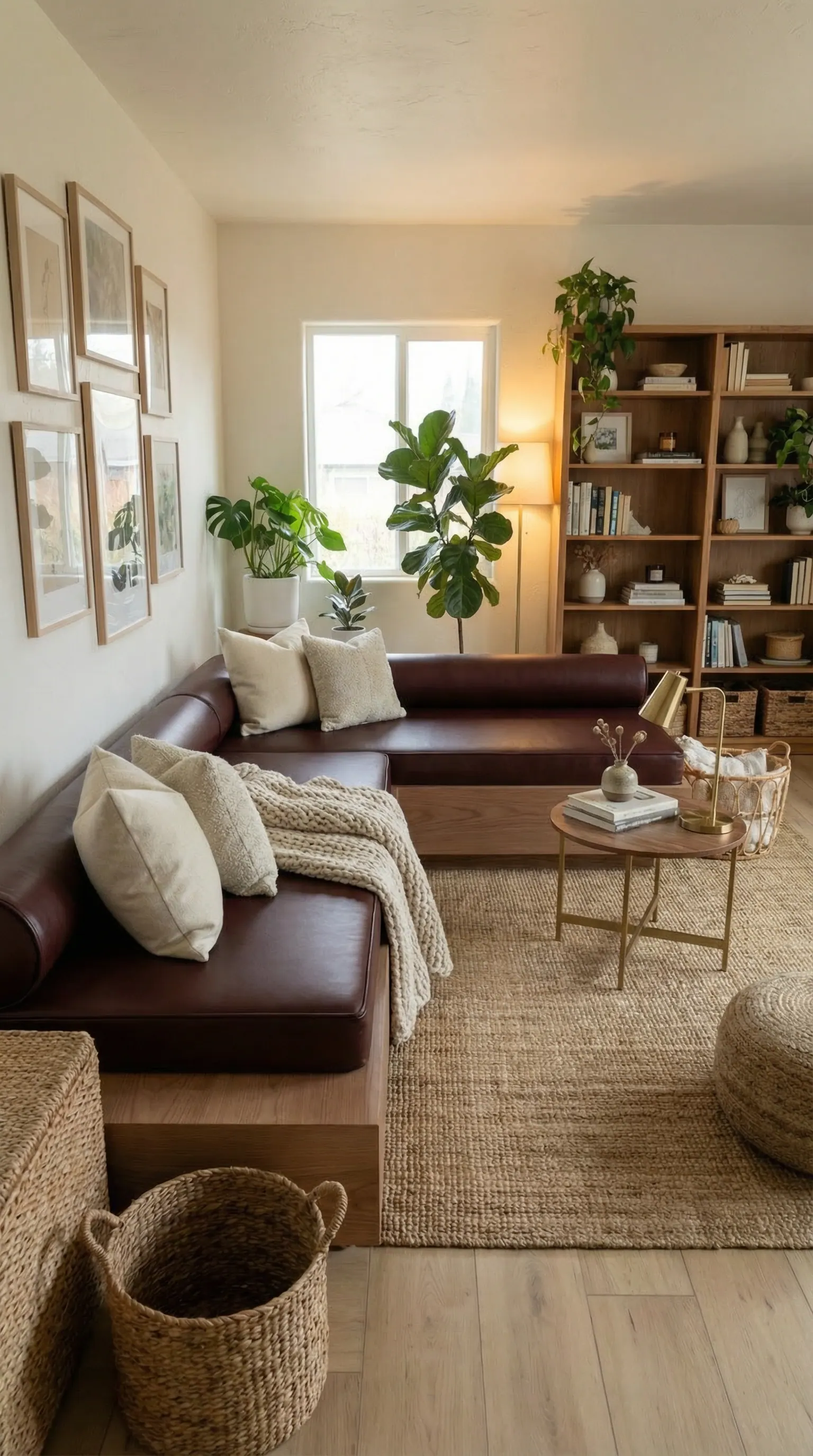
The gallery runs the same test in taupe, dove gray and oxblood brown; on the oxblood bench a pale welt would shout loudest of all. For the full decision, see piping: matching, contrast or none and which piece owns the corner. More corners live among L-shaped bench cushions, and the cloth sits with bouclé and teddy.
Self, contrast or none on an L-shaped bouclé bench
| Edge | At the corner joint | On bouclé | Verdict here |
|---|---|---|---|
| Self piping | The joint reads as one soft line | Loops half-bury the welt | Chosen |
| Contrast piping | Outlines both cushions and doubles the line at the split | Crisp, but loud in a tonal scheme | Save it for straight runs |
| No piping | The joint depends on the cut alone | Loops blur the edge | Too soft for a box edge |
Pinned by Nate: five parts of the corner
Five pins, from the long oatmeal run and the short return to the wicker basket on the floor.
- Oatmeal long cushion
Oatmeal bouclé blends with the cream base so the banquette reads as one soft block.
- Short return cushion
The return cushion is separate, so each piece lifts to reach the storage below.
- Chocolate lumbar
One chocolate pillow gives the eye a dark anchor in an all-neutral corner.
- Wheat in a jug
Dried wheat on the table ties the oak and oatmeal together.
- Wicker basket
A woven basket adds texture at floor level without adding color.
- Oatmeal long cushionOatmeal bouclé blends with the cream base so the banquette reads as one soft block.
- Short return cushionThe return cushion is separate, so each piece lifts to reach the storage below.
- Chocolate lumbarOne chocolate pillow gives the eye a dark anchor in an all-neutral corner.
- Wheat in a jugDried wheat on the table ties the oak and oatmeal together.
- Wicker basketA woven basket adds texture at floor level without adding color.
An L that doubles as a bed: 6 in seats, 5 in backs
A buyer in the US designed a small L-shaped couch for sitting and sleeping, with backrests on the two outer edges. That meant one seat had to run longer to cover the corner.
The numbers: seats at 78 x 31 x 6 in (198 x 79 x 15 cm) and 24 x 26 x 6 in (61 x 66 x 15 cm); backs at 78 x 18 x 5 in (198 x 46 x 13 cm) and 55 x 18 x 5 in (140 x 46 x 13 cm). They chose 6 in seats so the couch would last and could double as a bed. The shop took it on as a custom order.
The rule it proves: in an L, one run overlaps the corner, so one seat is sized longer than its wall. The L-shaped measuring guide shows how to measure both runs.
Buyer questions: mitered corners, tufted backs and bay depth
- A common question
My banquette cushions meet at a 45-degree angle in the corner. Can I just mention that in the notes?
The workshop's answerNo. Once cut on the diagonal, the cushions are trapezoids, which changes the listing and raises the price slightly. Order through the trapezoid listing, pick the size range by each cushion's longest and deepest measurements, and upload a drawing with every edge measured, the 45-degree cut included.
- A common question
On the French-style tufted bench cushion, how big is the back cushion, and do the backrest and armrests come off?
The workshop's answerThey come with the seat. For a 24 x 48 in (61 x 122 cm) seat, the backrest is 16 x 48 in (41 x 122 cm). The pieces aren't attached to each other or to the base, so the backrest can lie flat and the armrests move around like pillows. Being tufted, their covers don't zip off.
- A common question
How do I enter depth and length for a bay window cushion on the trapezoid listing?
The workshop's answerFor depth, measure straight from the short angled sections to the long edge. For length, enter the total between the outer corners of the angled sections. Then upload the two requested images, a photo and a drawing, and that is everything needed.
On the cutting table: the oatmeal banquette
| Product | Two-piece L-shaped bench cushion: long run plus short return |
|---|---|
| Fabric | Oatmeal bouclé |
| Piping | Self piping |
| Edge | Box edge |
| Base | Cream L-shaped storage banquette with lift-up lids |
| Corner | Separate cushions, so each lid opens on its own |
| Accent | One chocolate bouclé lumbar |
| Care | Choose a zippered cover; dining seats get washed most |
| Best for | Kitchen nooks around a round pedestal table |

Have it made
Have this made — ask Nate’s workshop
Send the numbers in inches: length × depth × thickness, plus any angle. The workshop checks them with you, because foam has no undo button. — Nate
Leave your details and the workshop will call you to confirm measurements, fabric, foam and piping. No prices, dates or payment on this page: it is a request, not an order.
On an L-shaped bench cushion, contrast piping outlines every split; self piping lets the long run and the short return read as one soft block.
Nate
Questions buyers ask next
Does contrast piping suit an oatmeal bouclé corner banquette?
It can, but on an L it outlines both cushions and doubles the line at the corner joint. On a tonal scheme like oatmeal on cream, self piping keeps the banquette reading as one block and leaves the accent to a single dark pillow.
Why make an L-shaped storage banquette cushion in two pieces?
So each lid can open on its own. With a long run and a short return, you lift only the cushion over the storage you need, and the other piece stays put. Size the runs so one cushion owns the corner.
Why does a round pedestal table suit an L-shaped banquette?
A round top leaves no sharp corner to squeeze past as you slide onto the bench, and a single pedestal keeps legs out of the way. It also softens a corner full of straight cushion edges and box welts.
± 1/4 in — Nate
More photographs to read
 Save
 Save
 Save