A Reading by MaggieDining Chair Cushions & Pads
The green stripe hall chair cushion: finishing details that make it look tailored
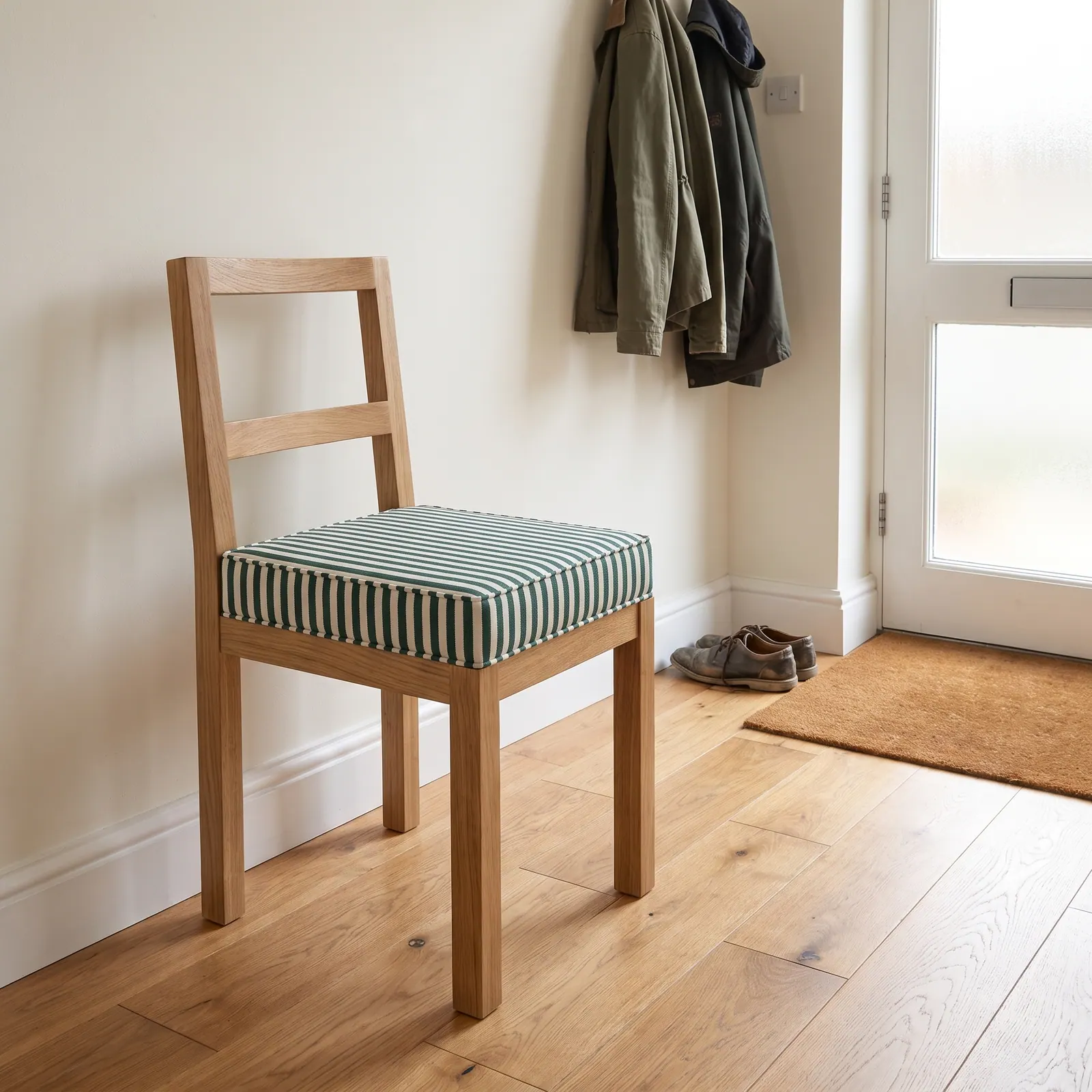
One oak chair, one forest green stripe, a coir mat and somebody's boots. I read this photograph the way I would inspect a finished cushion: corners first.

 Save
The quick answer
A chair cushion looks tailored when the stripe is centered, runs front to back and carries straight over the box edge, and when the piping stays straight at every corner. This green and white box cushion fits snugly between the chair's rails, so it needs no ties; add ties at the corners or two at the back if yours slides.
The cushion, cut open
Cover fabric. A removable, zippered cover. Machine wash at 86°F (30°C) on a gentle cycle and air dry.
Piping. A fabric-covered cord sewn into the seams. It sits on the seam line, so it does not change the size.
Fiber wrap. Polyester fiber (Dacron) batting around the foam: it fills the cover out and softens the edges.
Foam core. About 2.0 lb/ft³ (32 kg/m³) high-resilience foam, firm to medium-firm, cut to the ordered size.
Zipper. Along the back band, as hidden as possible. The zipper side faces down or toward the wall.
Base panel. The underside of the cover. A non-slip fabric backing can cover the whole of it instead.
Read it from the corners in
A plain oak hall chair, a thick box cushion in forest green and white, and a pair of leather lace-ups waiting by the door. Nothing in this entrance hall is trying hard, which is exactly why the stripe works.
Start at the corners, where the craft shows. The self piping runs in a clean line around the top of the box, with no ripple where it turns. A straight welt is a kind of honesty: it tells you the cover was cut square and never stretched to fit.
Now the stripe. It runs front to back across the seat, so from the doorway the front face of the box shows bold vertical bands. Wide bands read at a distance; a pinstripe would blur to one green from the front door. The light helps, too. Flat daylight through the frosted glass door shows every band cleanly, with no glare.
The props explain the job. Olive and navy coats on the hooks echo the green, the shoes say this is where boots get laced, and the coir mat and oak planks keep the floor warm and practical. For a hall or mudroom seat, that is all the styling a chair needs.
This cushion has no ties at all, dear. It is cut to sit snugly between the chair's rails, and a snug box stays put on its own. If your chair has an open seat and the cushion wanders, ties at the corners or two at the back solve it; see tie placement for chairs.
Pinned by Maggie: five clues by the front door
Five pins mark the striped front face, the coats, the shoes, the coir mat and the frosted door that lights it all.
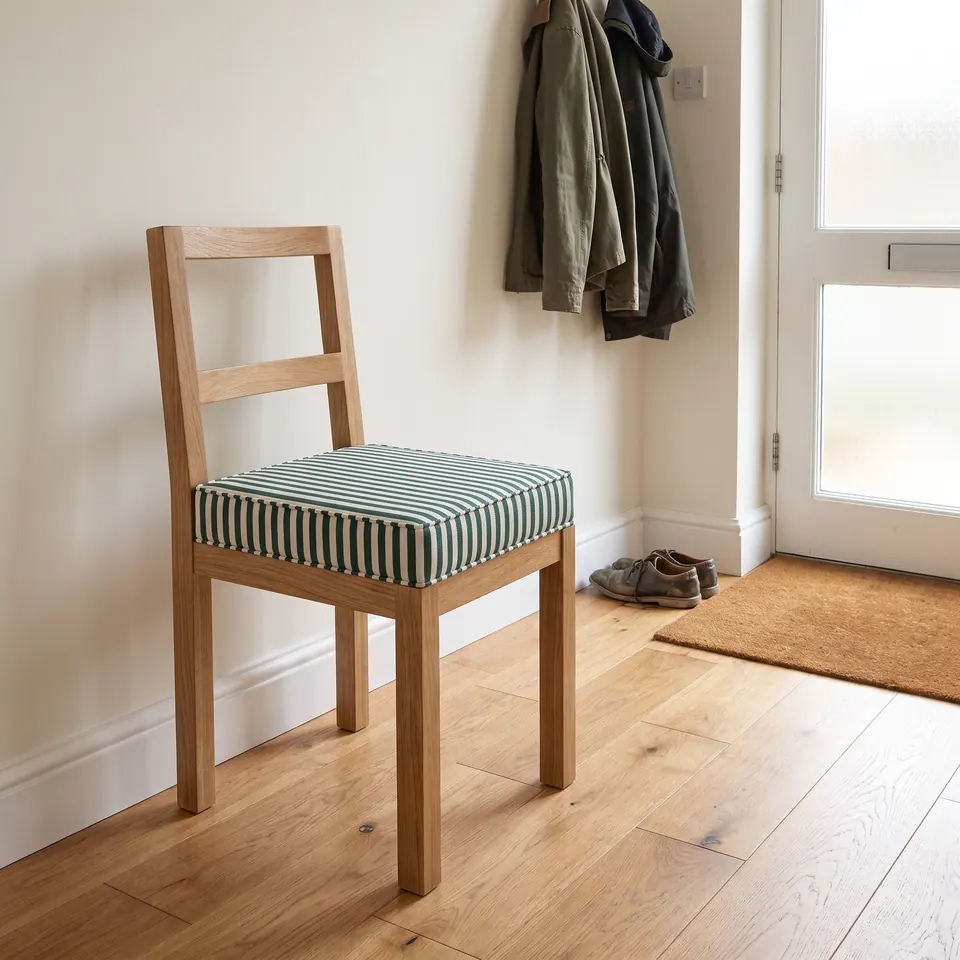
- Striped front face
Stripes run front to back, so the front face shows bold vertical bands from the doorway.
- Coats on hooks
Olive coats echo the green stripe and explain the chair's job.
- Leather shoes
Shoes by the door make this a seat for lacing boots.
- Coir doormat
Natural coir keeps the floor warm-toned and practical.
- Frosted front door
Diffused light through the glass lets the stripe read clearly.
- Striped front faceStripes run front to back, so the front face shows bold vertical bands from the doorway.
- Coats on hooksOlive coats echo the green stripe and explain the chair's job.
- Leather shoesShoes by the door make this a seat for lacing boots.
- Coir doormatNatural coir keeps the floor warm-toned and practical.
- Frosted front doorDiffused light through the glass lets the stripe read clearly.
Four finishing details to check on any striped chair cushion
- The stripe is centered on the seat, not a band short on one side.
- The bands carry straight from the top panel over the box edge onto the front face.
- The piping lies flat at every corner, with no pucker where it turns.
- The box wall is the same height all the way around, so the cushion sits level between the rails.
Six numbers for a spindle-back seat
A buyer in the US wanted pads for spindle-back designer dining chairs, the kind whose seat narrows at the back and swells in the middle. To copy the shape, the workshop drew three horizontal and three vertical lines on the buyer's photo and asked for a measurement along each.
Back came the numbers: back width at the spindles 14.5 in (37 cm), widest width 17 in (43 cm), front width 14 in (36 cm), and depths at left, center and right of 14.5, 15.5 and 13.5 in (37, 39 and 34 cm). With six numbers, the shaped pad could be cut accurately.
I will confess I once cut a chair pad from one width and one depth. It fit the way a borrowed coat fits. A shaped seat needs at least three widths and three depths, and our dining chair pad measuring notes and the chair cushion builder walk you through them. How many widths does your chair have?
Buyer questions: curves, mixed fabrics and ties
- A common question
My chair seat is rounded at the back and dips a little. Can you make a horseshoe-shaped cushion?
The workshop's answerYes, a curved edge can be made. For a horseshoe shape the workshop needs a clear drawing with the width, the depth, where the curve starts and ends on each side, and how deep the curve runs, plus a photo of the chair. The shape is confirmed with you before you order.
- A common question
Could I pair a tough outdoor fabric with velvet piping on my dining chair cushions?
The workshop's answerIt can be made, but the workshop advises against mixing an outdoor and an indoor fabric on one cushion. If durability is the goal, it recommends indoor fabrics that stand up to heavy use instead.
- A common question
Can I get ties on my chair cushions?
The workshop's answerYes. Ties can go on the corners, or two on the back for chair pads. Mention it in the personalization box when you order.
On the cutting table: the hall chair cushion
| Product | Box chair cushion for a plain oak hall chair |
|---|---|
| Fabric | Striped cotton, forest green and white, wide awning-style bands |
| Stripe direction | Front to back across the seat |
| Edge | Box edge, thick and even |
| Piping | Self piping in the same stripe |
| Fastening | None; cut to sit snugly between the rails |
| Light | Flat daylight through a frosted glass door |
| Best for | Pulling on boots in a mudroom or entry hall |

Have it made
Have this made — ask Maggie’s workshop
I once cut a lovely cushion two inches short, and I have not forgotten it. That is why the workshop goes over your measurements with you on the phone. — Maggie
Leave your details and the workshop will call you to confirm measurements, fabric, foam and piping. No prices, dates or payment on this page: it is a request, not an order.
A striped chair cushion looks tailored when the stripe runs front to back and carries straight over the box edge, with no jog at the piping.
Maggie
Questions buyers ask next
Does a box cushion on a hall chair need ties?
Not always. A thick box cushion cut to fit snugly between the chair's rails stays put on its own, as on this oak hall chair. If your seat has no rails, or the cushion slides when you stand, add ties.
Should the stripe on a chair pad run side to side or front to back?
Front to back, for a chair seen from a doorway. The bands then show as bold vertical lines on the front face of the box, which read clearly from across a hall or mudroom.
How wide should stripes be on a cushion seen from across a room?
Wide enough to hold their shape at a distance. Awning-style bands like this forest green read from the front door; a fine pinstripe blurs into a single tone once you step back a few paces.
Is striped cotton a sensible choice for a mudroom chair?
It is handsome, but the striped fabrics are 100% cotton and stain more easily than the linen, soft or velvet ranges. Use it where clothes are dry, or choose an easy-clean range for wet boots and coats.
Stitch straight — Maggie