 Save
- Back cushion pair
Two backs divide the bench into seats like a sofa.
- Seat module
Separate seats can each be flipped and dried.
- Ties over stone
Masonry gives no grip, so ties drop over the stone edge.
- Limestone cap
Rough stone shows under the cushions as a warm border.
- Olive tree
Olive leaves echo the deep green fabric.
Plate Forest Green Cushions on a Stone-Topped Masonry Bench
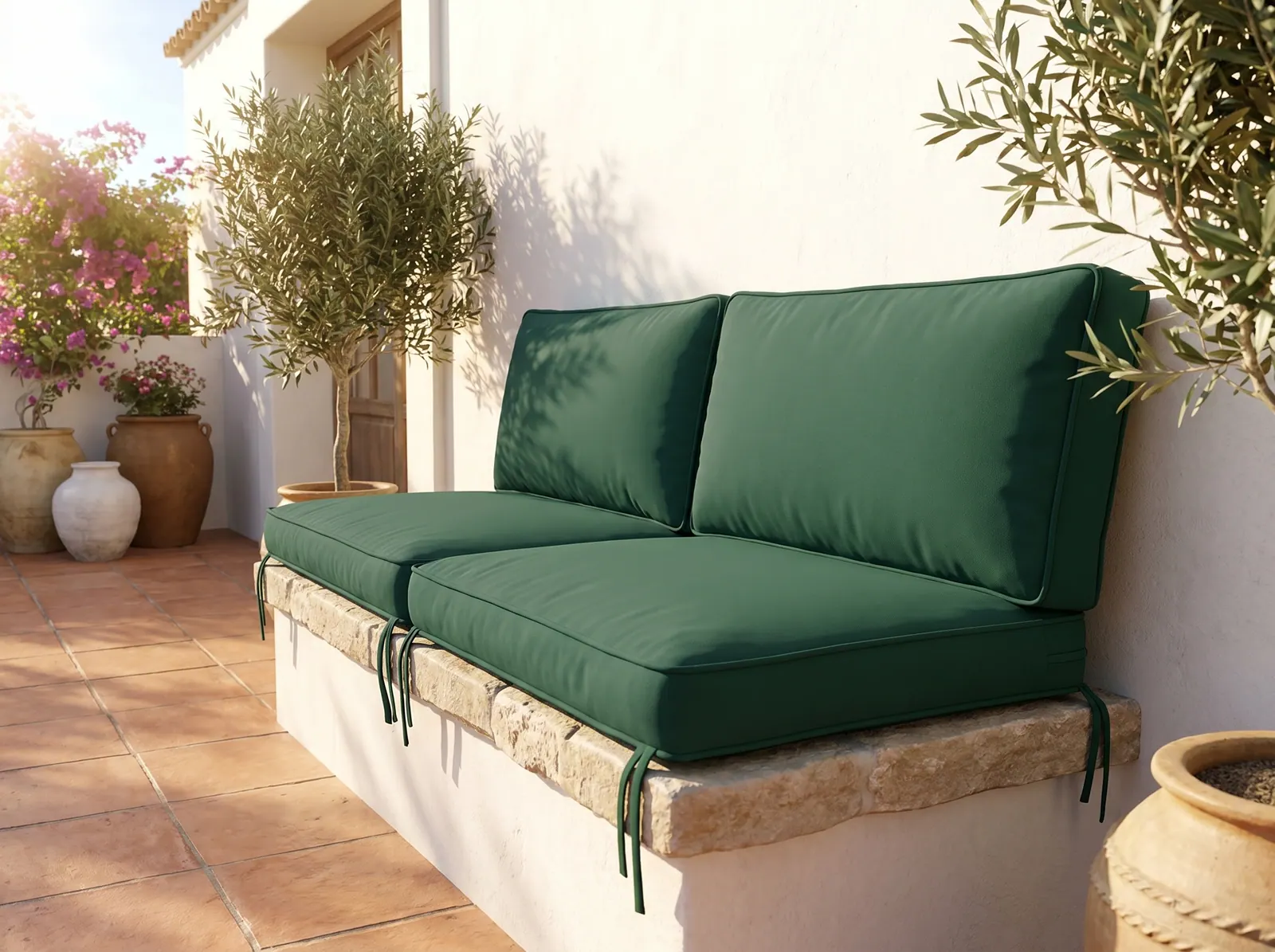
Two pairs of forest green seat and back cushions turn a built-in masonry bench into outdoor seating on a whitewashed terrace.
A Reading by CallumBench Cushions
Forest green on white masonry, seen from ten feet and from ten inches
Stand in the terrace doorway and you see two things: green and white. Walk up close and you see ties, welts and rough stone. Both views have a job to do.
The quick answer
On a long masonry bench, split the cushions into equal seat and back modules and tie them over the stone edge, because masonry gives a cushion nothing to grip. Forest green outdoor fabric keeps a clear edge against white render in hard sun, and each module lifts off to flip and dry on its own after rain.
Pinned by Callum: five marks on the terrace
Five pins: the pair of backs, a seat module, the ties over the stone, the limestone cap and the olive tree that set the color.
The numbers match the pins on the plate.
- Back cushion pairTwo backs divide the bench into seats like a sofa.
- Seat moduleSeparate seats can each be flipped and dried.
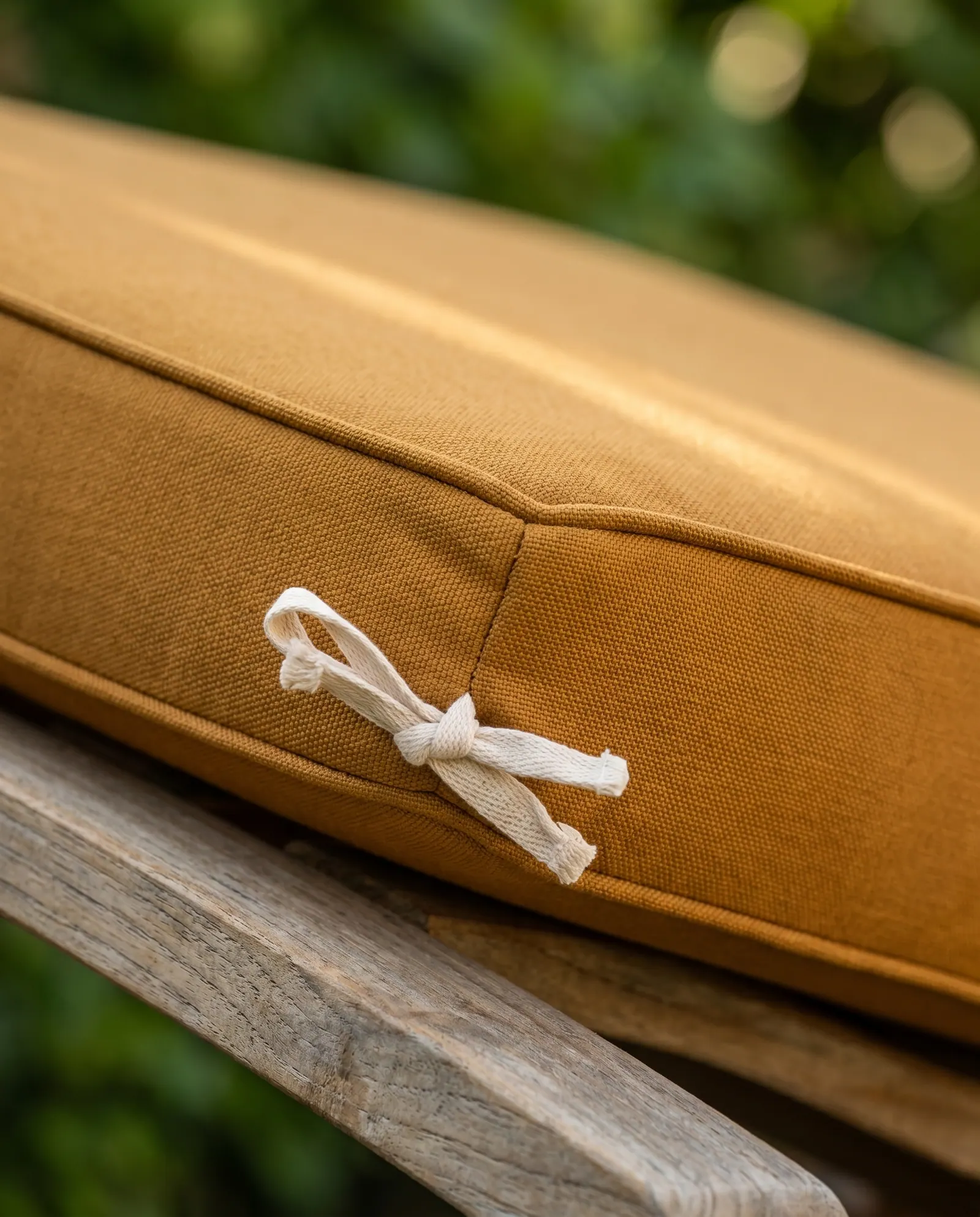
- Ties over stoneMasonry gives no grip, so ties drop over the stone edge.
- Limestone capRough stone shows under the cushions as a warm border.
- Olive treeOlive leaves echo the deep green fabric.
The ten-foot view: a green top on a white block
From the doorway the bench is a white block with a green top. That is the whole read, and it is a good one.
Forest green is dark enough to hold its outline against whitewash at noon. A pale cushion would bleach into the wall in that light; this one keeps an edge. The potted olive carries the same green up the corner, and the bougainvillea gives the eye one hot color to land on.
The second thing ten feet shows you is rhythm. Two backs, two seats. The bench stops being a ledge and starts looking like a sofa with places in it. People sit where the joins tell them to.
The clay urns and the white vase stand at the end like mooring posts. Terracotta tiles repeat the warm limestone. There is nothing on the seats but cushion, and out here that is sense before style. Rain doesn't negotiate, and every extra pillow is one more thing to carry in when the sky turns.
So the fabric comes from the outdoor acrylic family, and the rest of the build is about edges. How long is your bench, end to end? Put it into the bench cushion builder and see how the modules fall.
The ten-inch view: what only shows up close
| Detail | From ten feet | From ten inches |
|---|---|---|
| Self piping | Disappears into the green | A firm line that keeps the box edge square |
| Ties | Invisible | Dropped over the stone edge, the only grip on offer |
| Limestone cap | A warm border under the green | Rough stone that would let a loose cushion wander |
| Module joins | Two places to sit | Each seat lifts off to flip and dry alone |
| Olive leaves | A green echo up the wall | Gray-green, a lighter cousin of the fabric |
Fourteen feet of built-in sofa, two cushions
A buyer messaged the workshop about a built-in sofa bench 173 in (440 cm) long and 23 in (58 cm) deep. They didn't want one cushion that length, and I don't blame them: that is a sail, not a seat. They asked for two cushions of about 86 1/2 in (220 cm) each, from the linen bench cushion range, and that is how the workshop made them.
Same thinking as the terrace here. Two equal pieces meet in the middle, each light enough for one person to carry, turn and set back square. When weather rolls in, friend, you carry in two manageable pieces instead of wrestling one long one. Our Pattern on one piece or two runs the numbers, and ties and non-slip bases covers the grip. More outdoor builds sit under patio and porch cushions.
Buyer questions: long seats, stripes and a set of three
- A common question
My bench runs almost 111 inches. Can the seat cushion be one piece?
The workshop's answerFor a seat of 111 in (2.83 m), the workshop recommended two separate pieces for durability and easier handling. Another bench, 111 in (282 cm) in total, was made as two 55 in (140 cm) cushions. A one-piece 98 in (2.5 m) banquette seat has also been made when a buyer asked for it.
- A common question
On a long striped cushion, which way will the stripes run?
The workshop's answerAcross the cushion. The fabric is 55 in (140 cm) wide, so long cushions get horizontal stripes by default. Vertical stripes on a 92 in (234 cm) cushion would need two pieces joined with a seam; for one buyer the shop offered to share that cost and add a bolster over the join. If a stripe is too narrow to cut piping from, a solid matching fabric is used for the piping.
- A common question
I need three seat cushions in different sizes. How do I get one quote for the set?
The workshop's answerSend every size and detail together. One set was a 26 x 44 1/2 x 4 in (66 x 113 x 10 cm) cushion plus two at 26 x 31 x 4 in (66 x 79 x 10 cm) in green, with no piping or tufting. Another was 48 x 19 x 5 in, 30 x 19 x 5 in and 19 x 19 x 5 in. Each was quoted as a set, with a reduction for a first purchase.
On the cutting table: the terrace bench
| Layout | Two seat cushions and two back cushions on one built-in bench |
|---|---|
| Fabric | Forest green outdoor acrylic |
| Edge | Box edge |
| Piping | Self piping in the same green |
| Fastening | Ties dropped over the stone edge |
| Base | Whitewashed masonry with a rough limestone cap |
| Why modules | Each piece flips and dries on its own |
| Best for | Built-in terrace, patio and courtyard benches |

Have it made
Have this made — ask Callum’s workshop
Short list: size, sun hours, how fast it has to dry. The workshop goes through it with you. — Callum
Leave your details and the workshop will call you to confirm measurements, fabric, foam and piping. No prices, dates or payment on this page: it is a request, not an order.
Masonry gives a cushion nothing to grip. On a stone-topped bench, the ties drop over the front edge and the length splits into equal modules.
Callum
Questions buyers ask next
What color outdoor cushion holds its own against a whitewashed wall?
A dark, saturated color such as forest green. It keeps a clear outline against white render in bright sun, where pale cushions tend to wash out. Borrowing the green from nearby plants, like an olive tree, ties it to the terrace.
Do cushions on a stone or masonry bench need ties?
Usually, yes. Stone and render give a cushion nothing to grip, so ties dropped over the front edge of the cap hold the seats in place. On this terrace the ties hang over the limestone lip below each seat module.
Why split a built-in outdoor bench into several seat cushions?
Equal modules are easier to lift, flip and dry after rain than one long piece, and they divide the bench into places the way a sofa does. If one module gets stained or worn, it can be replaced without redoing the whole run.
Fair winds — Callum
More photographs to read
 Save
 Save
 Save
 Save
 Save
 Save