A Reading by ÉlodieBench Cushions
An espresso grain-sack striped bench cushion on an oak settle, and how to mix patterns
A letter about one dark stripe, a wall of oak boards and the quiet arithmetic of mixing stripes, plains and texture without adding a single new color.

 Save
The quick answer
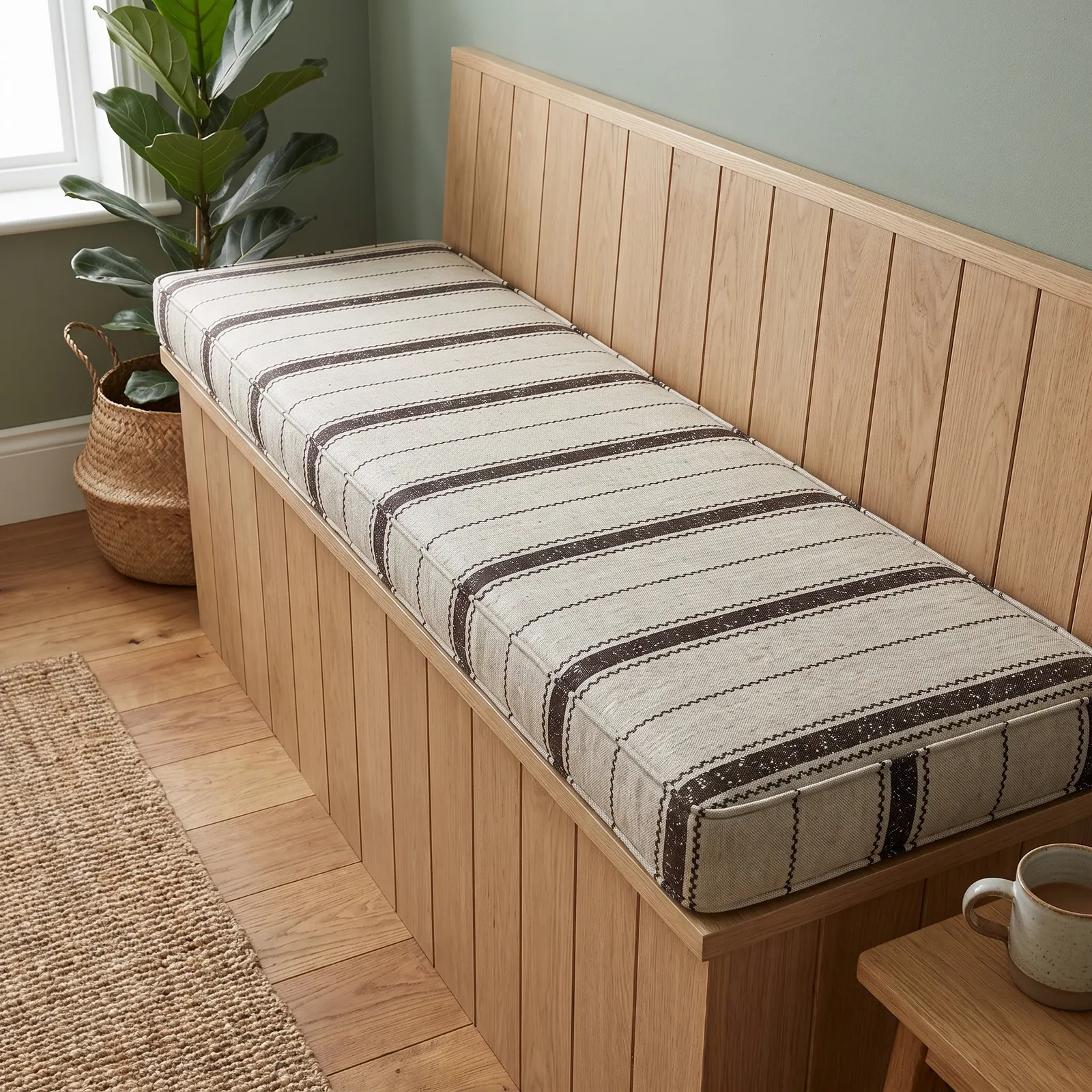
A striped bench cushion mixes well with a patterned room when the stripe brings pattern but no new color, like these espresso grain-sack bands on oatmeal linen on an oak settle against a sage wall. Pair one bold stripe with fine wood lines, natural textures and one plain wall, and skip back cushions on a board-backed bench.
New Orleans ·
My friends,
Pattern without a new color
Before you ask where the color is, look at what the bench already has. An all-oak settle with a tall tongue-and-groove back is a pattern of its own: fine vertical lines in honey wood. Against a sage wall, in warm afternoon light, it is already a full sentence.
So the cushion adds pattern, not color. Wide espresso grain-sack bands on an oatmeal linen ground, darker than the oak and softer in mood than they sound. Come closer and each band is edged with a small zigzag stitch line. That detail is the difference between heritage grain-sack cloth and an ordinary stripe; the eye catches it before the mind names it.
Here is the mix, counted. One bold stripe: the cushion. One quiet stripe: the boards behind it. Texture in three naturals: the seagrass belly basket holding a fiddle-leaf fig, the jute runner, the linen itself. One plain: the sage wall, with a white window sill for rest. Let one color speak and the others listen. Here espresso speaks, and oak, sage and oatmeal listen.
The piping is self piping, cut from the same cloth, so the front edge stays simple against the busy boards. The stoneware mug of tea on a little oak stool says what the stool is for: a side table, within reach. A bench cushion on a settle like this needs to be firm and nothing more. Skip back cushions; the boards are the back. Add a single throw if the evening turns cool.
What is already patterned in your room before the cushion arrives?
Pinned by Élodie: the stripe and its company
Five places where stripe, plain and texture meet on one oak bench.
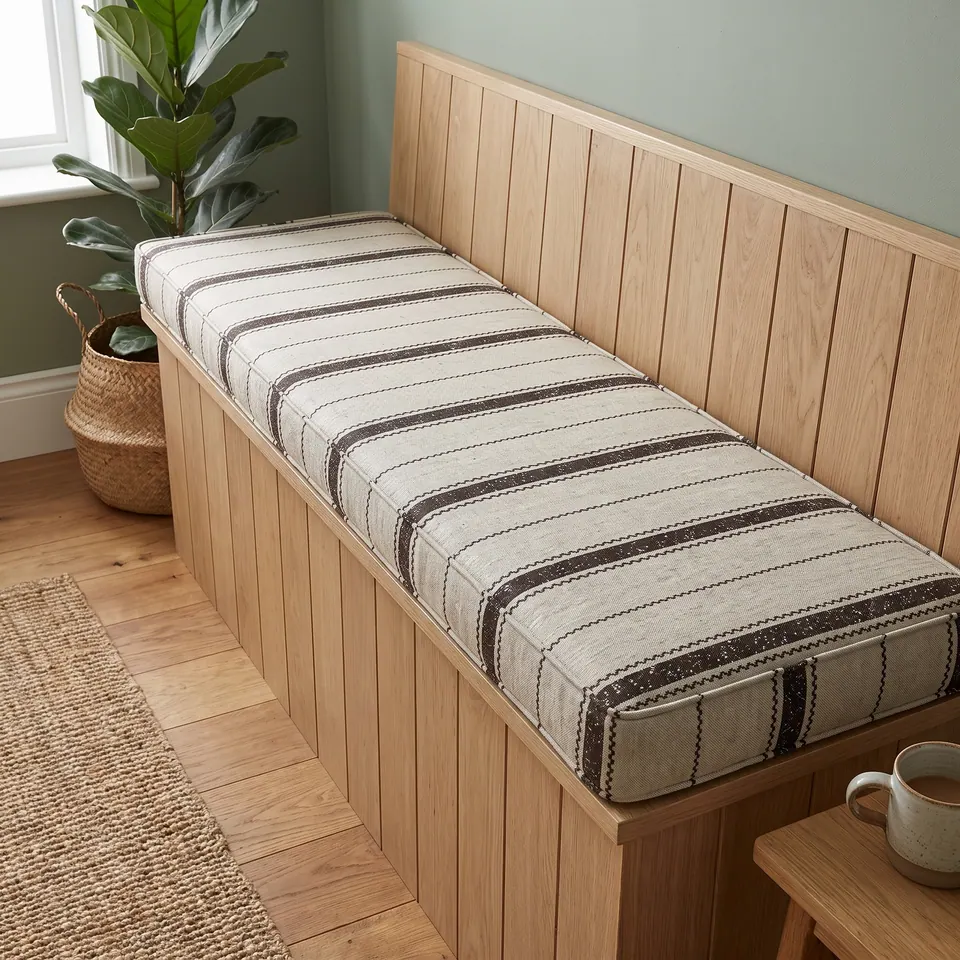
- Espresso grain-sack band
Wide dark bands give pattern without adding a new color to the oak and sage.
- Zigzag stitch detail
The small zigzag lines along each band are what make it read as heritage grain-sack cloth.
- Self-piped front edge
A matching welt keeps the seat simple against the busy board pattern.
- Seagrass plant basket
The basket repeats the cushion's natural oatmeal ground.
- Stoneware mug on stool
A small stool beside the settle works as a side table.
- Espresso grain-sack bandWide dark bands give pattern without adding a new color to the oak and sage.
- Zigzag stitch detailThe small zigzag lines along each band are what make it read as heritage grain-sack cloth.
- Self-piped front edgeA matching welt keeps the seat simple against the busy board pattern.
- Seagrass plant basketThe basket repeats the cushion's natural oatmeal ground.
- Stoneware mug on stoolA small stool beside the settle works as a side table.
Six colors on one oak settle
- Oatmeal ground#D9CBB0The linen base, warm and undyed-looking: the plain inside the stripe.
- Espresso band#3E2B22The one strong note, darker than the oak, so it reads as pattern and not as more wood.
- Honey oak#B98A56The settle’s boards, a fine stripe of their own.
- Sage wall#A3AD91The plain. Cool enough to let the oak glow.
- Seagrass#B7A273Texture that repeats the oatmeal ground in a coarser weave.
- Jute runner#C4AC80Texture on the floor, carrying the naturals down.
A mudroom niche, worked backwards from 18 inches
A buyer wrote to the workshop about a mudroom bench niche, 17 × 35.75 in (43 × 91 cm), with the bench top 15 in (38 cm) off the floor. They knew the seat height they wanted to end at: 18 in (46 cm). Subtract, and the cushion had to be 3 in (7.5 cm) thick.
That is the lovely part. They did not start with the cushion; they started with the knees. The workshop suggested choosing 17 in wide, 36 in long and 3 in thick from the size options, then writing the exact 35.75 in length in the order note. Production took about a week, with 3 to 5 days for delivery. The seat height calculator does the same subtraction for your own bench.
- Sizes
- 17 × 35.75 × 3 in (43 × 91 × 7.5 cm); bench top 15 in (38 cm), finished seat 18 in (46 cm)
- Fabric
- Linen
The lesson: Work backwards from the seat height you want to choose the cushion thickness.
Black that isn’t, backrests without velcro, and sets
- A common question
Is this fabric really black? I need a true black.
The workshop's answerCheck before you order, because several fabrics that look black on a screen aren’t. One dot print is dark gray with white dots, one stripe is a very dark navy that passes for black in photos, and the darkest corduroy is dark brown. There is no black corduroy in the range, so ask for a photo first.
- A common question
Do the L-shaped backrests attach with velcro, or can I use them on my own modular sofa?
The workshop's answerThey have no velcro and no other attachments, so they work anywhere as standalone cushions. An L-shaped backrest measures about 39 × 39 × 15.4 in (100 × 100 × 39 cm).
- A common question
How much more does it cost to add a back cushion and two armrests to a seat?
The workshop's answerThe workshop’s rule of thumb: multiply the seat cushion price by about 1.8 for the full set of one seat, one back cushion and two armrests. It works the same for a 24 × 24 in seat, and sets come with a few small gifts.
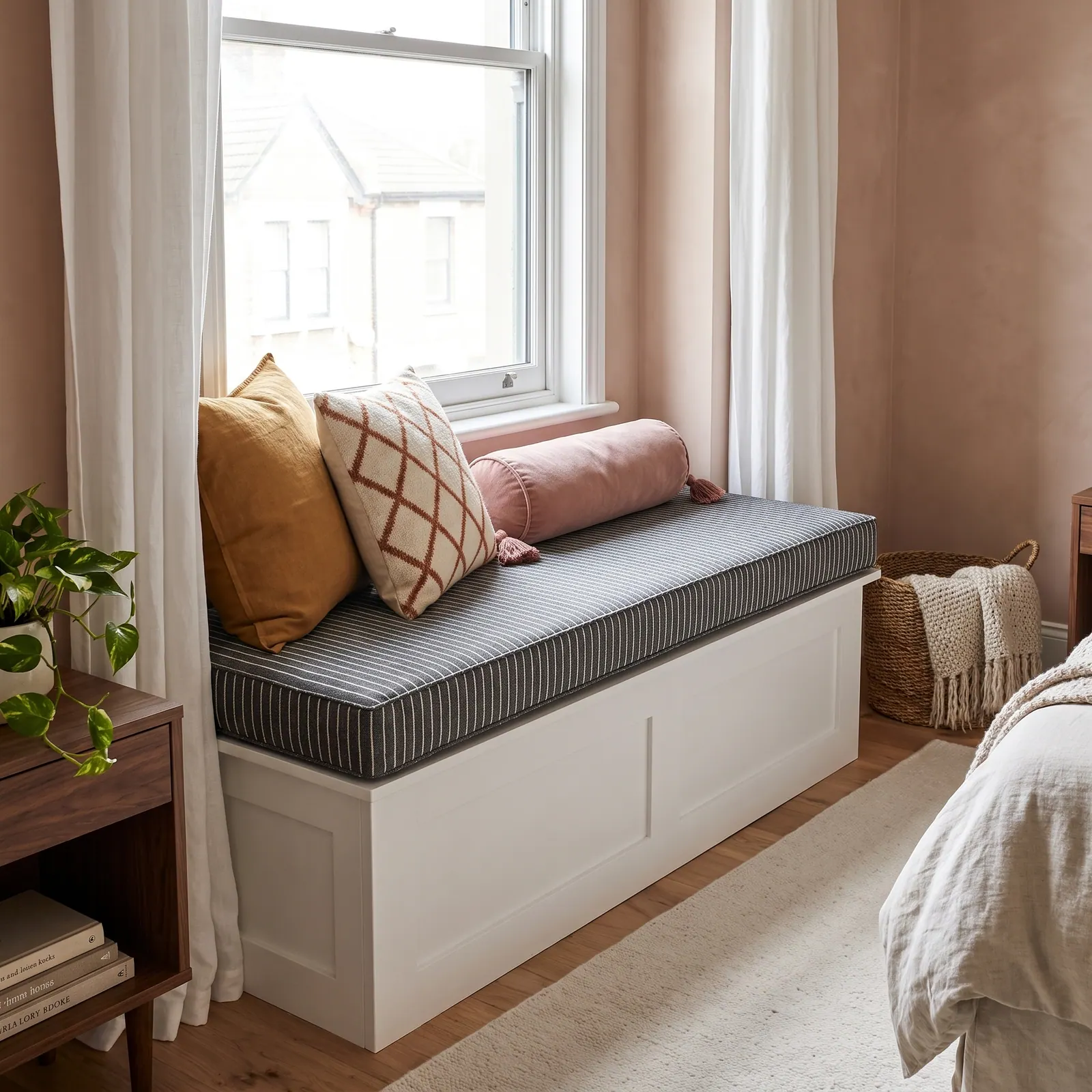
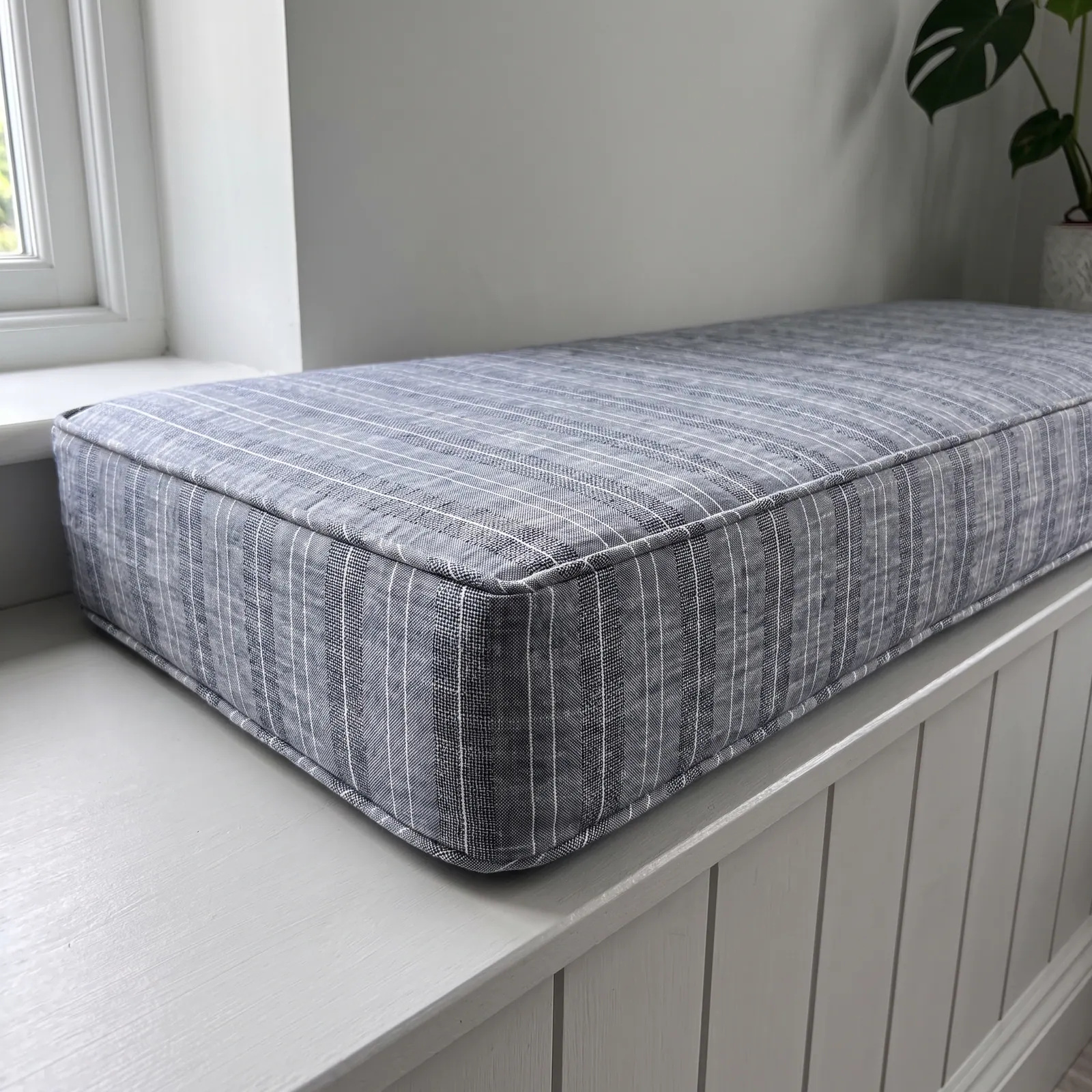
A grain-sack stripe is a stripe with a stitch: the thin zigzag line along each band is what makes a bench cushion look heritage, not just striped.
Élodie
On the cutting table: the settle cushion
| Cushion | Bench seat cushion, box edge |
|---|---|
| Fabric | Oatmeal linen with espresso grain-sack bands and zigzag stitching |
| Piping | Self piping |
| Bench | Oak tongue-and-groove settle with a tall board back |
| Back cushions | None needed; the boards are the back |
| Pairs with | Sage walls, seagrass, jute and stoneware |
| Order note | The exact size, when it falls between the size options |
| Best for | Settles, mudroom niches, kitchen benches with wooden backs |

Have it made
Have this made — ask Élodie’s workshop
A fabric reads one way at noon and another at dusk. Mention your light, and the workshop will weigh it with you. — Élodie
Leave your details and the workshop will call you to confirm measurements, fabric, foam and piping. No prices, dates or payment on this page: it is a request, not an order.
Questions buyers ask next
What makes grain-sack fabric different from a regular stripe?
Grain-sack cloth has wide bands edged with small stitch lines, here a zigzag, which give it a heritage look. A plain woven stripe has no stitch detail, so it reads cleaner and more modern.
Do I need back cushions on a bench with a wooden back?
Usually not. A tall board back already supports you, so a firm, self-piped seat cushion is enough. Add a single throw for softness rather than a row of back cushions.
How many patterns can one bench corner hold?
Count them: one bold pattern, one quiet linear one such as wood boards, and textures in natural colors. Keep at least one large plain surface, like a painted wall, so the eye has somewhere to rest.
How do I choose bench cushion thickness for a niche?
Work backwards: target seat height minus bench height equals thickness. A 15 in bench with an 18 in target takes a 3 in cushion. Write the exact length in your order note if it falls between size options.
With color and care — Élodie
P.S. Ask for a close photo of the stripe in daylight before you order. The zigzag stitch is the first thing a screen loses.
More stripes on wooden benches
 Save
 Save
 Save
 Save
 Save
 Save