 Save
- Espresso wide-wale top
The darkest surface in the room, so the eye lands on the seat first.
- Self-piped front edge
Piping in the same corduroy keeps the edge crisp without adding a second color.
- Tapered oak leg
Honey oak under dark brown repeats the warm-over-dark contrast of the window frames.
- Rattan drum pendant
A woven shade overhead brings texture back so the brown never feels heavy.
- Tartan fringed throw
The neighboring chair carries the pattern, leaving the cushion plain.
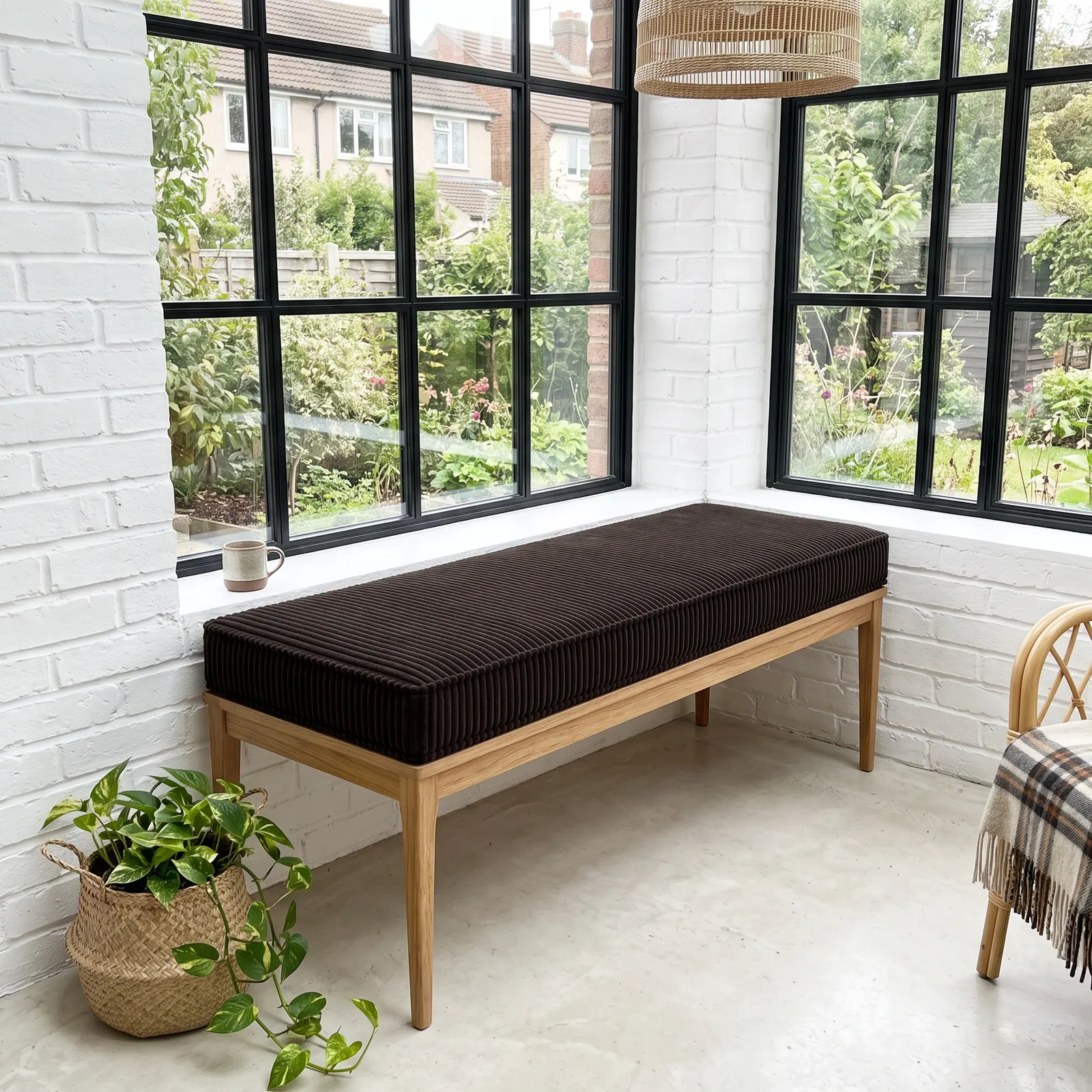
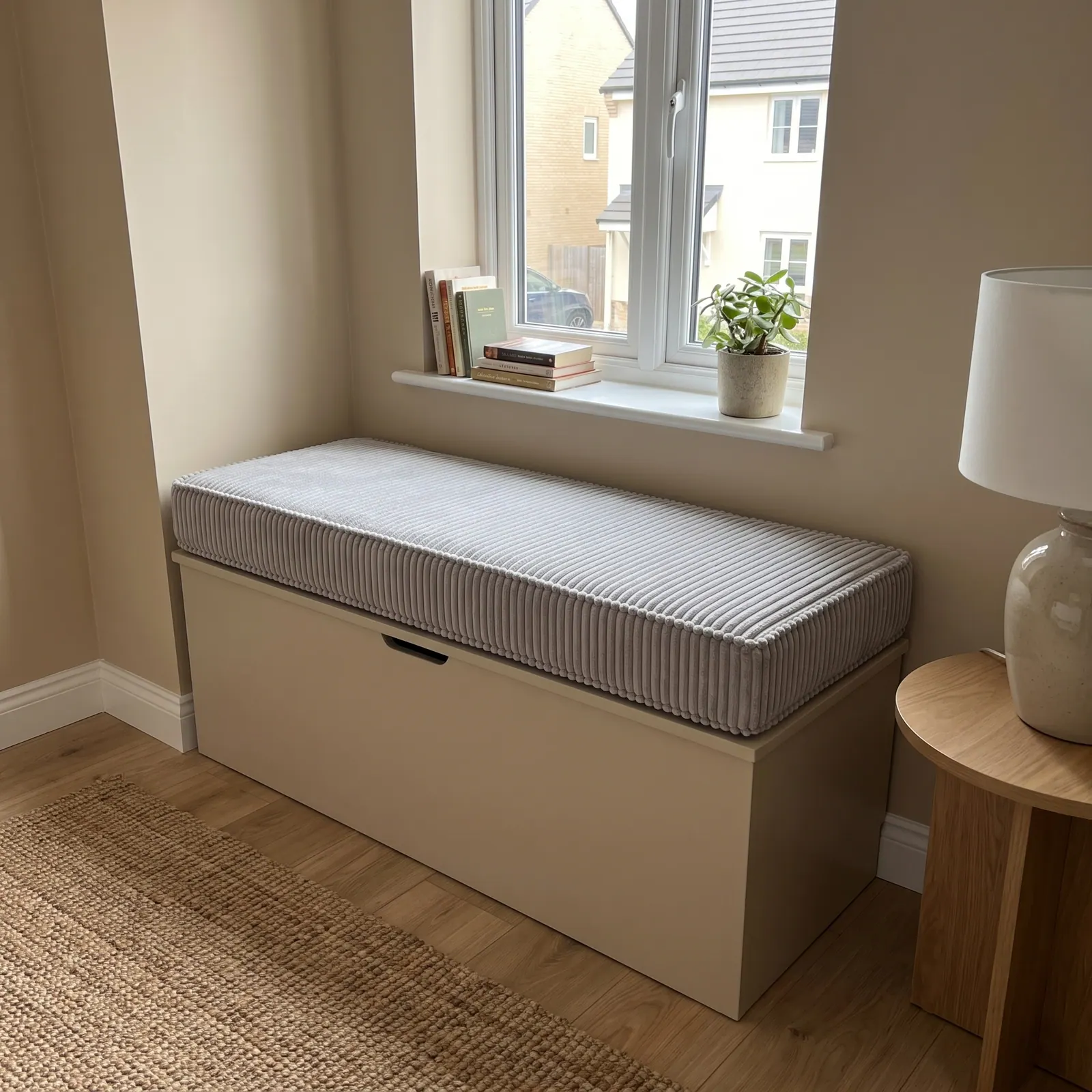
Plate Espresso corduroy cushion on an oak bench in a white brick sunroom
A deep brown corduroy cushion gives a pale oak bench some weight against white brick and black window frames. The self piping keeps the edge crisp without adding another color.
A Reading by ÉlodieBench Cushions
An espresso corduroy custom bench cushion in a white brick sunroom, where plain, pattern and texture share one corner
Élodie reads a dark wide-wale seat against white brick and black steel windows, and shows how one plain cushion lets a tartan, a rattan shade and a seagrass basket speak without talking over each other.

The quick answer
To mix patterns around a corduroy bench cushion, keep the cushion plain and let one neighbor carry the pattern. Here an espresso wide-wale box cushion with self piping anchors a white brick sunroom, a tartan throw on the next chair holds the pattern, and rattan and seagrass add texture, so the dark seat never feels heavy.
Pinned by Élodie: five places the eye lands
The pins run from the espresso top and its self-piped edge down to the oak leg, then up to the rattan pendant and across to the tartan throw.
The numbers match the pins on the plate.
- Espresso wide-wale topThe darkest surface in the room, so the eye lands on the seat first.
- Self-piped front edgePiping in the same corduroy keeps the edge crisp without adding a second color.
- Tapered oak legHoney oak under dark brown repeats the warm-over-dark contrast of the window frames.
- Rattan drum pendantA woven shade overhead brings texture back so the brown never feels heavy.
- Tartan fringed throwThe neighboring chair carries the pattern, leaving the cushion plain.
Why the darkest thing in the room is the seat
Soft overcast daylight, white-painted brick, a pale concrete floor. Into all that pale, one deep espresso cushion. The eye sits down first, and here it sits on the bench.
The color. Not simply brown: espresso that deepens to dark chocolate in the valleys of the wale. It takes its cue from the darkest line in the room, the black steel window frames, not from the walls. That's the move worth copying. Match a dark cushion to the room's darkest line and it anchors; match it to nothing and it floats.
Proportion. The cushion is roughly as deep as the bench apron below it, so seat and frame read as one solid block, not a pad perched on tapered legs.
The edge. Self piping in the same corduroy. A contrast welt would draw a second line; this one only sharpens the first. The wale already gives the surface its stripe.
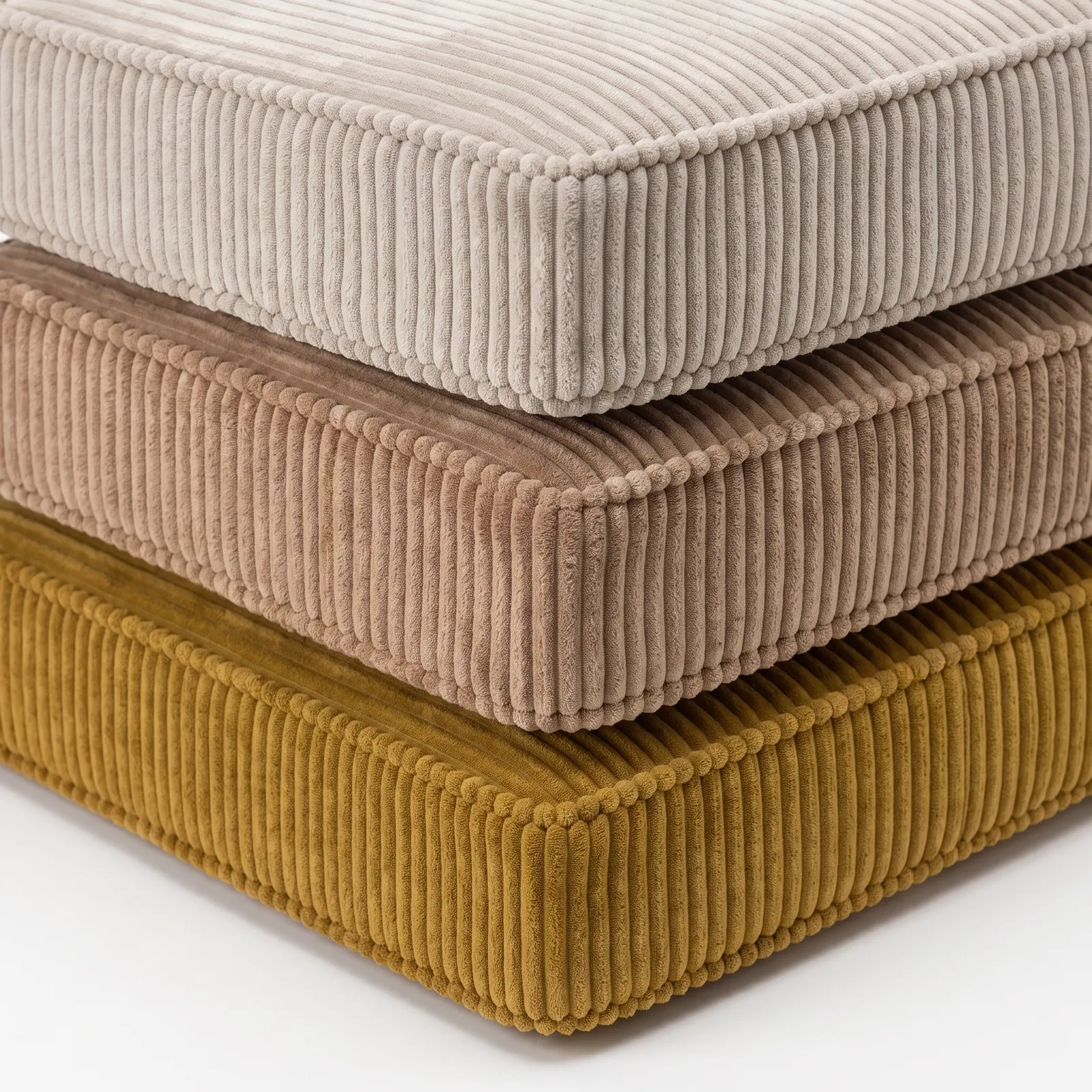
Light on pile. Wide wale catches soft light along every ridge, so even a plain color moves. Brushed one way it reads a shade lighter than the other, which is why nap direction matters at the cutting table. The corduroy wale and nap Pattern explains it, and the corduroy shelf holds the colors.
Where is the darkest line in your room? Start there, then browse bench cushions with it in mind.
Plain, pattern, texture: who does which job
| Job | Who carries it | Why it works |
|---|---|---|
| Plain | Espresso corduroy seat | One deep color gives the corner weight without a busy edge |
| Pattern | Tartan wool throw on the rattan chair | The pattern lives on a piece you can move, not on the seat |
| Texture | Rattan drum pendant, seagrass basket, the wale itself | Three textures keep dark brown from feeling heavy |
| Line | Black steel window bars | The dark line overhead echoes the dark seat below |
| Warmth | Honey oak tapered legs | Warm wood under dark brown repeats the frame contrast |
Oatmeal, charcoal and two dogs
A dog owner in the US wrote to the workshop wanting bench cushions for an oatmeal-and-charcoal room, and asked the honest question: would linen survive two dogs jumping on and off?
The workshop steered them from linen to a pet-friendly polyester weave: 88,000 Martindale, about 11 oz per square yard (370 g/m²), wipe-clean. Then came the color matching, which is where I lean in. G-47 and G-48 matched the oatmeal, G-61 matched the charcoal, and the workshop warned that G-62 reads nearly black.
The buyer chose G-48 with contrasting G-60 piping and added the non-slip base. Two neutrals, one plain body and one darker line: pattern-mixing by restraint, my friends. For dogs, the pet-friendly fabric Pattern is honest about the limits, and sunroom cushions gathers seats that live in all-day light.
On the cutting table: the sunroom bench
| Piece | Box bench cushion for an oak frame with tapered legs |
|---|---|
| Fabric | Wide-wale corduroy in espresso (code V03) |
| Piping | Self piping in the same corduroy |
| Edge | Box edge, about as deep as the bench apron |
| Color source | The black steel window frames, the room's darkest line |
| Pattern partner | Tartan wool throw on the neighboring chair |
| Texture partners | Rattan drum pendant and seagrass belly basket |
| Light | Soft overcast daylight through steel-framed glass |
| Best for | A sunroom bench that needs one grounding color |

Have it made
Have this made — ask Élodie’s workshop
Color is easier to settle in a conversation than on a screen. Tell the workshop about the room and the light it gets, and the fabric choice follows. — Élodie
Leave your details and the workshop will call you to confirm measurements, fabric, foam and piping. No prices, dates or payment on this page: it is a request, not an order.
Buyer questions: a stripe-matched welt, small ties and slimmer backs
- A common question
Can the piping match one of the colors in my striped fabric?
The workshop's answerOften, yes. On one outdoor bench the piping was matched to the gray stripe. When stripes are too thin to cut a solid strip from, the workshop picks the closest solid from another chart, such as linen L-43 as piping for striped N23, comparing the two under natural light.
- A common question
Can you add ties to a small cushion for an oddly shaped bench?
The workshop's answerYes. One buyer ordered a 14 x 18 in (36 x 46 cm) cushion for an oddly shaped bench with the ties on the wider side, and the workshop quoted it that way.
- A common question
My new sofa is narrower and the arms eat the seat. Can the backrests be made smaller?
The workshop's answerNot in height, because that height is what supports the person sitting. They can be made thinner, but thinner backrests are less durable. In that case the workshop made two thin L-shaped backrests at a goodwill price.
A dark corduroy bench cushion anchors a white room when its color comes from the darkest line in view, like black steel window frames, not from the walls.
Élodie
Questions buyers ask next
Should a dark corduroy cushion have contrast piping?
Usually not. Corduroy already has a stripe in its wale, and a contrast welt adds a second line that competes with it. Self piping in the same corduroy keeps the edge crisp; a contrast welt suits a flat weave better.
How do I pick a cushion color for a room with white walls?
Look for the darkest line in the room, such as window frames, a stove or a picture rail, and take the cushion color from that. A cushion matched to the walls disappears; one matched to the darkest line anchors the corner.
Will a brown corduroy cushion feel too heavy in a sunroom?
Not if texture surrounds it. Here a rattan pendant, a seagrass basket and a wool tartan throw sit close by, and pale brick and concrete bounce daylight back onto the seat, so the espresso reads warm rather than heavy.
With color and care — Élodie
More photographs to read
 Save
 Save
 Save
 Save
 Save
 Save