The Pattern Room · a measuring pattern
Corduroy modular floor sofas and cushions: wale size, nap direction, why no piping
Corduroy is a field plowed in rows. Learn how wide the rows are and which way they lean, and you will know how your cushion will look, wear and settle in.
 Save
The quick answer
A corduroy cushion for a sofa or floor seat should be wide wale, roughly 3 to 8 ribs per inch, with every piece cut so the nap runs the same way. Side bands run the ribs sideways so they stay in one piece, and corduroy sofa covers skip piping because the ribs already draw the line. Keep it indoors.
Two colors in one cloth
Run your palm down a corduroy cushion, then back up. You will see two colors, and neither of them is wrong.
That is the first thing to know about a corduroy cushion: the cloth has a direction. Its ribs, the wales, run in rows like a plowed field, and the short pile on each rib leans one way. How wide those rows are, and which way they lean, decides how the cushion looks the day it arrives and how it wears after.
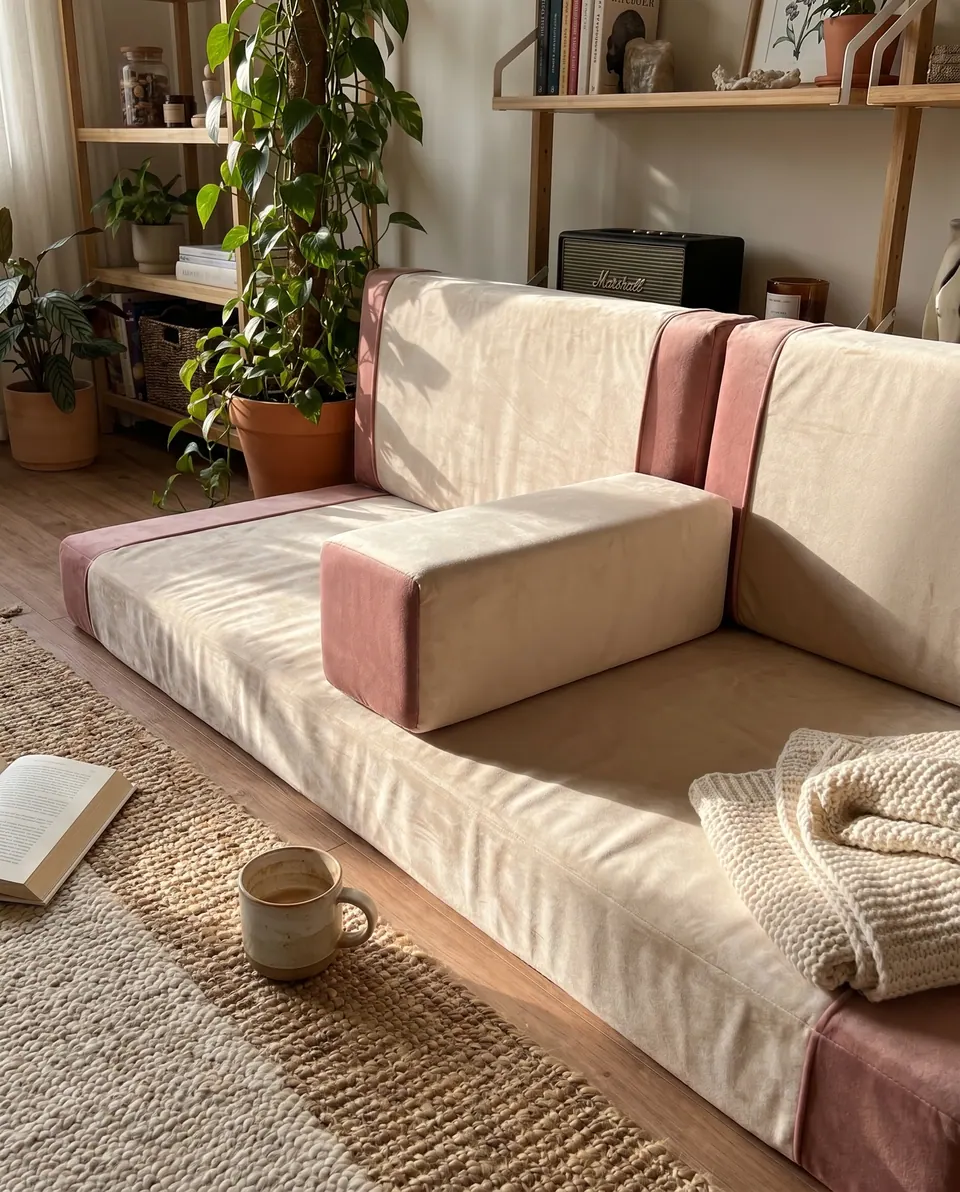
The photograph above shows an oat corduroy floor sofa in a nursery, a daisy pillow on the seat and a shelf of plush bunnies overhead. Look at the seat band. The ribs run sideways, low and even. That was not an accident, and I will tell you why further down.
Corduroy is the standard cloth on the workshop's modular floor sofas and many floor cushions. One family wanted a frameless sofa for a tiny house, and the corduroy modular the workshop suggested measures 78.5 in wide, 39 in deep and 29 in high (199 x 99 x 74 cm), with a 14 in (36 cm) seat. Questions about the cloth come in three kinds: how wide is the wale, why do the ribs run sideways on the band, and why does the seat look patchy where the family sits.
Wale counts, from shirt cord to sofa cord
| Corduroy | Wales per inch | Weight | Where it usually goes |
|---|---|---|---|
| Pinwale or needlecord | 16 to 23 | about 6 to 7 oz/yd² (200 to 250 gsm) | Clothing; seldom a seat |
| Standard wale | 8 to 14 | about 8 to 10 oz/yd² (260 to 340 gsm) | General-purpose cord |
| Wide wale | 3 to 8 | heavier than standard | Upholstery: floor sofas and floor cushions |
| Jumbo or elephant | 1 to 6 (some sources count up to 10) | about 12 to 15 oz/yd² (400 to 500 gsm) | Bold upholstery ribs |
Reading corduroy before you order, in eight steps
Hold the sample, not the photo
Samples are cut from the same corduroy used in production, so what you hold is what the sofa gets. The sofa cord is a coarse wide wale. One buyer found the sample finer than the photos promised; there is a second corduroy with wider wales, and a sample of that can be sent too.
Ask what the fiber is
Furniture corduroy is mostly synthetic. The sofa cord has been described as 100% polyester or as a polyester-cotton blend, never pure cotton, and it holds no hemp. Ask for the fiber content of the exact code. If you are sensitive to synthetics, a 100% cotton chart, pure linen or cotton-linen are the alternatives.
Choose from the colors that exist
The sofa corduroy comes in a fixed palette of about ten: green, brick, mustard, beige, dark brown, anthracite, off white, dark blue, indigo and silver gray. There is no black, maroon, fuchsia, lilac or lavender, and dyeing the cord is not advised. Those shades live in velvet or soft fabric.
Mix colors piece by piece, in writing
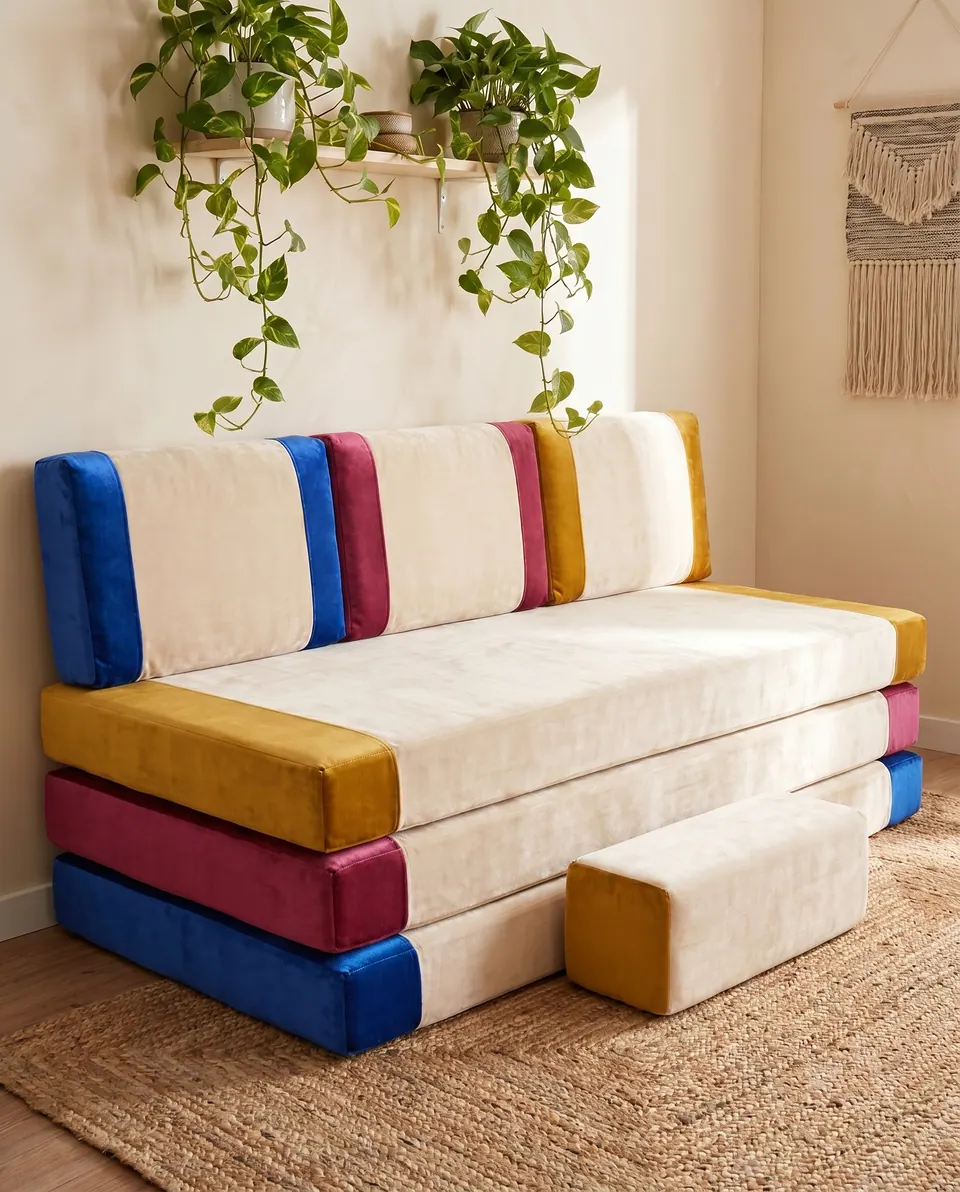
Each piece of a modular sofa can be a different color. Choose the mixed-color option and write in the order note which piece gets which color. Since there is no black, one mixed sofa that looked dark in photos was really dark blue with cream.
Decide the piping by the piece
Corduroy sofa pieces and daybed covers come without piping. Box cushions such as window seats and benches can be piped on request, in a matching corduroy or a contrasting one.
Say which way the ribs run
On each top panel, say whether the ribs run with the long edge or across it. Wide wales are matched like stripes. The roll is about 55 in (140 cm) wide, so ribs running across a panel wider than about 54 in (138 cm) would need a seam. The stripe direction pattern works the same way.
Keep the nap running one way
Brushed down, corduroy looks lighter and wears better; brushed up, it turns richer and darker. Every piece of one sofa must be cut with the nap running the same way, or two cushions of one color will sit side by side looking like cousins.
Unpack early and steam the creases
Compressed shipping leaves creases. Steam them out in the first days, on low heat, holding the iron's weight off the pile, through a pressing cloth or over a towel. Test on a hidden seam allowance first. Left under a blanket for weeks, creases set.
Have it made
Measured it? Have Harlan’s workshop make it
Old upholsterers will tell you the real cutting happens in the conversation, long before the shears come out. Tell the workshop what you sit on, and they will talk it through with you. — Harlan
Leave your details and the workshop will call you to confirm measurements, fabric, foam and piping. No prices, dates or payment on this page: it is a request, not an order.
Fabric · Foam · Pipingwhat the workshop will confirm with you
Key facts
- Upholstery corduroy is usually wide wale, about 3 to 8 ribs per inch; pinwale runs 16 or more.
- Brushed with the nap running down, corduroy looks lighter and wears better; brushed up, it looks richer and darker.
- Side bands are cut with the ribs running sideways so they stay in one piece along the roll; vertical ribs may need joins.
- Corduroy daybed covers and modular floor sofa pieces are made without piping; corduroy box cushions can be piped on request.
- The sofa corduroy is indoor-only, with no UV or water resistance, and comes in about ten fixed colors with no black.
Why the ribs run sideways on the band, and why there is no piping
A buyer once asked whether the ribs on the side of a corner floor cushion could run up and down, the way they did in the listing photos. Both ways are possible. Only one is standard.
Corduroy comes off a roll about 55 in (140 cm) wide. The side band of a cushion is one long strip that wraps around it. Cut along the length of the roll, the ribs lie sideways and the band comes out in one unbroken piece. Cut with the ribs standing up, the strip can only be as long as the roll is wide, so a long band needs joins.
A seam is a promise. I would rather not make one the cloth never asked for. So sideways is the standard, and vertical ribs are a special request that may bring joins or seams along the band.
Piping follows the same thinking. Corduroy daybed covers and modular sofa pieces are sewn without it, on purpose. The ribs already draw the lines, and a cord laid along the seam would only argue with them. Box cushions are another matter: corduroy window seats and benches have been piped all round, and one kitchen window seat went green corduroy with cream corduroy piping. The piping pattern covers the choice for other cloths.
How corduroy wears: seat marks, tired ribs and weather it cannot take
New corduroy shows where you sat. The pile shifts under you and the seat reads lighter in patches, as though the color had washed out. It hasn't. After a few days of use the pile settles back to its normal look. Velvet does the same; pressure marks are how pile fabrics keep a diary.
If the color still doesn't sit right with you after that, covers in another color can be ordered on their own, which is gentler than sending back a whole sofa. Replacement floor sofa covers explains how those are ordered.
Corduroy has limits, my friend, and I would rather say them plainly. Under hard daily use the ribs can split. The workshop has remade split corduroy covers in harder-wearing linen, and for rentals and heavy use it steers buyers toward performance linen or velvet. No fabric is claw-proof, and corduroy is no exception.
And it lives indoors. The sofa cord has no UV or water resistance. For a porch or patio, start from the outdoor range, not the corduroy chart.
Creases that stayed four weeks too long
A family in the US wrote to the workshop about their corduroy modular floor sofa. Two things had gone wrong.
The metal support bars arrived flaking. The workshop took it for production oxide and suggested wiping it off. When wiping didn't do it, new bars went out, and the family found them much nicer.
The second trouble was the cloth. Four weeks on, the corduroy covers still carried their shipping creases. The advice was hot steam or careful ironing, and discounted replacement covers were offered in case the creases would not let go.
Here is what I took from it. Corduroy that has traveled compressed wants attention in its first days, not its fifth week. Steam it early and let it breathe. Throw a blanket over it for a month and the creases settle in like an old habit.
Corduroy side bands run the ribs sideways because a band cut along the roll needs no joins; vertical ribs on a long band mean seams.
Harlan Pruitt
Common mistakes with corduroy
- Judging the wale from a screen instead of a sample cut from the production cloth.
- Assuming furniture corduroy is cotton instead of asking the fiber content of the exact code.
- Asking for black, maroon or lilac corduroy; those colors live in velvet or soft fabric.
- Forgetting to say which way the ribs run on each cushion.
- Cutting pieces with the nap running different ways, so one color reads as two.
- Mistaking early seat marks for fading and sending the sofa back.
- Leaving compressed covers creased under a blanket for weeks.
- Putting corduroy on an open porch, or in a rental that sees hard daily use.
Corduroy on a bench seat
Corduroy bench cushions are a fabric-first buy: shoppers search the fabric name plus 'bench cushion' and pick by color. On a seat, the ribs show wear where people sit most, flattening and looking lighter, so expect the seat to age faster than the sides. The workshop's corduroy is a plush velvet corduroy, indoor only, with no water or UV resistance, so keep it off open porches. Corduroy sofa pieces and daybed covers are made without piping by design, because the ribs already outline the shape, but box cushions have been piped on request. Side bands are cut with the ribs running horizontally so they stay seamless along the roll.
Buyer questions: questions about the cord
- A common question
Is the corduroy on your floor sofa fine wale or wide wale?
The workshop's answerWide. The sofa uses a coarse, wide-wale corduroy, and fabric samples are cut from that same production cloth, so the sample in your hand is what the sofa gets. If it looks finer than you hoped, there is a second corduroy with wider wales, and a sample of that one can be sent as well.
- A common question
Can the ribs on the side band of my corner floor cushion run up and down, like in the photos?
The workshop's answerAs standard, the side band is cut with the ribs running sideways, because cutting along the length of the roll keeps the band seamless. Vertical ribs can be made as a special request, but the side band may then need joins or seams along its length.
- A common question
Our new corduroy sofa looks washed out where we sit. Is something wrong with it?
The workshop's answerNo. Pile fabrics such as corduroy and velvet shift when you sit and show lighter patches at first, then settle back to their normal look after a few days of use. If you still don't like the color after that, covers in another color can be bought at cost instead of returning the sofa.
- A common question
Why doesn't the corduroy daybed cover have piping?
The workshop's answerCorduroy daybed covers and modular sofa pieces are made without piping on purpose: the ribs already give the lines and definition, so piping isn't needed for looks or structure. Velvet and other fabrics can have matching or contrast piping, and corduroy box cushions for window seats and benches have been piped on request.
- A common question
Can I get the corduroy in black, maroon or lilac?
The workshop's answerNo. The corduroy comes in a fixed, limited palette, and black, maroon, fuchsia, lilac and lavender aren't available, with no plans to add them. The full chart and close-ups of near shades can be sent. For those colors, velvet or soft fabric have far wider ranges; dyeing the corduroy isn't recommended.
- A common question
Is the sofa corduroy cotton or polyester? I have sensitive skin.
The workshop's answerMostly synthetic. The furniture corduroy has been described as 100% polyester or as a polyester-cotton blend; it isn't made in pure cotton and contains no hemp. The covers are removable and machine washable. If you are sensitive to synthetics, a 100% cotton chart, pure linen or a cotton-linen fabric can be used instead.
Corduroy questions from the workbench
What does 'wale' mean on corduroy?
A wale is one raised rib, and the wale count is how many ribs fit in an inch. Pinwale runs 16 or more per inch, standard cord about 8 to 14, and wide wale about 3 to 8. Upholstery usually uses wide or jumbo wale, which stands up to sitting.
Can I use corduroy cushions on a porch?
Treat corduroy as indoor-only. The sofa corduroy has no UV or water resistance, so sun and damp are hard on it. For a porch, a patio or anywhere rain can reach, choose from the outdoor range and let the corduroy stay in the living room or playroom.
How should I iron or steam corduroy covers?
Gently. Steam on low heat with the iron's weight held off the pile, through a pressing cloth or over a towel, so the ribs aren't crushed. Test on a hidden seam allowance first, and deal with shipping creases in the first days rather than weeks later.
Is corduroy a good choice for a rental or a heavily used seat?
It is not the strongest choice. Corduroy ribs can split under hard daily use, and the workshop has remade split corduroy covers in harder-wearing linen. For rentals and heavy use, performance linen or velvet is the usual recommendation.
Can I buy spare corduroy covers in a second color?
Yes. Buyers order spare cover sets in a second color to swap between, and each piece of a modular sofa can be a different color from the start. Write which piece gets which color in the order note so nothing is left to guesswork.