 Save
A Reading by MaggieDining Chair Cushions & Pads
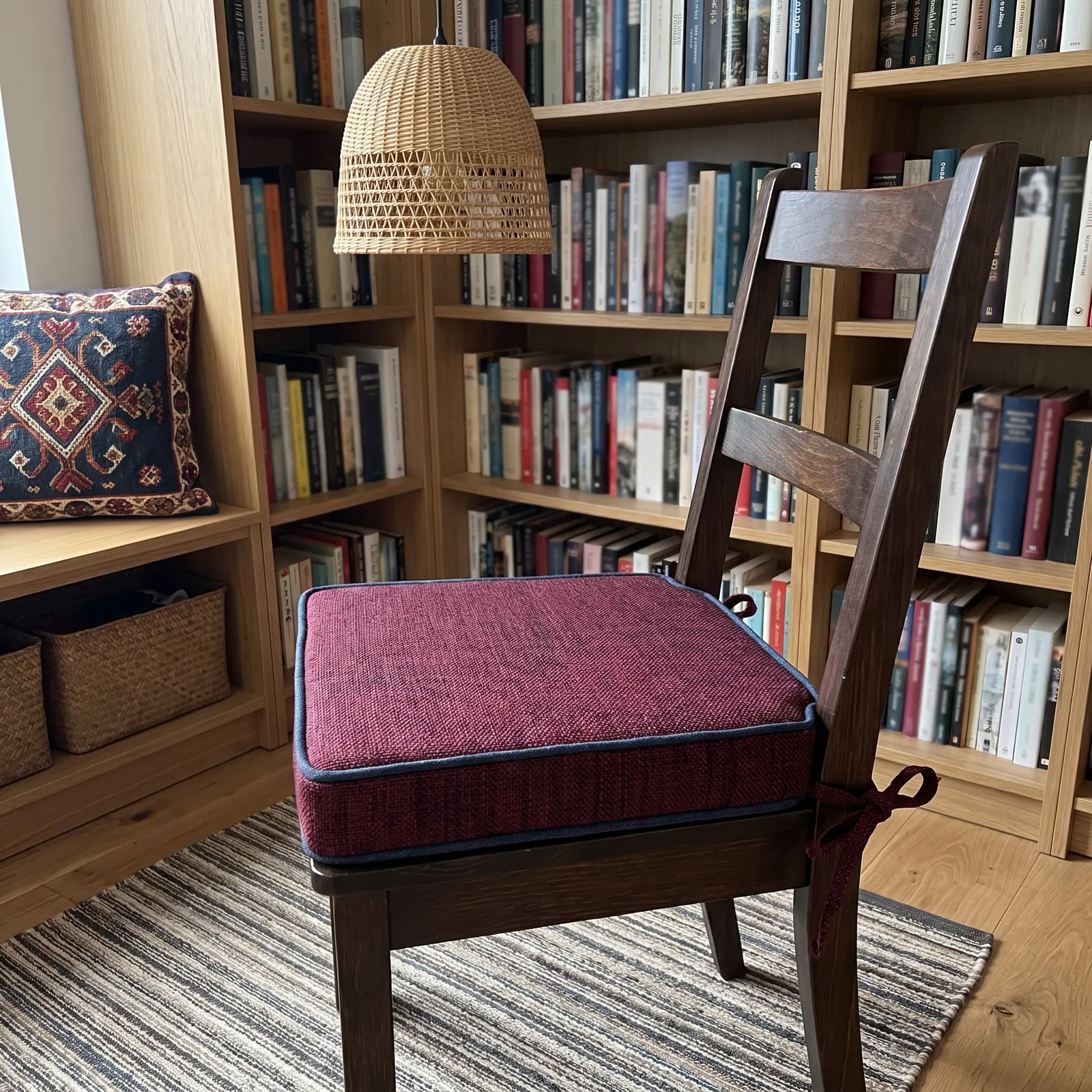
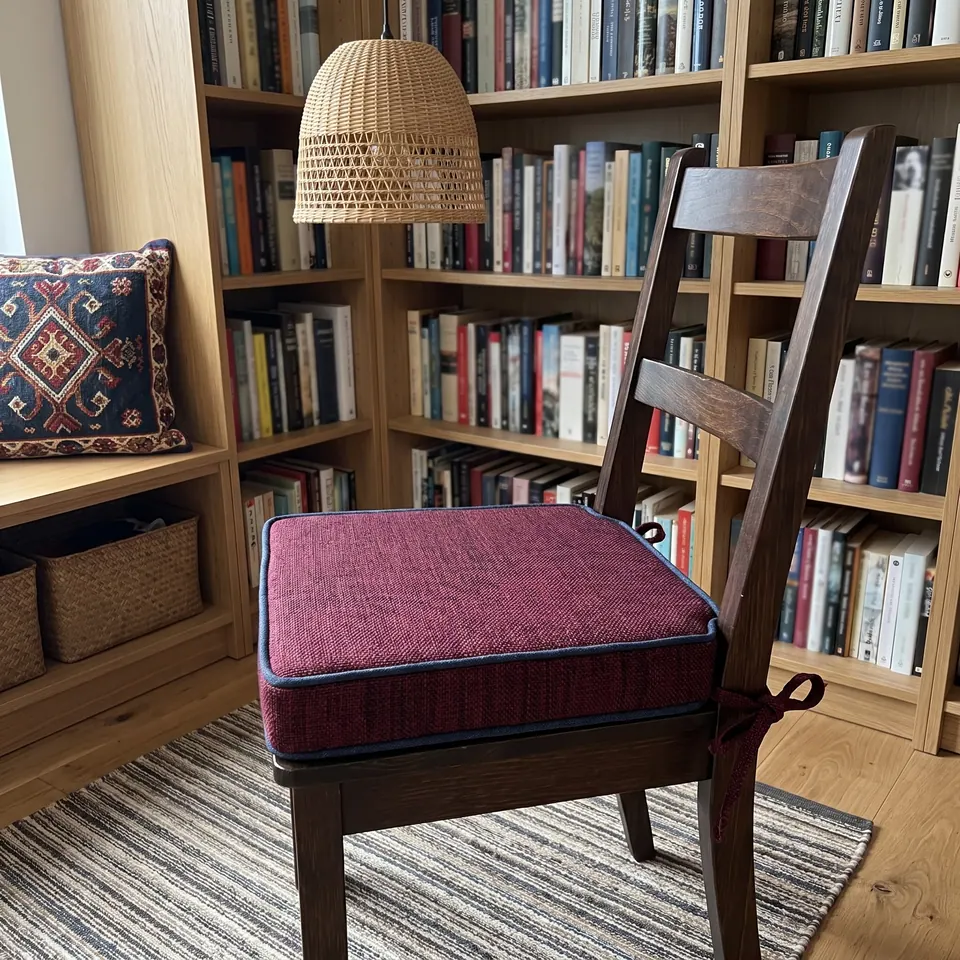
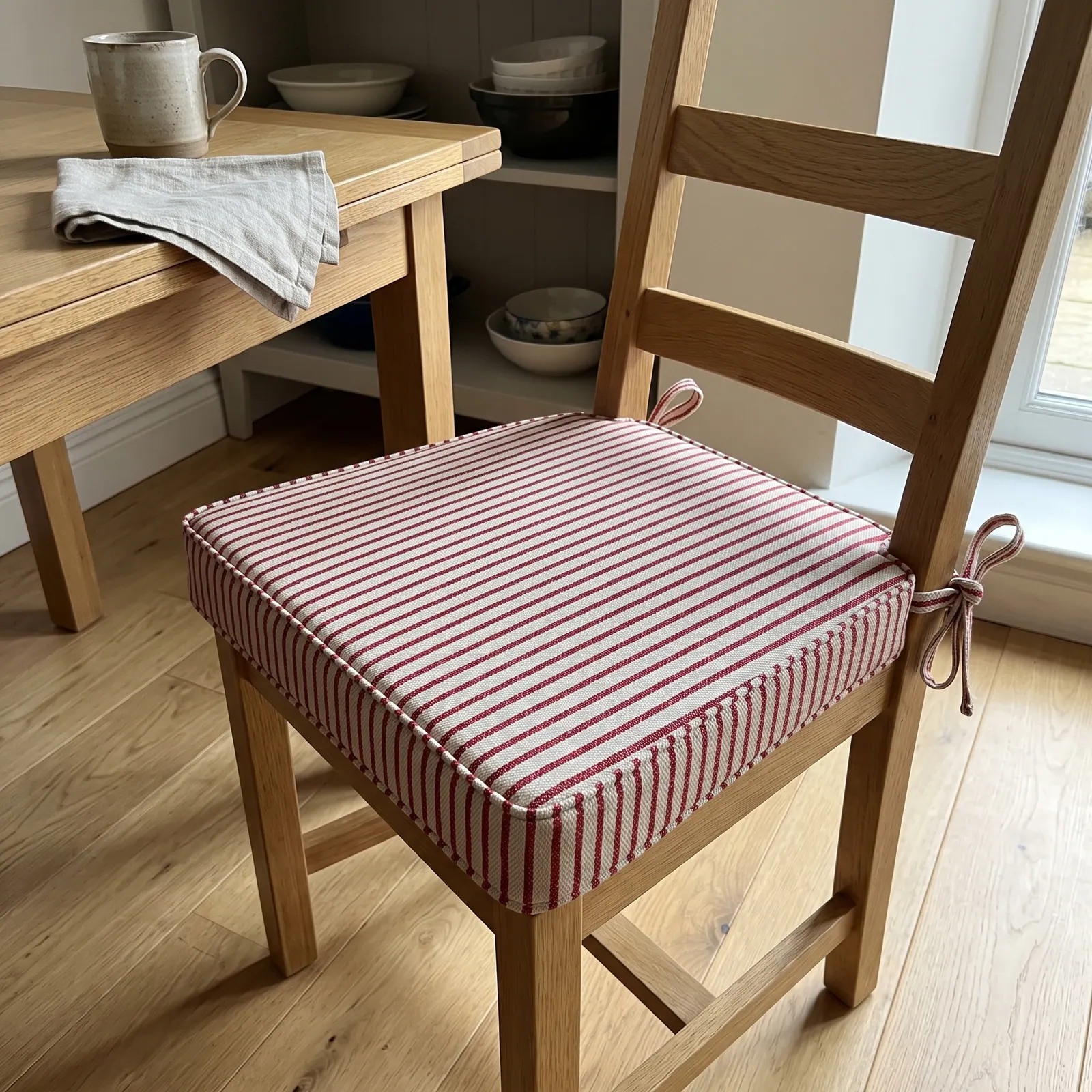
A crimson chair cushion with indigo piping and ties, finished for a library
Right, then. A dark ladder-back, a wall of books, and a crimson pad tied on with a proper bow. Everything worth noticing here was decided in the last hour of the work, not the first.
Crimson and indigo come straight from the book spines, so the chair looks like it belongs in the library.

The quick answer
A chair cushion with ties looks tailored when the finishing is right: piping that runs straight and turns rounded corners cleanly, ties in the body color set to meet the back posts, the zipper along the back edge, and a non-slip base. For chairs with deep back supports, an arched back edge fits more reliably than notches.
Colors borrowed from the book spines
Somebody looked at the shelves before they chose the fabric, and it shows. Crimson and navy are the spine colors that turn up most often on these oak shelves, so a crimson body with indigo piping makes the chair look as if it came with the library rather than arriving last Tuesday.
The cloth is a linen-look weave with a close, even texture, and the pad is thick. That matters on a dark ladder-back standing beside floor-to-ceiling shelving; a thin pad would vanish against all that height. Thickness gives the chair presence and turns it into an invitation.
Now the props, because none of them is an accident. A woven rattan pendant softens a wall of straight lines. On the window bench, a kilim-pattern pillow repeats red and navy in a handmade weave. Wicker baskets under the bench add texture and hide the clutter every reading room collects. A striped cotton rug grounds the lot.
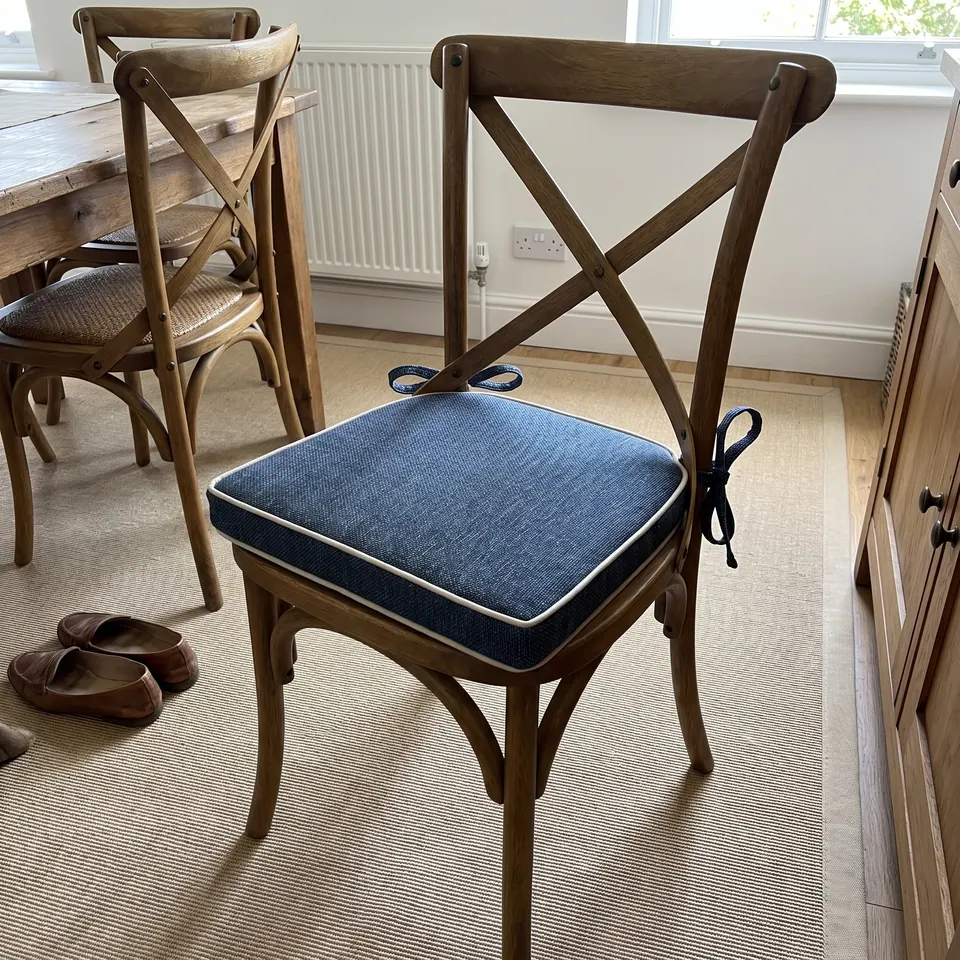
And the bow. A crimson tie knotted around the back post in the body color, so it reads as part of the cushion rather than a string holding it on. I once tied a red pad on with white tape because it was what I had in the drawer. I still see those ties when I close my eyes.
More pads like this live under dining chair cushions, the cloth under linen-look fabrics, and the room under reading nook cushions. What color are the spines on your shelves?
Finishing you can check from the doorway
Five details on this chair that were settled by hand, not by machine.
- Crimson tie bow
A body-color tie holds the thick cushion to the ladder-back post.
- Indigo piping
Navy welt on crimson borrows the two most common spine colors on the shelves.
- Kilim throw pillow
A patterned pillow on the window bench repeats red and navy in a handmade weave.
- Rattan pendant
Woven rattan softens the wall of straight shelving.
- Wicker baskets
Baskets under the bench add texture and hide clutter.
- Crimson tie bowA body-color tie holds the thick cushion to the ladder-back post.
- Indigo pipingNavy welt on crimson borrows the two most common spine colors on the shelves.
- Kilim throw pillowA patterned pillow on the window bench repeats red and navy in a handmade weave.
- Rattan pendantWoven rattan softens the wall of straight shelving.
- Wicker basketsBaskets under the bench add texture and hide clutter.
Eight chairs, an arch, and a 1 in catch
A buyer got in touch about pads for eight wooden dining chairs whose back supports cut deep into the seat. Notches around supports like those can't be made reliably from a distance, so the workshop proposed an arched back edge instead.
Then it checked the buyer's CAD drawing and caught a 1 in depth inconsistency before a single cut. The confirmed diagram: 20 in (51 cm) wide, 18 1/4 in (46 cm) deep, 13 1/2 in (34 cm) straight sides rising to a 5 in (13 cm) arc, 1 in (2.5 cm) rounded front corners, the zipper along the arc, ties inset 4 1/2 in (11.5 cm) and a non-slip base. The buyer approved the fabric and piping pairing from a photo of a finished cushion, then ordered eight pads and a spare cover.
- Sizes
- 20 × 18 1/4 in (51 × 46 cm), 12 1/2 in (32 cm) radius arc, 2 in (5 cm) thick
- Fabric
- Linen-look body with contrast piping
The lesson: Replace hard-to-fit notches with an arched edge, and confirm the geometry on a diagram.
Maggie's finishing checklist
- Piping runs straight along the front and turns each rounded corner without a pucker
- Ties cut from the body fabric and placed to meet the back posts
- Zipper on the back edge, facing the chair back, never the front
- A non-slip base on any pad that has to stay put
- A diagram with every edge labeled, checked before anyone cuts
- Measure the seat, dear, not the old pad; for new covers, measure the bare foam
- A spare cover ordered with the set, from the same dye lot
Chair pad questions
- A common question
How should I measure for replacement covers on shaped chair pads?
The workshop's answerDraw the foam insert with every side labeled, for example a slight trapezoid with rounded front corners at 17 3/4 × 16 7/8 × 19 5/8 × 16 7/8 in (45 × 43 × 50 × 43 cm), and give the thickness, here 1 5/8 in (4 cm). Measure the bare foam, not the old cover. When one first set came out about 3/4 in (2 cm) short, the remake was cut 1/2 to 3/4 in (1 to 2 cm) larger, with longer ties.
- A common question
What would two small seat cushions cost, 9 7/8 × 13 in and 2 in thick?
The workshop's answerSmall pieces are quoted as a pair. The workshop came down from its first quote for the two, then settled on a goodwill price the buyer accepted. The color, a beige, was picked from the color chart.
- A common question
Can you make a round chair cushion with a removable zippered cover and ties for the chair back?
The workshop's answerYes. One was quoted at 12 in (30 cm) across and 4 in (10 cm) thick, with filling, a zippered cover and a loop or ties to fasten it to the chair back.
When chair back supports cut deep into the seat, an arched back edge fits more reliably than notches, and it is easier to confirm on a diagram.
Maggie
On the cutting table
| Cushion | Tie-on chair pad, box edge |
|---|---|
| Fabric | crimson linen-look weave |
| Piping | indigo contrast piping |
| Ties | crimson body fabric, knotted at the back posts |
| Shaping | Arched back edge for chairs with deep back supports; rounded front corners |
| Zipper | Along the back edge |
| Base | Non-slip, on request |
| Best for | Ladder-back chairs, home libraries and reading corners |

Have it made
Have this made — ask Maggie’s workshop
Numbers first, fabric second, piping last. Jot down what you have, and the workshop will go down the list with you, item by item. — Maggie
Leave your details and the workshop will call you to confirm measurements, fabric, foam and piping. No prices, dates or payment on this page: it is a request, not an order.
Questions buyers ask next
How far apart should the ties on a chair cushion be?
Far enough apart to meet the chair's back posts. On one set of eight arched pads, the ties were inset 4 1/2 in (11.5 cm) to land at the posts. Measure post to post on your own chair before you order.
Why put the zipper along the back of a chair pad?
Because nobody looks there. On a shaped pad the back edge sits against the chair back, so the zipper stays out of sight. The arched pads in the story above had theirs sewn along the arc.
Can cushion colors come from my bookshelves?
Take them from the shelves rather than the walls. Crimson and navy are common spine colors, so a crimson body with indigo piping makes a chair look like part of the library. A kilim or striped pillow nearby repeats the pair.
Is a thick pad right for a ladder-back chair?
Next to tall shelving, often yes: a thicker pad gives a dark ladder-back presence and looks inviting. Check the seat height first; the seat height calculator shows what the added inches do to the table and your knees.
Stitch straight — Maggie
Chair pads, ties and piping at other tables
 Save
 Save
 Save
 Save
 Save
 Save