The Cutting Table · a checklist answer
How do I measure rounded corners so my new cushion or cover matches?
Also asked as:How do I measure rounded corners on my existing cushions?My chair seats have slightly rounded corners. Can cushions match?
A rounded corner is two short measurements hiding inside a rectangle, partner. Find them, photograph them, and the cutting table can draw the rest.

 Save
The quick answer
Measure the cushion as a full rectangle at its longest and widest points, then measure how far from each corner point the curve begins along both edges, for example 2.5 in (6.4 cm) on each side. Photograph every corner from directly above with a tape measure along the edges; for the most precise fit, trace the curve on paper and photograph the tracing.
Get a quote for a chair cushion with ties
Key facts
- Measure the cushion as a full rectangle first, at its longest and widest points.
- For each corner, measure where the curve starts along both edges, counted from the corner point.
- Example: a curve that begins 2.5 in (6.4 cm) from the corner on each edge.
- Photograph each corner from directly above with a tape measure along the edges.
- A paper tracing of the curve, photographed beside a tape measure, is the most precise record.
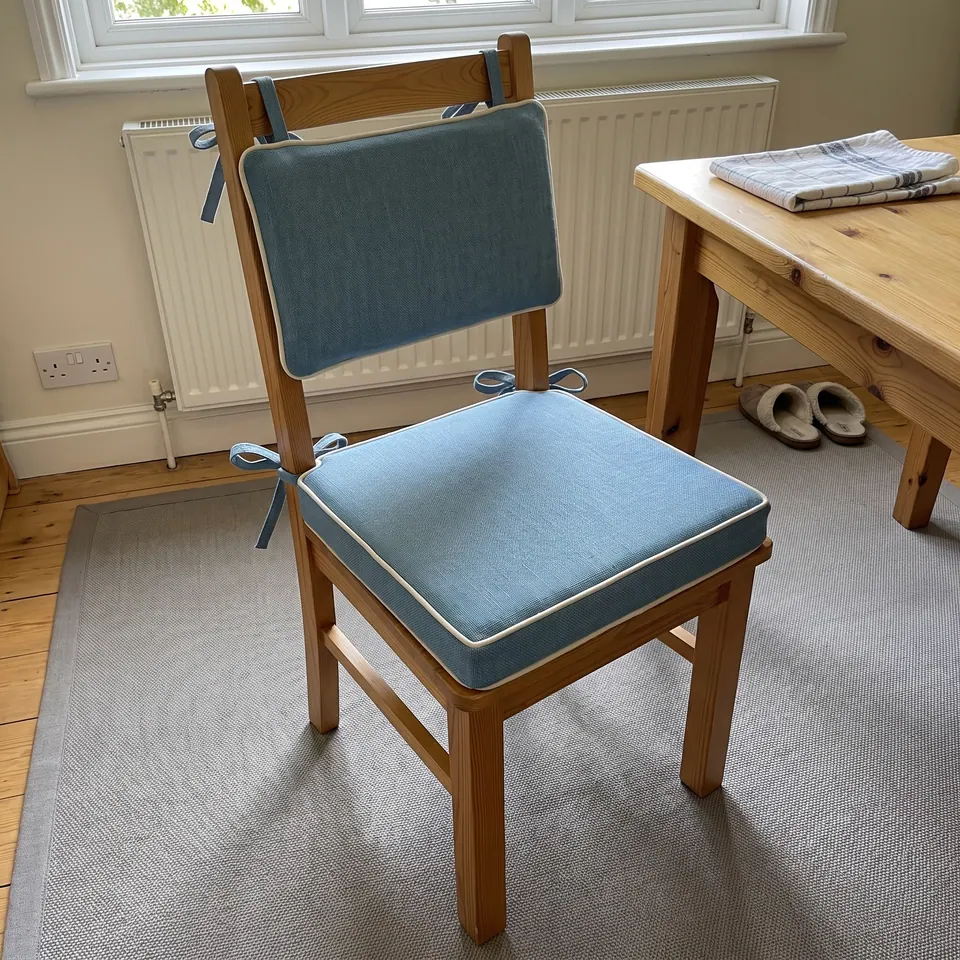
- Custom seat cushions can have rounded corners, with matching back cushions.
- The fit is confirmed from your measurements and photos before the cushion is made.
- Measurements can be sent down to the ¼ in, or in cm.
- Handmade cushions can differ from the ordered size by roughly 0.5 to 1 in (1-2 cm).

Have it made
Have Nate’s workshop cut this for you
Send the numbers in inches: length × depth × thickness, plus any angle. The workshop checks them with you, because foam has no undo button. — Nate
Leave your details and the workshop will call you to confirm measurements, fabric, foam and piping. No prices, dates or payment on this page: it is a request, not an order.
The rounded-corner checklist
- Measure the full rectangle: the longest length and the widest depth, as if the corners were square.
- Find the corner point, where the two straight edges would meet if the curve weren't there.
- Measure along the front edge from that point to where the curve starts, then do the same along the side edge.
- Write both numbers on your drawing at that corner, for example 2.5 in (6.4 cm) and 2.5 in (6.4 cm).
- Repeat for every rounded corner, even the ones that look identical.
- Photograph each corner from directly above with a tape measure lying along the edges.
- For the tightest match, trace the curve on a sheet of paper and photograph the tracing next to a tape measure.
Corner measurements that leave the cutter guessing
- A length taken short of the curve instead of at the cushion's longest point.
- One curve number with no note of which edge it was measured along.
- A corner photo shot at an angle instead of from directly above.
- A tracing photographed with nothing beside it to show the scale.
Two numbers per corner, and why
A rounded corner is a rectangle with a bite taken out of it. The bite is fixed by two lengths: how far from the corner point the curve leaves the front edge, and how far it leaves the side edge. Give the cutting table those two numbers plus the rectangle, and the pattern can be drawn. Leave them out and somebody has to guess.
Equal numbers, say 2.5 in (6.4 cm) on both edges, make an even round. Unequal numbers are fine too; just write each one on the edge it belongs to. Measure twice; the fabric remembers.
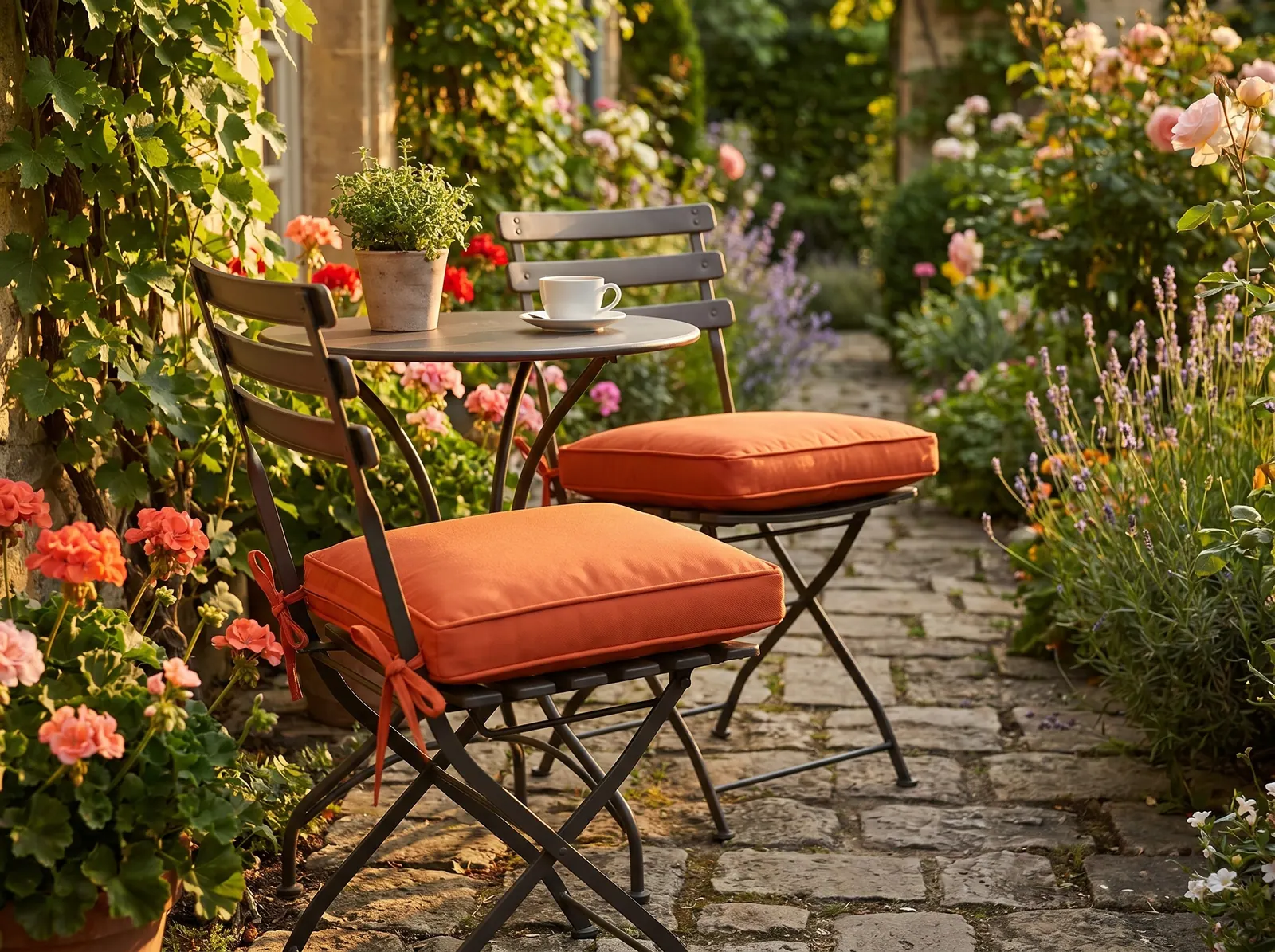
The same method covers dining chair cushions with slightly rounded seats. The workshop makes custom seat cushions with rounded corners, plus matching back cushions, once your measurements and photos confirm the fit. The rounded corner measuring Pattern has the diagrams, and the dining chair pad Pattern covers the rest of the seat. How far in from the corner does your curve start?
Measure a cushion with rounded corners as a full rectangle first, then note where each curve starts along both edges, counted from the corner point.
Nate
Buyer questions
- A common question
How do I measure the rounded corners on my current cushions so the new covers fit?
The workshop's answerMeasure the cushion as a full rectangle at its longest and widest points. Then, for each rounded corner, measure how far from the corner point the curve begins along both edges, for example 2.5 in (6.4 cm) on each side. A top-down photo of each corner with a tape measure along the edges helps, and a paper tracing photographed next to a tape measure is even more precise.
- A common question
My dining chair seats have slightly rounded corners. Can new cushions follow them?
The workshop's answerYes. The workshop makes custom seat cushions with rounded corners, and matching back cushions too. Send measurements and photos so it can confirm the fit before anything is cut.
- A common question
Can you make a floor cushion shaped to fit a curved reading nook?
The workshop's answerYes. Send the shape, the measurements and a few room photos before ordering. For a curve, the workshop needs the lengths of the two straight sides, and it confirms any size-based customization fee up front.
- A common question
How should I label the sides on my cushion drawing?
The workshop's answerWrite a length on every edge using letters, A to D, plus E and F for clipped corners, and add the depth and thickness. Pick the nearest size range; the workshop checks the geometry and sends a full list to confirm before cutting.
Questions buyers ask next
Is a paper tracing worth the extra five minutes?
For a curve, yes. Lay paper over the corner, trace the round, and photograph the tracing flat beside a tape measure so the scale reads clearly. Send it with the rectangle measurements; it is the most precise record of the curve you can give.
What if my corners are clipped straight rather than rounded?
A clipped corner is a short straight edge, not a curve, so it gets its own letter on the drawing, E or F, next to sides A to D. Write its length, and the workshop checks that the geometry closes before cutting.
Should the back cushions get rounded corners to match the seat?
They can. Custom seat cushions with rounded corners are made with matching back cushions. Send measurements and photos of both the seat and the back so the workshop can confirm the fit before either piece is made.