The Cutting Table · a checklist answer
Should I measure my old cushions or the bench itself?
Also asked as:what dimensions should I sendthe bench or the existing cushion
Two honest answers, partner, and one question decides between them: do the old cushions fit? Here is the checklist, then the one mistake it prevents.

 Save
The quick answer
Measure your old cushions only if they fit the bench well; if they don't, or you want a different thickness, measure the bench. For replacement covers on foam you're keeping, measure the bare foam insert, not the old cover, and label every side plus the thickness. Note any Dacron wrap separately so nothing is guessed.
Get a quote for an outdoor bench cushion
Key facts
- If the old cushions fit well, send their dimensions.
- If they fit poorly, or the thickness is changing, send the bench or seat dimensions.
- For covers on foam you already own, measure the bare foam, not the old cover.
- Draw the insert with every side labeled, plus its thickness.
- A remake of chair-pad covers that came out about 3/4 in (2 cm) short was cut 3/8 to 3/4 in (1 to 2 cm) larger, with longer ties.
- Replacement covers are quoted from insert sizes plus photos of your current color, and the closest velvet code can be suggested.

Have it made
Have Nate’s workshop cut this for you
Every edge and both diagonals, to the nearest 1/4 in. If the numbers do not close, the workshop will say so on the call. — Nate
Leave your details and the workshop will call you to confirm measurements, fabric, foam and piping. No prices, dates or payment on this page: it is a request, not an order.
Run this before you send numbers
- Sit on the old cushion. If it fits edge to edge at the right height, its size is your order size.
- If it gaps, overhangs, or you want it thicker or thinner, set it aside and measure the bench.
- Covers only? Unzip the old cover and measure the bare foam: length, width, thickness.
- Draw the insert from above and label every side, even the ones that look equal.
- Write any Dacron wrap and its thickness beside the foam size.
- Photograph the old cover in daylight so the closest color can be suggested.
What not to copy
- The old cover. Measure the foam it was hiding.
- A cushion that never fit. Copying it repeats the mistake.
- Only the two longest sides of a tapered pad. A slight trapezoid needs all four.
The chair pads that came out short
A buyer wrote in needing new covers for shaped dining chair pads: a slight trapezoid with rounded front corners, 17 3/4 x 17 x 19 3/4 x 17 in (45 x 43 x 50 x 43 cm), about 1 1/2 in (4 cm) thick. The first covers came out about 3/4 in (2 cm) short. The remake was cut 3/8 to 3/4 in (1 to 2 cm) larger, with longer ties.
- Measured
- 17 3/4 x 17 x 19 3/4 x 17 in · 1 1/2 in thick
- What it taught
- Label every side of a shaped insert and measure the foam itself.
The Dacron question
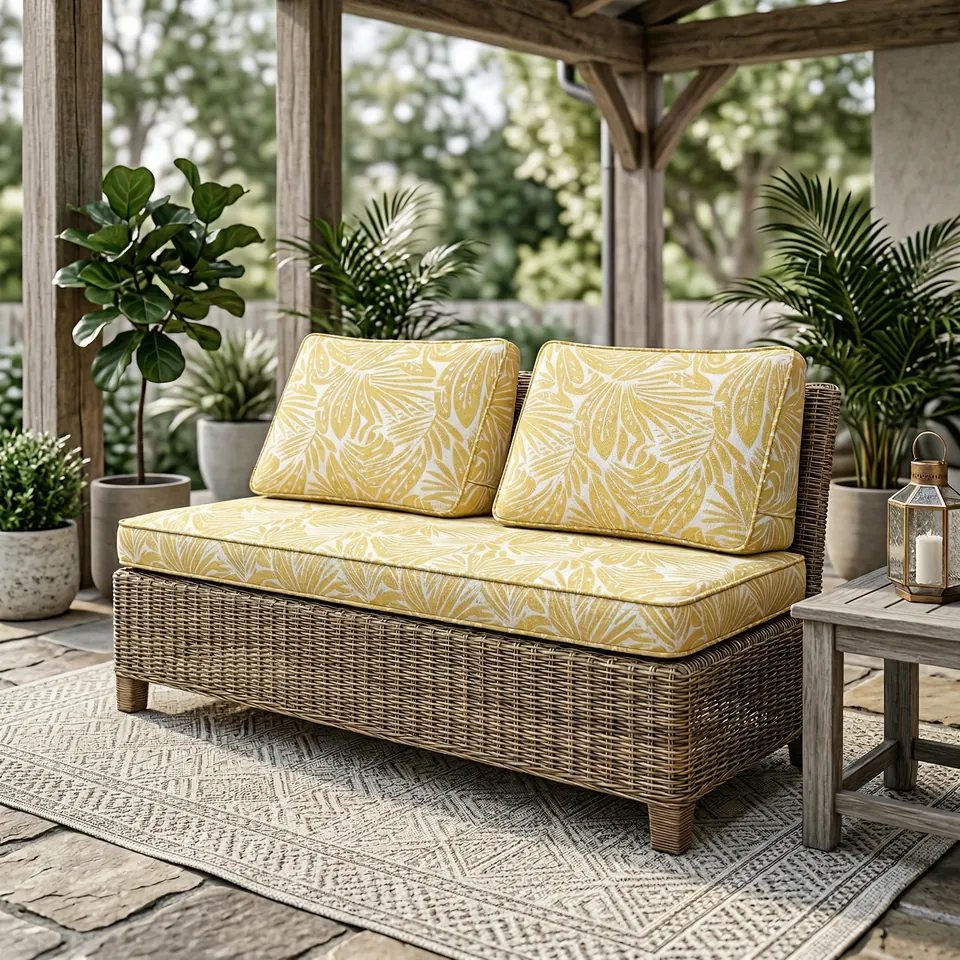
Buyers ask whether the batting wrap counts. The safe answer: give the foam's own size and write the wrap thickness beside it. The covers-only pattern shows the drawing, and the outdoor cushion atlas covers patio benches like the one above. What does your foam measure with the cover off?
Copy an old cushion's size only when the old cushion fits edge to edge; if it gaps or the thickness changes, measure the bench instead.
Nate
Buyer questions
- A common question
Do you want the bench measurements or the old cushions'?
The workshop's answerIf you're happy with how the current cushions fit, send their dimensions. If they don't fit well, or you want a different thickness, send the bench dimensions instead.
- A common question
Can you make new covers for the foam inserts from my vintage sofa?
The workshop's answerYes. Send the exact size of each insert and photos of your current fabric color. The workshop quotes the covers and can suggest the closest velvet code.
- A common question
Will you confirm my replacement size with a drawing first?
The workshop's answerYes. A drawing of your dimensions comes back for approval, and the cushion is made exactly to that layout, strictly to your numbers.
Questions buyers ask next
Can I change the thickness when I replace bench cushions?
Yes, but then the old cushion is no longer your template. Measure the bench for length and depth, choose the new thickness, and order a cover sized to that foam, since a cover is sewn for one thickness.
What if my foam insert is a trapezoid?
Draw it from above and write all four sides, plus the depth and the thickness. Even a small taper changes how a cover fits, so don't round the shape off to a rectangle.
Does the Dacron wrap count in the foam size?
Give the foam block's own size and write the wrap's thickness beside it, for example 5 x 23 1/2 x 29 in foam with a 1 in wrap. Then nothing has to be guessed at the cutting table.