 Save
A Reading by CallumOutdoor & Water-Repellent Cushions
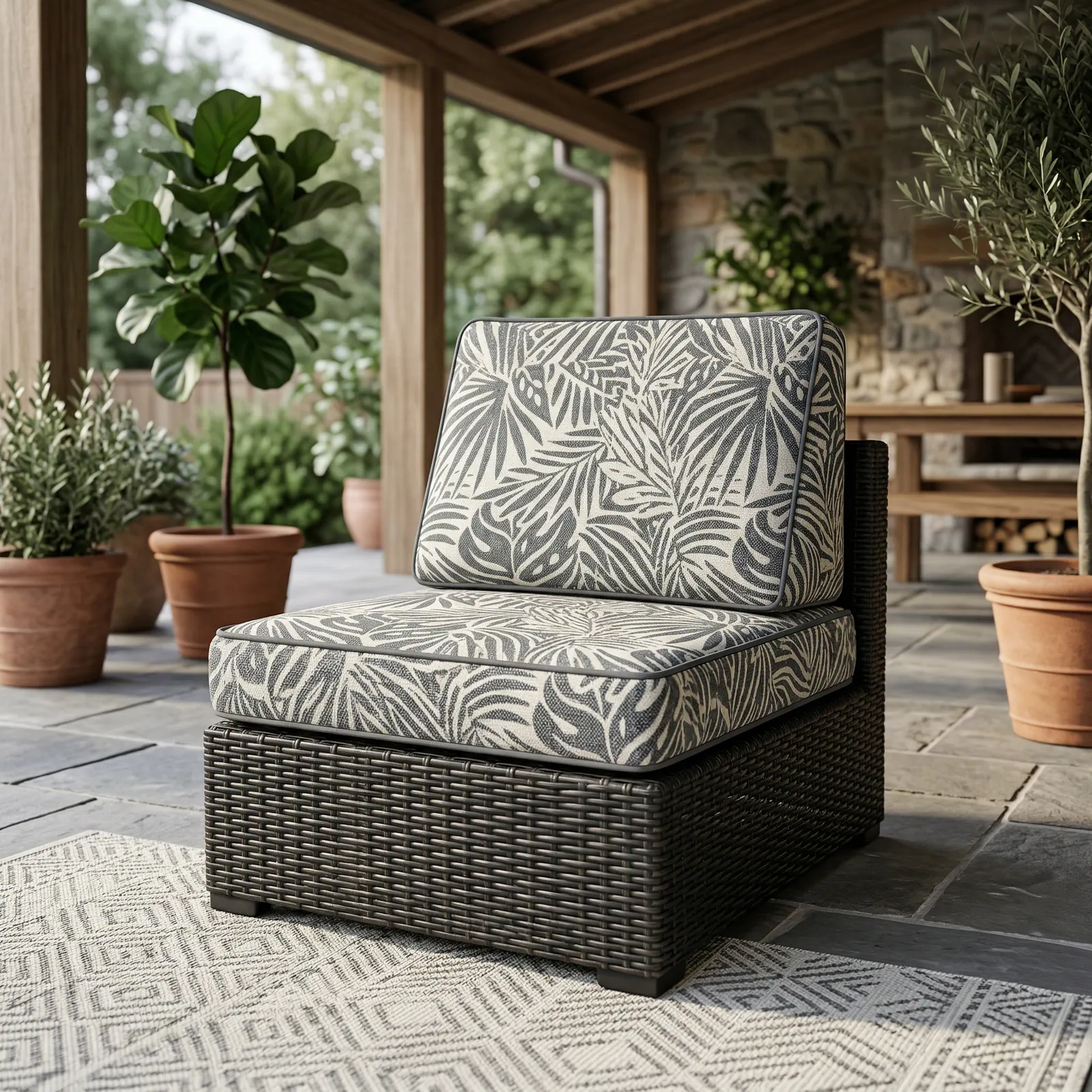
Box edge or knife edge? Outdoor cushion shapes on a palm-leaf chair
A print this bold makes you choose. Box edge or knife edge, square corners or round, and every choice moves where the leaves land and where the rain gets in.
Swatch strip measured from the photograph
- umber#534e3e28%
- espresso#2b241824%
- taupe#918d7b19%
- oatmeal#bab5a917%
- linen#cecac112%
The quick answer
For an outdoor bench cushion or chair seat, a box edge holds its shape longest and lets a print run down the front band, while a knife edge is softer, simpler and uses less fabric. Water-repellent cloth lets rain in first at seams and zippers, so fewer seams help in the open.
Five pins on a covered porch
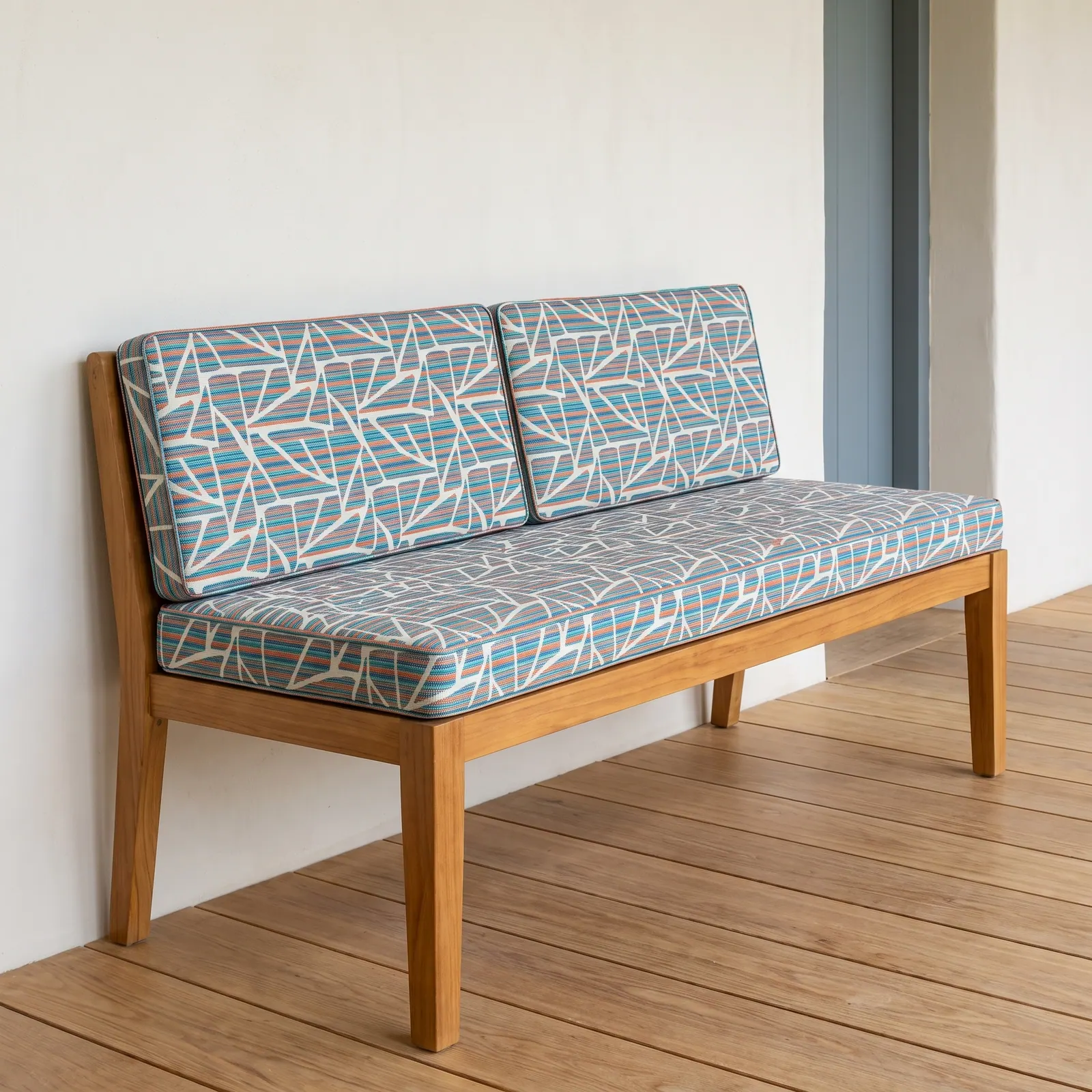
Five pins on one armless chair, from the leaf spray to the terracotta pot.
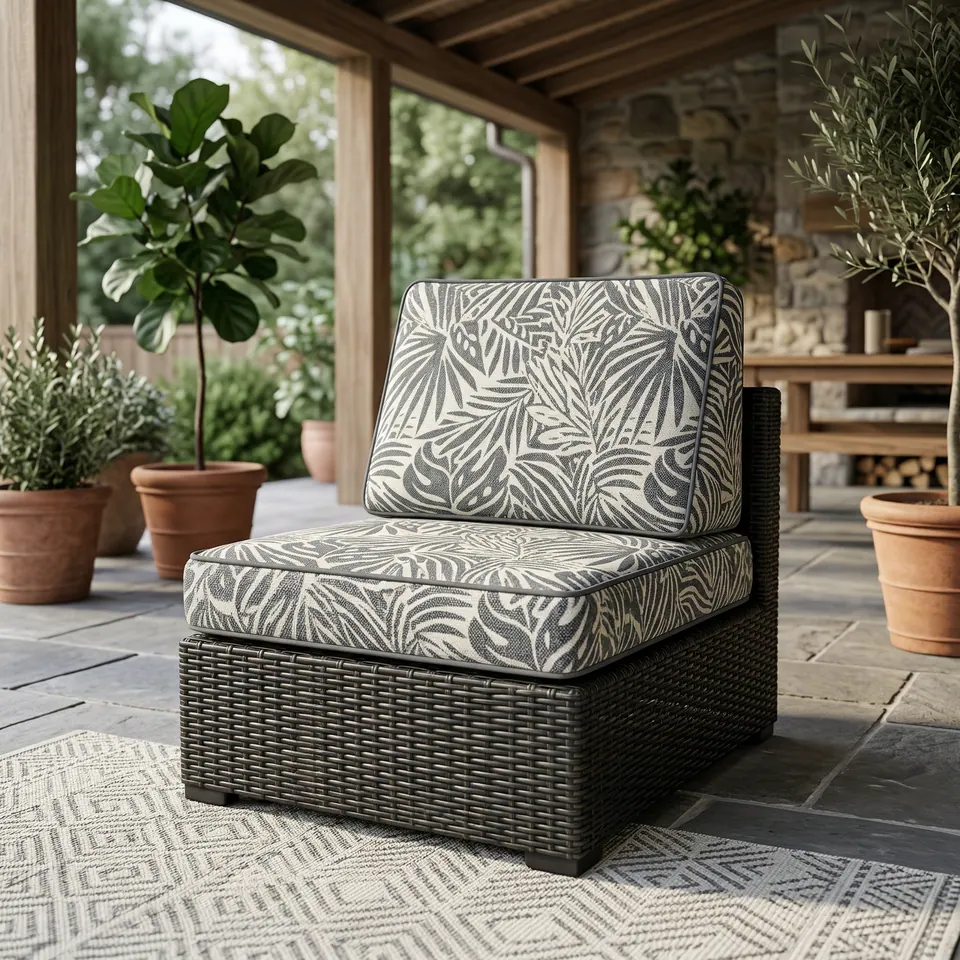
- Centered leaf spray
The print is placed so a full palm cluster lands on the back cushion.
- Charcoal piping
Repeats the darkest ink in the print and ties the cushions to the dark rattan.
- Box seat cushion
The pattern runs from the top face down the front boxing.
- Fiddle-leaf fig
Real leaves beside printed ones reinforce the tropical theme.
- Terracotta planter
Adds warmth to a gray-and-white palette.
- Centered leaf sprayThe print is placed so a full palm cluster lands on the back cushion.
- Charcoal pipingRepeats the darkest ink in the print and ties the cushions to the dark rattan.
- Box seat cushionThe pattern runs from the top face down the front boxing.
- Fiddle-leaf figReal leaves beside printed ones reinforce the tropical theme.
- Terracotta planterAdds warmth to a gray-and-white palette.
Why the seat is boxed and the leaves run over the edge
On a single armless chair the back cushion is seen first, so the print is placed to center a full palm cluster on it. A leaf cut in half at the top seam would look like a mistake from the garden path.
The seat has a box edge, a separate side band between top and bottom, and the pattern runs off the top face and down the front band without a break. Charcoal piping sits in both seams and repeats the darkest ink in the print, tying the cushions to the dark rattan. A knife edge, two panels sewn at the middle of the side, would have split the leaves at the seam and given a softer, pillowy profile.
Terracotta pots of fiddle-leaf fig, olive and rosemary bring the only warmth to a gray-and-white palette, and real leaves beside printed ones make the theme look grown, not bought. The geometric rug carries the ivory underfoot. The stone wall and timber posts say covered porch, friend, and that matters more than any of it. Is yours covered, or open to the sky?
Four edges and corners, weighed for weather
| Edge or corner | What it is | Outdoors |
|---|---|---|
| Box edge | Top, bottom and a side band | Holds its shape, frames a print; two seams |
| Knife edge | Two panels, one seam around the middle | Softer, simpler, less fabric; one seam |
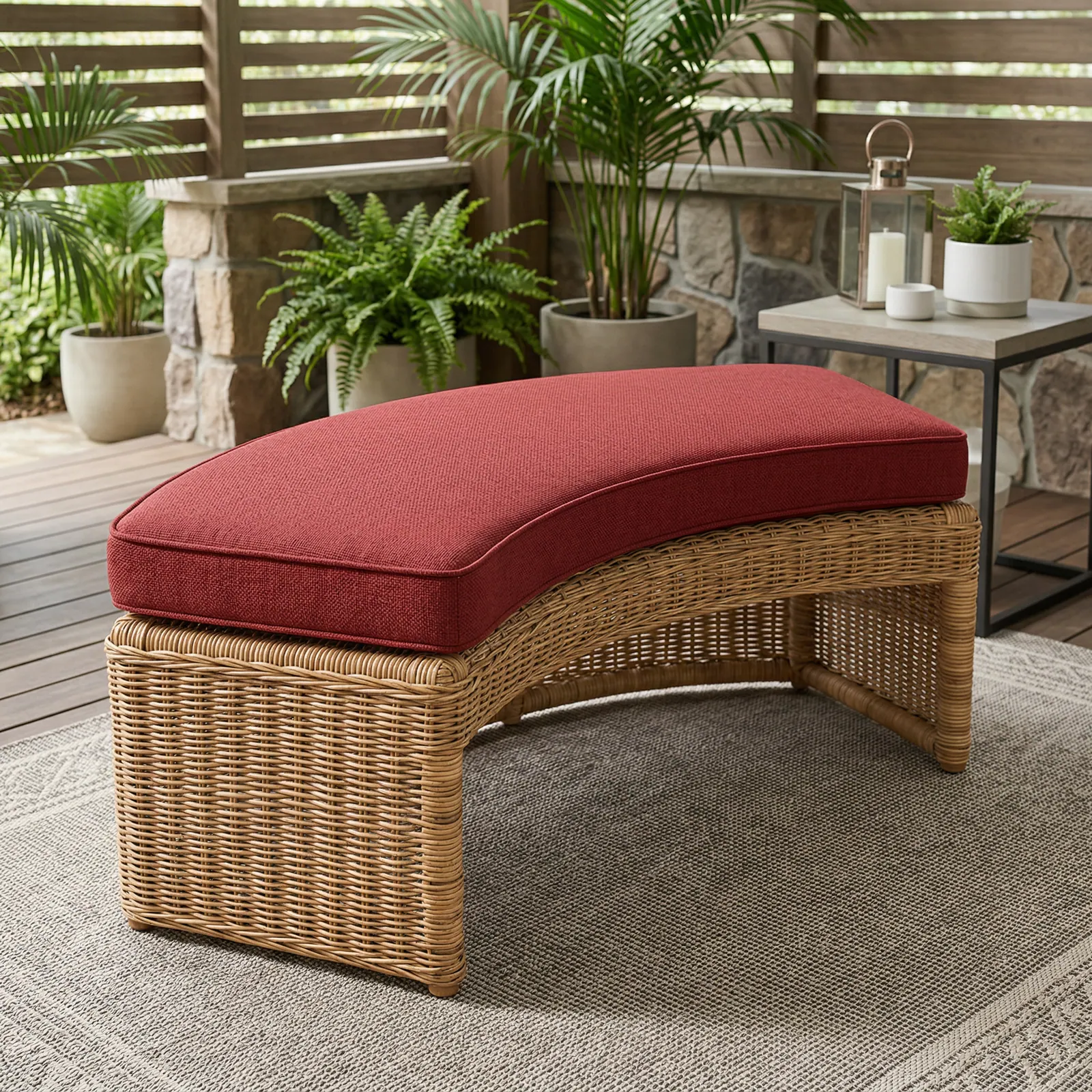
| Rounded corners | Corners cut on a radius | Follow wicker and curved frames |
| Clipped corners | A corner cut off at an angle | Clear a post or a bay angle |
Storage benches split at the lids, one run off square
A buyer in the US, in a climate with hot summers and snowy winters, sent drawings of outdoor storage benches with lift-up lids and backrests and asked for the seats split at the lid lines. One run was about 1 1/2 in (4 cm) off in depth, so the workshop asked for a separate full drawing of every piece.
It also told her straight what it does not offer: no big-name outdoor brand, no fast-drying mesh bottom, no quick-dry foam. Its UV-resistant, water-repellent outdoor fabric suits a covered porch or cushions stored for winter. She asked for close-ups of eight outdoor codes, chose HM-21, and the order covered 3 in (7.5 cm) seats, two of them 45 1/2 in (116 cm) long, plus full back pillows and long round lumbars. Bring them in before the first frost and they'll forgive you everything.
- Sizes
- Several sections, including two 45 1/2 in cushions; 3 in thick
- Fabric
- Outdoor fabric, code HM-21
The lesson: Sectioned seats over storage lids need every piece drawn separately, especially when one run is off square.
Three outdoor questions, answered plainly
- A common question
Can I use the linen or velvet cushions outside?
The workshop's answerNo. Those indoor fabrics aren't for outdoor use. Outdoor cushions and backrests come from the outdoor range, with more than 100 colors; the workshop canceled and refunded one indoor order so the buyer could reorder correctly.
- A common question
Can you put ties on the bench cushions and the backrests?
The workshop's answerYes, on seats and backrests alike. There is usually a small extra charge, though they are sometimes added free. On chair pads you choose the spot, for example 4 1/2 in (11.5 cm) in from the back corners to meet the chair braces.
- A common question
What is the fabric code of the cushion in your photo?
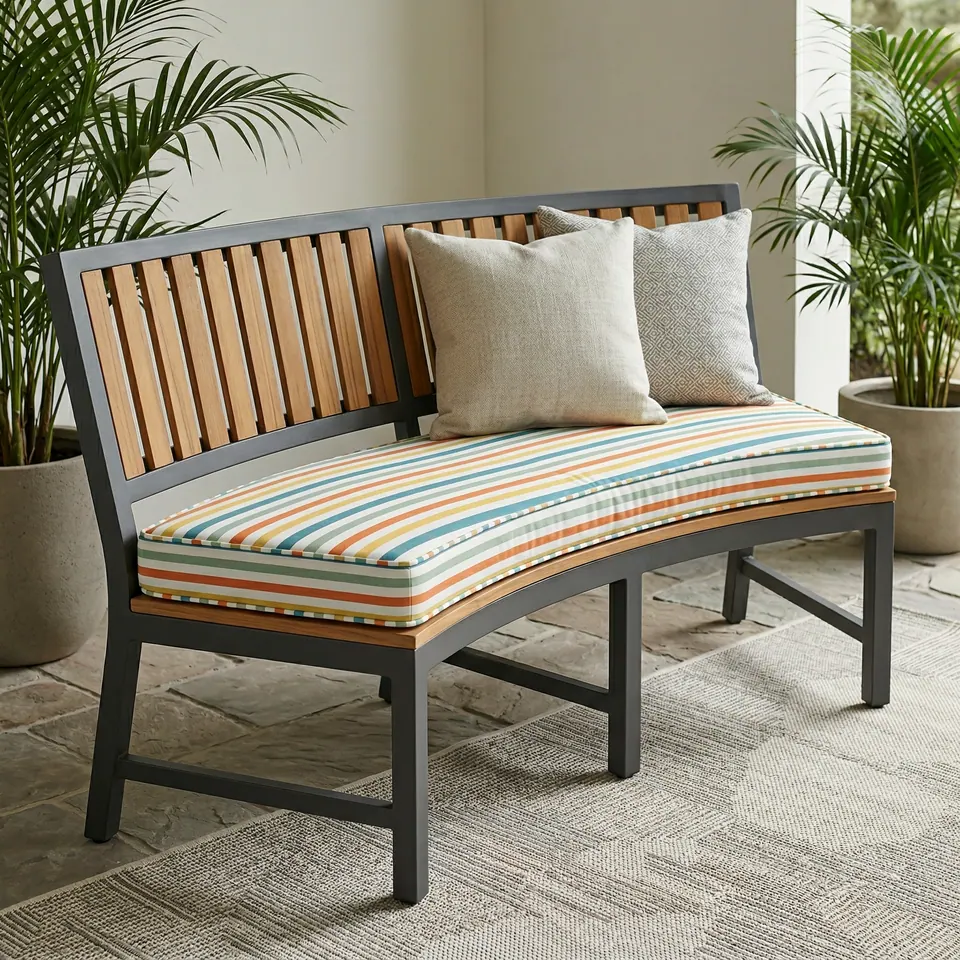
The workshop's answerAsk, and the workshop sends the code with a close-up. The wide blue, beige, sand and white outdoor stripe is V-38; one customer photo's green was Teddy 18 (922 also possible), and the thin green stripe was N-21.
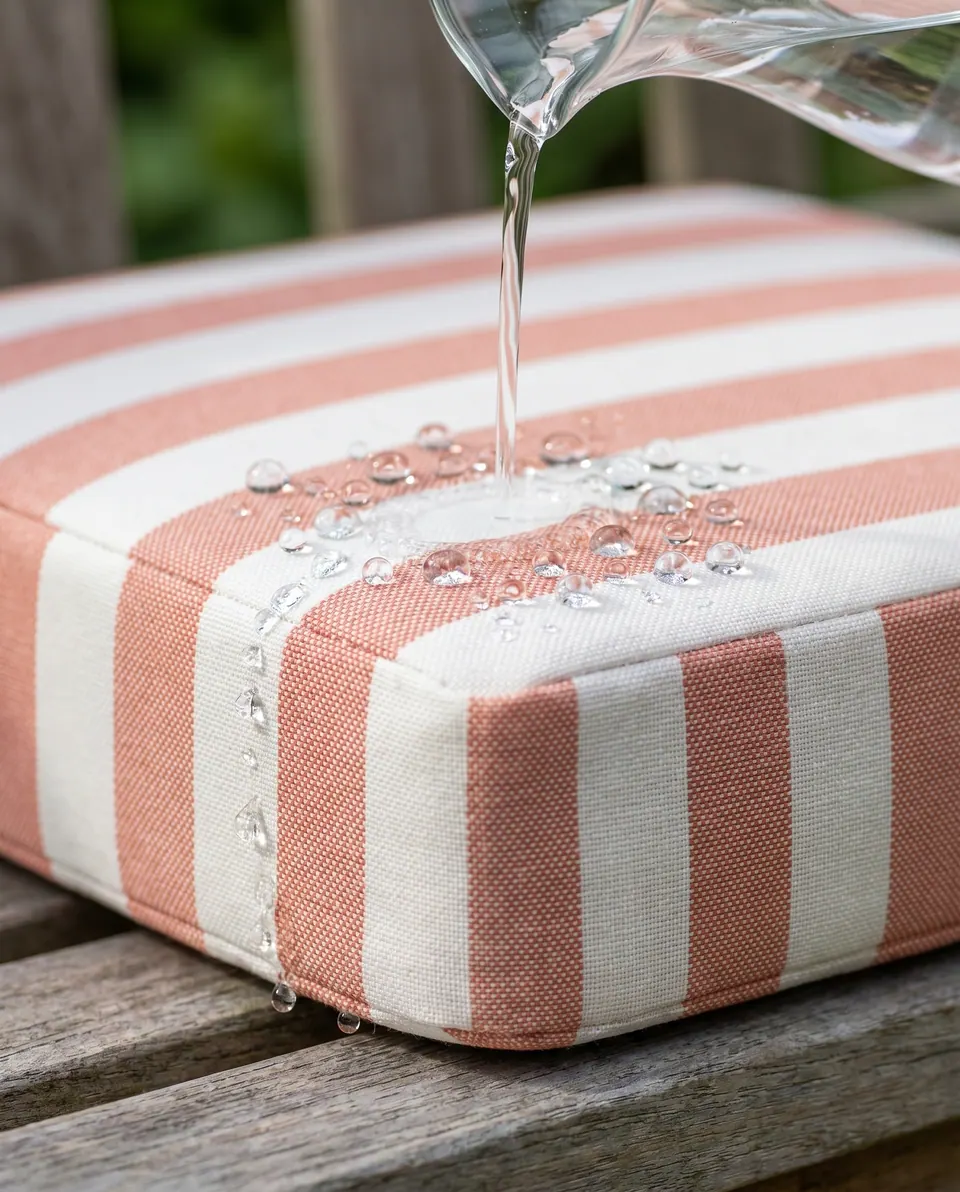
On an outdoor cushion, water-repellent fabric gives way first at seams and zippers. A box edge has two seams around it; a knife edge has one.
Callum
On the cutting table: the palm-leaf pair
| Cushions | Seat and back cushion, armless rattan chair |
|---|---|
| Fabric | Charcoal and ivory palm-leaf pattern, outdoor-rated |
| Piping | Charcoal contrast, both seams |
| Seat edge | Box edge; the pattern runs down the front band |
| Pattern placement | Full leaf spray centered on the back cushion |
| Best for | Covered porches; store for winter |
Have it made
Have this made — ask Callum’s workshop
Tell them where it lives. Porch, deck or boat: the weather picks the fabric and the foam before anyone else does. — Callum
Leave your details and the workshop will call you to confirm measurements, fabric, foam and piping. No prices, dates or payment on this page: it is a request, not an order.
Questions buyers ask next
Is a knife edge or a box edge better for outdoor cushions?
A box edge holds its shape longer and suits prints that run over the front; a knife edge is softer and simpler, with one seam. On an open patio, fewer seams mean fewer ways in for rain.
Can these outdoor cushions stay out all winter?
The workshop's water-repellent outdoor fabric suits a covered porch or cushions stored for winter. With no mesh bottom or quick-dry foam, bring cushions in before snow and freezing weather.
How do I order rounded corners on a patio cushion?
Give the corner's radius, or how far the curve runs along each side before it straightens. Tracing one corner on paper is the surest match for a wicker or curved frame.
Fair winds — Callum
More photographs to read
 Save
 Save
 Save
 Save
 Save
 Save