The Cutting Table · compared on the table
Is your linen cushion fabric really 100% linen?
Also asked as:Is the linen fabric 100% linen?Is it pure linen or linen-look?
On a cushion chart, linen is often a look before it is a fiber. Here is what each so-called linen is made of, laid out like swatches on a table.
 Save
The quick answer
Usually not: the standard linen cushion fabric is a blend or a linen-look weave, not 100% linen. Linen-look codes such as L44 are 100% polyester, the natural linen chart is 50% linen and 50% polyester, and another range is 50% cotton and 50% linen. A separate 100% linen chart and 100% cotton fabrics are available on request.
What each linen on the chart is made of
| On the chart | Fiber content | Chosen for |
|---|---|---|
| Linen-look codes, e.g. L44 | 100% polyester | Durability and easy cleaning |
| Natural linen chart | 50% linen / 50% polyester | Linen texture with easier care |
| Cotton-linen range | 50% cotton / 50% linen | Natural fibers throughout |
| Cotton linen-look | 100% cotton | A natural fiber with a linen look |
| Acrylic linen | Acrylic | Hard-working projects |
| Soft fabric | Poly-cotton blend | Thick, soft, easy to clean |
| Striped and ticking | 100% cotton | Classic stripes in a natural fiber |
| Separate linen chart | 100% linen | Pure fiber, sent on request |
Key facts
- The standard linen fabrics are not 100% linen.
- Linen-look codes such as L44 are 100% polyester.
- The natural linen chart is 50% linen and 50% polyester.
- One range is 50% cotton and 50% linen.
- A separate 100% linen chart and 100% cotton fabrics are available on request.
- A sturdy acrylic linen is recommended for hard-working projects.
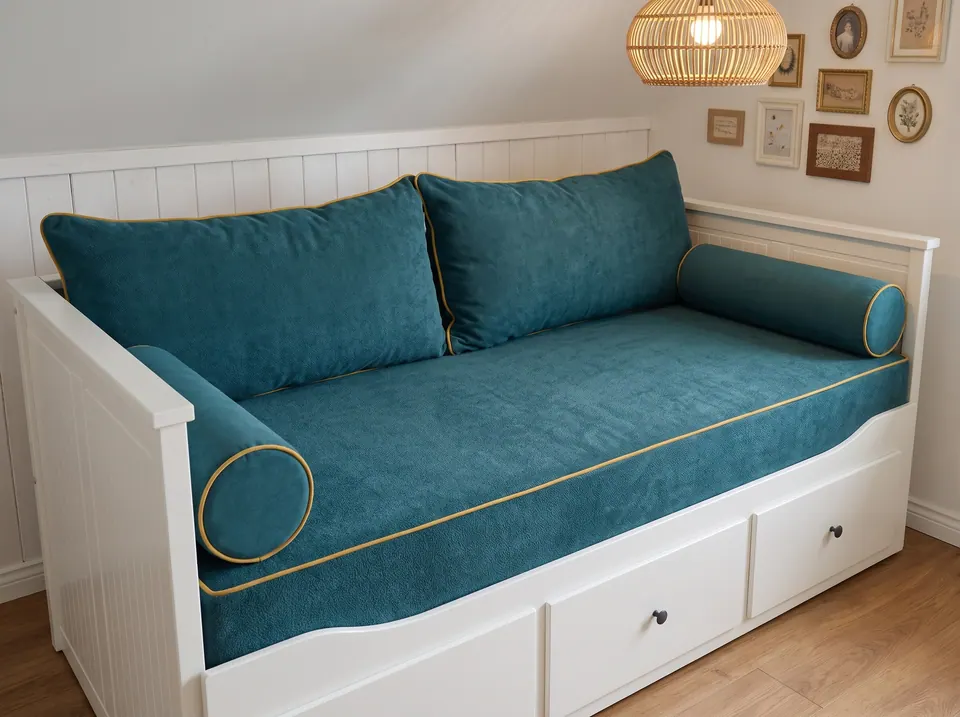
- The daybed cover set is made in velvet and soft fabric, not linen.
Have it made
Have Élodie’s workshop cut this for you
A fabric reads one way at noon and another at dusk. Mention your light, and the workshop will weigh it with you. — Élodie
Leave your details and the workshop will call you to confirm measurements, fabric, foam and piping. No prices, dates or payment on this page: it is a request, not an order.
Why the chart says linen and the label says polyester
Most of what sits on a cushion chart as linen is linen in look, not in fiber. The everyday codes are blends or linen-look weaves, picked because they are durable, easy to clean and the colors buyers reach for most. Replies over the years have described the same shelf in different words, so the honest answer always comes from your exact fabric code.
If you want the dry, slubbed character of the real thing, ask for the separate 100% linen chart, or start in the linen and cotton-linen family. The daybed cover set, for the record, is velvet and soft fabric. The real linen vs linen-look Pattern compares how each wears.
Daylight never lies; your screen sometimes does, my friends, so judge an oatmeal or a washed flax by a window, not a monitor. Which matters more to you, the fiber or the look?
Getting the fiber you actually want
- Ask for the fiber content of your exact code, not the family name.
- Want pure fiber? Request the separate 100% linen chart.
- Want a natural fiber with the linen look? There is a 100% cotton version.
- Want a stripe? The striped and ticking fabrics are 100% cotton.
- Hard-working bench? The sturdy acrylic linen is the workshop's pick.
Linen on a cushion chart is often a blend, 50% linen with 50% polyester or 50% cotton with 50% linen; pure linen lives on its own chart.
Élodie
Buyer questions
- A common question
Is the linen on your chart pure linen?
The workshop's answerNo. The standard linen is a linen-look polyester, like the velvet, chosen because it is durable, easy to clean and a best seller. Separate charts of real linen and 100% cotton fabrics are sent if you ask, and the striped and ticking fabrics are 100% cotton.
- A common question
Is the daybed cover set made in 100% linen?
The workshop's answerNo. The daybed cover set uses the shop's velvet and soft woven fabric. If you specifically want 100% linen, the workshop sends a separate 100% linen color chart.
- A common question
Real linen or linen-look? And what are the stripes made of?
The workshop's answerBoth exist. One linen range is 50% cotton and 50% linen, another is a linen-look polyester, and all the striped fabrics are 100% cotton.
- A common question
I would rather have a natural fiber. What are my options?
The workshop's answerThe standard linens are blends, so for a natural fiber there is a 100% cotton linen-look fabric. For hard-working projects, the workshop recommends its sturdy acrylic linen.
- A common question
What is the soft performance fabric made of?
The workshop's answerA poly-cotton blend: thick, soft, durable and easy to clean. The natural linen chart is 50% linen and 50% polyester, and linen-look codes such as L44 are 100% polyester.
Questions buyers ask next
What are most custom cushion fabrics made of?
Mostly polyester or polyester blends, chosen for durability and easy cleaning: velvet, soft fabric, linen-look and corduroy. The natural choices are the 100% cotton stripes, the linen-cotton blends and the separate 100% cotton and 100% linen charts. All covers wash at 86°F (30°C).
Is there a low-sheen alternative to velvet?
Yes, linen. The velvet has a short, tight pile, and its sheen has been described both as slightly glossy and as not shiny, so ask for real-life photos. For a reliably matte surface, a linen or linen-look fabric is the calmer choice.
How many fabric families can I choose from?
Three main indoor families, linen, velvet and easy-clean soft fabric, each with a chart of roughly 40 colors. Beyond those sit teddy, corduroy, 100% cotton or linen, faux leather and a water-repellent outdoor range, and thousands more fabrics can be sourced on request.