A Reading by HarlanStar Poufs & Giant Star Floor Cushions
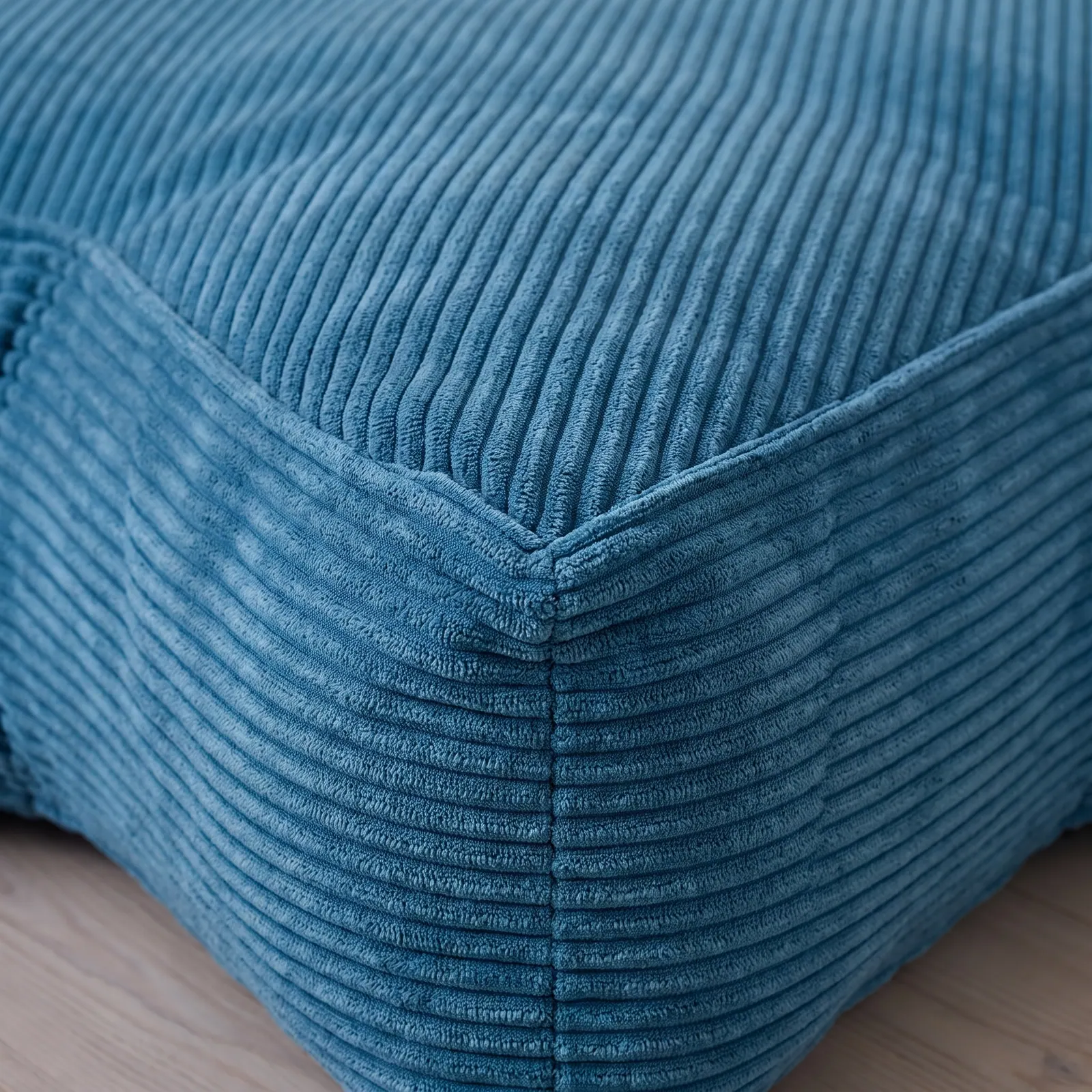
Reading one corner of a wide-wale corduroy star floor cushion
Harlan puts his nose an inch from a petrol blue star and reads what the seam, the ribs and the side light are saying about the whole cushion.

 Save
The quick answer
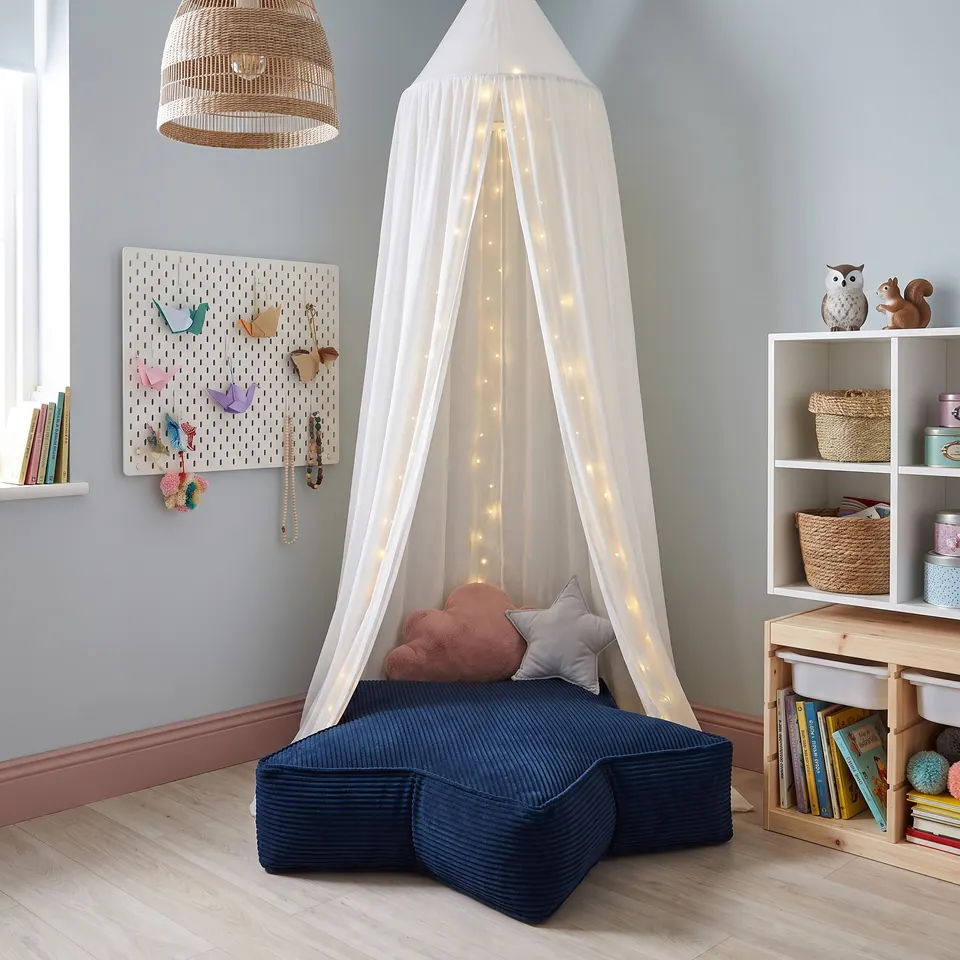
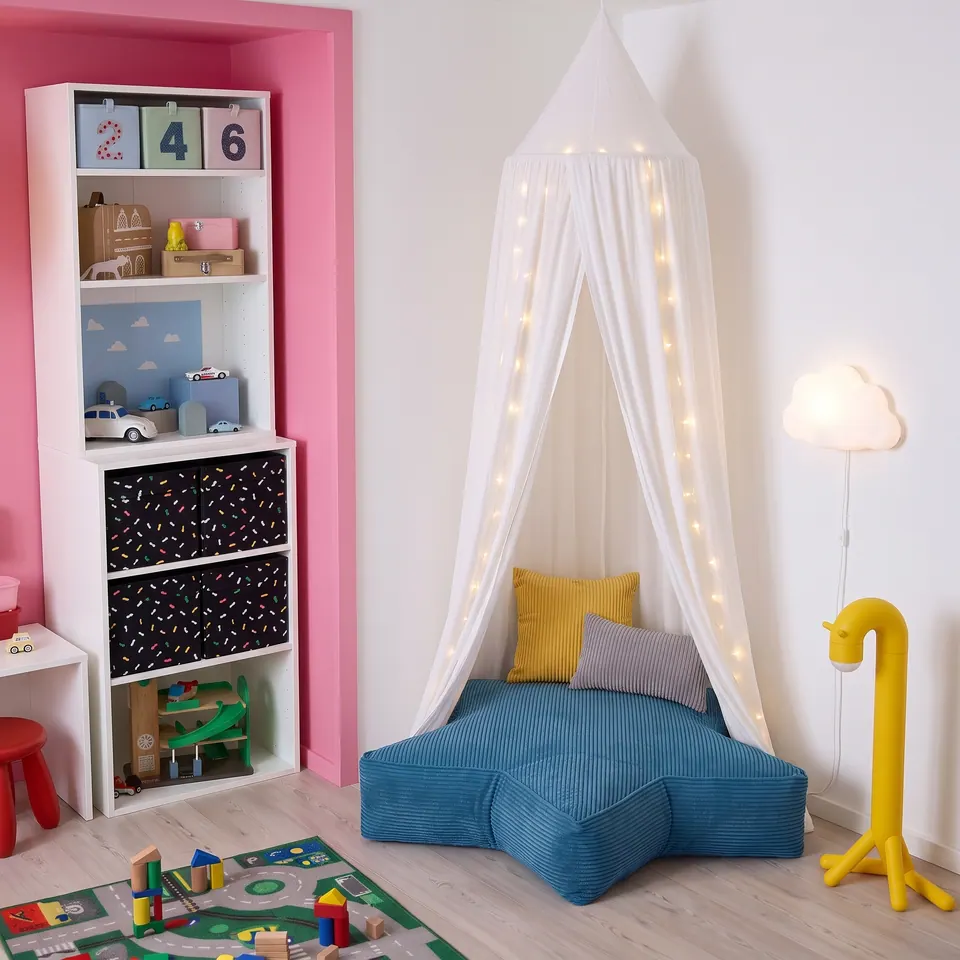
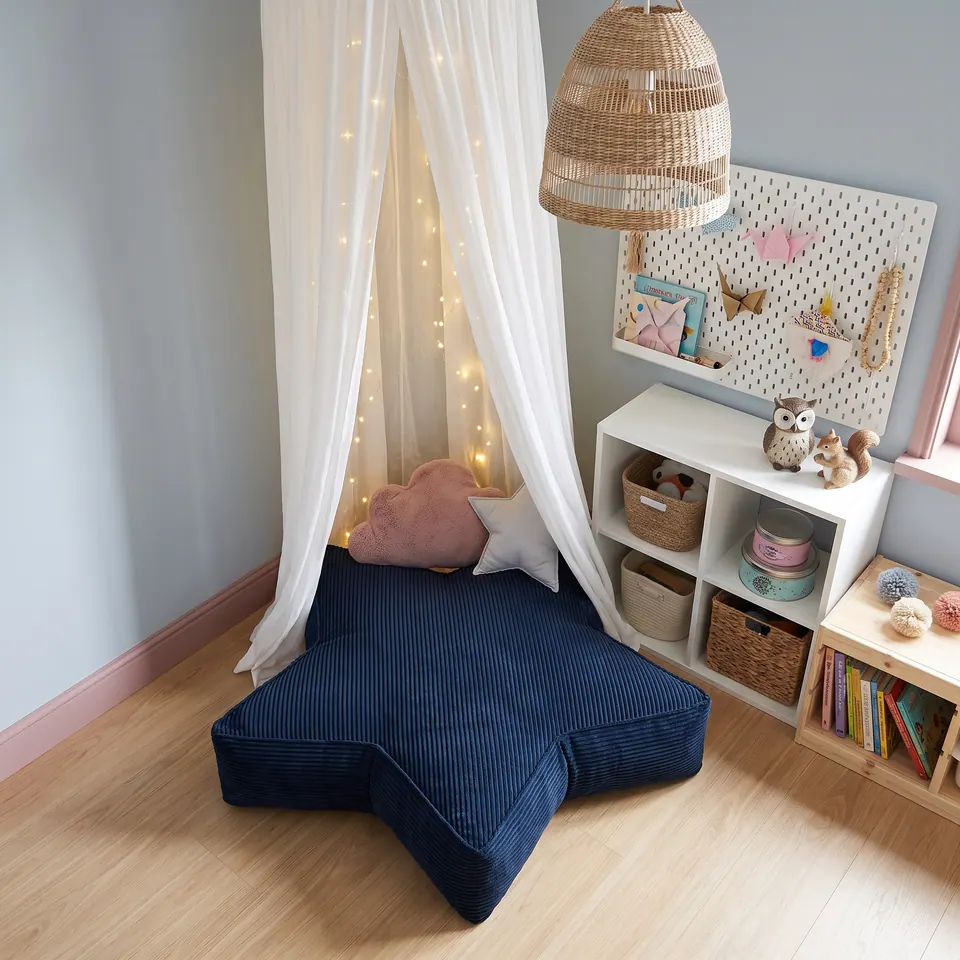
A star floor cushion is built like a box: a star-shaped top and bottom joined by side panels, with a straight vertical seam at every point. In wide-wale corduroy the top ribs run lengthwise while the side band is cut with ribs running sideways, so in raking light the two faces can look like two slightly different blues.
The cushion, cut open
Cover fabric. A removable, zippered cover. Machine wash at 86°F (30°C) on a gentle cycle and air dry.
Piping. A fabric-covered cord sewn into the seams. It sits on the seam line, so it does not change the size.
Fiber wrap. Polyester fiber (Dacron) batting around the foam: it fills the cover out and softens the edges.
Foam core. About 2.0 lb/ft³ (32 kg/m³) high-resilience foam, firm to medium-firm, cut to the ordered size.
Zipper. Along the back band, as hidden as possible. The zipper side faces down or toward the wall.
Base panel. The underside of the cover. A non-slip fabric backing can cover the whole of it instead.
What one corner says about the whole star
You can judge a star cushion by one corner, the way an old cobbler judges a boot by its heel.
This close-up shows three things meeting. The top panel, with its wide wales running lengthwise. The side band, cut so the ribs run sideways around the star. And a plain seam where they join, with no piping at all. Below, a vertical seam drops straight down from the tip, where two side panels meet.
That sideways band is no mistake, my friend. A star has a long zigzag edge, and cutting the band with the ribs running across lets one long strip travel round without extra joins. The price is that the pile leans two ways. The top catches the soft raking light one way and the side another, so the photograph shows two slightly different blues from one bolt of cloth. That is normal for corduroy, and it is why the workshop sends a photo of the actual fabric when production starts. Screens shift color; cloth in daylight does not.
Why no piping? Wide-wale corduroy already draws its own lines. Every rib is a little stripe, roughly 3 to 8 to the inch, and a cord of piping around five points and five valleys, top and bottom, would only argue with them. A plain seam lets the ribs finish the job.
The wide wale is soft and forgiving under a child who lands on it sideways, which is exactly what a star cushion is for, and the points make natural armrests. A seam is a promise, and a star asks a great many of them. The star floor cushion atlas, the corduroy shelf and the wale and nap pattern go further.
Pinned by Harlan: one corner, four seams
Start at the corner seam in the middle, then follow the pins up to the top ribs, across to the side band and down the vertical seam.
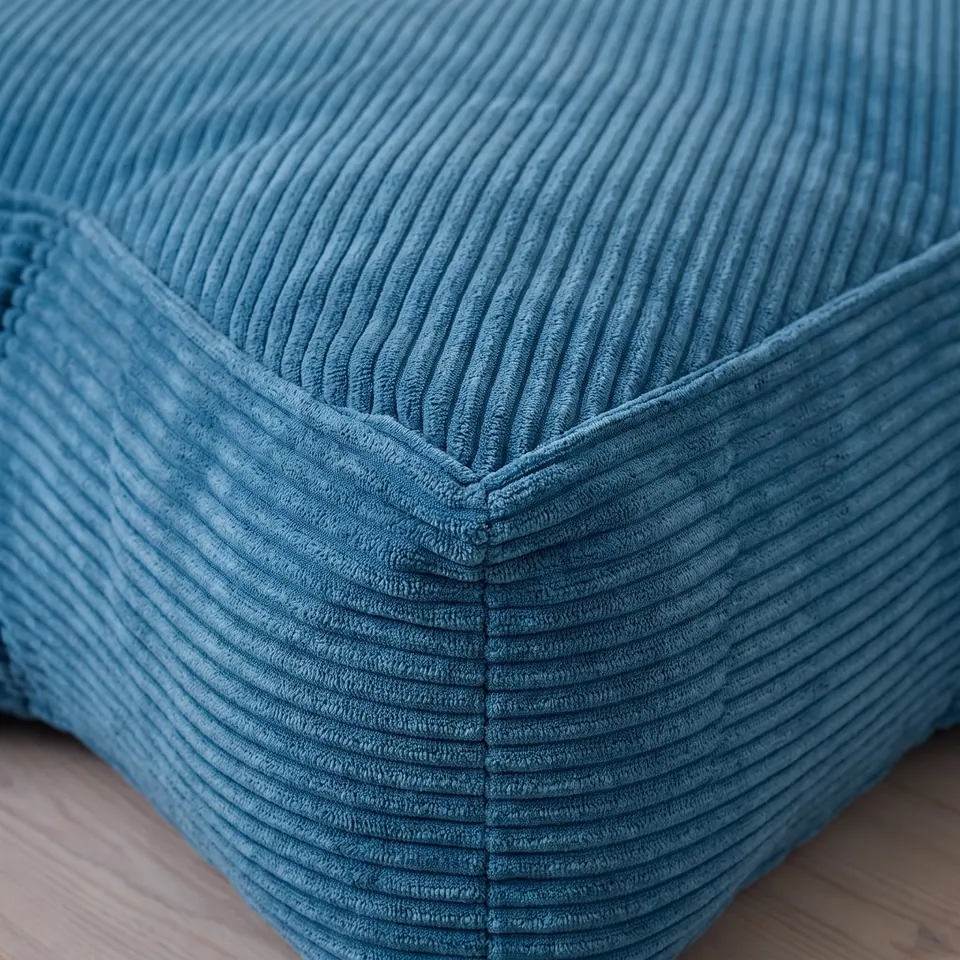
- Corner seam
Top and side panels meet at a plain seam with no piping.
- Top panel ribs
Wide wales run lengthwise across the top.
- Side panel ribs
On the side the ribs run horizontally, so the pile catches light differently.
- Vertical side seam
The side panels join straight down from the tip.
- Corner seamTop and side panels meet at a plain seam with no piping.
- Top panel ribsWide wales run lengthwise across the top.
- Side panel ribsOn the side the ribs run horizontally, so the pile catches light differently.
- Vertical side seamThe side panels join straight down from the tip.
Box, knife or plain: which edge a star can wear
| Edge | How it is sewn | What it does on a star |
|---|---|---|
| Box edge | Top, bottom and a side band, two seams around | Holds the points upright, and the band can run its ribs sideways |
| Knife edge | Top and bottom sewn straight together, one seam | Fullest in the middle and thin at the tips, so the points lose their stand |
| Plain seam | A box edge with no piping | Soft outline; the corduroy ribs draw the line |
| Self piping | A cord covered in the same corduroy, sewn into the seam | A crisper outline with no second color |
Ten cushions for a retreat, and the wisdom of ordering one
A buyer in the US was setting up a meditation space at a farm retreat. The plan was seven to ten floor cushions at 24 x 40 in (61 x 102 cm), plus more 24 x 24 in (61 x 61 cm) squares. They asked about cotton velvet, teddy and swatches.
The workshop quoted both sizes in each fabric. Teddy came in higher than the soft fabric or velvet, and a full set with a back and two arms runs about 1.8 times the price of the seat alone.
Then the buyer did the wisest thing in the whole exchange. They decided to order one cushion first, sit on it and check the quality, before the bulk run. For any group space, a studio, a classroom corner or a retreat, one sample cushion is cheap insurance. The meditation corner sketches and the zabuton sizing pattern help with sizes, and the kids' room atlas shows stars at home.
On the cutting table: the star corner
| Piece | Star floor cushion, one corner in close-up |
|---|---|
| Fabric | Wide-wale corduroy in petrol blue |
| Wale | Broad ribs, roughly 3 to 8 per inch |
| Rib direction | Lengthwise on the top; sideways on the side band |
| Edge | Box edge with plain seams |
| Piping | None |
| Side seams | Vertical, straight down from each tip |
| Sized by | Overall width across the points |
| Best for | Playrooms, kids' rooms and reading corners |

Have it made
Have this made — ask Harlan’s workshop
Old upholsterers will tell you the real cutting happens in the conversation, long before the shears come out. Tell the workshop what you sit on, and they will talk it through with you. — Harlan
Leave your details and the workshop will call you to confirm measurements, fabric, foam and piping. No prices, dates or payment on this page: it is a request, not an order.
Buyer questions: foam, fabric and a size left blank
- A common question
Is the foam inside open-cell cold foam, and what about the corduroy?
The workshop's answerYes, the foam is open-cell cold foam, the European name for high-resilience foam. The corduroy is one of the fabrics from OEKO-TEX Standard 100 certified mills.
- A common question
I ordered a floor cushion and got a refund instead. Did I only buy a sample? Is the cushion just fabric?
The workshop's answerIf no size is selected, the order is for fabric samples, not a cushion. The workshop refunded that order and asked the buyer to choose a size and order again. Floor cushions come filled, and the price rises with the size you pick.
On a wide-wale corduroy star cushion, the top ribs run lengthwise and the side band runs sideways, so one cushion can show two blues in side light.
Harlan
Questions buyers ask next
Why do the top and sides of a corduroy star look like different colors?
The ribs on top run lengthwise while the side band is cut with ribs running sideways. Pile catches light differently in each direction, so the two faces can read as two shades of the same color. It is normal for corduroy.
How is a star floor cushion measured?
By its overall width across the points, plus the thickness. The points double as armrests and backrests for children, so pick a width a child can stretch out on and enough thickness that the floor stays out of reach.
Does a corduroy star cushion need piping?
No. Wide-wale ribs already draw lines of their own, and a plain seam lets them finish the edge. Piping is a matter of taste; buyers who write to the workshop split roughly half and half on it.
Is wide-wale corduroy a good choice for a playroom floor cushion?
Yes. It is a heavy, broad-ribbed cloth made for upholstery, soft to sit on and forgiving of a hard landing. Many floor sofas and chunky floor cushions are made from it, which is why it turns up in so many kids' rooms.
Sit well. — Harlan