 Save
A Reading by HanaKids' Floor Sofas & Play Couches
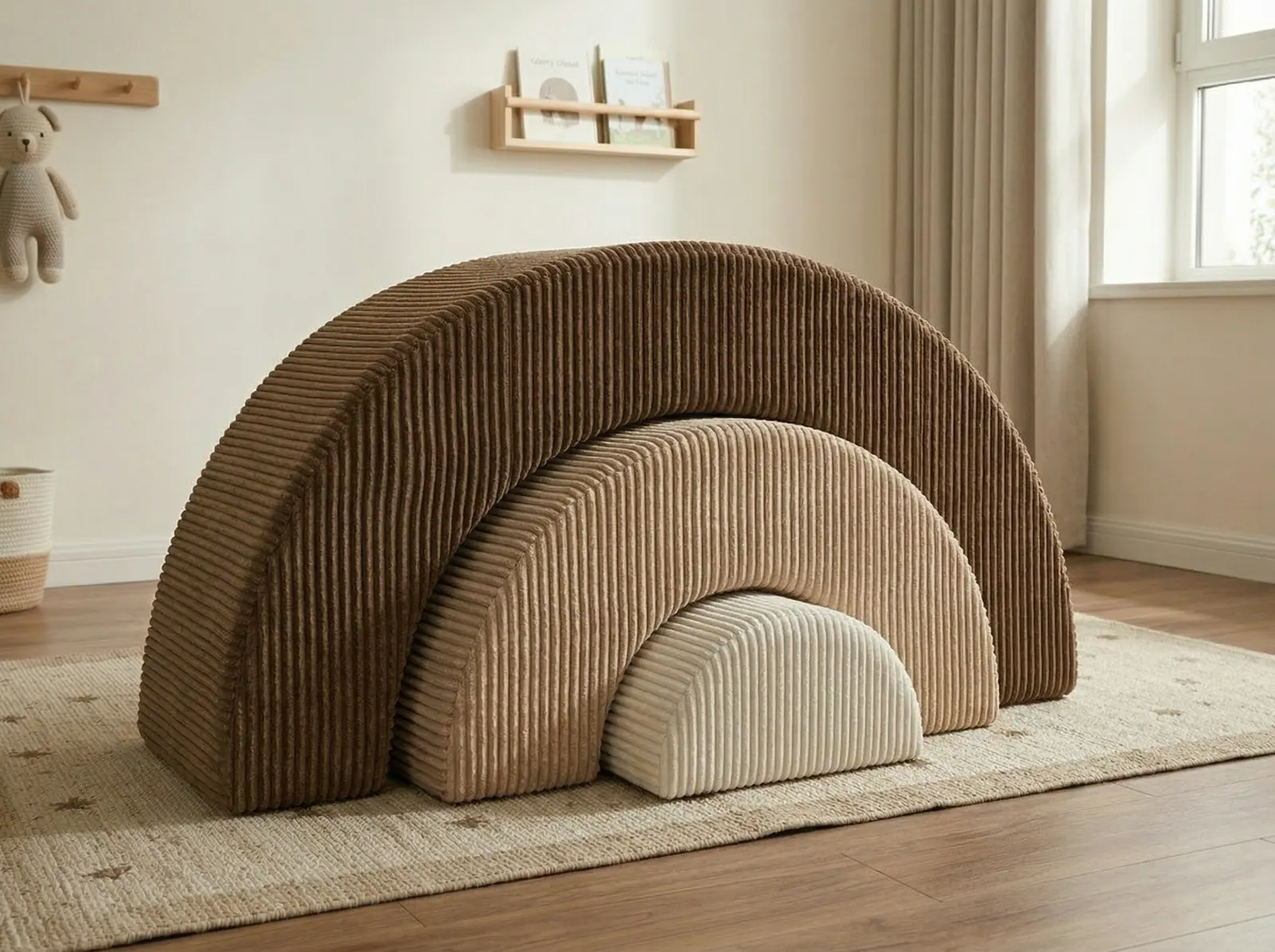
Tonal corduroy arches for a kids floor sofa corner, read from the window side
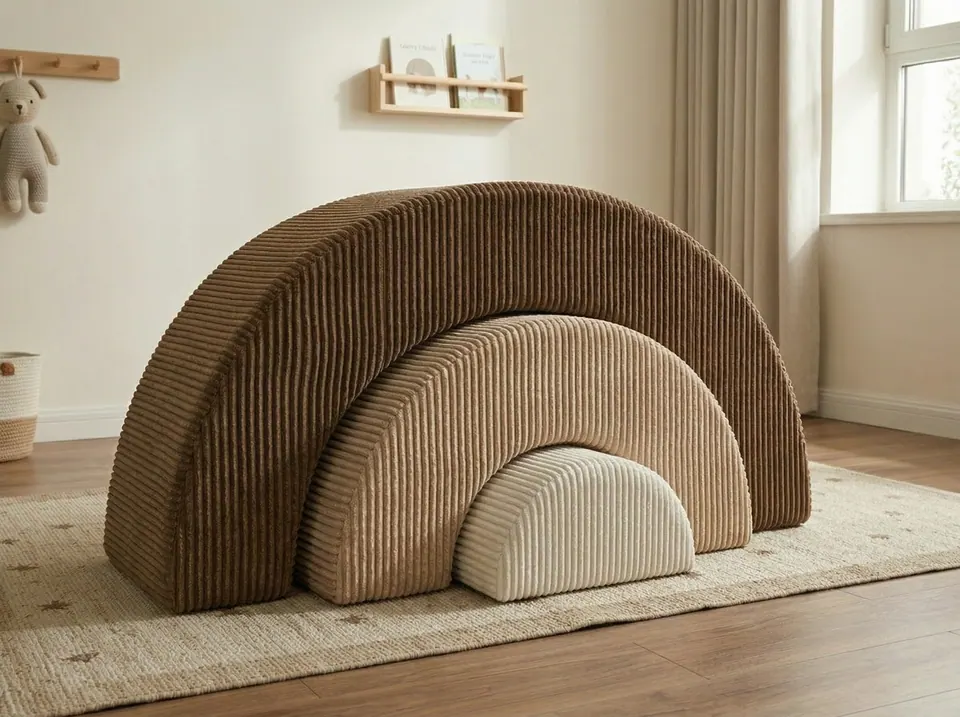
The window sits behind the arch this time. Backlight shows the gusset, the curve and the depth of each piece, and depth decides whether a child can climb it.
From the window side, the depth of each arch and the neat gusset seams are easier to judge.
The quick answer
For a kids floor sofa or nesting play arch, a box edge with a sewn gusset gives every curve the same depth, so each piece stands steady and nests without wobbling. If the arches will be bridges or tunnels, ask for one depth across all pieces, and keep the colors tonal so a small room stays calm.
Backlight finds the seam
Turn the camera toward the window and a cushion shows how it was sewn.
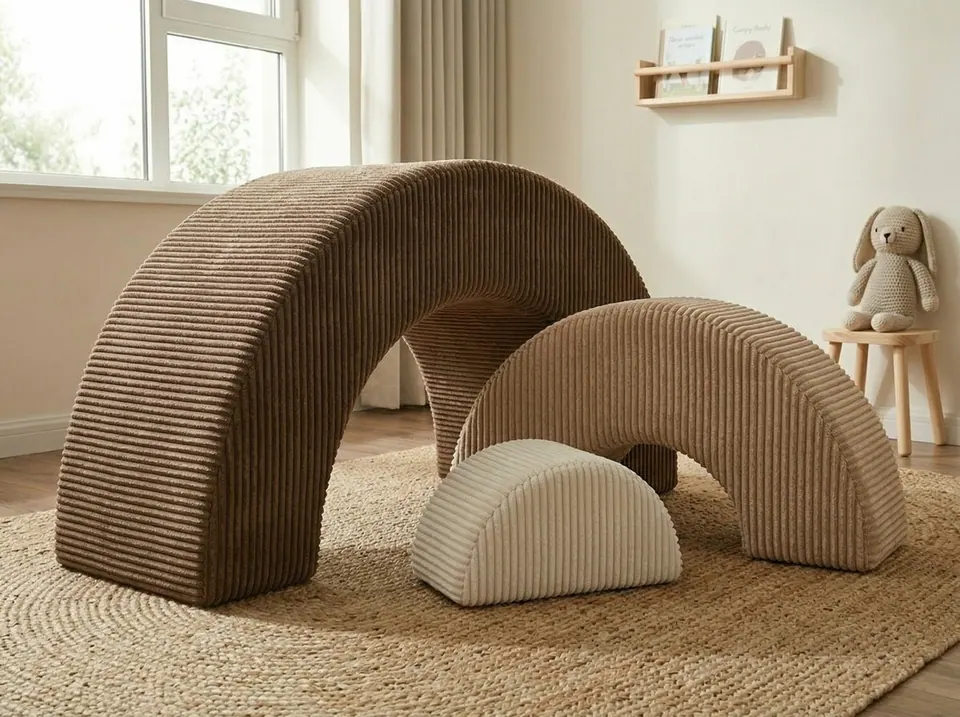
Here the light sits behind three nesting arches in corduroy. Walnut brown outside, sand in the middle, a cream dome at the center. The light runs along the top of the outer arch and finds the gusset seam. It shows as one soft line following the curve. No piping. The seam is the only edge detail, and it is enough.
This is a box edge bent into a rainbow. The gusset is a flat band between the two faces, so each arch keeps the same depth all the way around. That depth matters more than color. A deeper arch stands steadier when a child climbs over it. Children measure comfort with their whole body.
The sand arch and the cream dome share the outer piece's depth. So they stand level as a bridge, and the dome sits flush inside the sand arch without rocking.
Three tones of one cloth keep a small room quiet. Corduroy wale catches light in lines, so even the cream shows texture. The knit bunny on the peg rail balances the bright window on the far wall. The book ledge keeps picture books face out and off the floor. A woven basket, a star-dotted rug, linen curtains, oak boards. Nothing louder than the arch.
Will your pieces stand alone, or will they be climbed? Decide that before choosing an edge. Box edge or knife edge and corduroy wale and nap cover the details, and the cloth is in corduroy.
Light from behind. A seam to follow. A depth to trust.
Box, knife, rounded, angled: what each edge does on the floor
| Edge | How it is built | On a play piece |
|---|---|---|
| Box edge | A flat gusset band joins the two faces | Even depth; pieces stand, nest and bridge level |
| Knife edge | Two faces sewn together at the rim | Thins toward the edge; better for pillows than standing shapes |
| Rounded corners | A box cushion with corners cut on a curve | A softer outline on floor sofa seats and ottomans |
| Angled corners | Corners cut to meet a wall or a neighboring piece | Helps modular seats meet in an L |
Pinned by Hana: five points, window side
Five pins, from the curved top gusset to the knit bunny that balances the window.
- Curved top gusset
Backlight shows the soft seam line along the top of the outer arch.
- Sand middle arch
Matching depths let the pieces stand level when used as a bridge.
- Cream dome
The dome sits flush inside the sand arch with no wobble.
- Knit bunny
A hanging toy on the far wall balances the bright window.
- Window
Placing the window behind the arch wraps its curve in light.
- Curved top gussetBacklight shows the soft seam line along the top of the outer arch.
- Sand middle archMatching depths let the pieces stand level when used as a bridge.
- Cream domeThe dome sits flush inside the sand arch with no wobble.
- Knit bunnyA hanging toy on the far wall balances the bright window.
- WindowPlacing the window behind the arch wraps its curve in light.
A floor sofa fitted to 79 inches one way
A buyer in the US liked the modular corduroy floor sofa with straight cushions. The room allowed 79 in (201 cm) in one direction and only about 70 in (178 cm) in the other.
So the plan changed shape. The main sofa stayed standard. The ottoman was cut down from 37 in (94 cm) square to 32 in (81 cm) square, and a matching 32 in backrest was added so the set could turn the corner as an L.
One detail mattered. The iron supports behind the backrests only stop them sliding. They do not join the bases. So the extra backrest needed one extra support of its own.
Modular pieces can be resized. Each backrest needs its own bar. Support bars and assembly and kids floor sofas show how the same thinking works at a child's scale.
Buyer questions: firmness, a second sofa, an L to measure
- A common question
How firm are the cushions, and will they keep their shape for an adult between 120 and 180 lb (54 to 82 kg)?
The workshop's answerThe shop describes them as firm and made to be used for years without problems, and it sets no weight limit.
- A common question
We moved and want more couch. Can we buy a second of the same modular floor sofa to make ours bigger?
The workshop's answerYes. Order one more of the same sofa and the two join into an L-shaped corner set. The shop then sends one straight backrest and one L-shaped backrest instead of two L-shaped ones, and because the straight one costs less, it refunds the difference once the order is placed.
- A common question
Can the floor sofa be made as an L to my own wall-to-wall measurements?
The workshop's answerPartly. A 27 in (69 cm) seat depth is too narrow once the backrests are on, so the shop suggested one custom-length sofa at 65 in (165 cm) plus a standard 39 x 39 in (99 x 99 cm) ottoman. Some pieces are standard only: the ottoman has no custom width, and the floor lounge chair's 43 x 43 in (109 x 109 cm) seat can't be changed.
On the cutting table: three arches, one depth
| Product | Nesting play arch in three pieces |
|---|---|
| Fabric | Corduroy in walnut brown, sand and cream |
| Edge | Box edge with a sewn gusset along the curve |
| Piping | None; the gusset seam is the only line |
| Depth | The same on every piece, for bridging and nesting |
| Fit | Cream dome sits flush inside the sand arch |
| Room | Pale nursery, jute rug, window behind |
| Best for | Climbing, tunnels and quiet play in small rooms |
Have it made
Have this made — ask Hana’s workshop
Leave your numbers and the height you like to sit at. The rest is a short conversation. — Hana
Leave your details and the workshop will call you to confirm measurements, fabric, foam and piping. No prices, dates or payment on this page: it is a request, not an order.
Play arches used as a bridge need the same depth on every piece; a box edge keeps each curve level so the arches stand even.
Hana
Questions buyers ask next
What is a gusset on a curved cushion?
A gusset is the flat strip of fabric sewn between the top and bottom faces of a box cushion. On a curved arch it follows the bend, giving the piece an even depth and a clean seam line along the top.
Why choose tonal corduroy for a nursery play corner?
Corduroy's ribs catch light in lines, so even pale tones show texture. Walnut, sand and cream in one cloth read as a single calm object in a small room, and the wale should run the same way on every piece.
Knife edge or box edge for a kids floor sofa?
A box edge. It keeps the full thickness out to the sides, so seats, backrests and play shapes stand square and stack neatly. Knife edges thin toward the rim and suit throw pillows better than pieces children climb on.
— Hana