 Save
A Reading by MaggieBanquette & Kitchen Nook Cushions
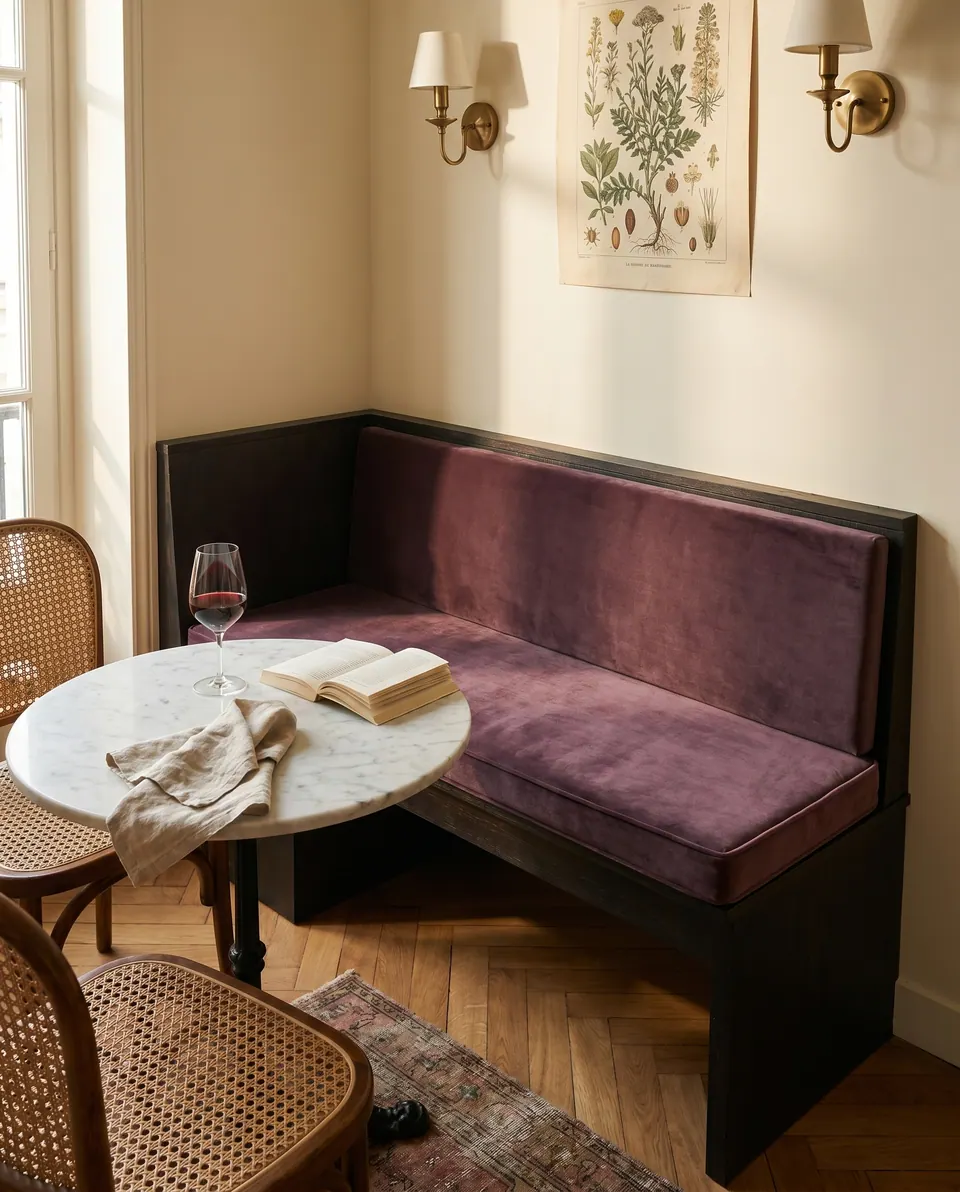
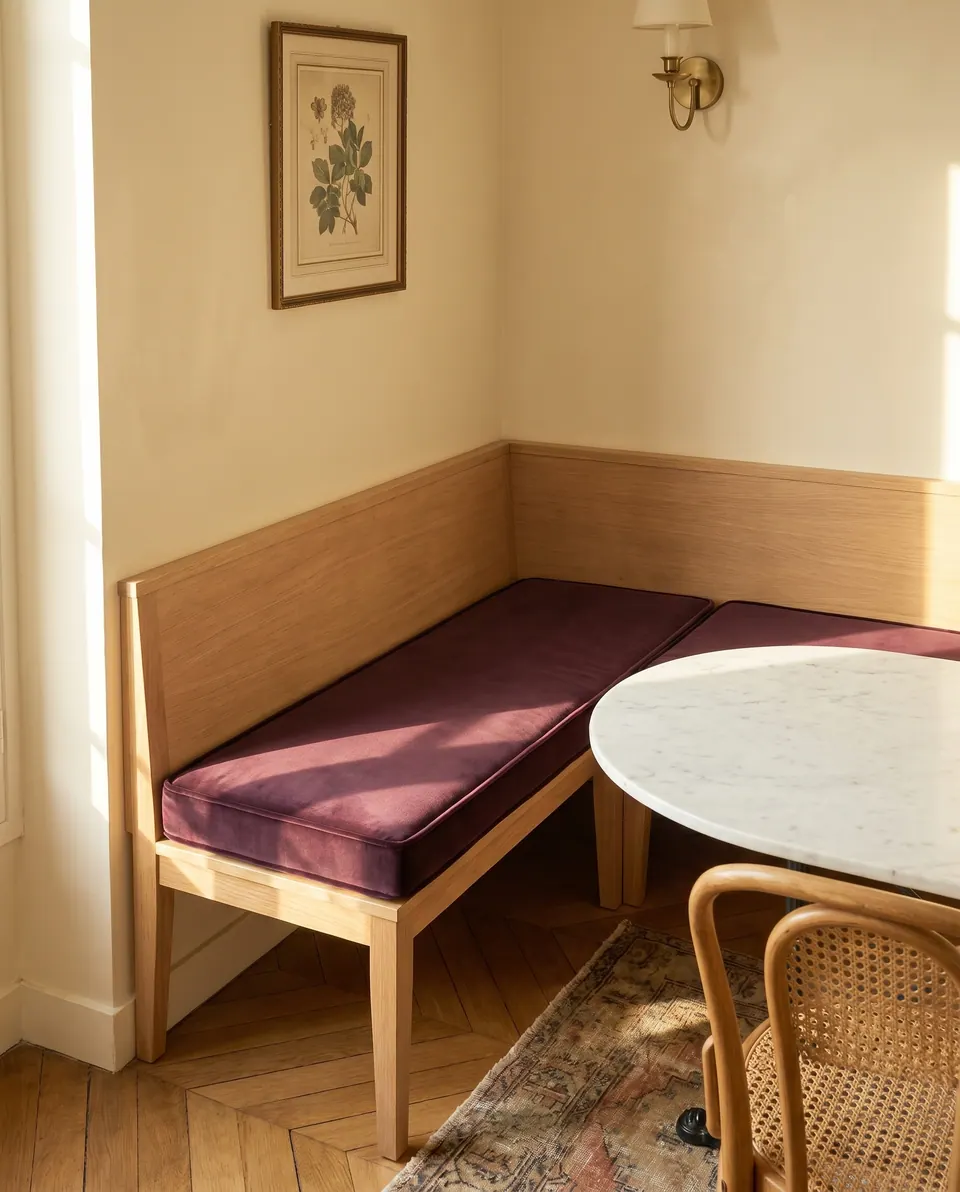
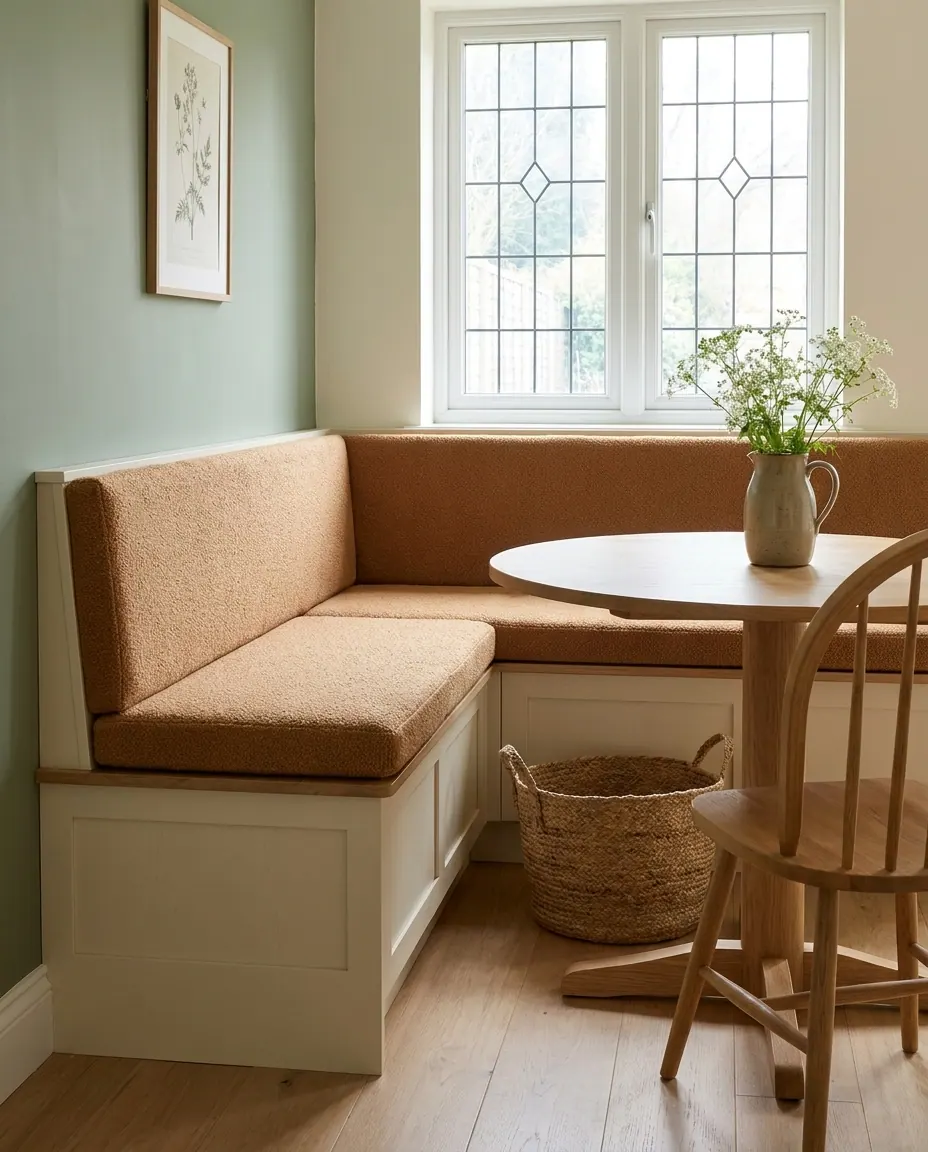
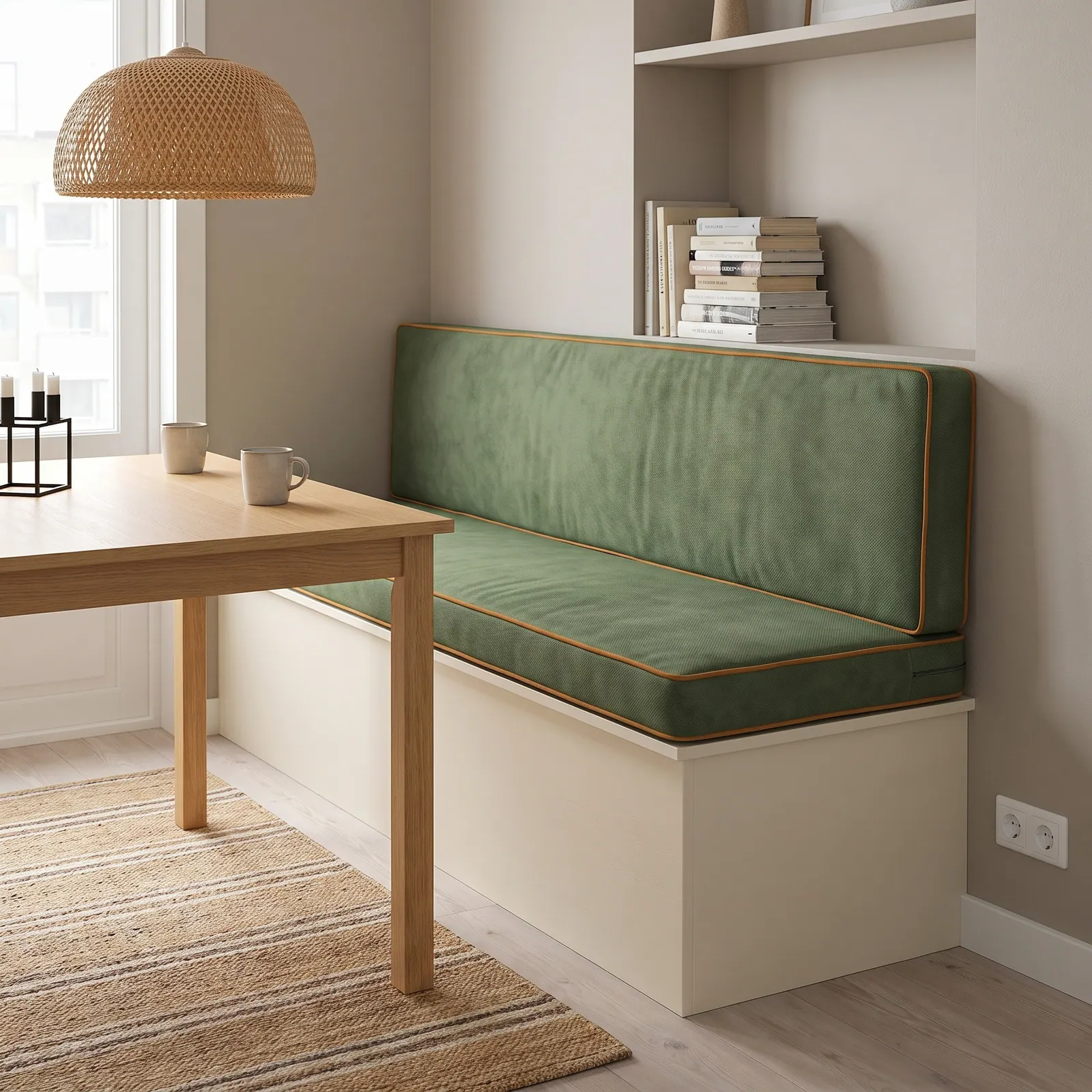
Sage velvet banquette cushions with caramel piping: an alcove made over
Before, a white box under a bookshelf. After, the seat everyone takes first. One cushion did most of the work, and the piping did the rest.

Swatch strip measured from the photograph
- camel#86786333%
- oatmeal#c7b9ab21%
- umber#65554021%
- camel#a79b8814%
- linen#e6dfd811%
The quick answer
A banquette cushion turns a plain white box bench into something close to a built-in sofa when the back pad spans the alcove wall to wall and rests on the seat. Take the piping color from wood in the room, not from the fabric. For daily dining, 3 in (7.6 cm) of firm foam supports without raising the seat too far.
Swatch strip: five colors from the alcove
- Sage velvet#9DAE8CSeat and back pad; the pile shades lighter where daylight lands.
- Caramel welt#B07A45Contrast piping on every edge, borrowed from the wood, not the cloth.
- Oak table#C49A6CThe permanent warm note the piping answers.
- Rattan pendant#B38B5AWoven texture overhead that warms the cool green.
- White box banquette#F1EFEAThe plain base the cushions turn into furniture.
Before and after: a white box becomes a built-in sofa
Here is the before: a white box banquette tucked into an alcove, an open shelf of paperbacks above, an oak table in front. Serviceable. Nobody lingers on a white box.
Here is the after, in three moves.
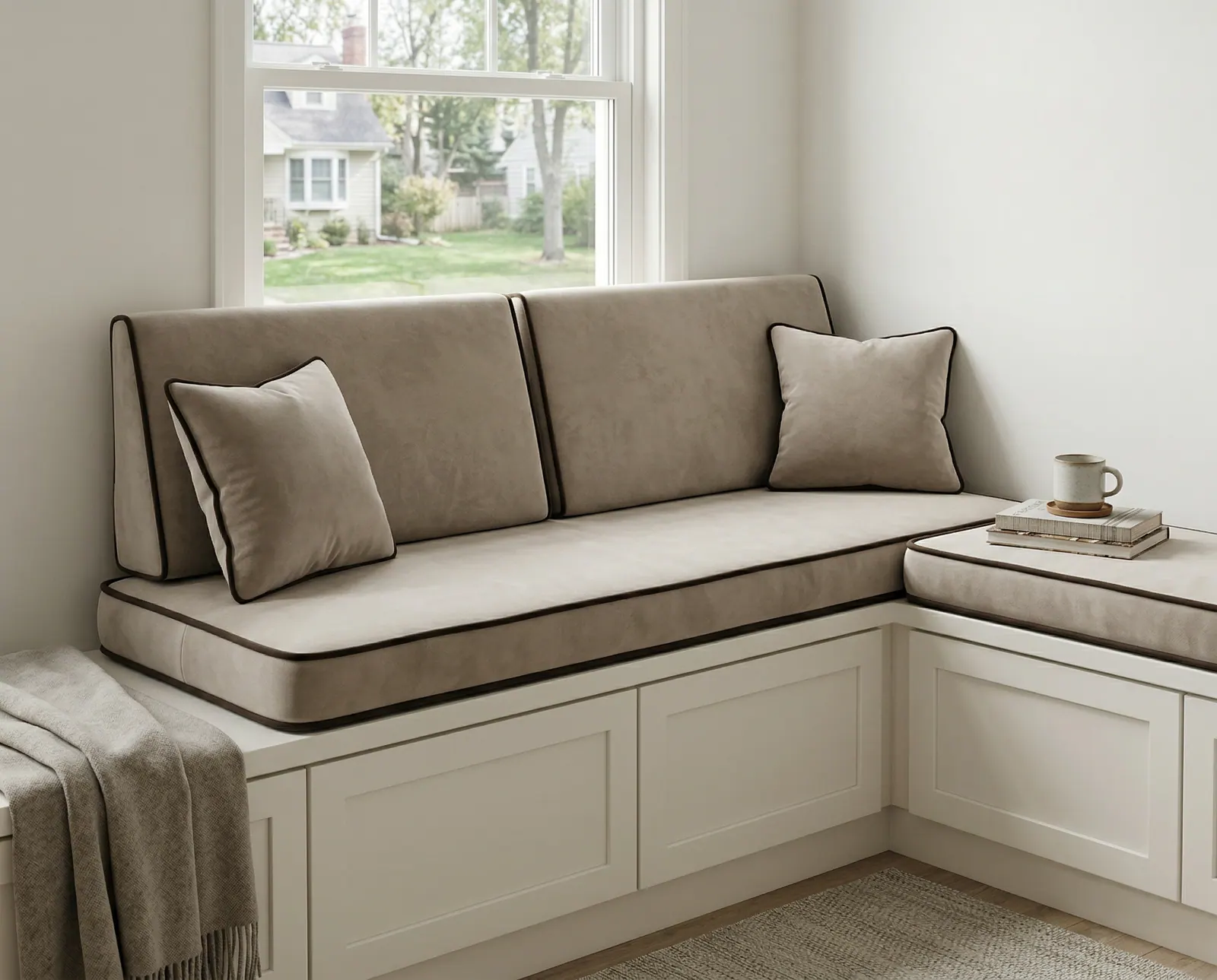
- A back pad that spans the alcove wall to wall and rests on the seat. No gap, no floating pillows. It reads like upholstery that came with the house.
- Sage velvet on both pieces. The soft pile shades lighter where the light hits, so one green has depth instead of looking flat.
- Caramel contrast piping on every edge. Its color comes from the oak table and the rattan pendant, which is why the green never looks cold.
The props finish the story. Two ceramic mugs, a black metal candle holder, the paperbacks, a striped jute rug. They promise slow breakfasts, not formal dinners, and that is the right promise for a kitchen nook cushion.
I once piped a banquette to match its own fabric and spent a week wondering why it looked bought. Borrow the welt from something in the room instead. A straight welt is a kind of honesty, dear: it shows every edge you cut, so cut them true.
More alcove seating lives with our banquette cushions, the cloth in velvet, and the choices in matching, contrast or no piping. Which wood in your kitchen isn't going anywhere?
Pinned by Maggie: five points in the alcove
Five pins, from the rattan pendant to the caramel welt where the back pad meets the wall.
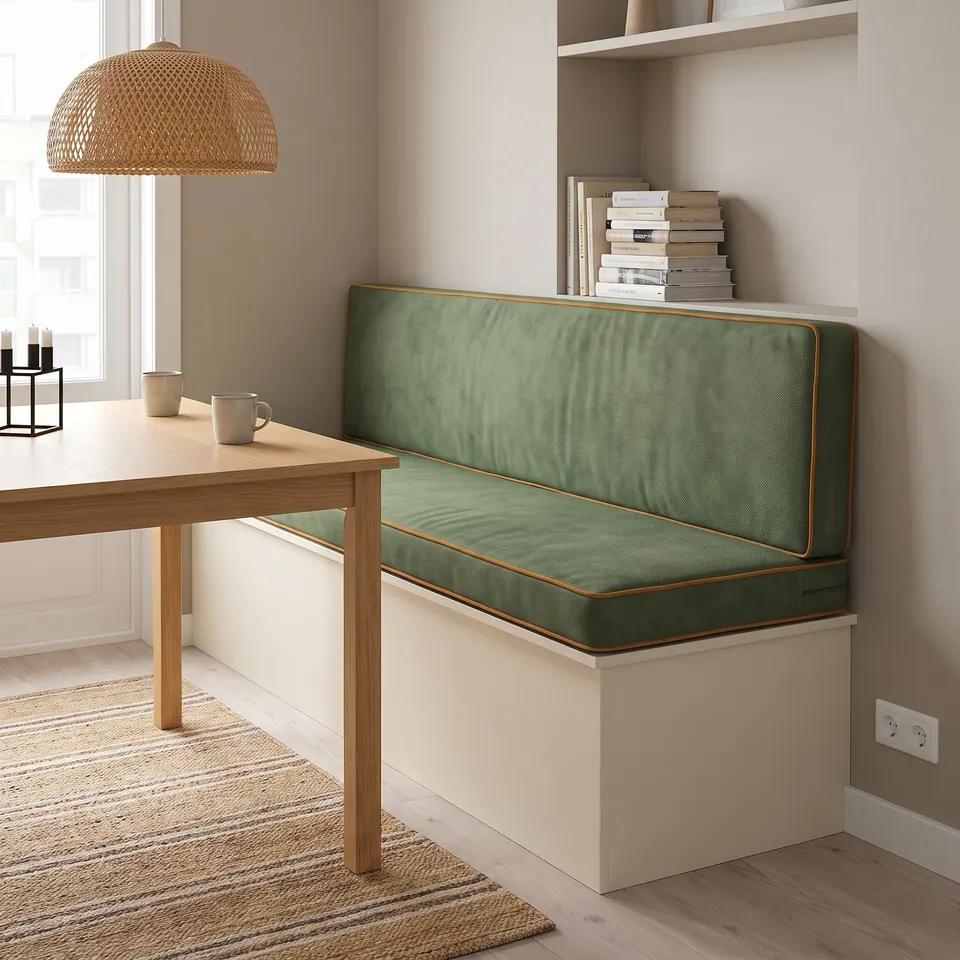
- Full-width back pad
The back cushion spans the alcove wall to wall and rests on the seat, like a built-in sofa.
- Sage velvet seat
The soft pile shades lighter where light hits, giving the green depth.
- Caramel piping
The piping color is taken from the oak table and rattan, not from the fabric, so it looks designed for the room.
- Rattan pendant
Woven texture overhead warms the cool green seat.
- Books on shelf
A shelf above the bench makes the corner a place to linger after a meal.
- Full-width back padThe back cushion spans the alcove wall to wall and rests on the seat, like a built-in sofa.
- Sage velvet seatThe soft pile shades lighter where light hits, giving the green depth.
- Caramel pipingThe piping color is taken from the oak table and rattan, not from the fabric, so it looks designed for the room.
- Rattan pendantWoven texture overhead warms the cool green seat.
- Books on shelfA shelf above the bench makes the corner a place to linger after a meal.
Three bench cushions, four close-ups and a 3 in answer
A buyer sent a drawing for three dining bench cushions: two rectangles and one trapezoid for an angled end. She asked for close-up photos of four linen colors, and we warned her that close-ups look darker than the fabric does in daylight. She chose one linen for the body and a second for the piping.
Then came the question every banquette owner should ask: how thick for a bench used every day? The workshop recommended 3 or 4 in (7.6 or 10 cm) of its firm 32-density foam. She chose 3 in. The zippered covers wash in the machine at 86°F (30°C).
My checklist from that exchange: draw every piece, judge color by the window, and let daily use set the thickness. For the angled piece, the trapezoid cushion calculator saves an argument, and banquette cushion thickness and table height explains the 3 in choice.
Buyer questions: backrests, small children and sage
- A common question
Can I order only the backrest cushions from the teddy sofa set?
The workshop's answerYes. Backrests are sold on their own, with or without a cover for the seat cushion. Each L-shaped backrest measures 39 x 39 in (100 x 100 cm) along the L and stands 15 in (38 cm) high. A single straight backrest is also available, with or without a metal support bar.
- A common question
We have two small kids eating on the bench every day. Which fabric is easiest to keep clean?
The workshop's answerVelvet or the soft polyester fabric. Velvet is the easiest to spot-clean between washes, because marks lift off the pile more readily than off textured weaves. The striped cottons are the ones to skip with small children at the table.
- A common question
What neutral cushion color works on a sage green bench?
The workshop's answerWarm neutrals: cream, oatmeal or light beige (910, 915 and 916 in the soft range). Beige or oatmeal is the safest; terracotta or rust is the natural complement and hides stains; mustard or ochre is sunnier. Skip pure white and cool grays, and choose around permanent things like the bench and walls, not a table that may change.
On the cutting table: the sage alcove
| Pieces | Banquette seat cushion plus a full-width back pad |
|---|---|
| Fabric | Sage green velvet |
| Piping | Contrast caramel welt on every edge |
| Edge | Box edge on seat and back |
| Back pad | Spans the alcove wall to wall, resting on the seat |
| Foam for daily dining | 3 to 4 in (7.6 to 10 cm), firm |
| Care | Zippered covers; spot-clean the pile between washes |
| Best for | Kitchen nooks and dining alcoves used every day |

Have it made
Have this made — ask Maggie’s workshop
Have the tape measure handy when they call. Old cushions shrink and sag; the seat underneath does not. — Maggie
Leave your details and the workshop will call you to confirm measurements, fabric, foam and piping. No prices, dates or payment on this page: it is a request, not an order.
Take banquette piping from the wood in the room, not the fabric. A caramel welt beside an oak table keeps sage velvet from looking cold.
Maggie
Questions buyers ask next
Should a banquette back cushion rest on the seat or hang above it?
Resting on the seat, as in this alcove, closes the gap and makes the pair read as one built-in sofa. Span the back pad wall to wall so there are no loose ends at the corners.
Is velvet a sensible cloth for a dining banquette?
Yes. Marks lift from the pile more readily than from textured weaves, so everyday spills spot-clean easily. Choose a zippered cover so the whole case can be washed when spot-cleaning isn't enough.
How do I order a banquette with one angled end?
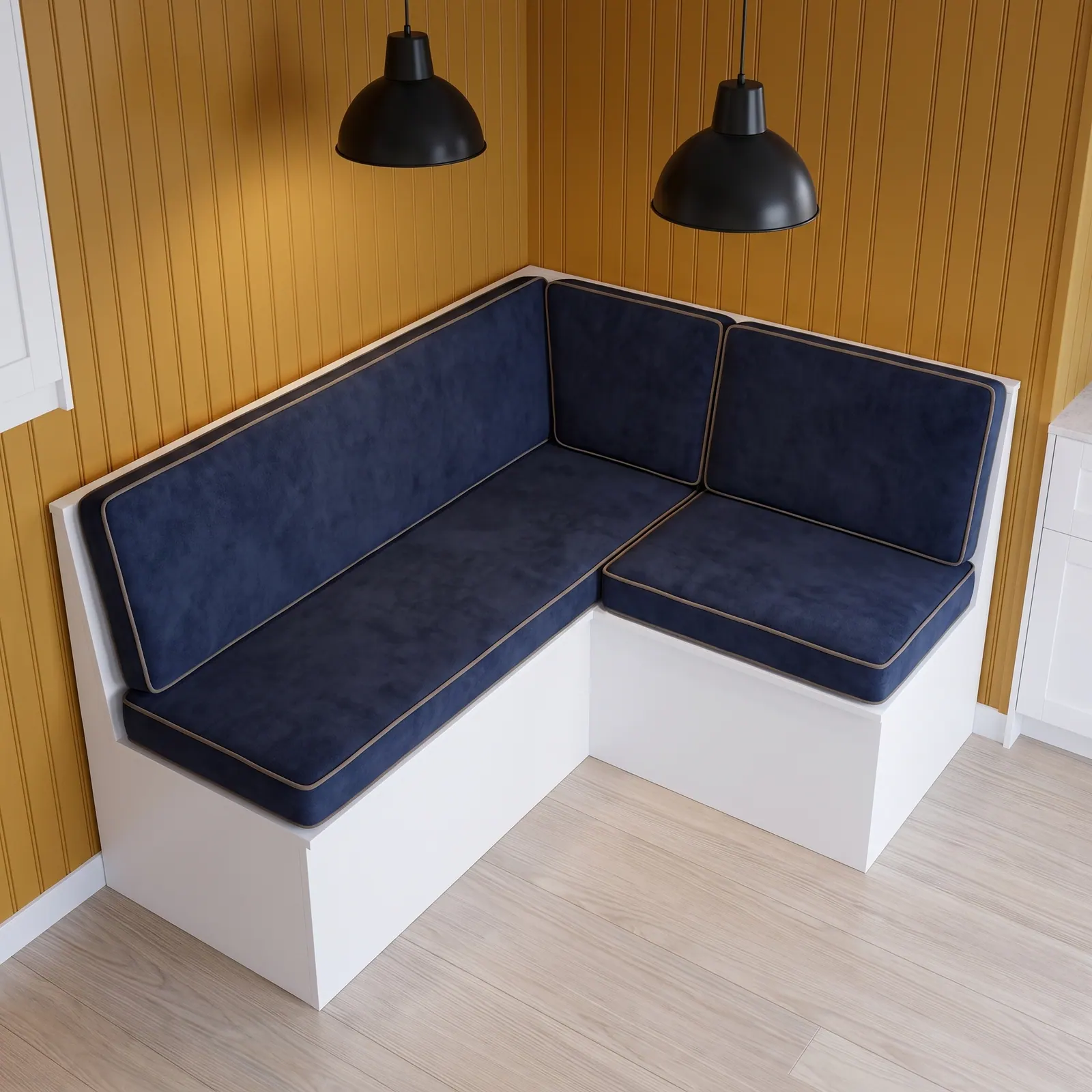
Send a drawing of every piece. The angled end is a trapezoid cushion: give its front, back and depth, and measure each slanted side corner to corner rather than assuming it.
Why pick the piping color from the room instead of the fabric?
Piping matched to the cloth disappears. Piping taken from a table, floor or pendant ties the cushion to the room, so it looks made for the space rather than bought for it.
Stitch straight — Maggie
More photographs to read
 Save
 Save
 Save
 Save
 Save
 Save