A Reading by MaggieBench Cushions
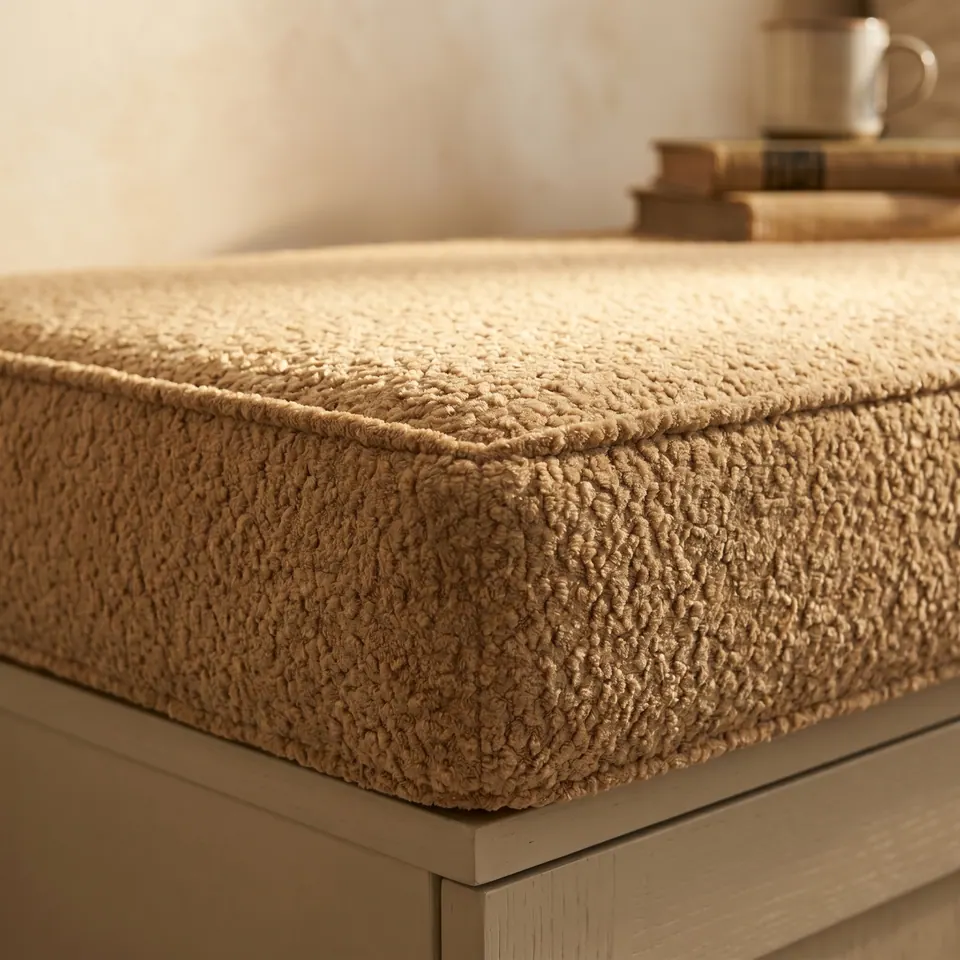
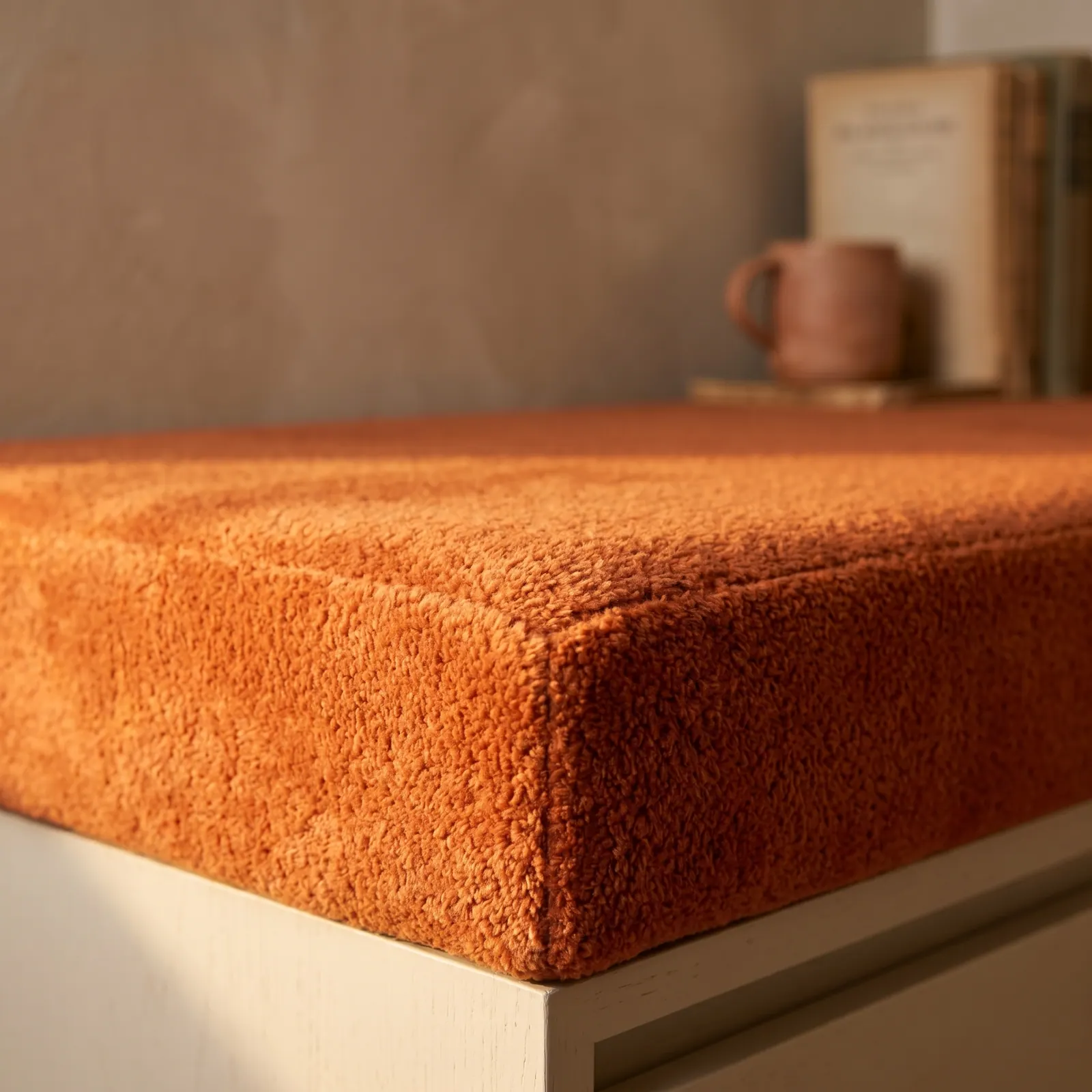
Anatomy of an unpiped corner: a rust orange bouclé bench cushion
Maggie, who judges every cushion by its welt, studies one without any. Then a checklist for ordering long custom sizes by the note, not by hope.

 Save
The quick answer
A bouclé bench cushion without piping has a softer, slightly rounder corner, because the seam sinks into the loop pile and the texture runs unbroken over the edge. Choose no piping for a relaxed, sofa-like look in a heavy bouclé; choose piping when a long bench cushion has to hold a sharp, straight line.
The cushion, cut open
Cover fabric. A removable, zippered cover. Machine wash at 86°F (30°C) on a gentle cycle and air dry.
Piping. A fabric-covered cord sewn into the seams. It sits on the seam line, so it does not change the size.
Fiber wrap. Polyester fiber (Dacron) batting around the foam: it fills the cover out and softens the edges.
Foam core. About 2.0 lb/ft³ (32 kg/m³) high-resilience foam, firm to medium-firm, cut to the ordered size.
Zipper. Along the back band, as hidden as possible. The zipper side faces down or toward the wall.
Base panel. The underside of the cover. A non-slip fabric backing can cover the whole of it instead.
Pinned by Maggie at one rust corner
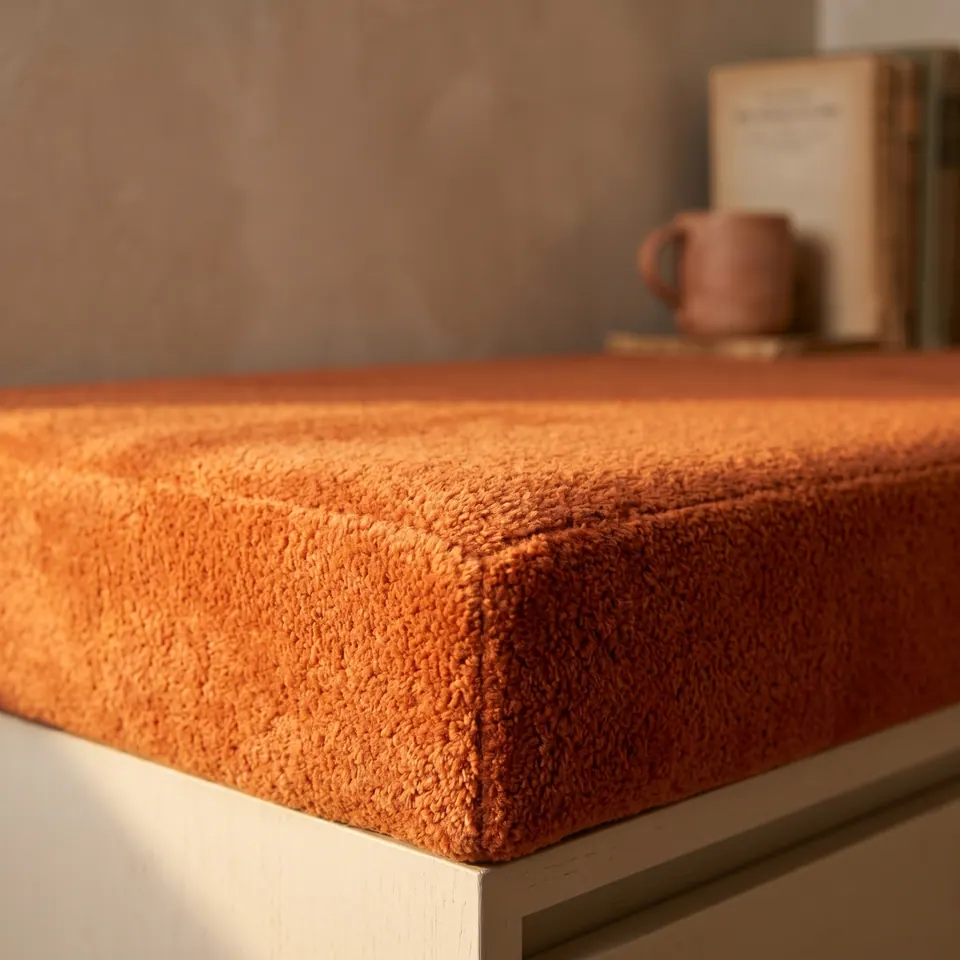
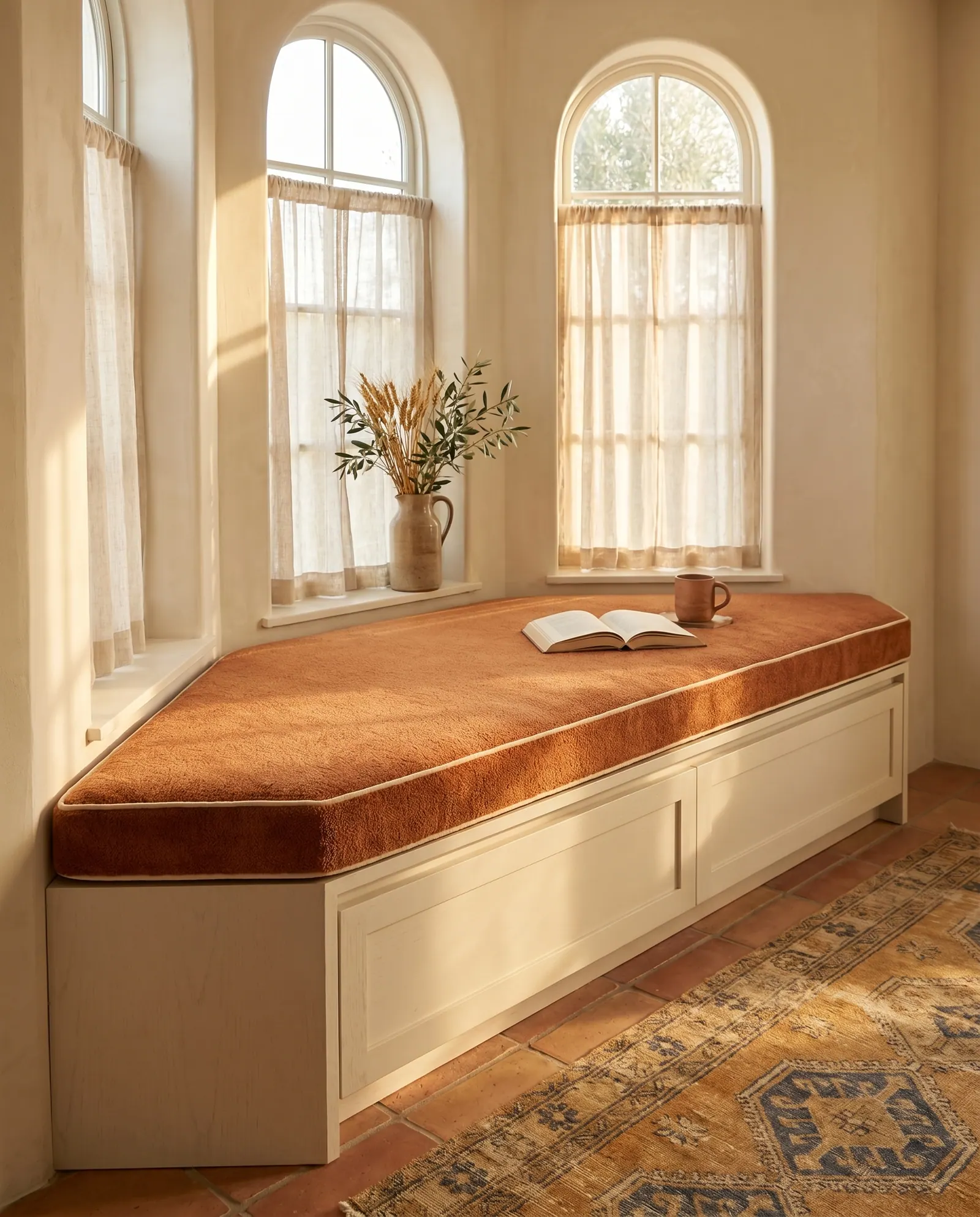
Four pins: the unpiped corner seam, the unbroken loop pile, a clay mug and the flush cabinet edge.
- Unpiped corner seam
Without a cord the seam sinks into the pile, giving a softer, slightly rounder corner.
- Continuous texture
The loop pile runs uninterrupted across the top and down the side.
- Clay mug
Repeats the rust color at a small scale in the background.
- Cream cabinet edge
The cushion stops flush with the cabinet, with no overhang.
- Unpiped corner seamWithout a cord the seam sinks into the pile, giving a softer, slightly rounder corner.
- Continuous textureThe loop pile runs uninterrupted across the top and down the side.
- Clay mugRepeats the rust color at a small scale in the background.
- Cream cabinet edgeThe cushion stops flush with the cabinet, with no overhang.
Anatomy of a corner with no cord in it
I have spent thirty-odd years telling people the piping line is the signature of a cushion. So here is a cushion with no signature at all, and I like it. Right, then. Let me explain myself.
Take the corner apart in your head: a top panel, a boxing strip, a bottom panel, and the seams that join them. With piping, a covered cord sits in each seam and draws a hard line around the box. Without it, the seam simply folds under, and in heavy bouclé it sinks into the loops. The corner comes out a touch softer and rounder, and the texture runs across the top and down the side without a break.
That suits rust orange bouclé. A welt on this much pile would look fussy, like a starched collar on a sweater. The cushion also stops flush with the cream cabinet top, no overhang, which is the tidy way to seat a reading nook cushion.
The props do the color work. Gray plaster behind cools the orange. A clay-pink mug repeats the rust at a small scale, and a row of old books says someone actually sits here to read.
The trade-off, in one line: no piping for relaxed, piping when a long bench cushion must hold a straight edge. Matching, contrast or no piping shows both side by side. Which edge suits your room?
Three long bench runs, sized in the note
A buyer messaged the workshop with three long bench runs: one cushion of 104.3 x 19.3 in (265 x 49 cm) and two of 80.7 x 19.3 in (205 x 49 cm), all 4 in (10 cm) thick, in one of two fabrics they had narrowed it down to.
Sizes like those are well past any dropdown. So the workshop priced each piece individually, trimmed the price on the longest one, and the buyer wrote the exact sizes into the personalization box at checkout.
Nothing dramatic happened, dear, and that is the point. The order went through on the first try because every number was in writing, in the unit the buyer had measured, before anyone cut foam. The personalization note guide shows the format, and a custom size not on the menu covers the dropdown.
- Sizes
- 104.3 x 19.3 x 4 in (265 x 49 x 10 cm); two at 80.7 x 19.3 x 4 in (205 x 49 x 10 cm)
The lesson: Oversized custom cushions may be priced individually; ask for a quote and write the exact sizes in the note.
Maggie's checklist for the personalization note
- Pick the nearest size option, usually the next size up.
- Write the exact finished size, length x depth x thickness, in the unit you measured.
- Add the fabric code and the piping code, or write no piping.
- For anything oversized or odd, ask for a quote first; the workshop can add a custom option.
- Attach a sketch for any shape that is not a plain rectangle.
- Keep your tape-measure photos; they help if the cushion needs checking on arrival.
Buyer questions: blush codes, rippled arrivals and missing sizes
- A common question
How pink is the blush on your chart? I want a soft blush, not a strong pink.
The workshop's answerThat code sits in soft blush territory rather than a strong pink. No cushion had been made fully in it yet, so the workshop sent a photo where it was used as piping against a body fabric.
- A common question
My cushion arrived creased, rippled and a little short. Is it faulty?
The workshop's answerUsually not. Creases, ripples and a slightly short length come from vacuum compression. The foam needs about 3 to 5 days to regain its full shape and can arrive about 3/4 in (2 cm) short, then keep expanding. If it still doesn't fit after that, send tape-measure photos or a continuous video with the numbers readable, so the workshop can check them against the order.
- A common question
My size isn't in the dropdown. How do I order a custom size?
The workshop's answerChoose the closest option, usually the next size up, for example the 17.75 x 47.25 in (45 x 120 cm) option for a 15.75 x 47.25 in (40 x 120 cm) cushion. Then write your exact dimensions, fabric code and piping code in the personalization box. For larger or unusual orders the workshop adds a custom option or makes a listing with your exact sizes.
On the cutting table: one rust corner, layer by layer
| Cushion | Bench cushion, box edge, flush with the cabinet top |
|---|---|
| Fabric | Rust orange bouclé, heavy loop pile |
| Piping | None; the seams sink into the loops |
| Corner | Slightly softer and rounder than a piped corner |
| Texture | Unbroken from the top panel down the boxing strip |
| Setting | Cream painted cabinet against a gray plaster wall |
| Props | Clay-pink ceramic mug, a row of old books |
| Choose piping instead | When a long bench cushion must hold a sharp line |
| Best for | Reading nooks and cabinet tops with a relaxed, sofa-like look |

Have it made
Have this made — ask Maggie’s workshop
Have the tape measure handy when they call. Old cushions shrink and sag; the seat underneath does not. — Maggie
Leave your details and the workshop will call you to confirm measurements, fabric, foam and piping. No prices, dates or payment on this page: it is a request, not an order.
A bouclé bench cushion without piping trades a sharp edge for texture that runs unbroken over the corner. Keep the piping only when the line matters more.
Maggie
Questions buyers ask next
Does a cushion without piping hold its shape?
Yes. The foam holds the shape; piping only draws the outline. An unpiped corner looks a little softer and rounder, which suits thick bouclé. On a long bench cushion that needs a crisp edge, piping helps the line read straight.
Why does a rust bouclé cushion look good against gray plaster?
Gray is cool and quiet, so it tempers a strong orange without fighting it. Repeat the rust once at a small scale, a clay mug or a book spine, and the cushion looks planned rather than dropped in.
Can very long bench cushions be ordered online?
Yes. Oversized pieces, like a 104 in (265 cm) bench run, may be priced one by one, so ask for a quote first, then write the exact sizes in the personalization note when you order.
Should a bench cushion overhang the cabinet it sits on?
For a neat built-in look, no. Stopping the cushion flush with the front of the cabinet top keeps the edge clean and tailored. Measure the top itself, edge to edge, rather than an old cushion.
Stitch straight — Maggie
More photographs to read
 Save
 Save
 Save
 Save
 Save
 Save