A Reading by NateBench Cushions
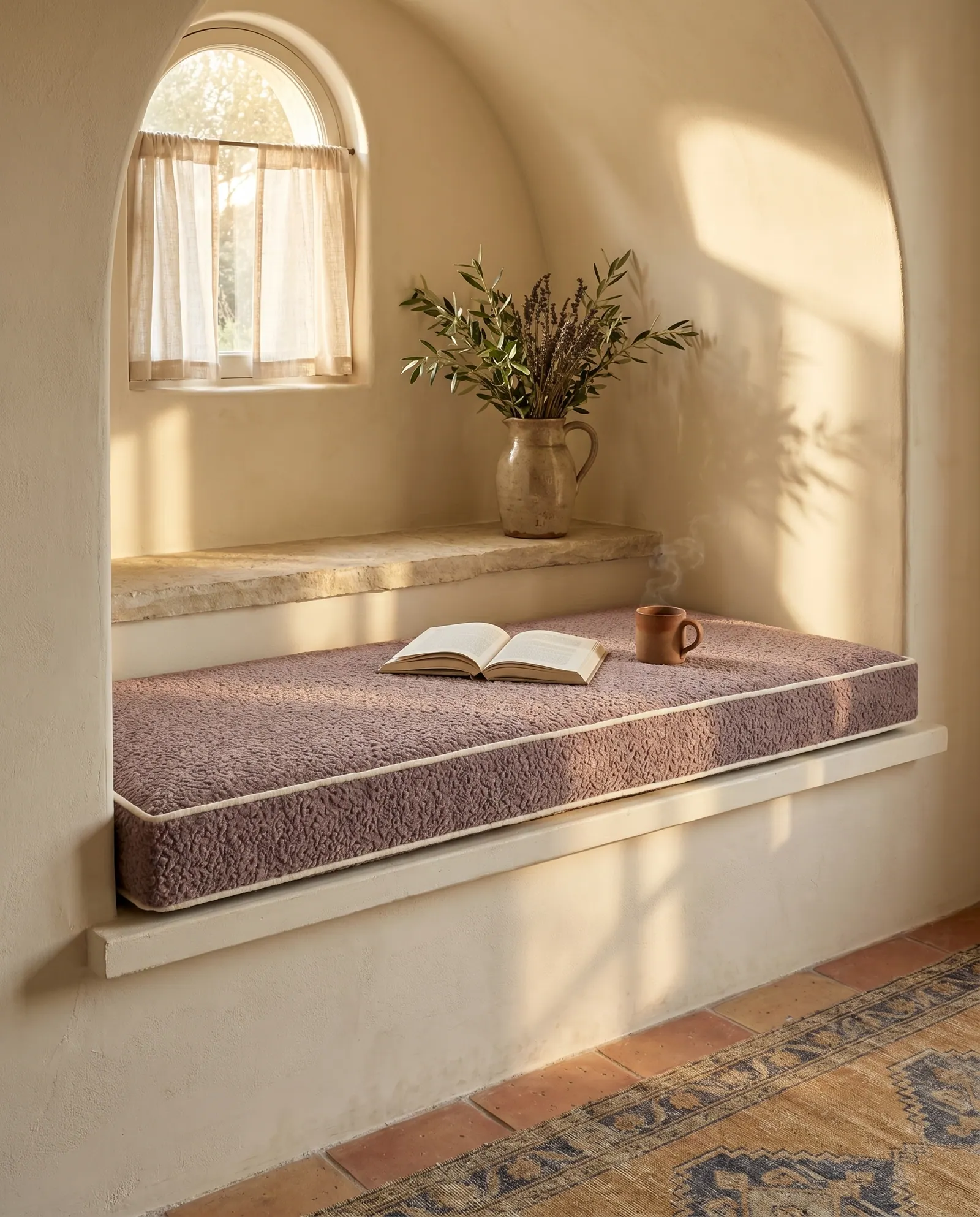
A blush bouclé bench cushion in a plaster alcove, read layer by layer
Nate reads a blush bouclé seat in an arched plaster niche as a cross-section, from tile to arch, and gives every prop a job description you can copy at home.

 Save
The quick answer
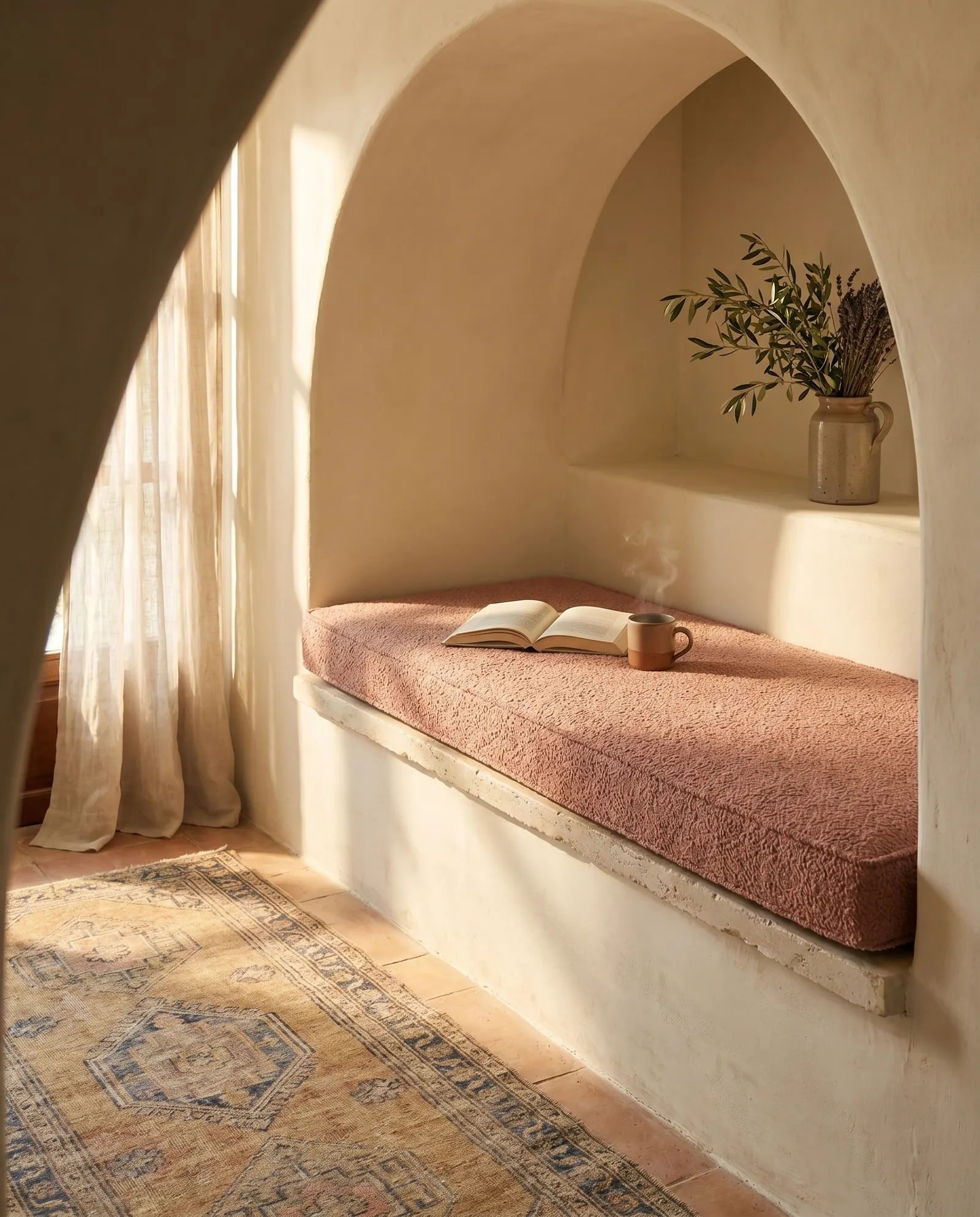
A custom bench cushion in a plaster alcove should run wall to wall with no gaps at the ends, and its props should each do a job: something to read, something warm to hold, one plant for height and soft light. Here a blush bouclé cushion fills the niche end to end above a stone ledge, with a paperback, a mug and olive stems.
The cushion, cut open
Cover fabric. A removable, zippered cover. Machine wash at 86°F (30°C) on a gentle cycle and air dry.
Piping. A fabric-covered cord sewn into the seams. It sits on the seam line, so it does not change the size.
Fiber wrap. Polyester fiber (Dacron) batting around the foam: it fills the cover out and softens the edges.
Foam core. About 2.0 lb/ft³ (32 kg/m³) high-resilience foam, firm to medium-firm, cut to the ordered size.
Zipper. Along the back band, as hidden as possible. The zipper side faces down or toward the wall.
Base panel. The underside of the cover. A non-slip fabric backing can cover the whole of it instead.
Pinned by Nate
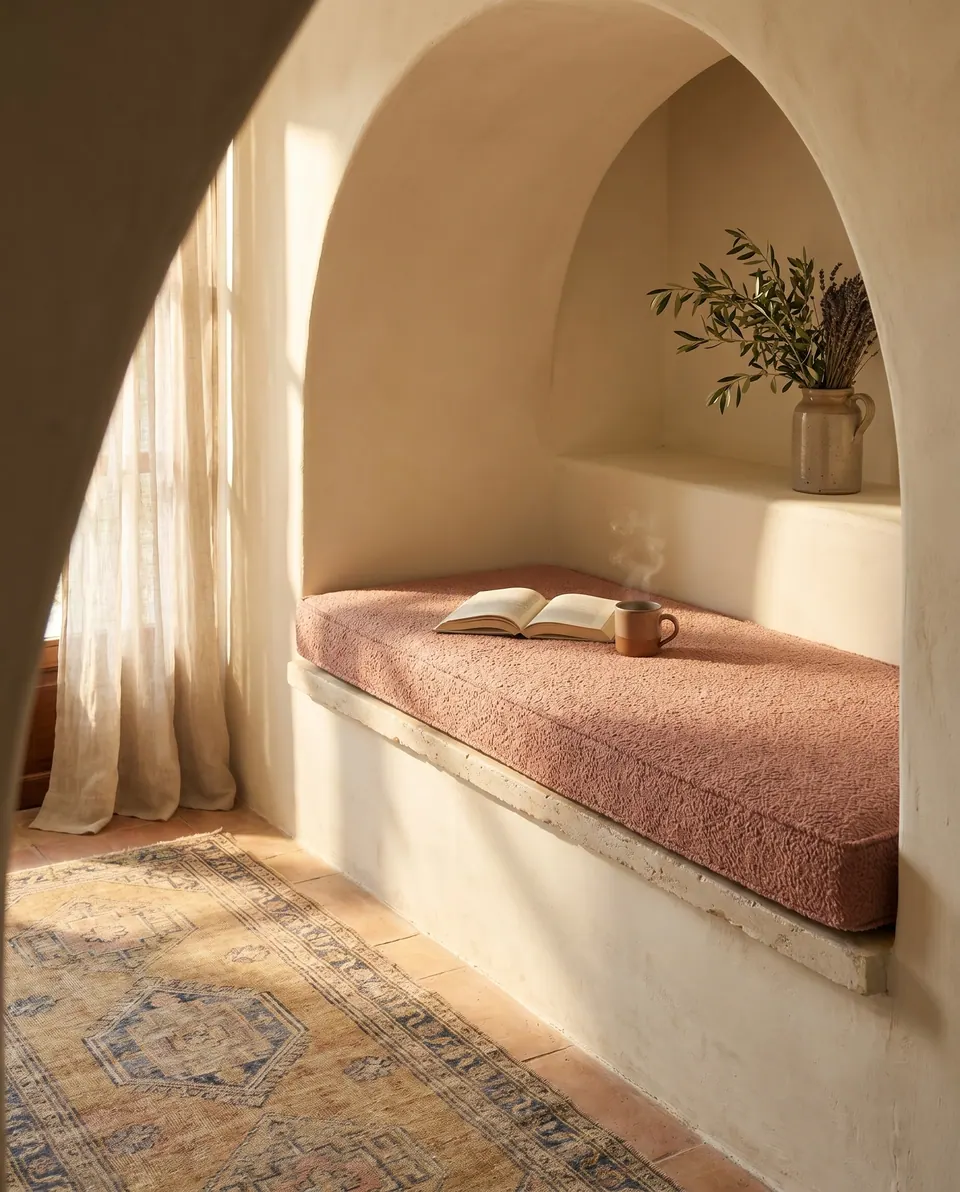
Five pins mark the wall-to-wall fit, the stone ledge, the book and mug, the olive and lavender stems and the sheer linen curtain.
- Wall-to-wall fit
The cushion fills the niche end to end, which is what makes an alcove look built in.
- Stone ledge
The cushion's depth roughly matches the ledge below, so the two layers read as a pair.
- Book and mug
A simple still life shows the seat is meant for sitting, not just looking at.
- Olive and lavender
Soft green and violet cool the blush without competing with it.
- Sheer linen curtain
Filtered light warms the pink rather than bleaching it.
- Wall-to-wall fitThe cushion fills the niche end to end, which is what makes an alcove look built in.
- Stone ledgeThe cushion's depth roughly matches the ledge below, so the two layers read as a pair.
- Book and mugA simple still life shows the seat is meant for sitting, not just looking at.
- Olive and lavenderSoft green and violet cool the blush without competing with it.
- Sheer linen curtainFiltered light warms the pink rather than bleaching it.
Cross-section: five layers from tile to arch
Read this photo from the floor up, like a cross-section, and every layer has a job.
Layer one is the ground: terracotta tiles under a faded Persian rug. Warm clay underfoot is why the cushion is blush and not a cool pink. Blush warms in low sun instead of clashing with the tile.
Layer two is the rough stone ledge. The cushion's band sits close to the ledge's own, so the two stack as a matched pair. Get that ratio wrong and one of them looks like an accident.
Layer three is the cushion: blush bouclé, box edge, self piping, cut wall to wall. Any gap at the ends collects crumbs and makes a built-in look like an afterthought. The bouclé loops soften a niche made entirely of hard plaster and stone.
Layer four is the still life on the seat, an open paperback and a terracotta mug still steaming. It tells you the seat is for sitting, not for looking at.
Layer five is the niche shelf and the window. A stoneware jug of olive and lavender stems cools the blush with soft green and violet. A sheer floor-length linen curtain filters the evening light, so it warms the pink instead of bleaching it.
Measure twice; the fabric remembers. Plaster alcoves are rarely square, so measure the back and the front separately and send both. The workshop draws the shape from those numbers and sends it back for you to check before cutting. The alcove and niche bench cushions sketch and the paper template pattern show the method.
How to style a bouclé alcove seat with 4 props
Something to read
One open book on the seat, not a stack. It sets the scale of the nook and says sit here.
Something warm
A mug in a clay tone that repeats the floor. Here terracotta links tile, mug and blush.
One plant for height
Stems in a jug on the niche shelf. Olive and lavender put a cool color above a warm seat.
Filtered light
A sheer linen curtain softens low sun, so the bouclé loops cast soft shadow instead of glare.
Stop at four
No pillows in this niche; the back wall is the backrest. If styling takes more than four props, you are furnishing, not styling.
The curved benches the workshop turned down
Not every shape should be cut from a drawing. A buyer wrote to the workshop about two identical curved, banana-shaped outdoor benches and a matching chair. First estimate: about 54 in (137 cm) at the longest and roughly 19.75 in (50 cm) deep.
The workshop asked for the right data: straight and curved edge lengths, depths at the center and at the ends, and a paper tracing. The buyer delivered all of it:
- Straight edge: 55 1/4 in (140.5 cm)
- Back curve: 74 3/4 in (190 cm)
- Front: 56 1/4 in (143 cm)
- Center depth: 19 3/4 in (50.3 cm)
Quotes were requested at 2 3/4 and 3 1/8 in (7 and 8 cm) thick. After talking it over with the master craftsmen, the workshop declined. Kidney shapes that strong carry too much fit risk without a fitting in person, so the buyer was pointed to a local upholsterer who could fit them on site.
The tolerance lesson: a paper template is the minimum for any curve, and the strongest curves are best fitted in the room. Read chord, rise and radius before you draw one, partner.
Buyer questions: stuck zippers, wedge pillows and the wrong listing
- A common question
The zipper on my cushion seemed stuck, maybe broken, when it arrived. What do I do?
The workshop's answerUsually it isn't broken: the fabric tape underneath has caught in the teeth. Gently pull the fabric free with your fingers, then slide the zipper back a little and forward again. If it still won't move, send the workshop a short video of it.
- A common question
Can you make a custom wedge back pillow, and what numbers do you need for a quote?
The workshop's answerYes, as a custom quote. One wedge was 28 in (71 cm) wide and 24 in (61 cm) tall, tapering from 9 in (23 cm) thick at the base to 4 to 5 in (10 to 13 cm) at the top. Width, height and both thicknesses are the numbers to send.
- A common question
I ordered a trapezoid cushion on the rectangle listing by mistake. What now?
The workshop's answerReorder through the trapezoid listing, selecting the right size options and writing the exact measurements with your drawing. When one buyer did that, the workshop canceled the first order and refunded it.
On the cutting table: the alcove seat
| Product | Bench cushion for a plaster alcove, rectangle |
|---|---|
| Fabric | Blush pink bouclé |
| Edge | Box edge |
| Piping | Self piping |
| Fit | Wall to wall, no end gaps |
| Below | Rough stone ledge in a matching band |
| Props | Paperback, terracotta mug, olive and lavender in a stoneware jug |
| Light | Honeyed evening sun through a sheer linen curtain |
| Best for | A reading nook built into a wall niche |

Have it made
Have this made — ask Nate’s workshop
Every edge and both diagonals, to the nearest 1/4 in. If the numbers do not close, the workshop will say so on the call. — Nate
Leave your details and the workshop will call you to confirm measurements, fabric, foam and piping. No prices, dates or payment on this page: it is a request, not an order.
Cut an alcove bench cushion wall to wall; any gap at the ends collects crumbs and makes a built-in look like an afterthought.
Nate
Questions buyers ask next
What props suit a small reading alcove?
Few, and each with a job: one book, one warm mug, one plant or a jug of stems for height, and a sheer curtain to soften the light. In a niche the back wall acts as the backrest, so extra pillows are optional.
Is bouclé practical for an alcove or window seat?
It is soft and forgiving to look at, and its loops add texture against plaster and stone. Loops can snag on claws, rough jewelry or hook-and-loop tape, so read the bouclé care notes if pets or kids share the seat.
Why measure the back and front of an alcove separately?
Plaster walls are rarely square, so the back can be longer or shorter than the front. Sending both lets the maker draw the true shape and send it back for you to check before any fabric is cut.
± 1/4 in — Nate
More photographs to read
 Save
 Save
 Save
 Save
 Save
 Save