 Save
A Reading by MaggieBench Cushions
An unpiped rose chenille bench cushion, read corner first and season by season
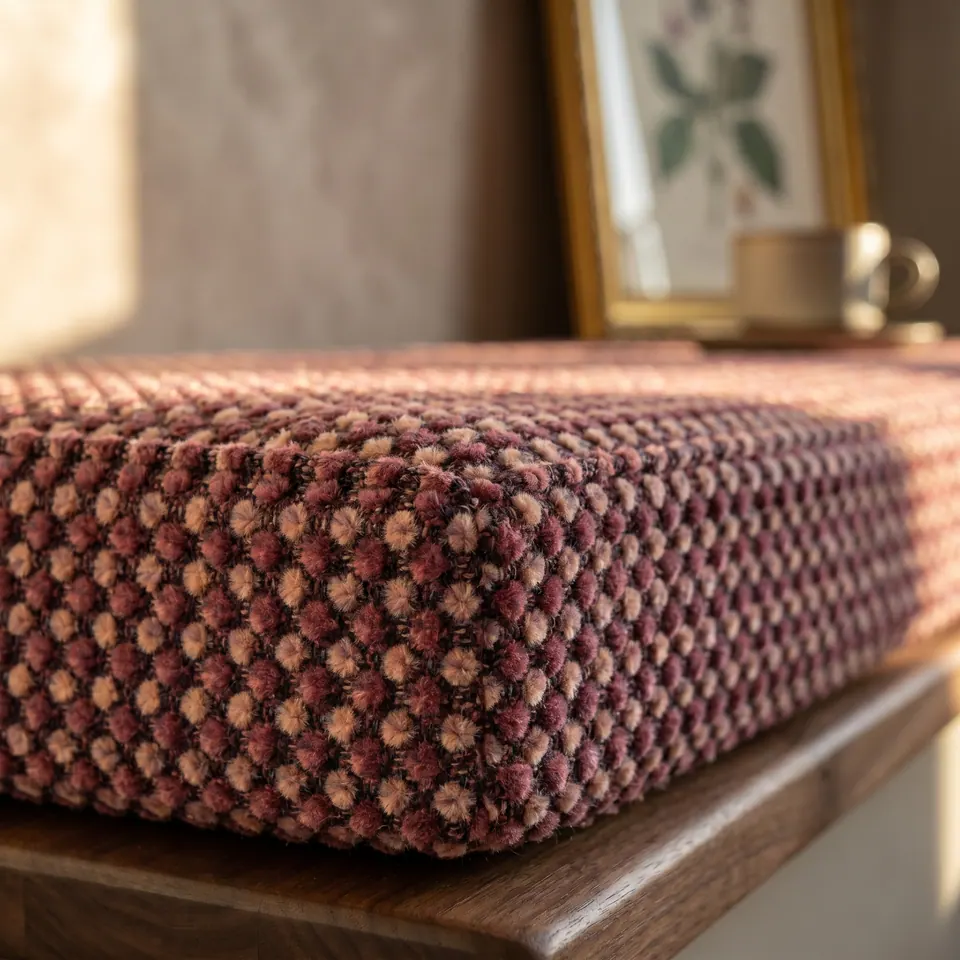
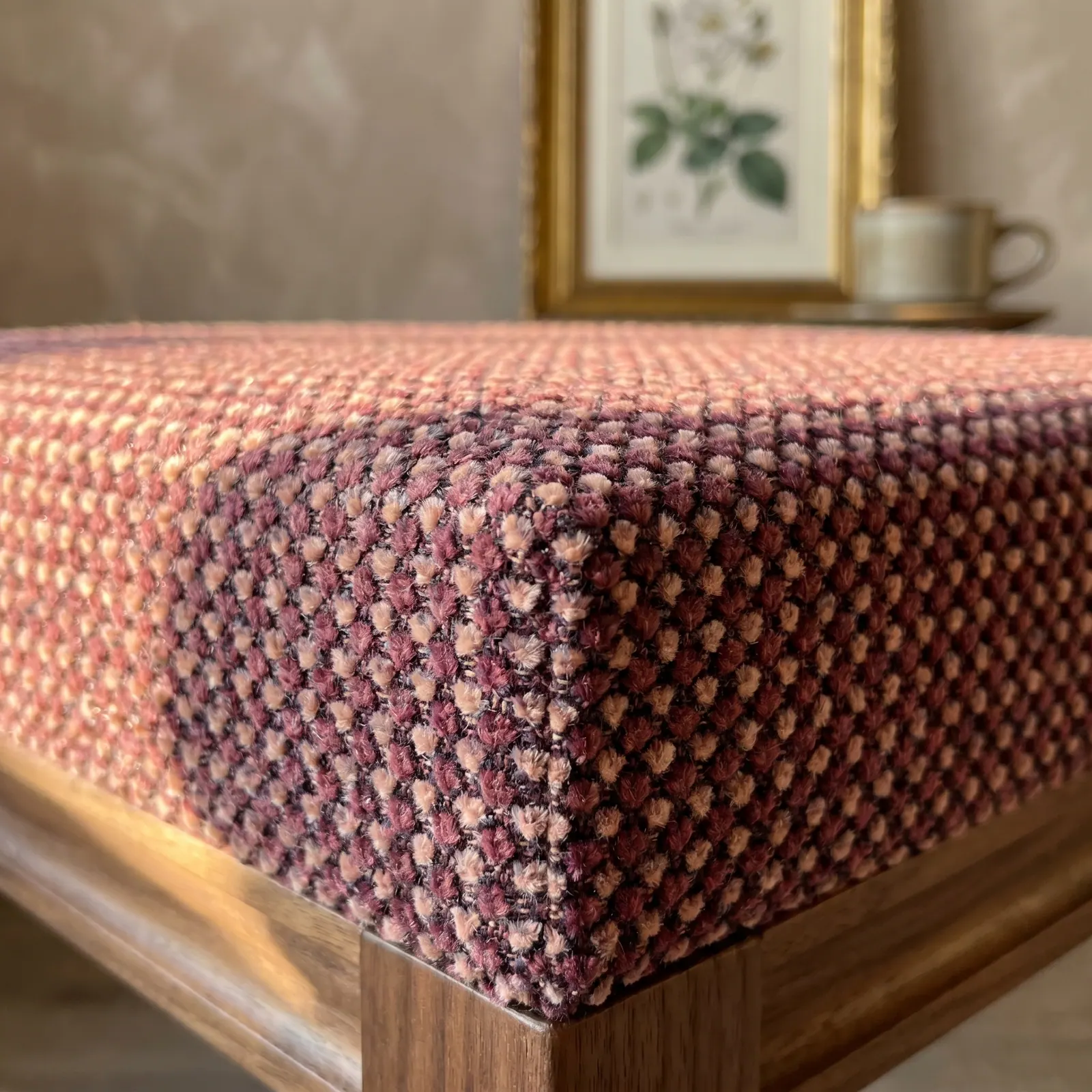
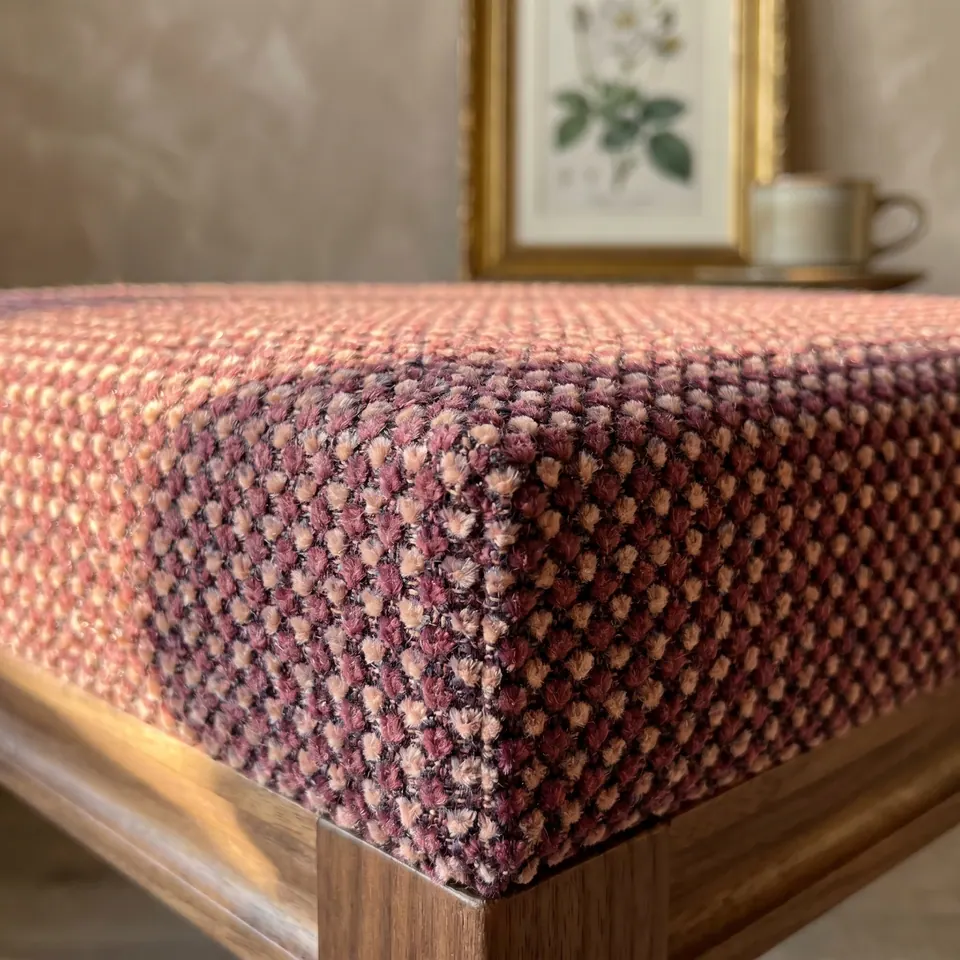
Maggie leans in close to one corner of a dotted chenille bench cushion over walnut, then steps back to watch its color and comfort change from January to August.
At this distance you can judge the corner seam: straight, flat and without a corded edge.

The quick answer
A custom bench cushion in a textured chenille can go without piping and still look tailored, provided the box seam is cut straight and the corners line up with the frame. Expect the color to move with the seasons: low winter side light warms the top toward coral, while higher summer light flattens it. Standard thickness is 4 in (10 cm).
The corner with no cord to hide behind
An unpiped corner has nowhere to hide a wobble, which is exactly why this photo was taken so close.
The piece is a custom bench cushion in a rose and plum dotted chenille, boxed, with a plain seam where most people expect a cord. Follow the fold above the walnut leg. The seam drops straight to the frame, and the dots carry over the edge without a visible join. That only happens when the top and the side panel are lined up before the needle goes in.
Piping would have been easier. A cord stiffens an edge and forgives small sins. On a busy, textured chenille, though, a cord draws a second outline around a surface already covered in dots. Right, then: leave it off, and cut carefully. The piping pattern weighs all three roads, more woven patterns wait on the jacquard and damask shelf, and open-frame benches of every length live in the bench cushion atlas.
Pinned by Maggie
Start at the unpiped fold over the walnut leg, then let the pins walk you up the coral-lit top to the gilt frame behind.
- Unpiped corner fold
The seam sits straight above the bench leg, proof a plain edge can still look sharp.
- Coral-tinted top
Light from above warms the top toward coral while the sides stay plum.
- Walnut leg
The corner is aligned to the frame so the cushion looks fitted, not placed.
- Gilt-framed print
Blurred gilt and botanical green keep the background soft and old-house.
- Unpiped corner foldThe seam sits straight above the bench leg, proof a plain edge can still look sharp.
- Coral-tinted topLight from above warms the top toward coral while the sides stay plum.
- Walnut legThe corner is aligned to the frame so the cushion looks fitted, not placed.
- Gilt-framed printBlurred gilt and botanical green keep the background soft and old-house.
From January light to August light
The photo was lit from the side, and it shows the whole trick of chenille. The top faces the light and leans toward coral. The sides turn away and stay plum. Same cloth, two colors, depending on where the sun sits.
That changes through the year. In winter the sun comes in low and sideways, so expect exactly this: a warm coral top over deep plum sides. By midsummer the light climbs, and the whole cushion reads flatter and pinker. Hold your swatch against the bench at two times of day, and in two seasons if you have the patience.
Chenille also feels warm under the hand. Lovely in February, a bit much on a sticky July afternoon. If your living room runs hot, a second, lighter cover for summer is worth asking about; covers for existing foam explains how that works, and the linen question below covers the usual summer cloth.
The props are dressed for the cold months. A walnut frame. A gilt-framed botanical print gone soft in the background. A cream cup and saucer close at hand, which tells you this is an afternoon-tea corner, not a mudroom. Swap the cup for a glass and the print for something paler in June, and the same cushion carries the new season. Which month does your bench look best in?
Seven letters and a three-and-a-half-inch surprise
A buyer sent the workshop a drawing of an angled bay window with every edge lettered A to G: 103 in (262 cm) along one side, 73 in (185 cm) along another, and a depth of 19.25 in (49 cm). Our check came back with a doubt. By the math, the angled sides should have been about 24 in (61 cm), not the 21.5 in (55 cm) on the paper.
The buyer explained that the window frame sides stick out, confirmed the numbers, and trimmed the depth to 19 in (48 cm). On a second look the workshop found the culprit: two short straight sections of 3.5 in (9 cm) at A and B. Put those back in and the angled sides came to 21.5 in, exactly as measured.
I once lost an afternoon to a stubborn little return on a Victorian bay, so I sympathize. Three and a half inches looks like nothing on paper and moves every angle in the seat. Draw every short straight piece, however silly it looks, and let the bay window calculator do the arithmetic.
Swatch-day questions
- A common question
I spotted a cushion in one of your photos. Which color is it?
The workshop's answerSend the photo and the shop will name the code. A few that come up often: N-64 is the light gray on the dining banquette with a wall cushion, N-79 is the bench with flowers, N02 is the beige stripe, COR-205 is the terracotta jumbo cord, and 117 Dusty Mauve velvet with 317 piping is the pink velvet with the darker trim.
- A common question
Will your linen hold up as an everyday seat cushion, and what is it blended with?
The workshop's answerYes. It is a linen blend with polyester in the weave. The linen gives the natural look, texture and breathability; the polyester adds strength, shape retention and easy-care washing. Pure linen wears and wrinkles much faster on seating, which is why the blend is one of the most-used seat fabrics.
- A common question
Can my bench cushion be made thinner or thicker than standard?
The workshop's answerYes. Standard production thickness is 4 in (10 cm), and the workshop has made cushions from 2 in (5 cm) up to 6 in (15 cm), including 3 in and 5 in (12.5 cm). Choose the nearest option and write the thickness you want in the order note.
On the cutting table: the rose chenille bench
| Piece | Custom bench cushion, rectangular |
|---|---|
| Fabric | Rose, plum and coral dotted chenille |
| Edge | Box, with a plain seam |
| Piping | None |
| Thickness | 4 in (10 cm) standard; 2 to 6 in (5 to 15 cm) on request |
| Fit | Corners squared to the walnut frame and legs |
| Light | Warm side light: coral top, plum sides |
| Summer idea | A second, lighter cover for hot months |
| Best for | A living room bench used all year |

Have it made
Have this made — ask Maggie’s workshop
Have the tape measure handy when they call. Old cushions shrink and sag; the seat underneath does not. — Maggie
Leave your details and the workshop will call you to confirm measurements, fabric, foam and piping. No prices, dates or payment on this page: it is a request, not an order.
An unpiped chenille bench cushion shows every corner, so the box seam has to fall straight above the bench leg; a cord would only add a second outline to the dots.
Maggie
Questions buyers ask next
Does a bench cushion look finished without piping?
It can, if the seam is cut and sewn straight. On a textured or patterned cloth like dotted chenille, a plain box seam looks tailored but softer. On a plain, flat fabric, piping does more to define the edge.
Why does chenille look like two colors in a photo?
Chenille has a soft pile that catches light unevenly. Faces turned toward the light look brighter and warmer, and faces turned away look deeper. Here the top reads coral and the sides read plum on the very same fabric.
Should the cushion corners line up with the bench legs?
Yes, on an open-frame bench. When the cushion is measured to the frame itself, its corners sit directly above the legs and it looks fitted rather than placed. Measure the bench top, not the old cushion.
Stitch straight — Maggie