A Reading by NateL-Shaped Corner Bench Cushions
An oxblood L-shaped bench cushion, measured and finished by the numbers
Nate opens his notebook on an oxblood corner bench under a gallery wall: the arithmetic of an L, where the two pieces meet, and the finishing details a tape measure can check.

 Save
The quick answer
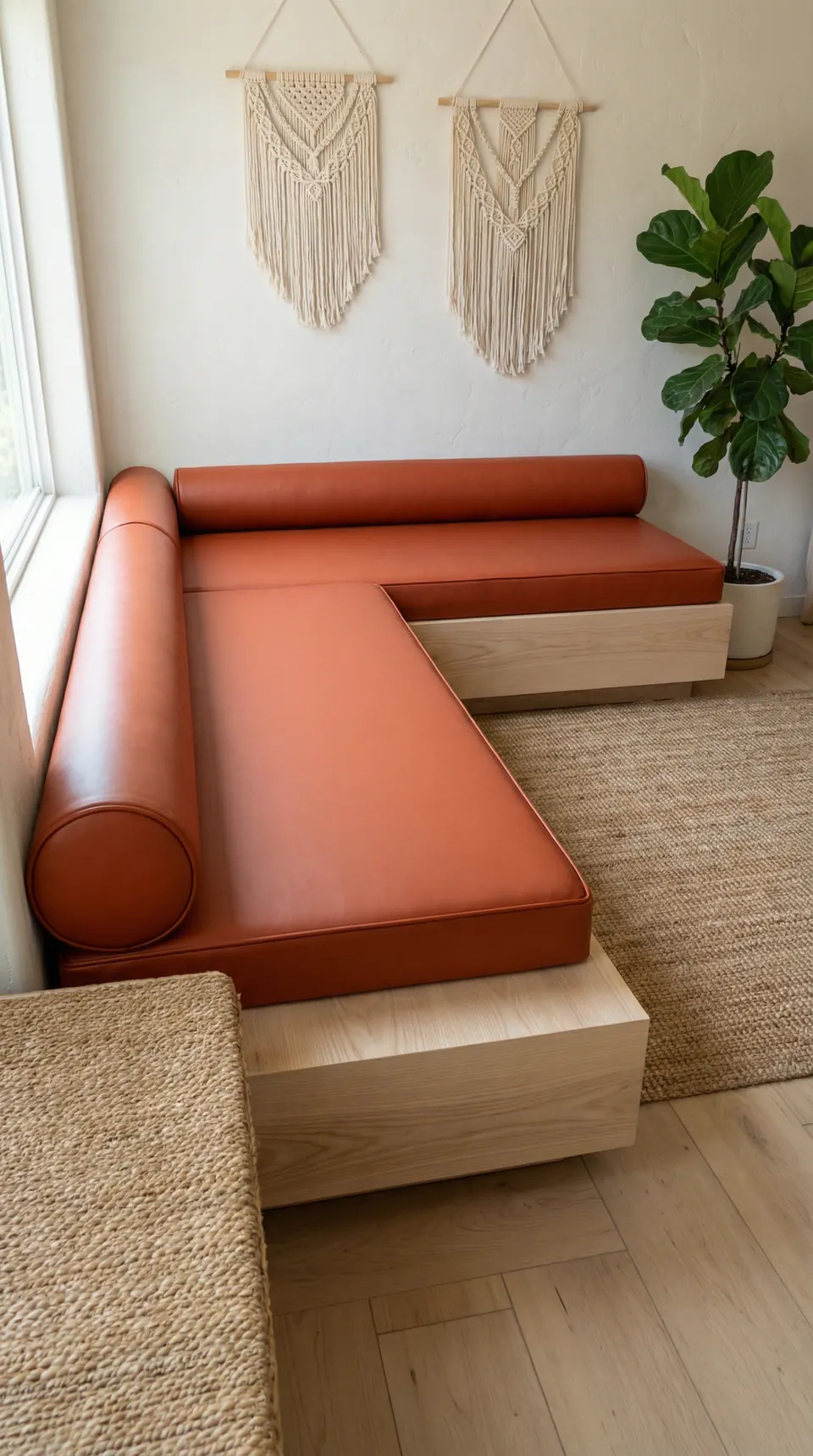
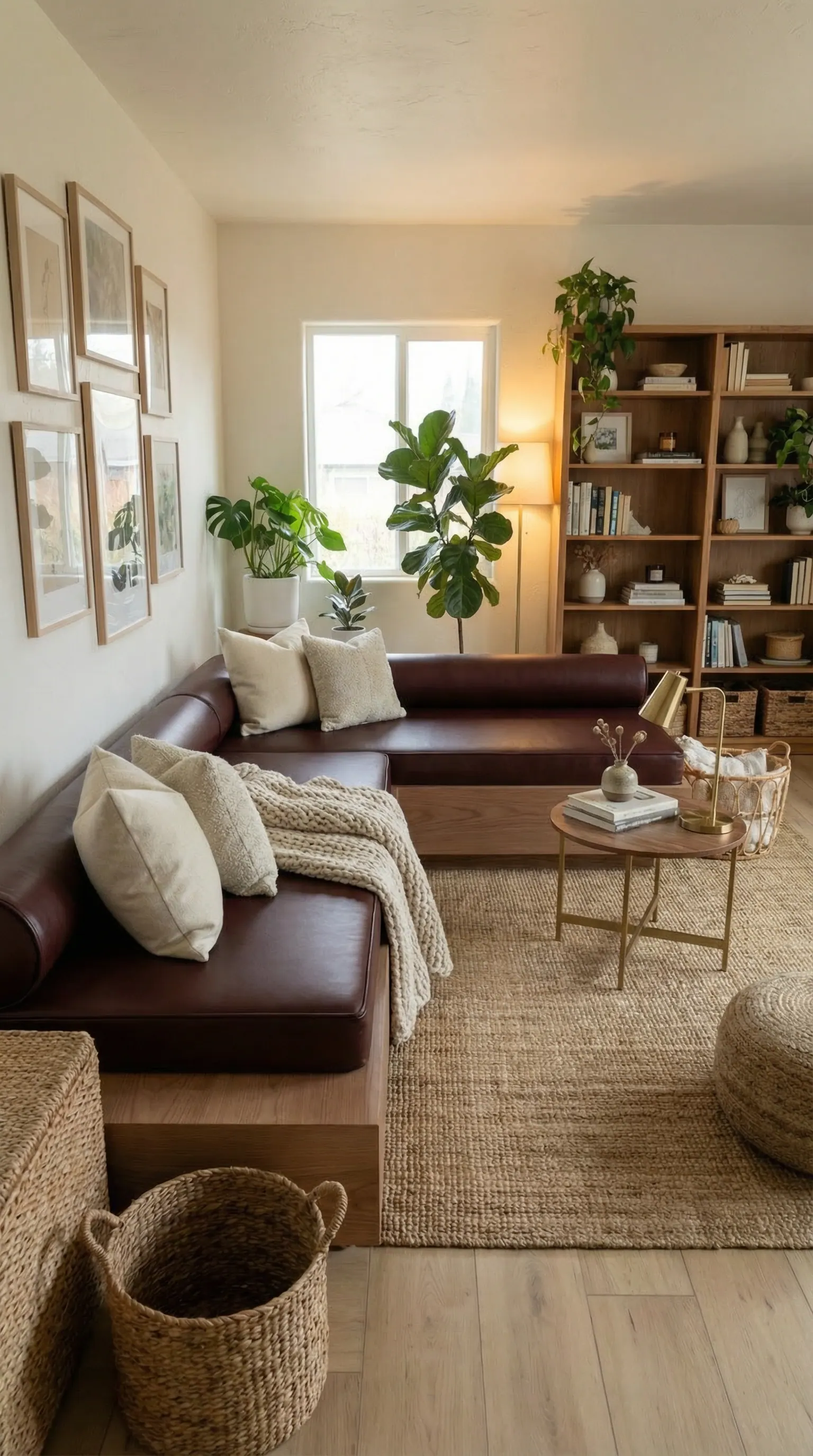
An L-shaped bench cushion is best made as two pieces that butt together at the corner, with the piping lined up across the joint. Subtract each inside length from its outside length to get the seat depths. This oxblood faux leather L has self piping, a bolster capping the open end, and cream linen pillows along the back.
Page one: reading the oxblood corner
Partner, an L is two rectangles pretending to be one. The craft is in making the pretense convincing.
Start with the color. Oxblood sits between brown and wine: dark enough to forgive a family's daily use, rich enough to look chosen. In a pale room a dark cushion needs a frame, and this one has two: the gallery wall of botanical prints above and the jute rug below.
Now the finishing. The seat runs corner to corner in faux leather with self piping, so the outline is drawn in the same oxblood. On a smooth, slightly glossy surface, any wobble in a welt catches the light. A straight one is the difference between upholstered and merely covered. Faux leather is honest that way; it shows everything.
The bolster caps the open end of the front run. It stops the seat from simply ending, and it doubles as an armrest for anyone lying lengthwise. Cream linen pillows along the back lift the dark seat and bounce window light around. An oatmeal knit throw softens one corner.
The props do structural work too. The gold-rimmed round side table is slim, so floor space stays open in front of a wide bench. The wooden bookcase, the brass rim and the seagrass baskets repeat the cushion's warmth across the room, which is how a dark piece joins a light one. A chunky knit pouf and a seagrass ottoman give extra seats that don't compete, and the fiddle leaf fig and monstera by the window balance the heavy corner with something tall and green.
More geometry lives in L-shaped cushions and the Pattern on the L-shaped cushion corner joint.
Pinned by Nate: five points on the L
Five pins from the bolster at the open end to the slim gold table that keeps the floor clear.
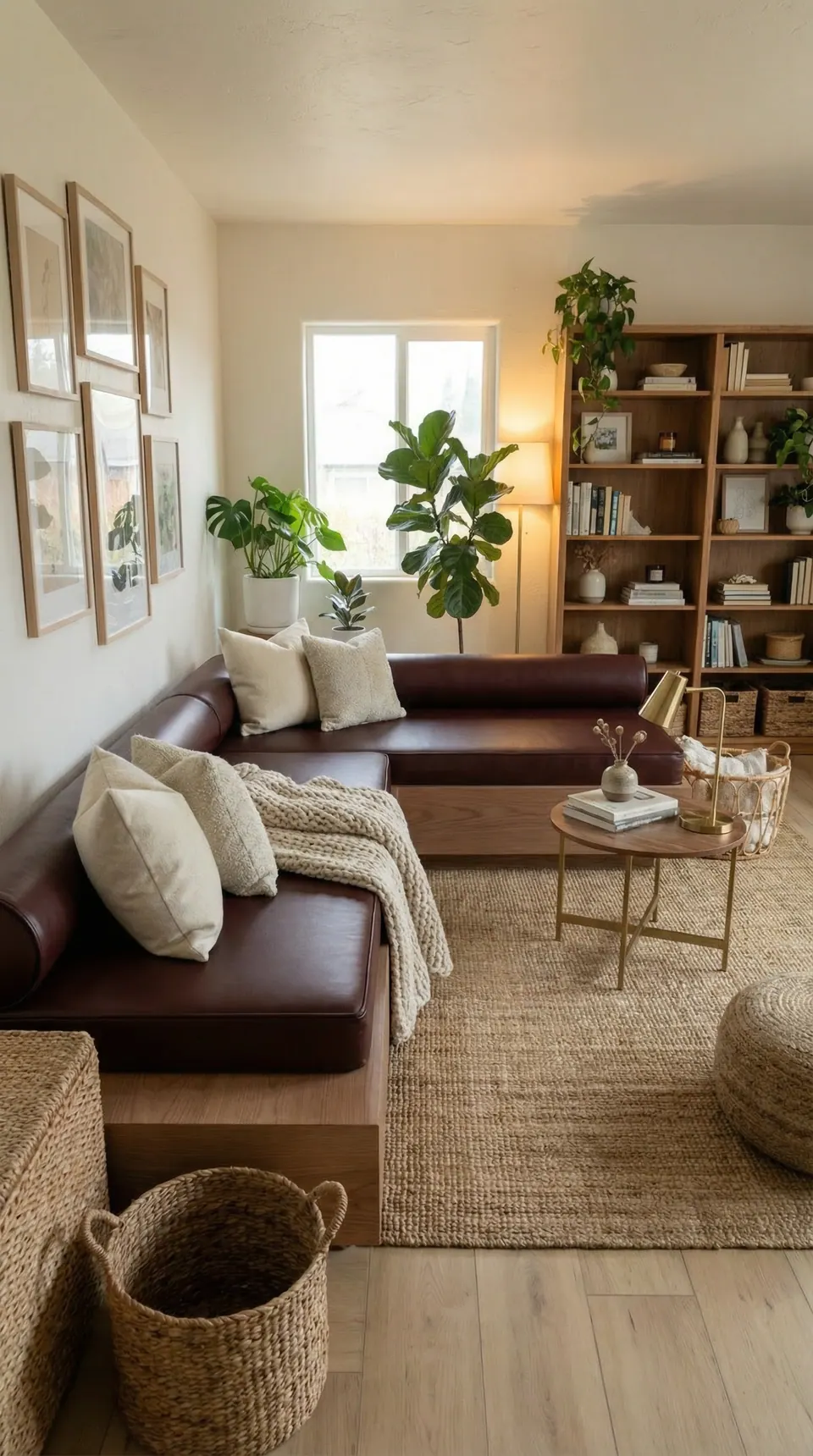
- End bolster
The bolster caps the front run and doubles as an armrest for anyone lying lengthwise.
- Front seat run
Deep wine-brown hides everyday marks, which matters on the run closest to the door.
- Cream pillows
Pale linen pillows along the back lift the dark seat and bounce window light.
- Gallery wall
Framed prints stacked above make the corner a destination rather than a pass-through.
- Gold side table
A slim metal table keeps floor space open in front of a wide bench.
- End bolsterThe bolster caps the front run and doubles as an armrest for anyone lying lengthwise.
- Front seat runDeep wine-brown hides everyday marks, which matters on the run closest to the door.
- Cream pillowsPale linen pillows along the back lift the dark seat and bounce window light.
- Gallery wallFramed prints stacked above make the corner a destination rather than a pass-through.
- Gold side tableA slim metal table keeps floor space open in front of a wide bench.
Page two: 90 by 55, outside minus inside
A buyer in the US sent an L-shaped bench with an outside L and an inside L. Outside: 90 x 55 in (229 x 140 cm). Inside: 72 3/4 x 39 in (185 x 99 cm). Subtract and you have both seat depths:
- 90 − 72 3/4 = 17 1/4 in (44 cm)
- 55 − 39 = 16 in (41 cm)
Two depths on one bench is normal. Walls are rarely symmetrical, which is why you measure both legs instead of assuming. Angles are just lengths in disguise.
The workshop confirmed it would be made as two cushions meeting at the corner, 3 in (7.5 cm) thick. One clean way to split it on paper: the long piece runs 90 x 16 in and owns the corner, and the short piece, 39 x 17 1/4 in, butts against it. Choosing 3 or 4 in (10 cm) didn't change the price, and the two pieces were offered as a set for less than buying them one at a time.
Page three: finishing checks you can do on delivery day
Sight the welt
Crouch at one end and look down the front edge. The piping should run as one straight line, with no waves where the fabric was eased.
Check the joint
Push the two pieces together at the corner. The box sides should meet flat, and the welts on each piece should sit at the same height, so the corner reads as one line.
Measure both depths
Tape each leg from wall to front edge and compare with your drawing. Two different depths are expected on an L; what matters is that each matches its own number.
Measurement table: the oxblood L
| Cushion | L-shaped corner bench cushion in two pieces, with back pillows |
|---|---|
| Fabric | Faux leather, oxblood brown toward dark cherry |
| Piping | Self piping |
| Edge | Box |
| Open end | One oxblood bolster |
| Back | Cream linen pillows |
| Depth rule | Outside length minus inside length, for each leg |
| Example L | Outside 90 x 55 in, inside 72 3/4 x 39 in, 3 in thick |
| Best for | Living room corners and busy family benches |

Have it made
Have this made — ask Nate’s workshop
Send the numbers in inches: length × depth × thickness, plus any angle. The workshop checks them with you, because foam has no undo button. — Nate
Leave your details and the workshop will call you to confirm measurements, fabric, foam and piping. No prices, dates or payment on this page: it is a request, not an order.
Page four: margin questions
- A common question
I ordered my trapezoid cushion through the rectangle listing by mistake. What happens now?
The workshop's answerThe shop asks you to reorder through the trapezoid listing, choose the right size options and write the exact measurements with your drawing. Once the new order is in, the first one is canceled and refunded.
- A common question
My window seat is 17 x 95 in and that size isn't on the menu. Can you still make it tufted?
The workshop's answerYes. A dark gray plush tufted bench cushion at 17 x 95 in (43 x 241 cm) was quoted with its own custom purchase link, which is how sizes outside the listing are ordered.
- A common question
Do you make bench cushions for a clinic or another business?
The workshop's answerYes. Commercial bench cushions are made to order; send the sizes and the shop will quote them.
On an L-shaped bench cushion, each seat depth is the outside length minus the inside length: 90 − 72 3/4 = 17 1/4 in.
Nate
Questions buyers ask next
Is it better to split an oxblood L-shaped bench seat at the corner?
Two, as a rule. Two cushions that butt together at the corner are easier to make, fit and handle, and a straight welt carried across the joint makes them read as one seat when they are pushed together.
How do I find the seat depth of each side of an L?
Measure the outside length and the inside length of each leg along the wall, then subtract. Outside 90 in minus inside 72 3/4 in gives a 17 1/4 in depth; the other leg, 55 minus 39, gives 16 in.
Is oxblood faux leather practical for a family bench?
Oxblood is dark enough to hide everyday marks, which helps on the run nearest the door, and rich enough to look deliberate next to cream pillows. The smooth surface does show a wavy welt, so straight piping matters more than on a textured weave.
What goes at the open end of an L-shaped bench?
A bolster. It gives the front run a finished end, doubles as an armrest for anyone lying lengthwise, and in a matching fabric it looks like part of the set rather than an extra pillow.
± 1/4 in — Nate